


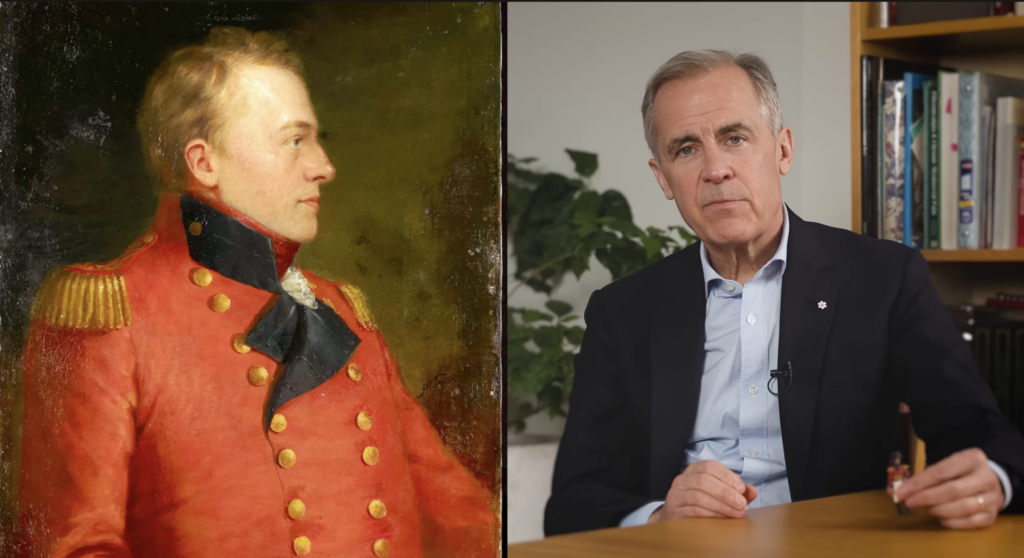
Mark Carney reflects on the legacy of Isaac Brock in a video posted to the prime minister’s YouTube channel. [youtube.com/Mark Carney]
Canadians learned this last week in a remarkable video Carney released—the first in a series of occasional public updates he is promising to deliver from the Prime Minister’s Office via YouTube.
The inaugural video posted on Sunday, April 19 was an internet-era version of U.S. President Franklin D. Roosevelt’s famous fireside chats, an effort to both comfort and energize the country through tough times ahead. In Carney’s case, he laid out the economic and security threats facing Canada and how his government plans to deal with them.
Sitting prominently in front of him during his chat was a small, red-coated figurine of Major-General Isaac Brock, the British commander whose heroics helped save Canada from American conquest in the War of 1812.
“When I get into the office, I always look at this statue on my desk,” said Carney.
“Brock was a hero who fought and gave his life for our forebears in the War of 1812. Before Canada even existed on paper, it had a shape in Brock’s imagination,” continued the prime minster. “Faced with the threat of an American invasion, Brock built alliances across our land and inspired what would eventually become Canada.”
The Brock figurine was a gift to Carney from Canadian actor Mike Myers during the last federal election campaign. Although best known for his Hollywood comedy, Myers is passionate about military history. His British-born parents both served in the Second World War—his father Eric as a sapper with the Royal Engineers and his mother Alice as a radar station technician with the Royal Air Force.
“Both my mom and my father were very respectful of the higher purpose of fighting the bad guys,” Myers has said. “The spirit of saying ‘no’ to bullies is something I have tremendous respect for.”
The current bullying posture of the U.S. administration—imposing tariffs against key Canadian industries and talk of making Canada the 51st state—echo in some ways the cross-border Zeitgeist of the early 19th century. Canada is unlikely to go to war with the U.S. again, and no one is arming the network of forts on the border in anticipation of an invasion. Yet there are similarities to the situation that preceded hostilities more than 200 years ago.
Isaac Brock, having cut his teeth as an army officer in the Napoleonic Wars, arrived in colonial Canada in 1802. It was a time of rising trade and diplomatic tensions between the U.S. and Britain, accompanied by the ongoing fever of American expansionism. While the U.S.’s primary interest was westward expansion—countered by a confederacy of First Nations opposed to American settlement in the Midwest—Canadians also lived in fear of the country annexing British North America by military force.
“When I get into the office, I always look at this statue on my desk,” said Carney.
By the start of 1812, Brock was a major-general in command of the Province of Upper Canada. Anticipating war, he spent considerable effort reinforcing fortifications along the border and strengthening the provincial militia. In contrast with his risk-averse superior, Gov. Gen. George Prevost—who favoured only defensive measures—Brock had outlined a bold strategy to confront an American invasion with aggressive offensive action in co-operation with forces from First Nations around the Great Lakes.
After the Americans invaded in July, Brock tried to rally members of the Upper Canada legislature but found them defeatist, like much of the populace.
“My situation is most critical, not from anything the enemy can do, but from the disposition of the people,” he wrote at the time. “Most of the people have lost all confidence—I however speak loud and look big.”
Historian Charles P. Stacey, assessing Brock in the Dictionary of Canadian Biography, wrote: “Many commanders would have allowed the current despondency to discourage them into adopting a supine defensive attitude. Brock took the offensive.”
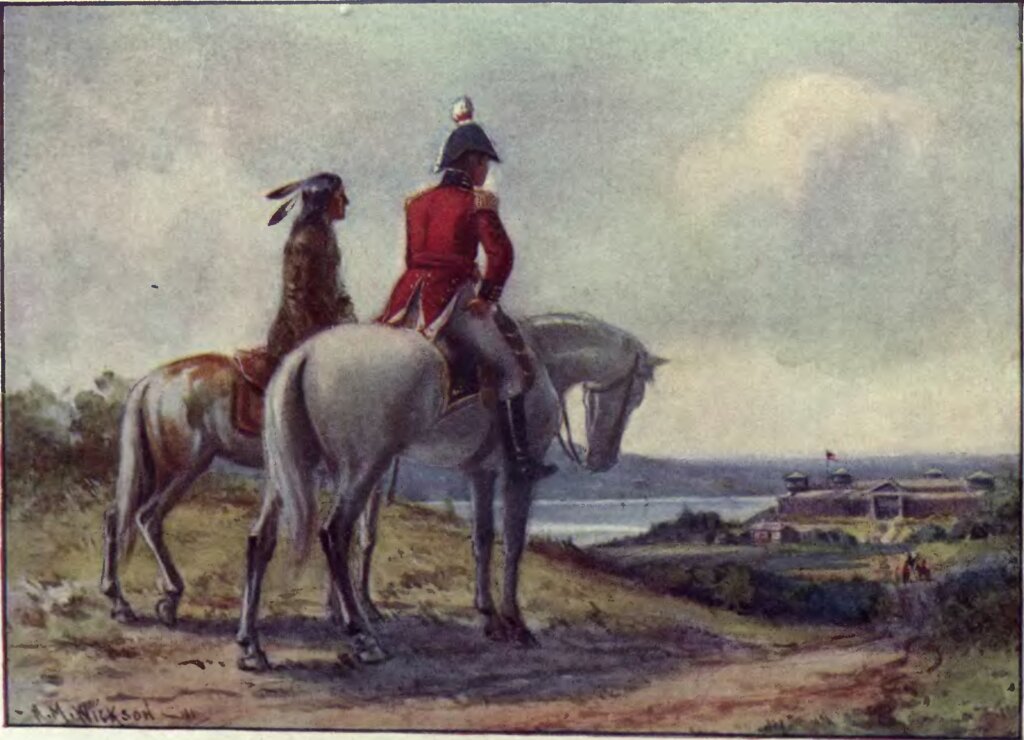
Shawnee Chief Tecumseh and Major-General Brock at the Surrender of Detroit. [A. M. Wickson/published in The Story of Tecumseh by Norman S. Gurd]
On Aug. 16, with about 1,300 men (of whom nearly half were First Nations warriors led by Shawnee Chief Tecumseh), Brock led an audacious attack against Fort Detroit, which bristled with artillery and was defended by a superior force of about 2,000 U.S. troops.
“Most of the people have lost all confidence—I however speak loud and look big.”
After crossing the Detroit River, Brock hoped the Americans would leave the town’s ramparts and fight in the open. Instead, the American commander—fearful, in part, of what his troops might face at the hands of Tecumseh’s warriors—surrendered Detroit and his army, along with more than 35 guns.
“In Upper Canada the effect of the dramatic and almost bloodless victory at Detroit was electric,” wrote Stacey. “No one now doubted that the country could be defended.”
Brock next applied his aggressive (some might say reckless) tactics on the frontier with New York.
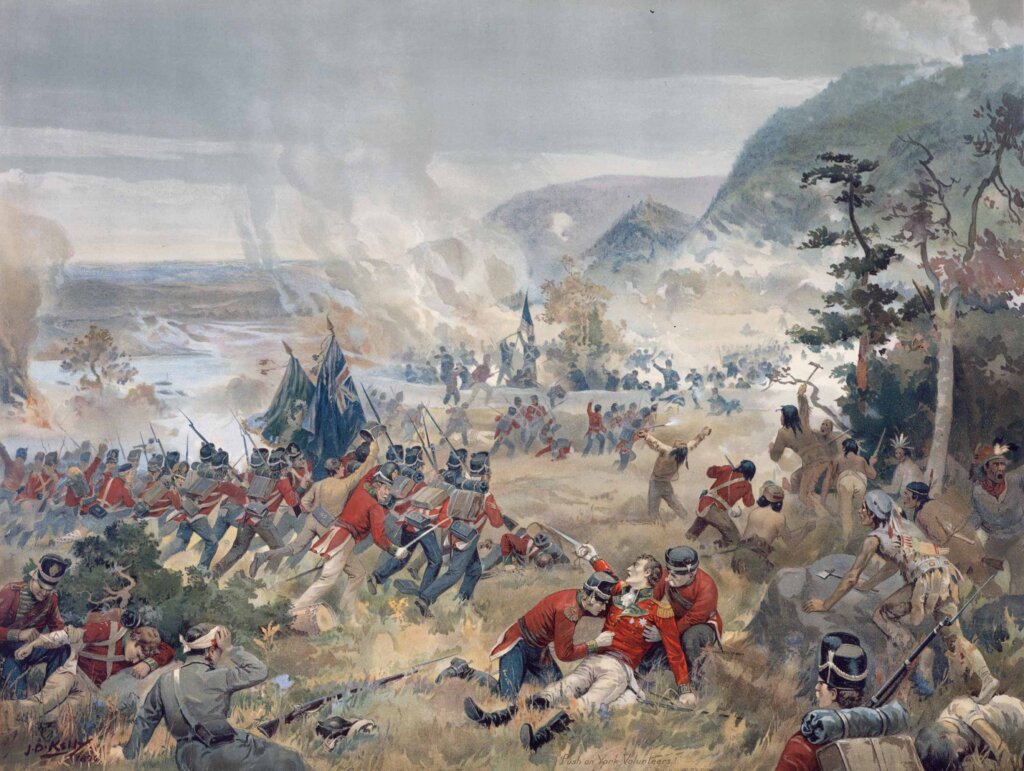
A painting depicts the death of Brock at the Battle of Queenston Heights. [John David Kelly/LAC]
After arriving at the battle, Brock impulsively led a collection of British infantry up the slopes on foot, in the hopes of dislodging the Americans. Leading from the front and being highly visible—standing six feet two inches in a bright red coat—Brock was shot dead through the heart by a sniper.
Brock’s forces ultimately recaptured the heights and prevailed at Queenston. Anne Prevost, the governor general’s daughter, lamented in her diary that “our noble defender, General Brock” did not live to witness the victory.
“In Upper Canada the effect of the dramatic and almost bloodless victory at Detroit was electric,” wrote Stacey. “No one now doubted that the country could be defended.”
“If he had but reserved his personal exertions till the reinforcements came up—which ultimately drove back the defenders—his Country might have had him still.”
Although the war continued for two years after Brock’s death, he received much of the credit for buoying the spirit and confidence of the colonists and saving Upper Canada from defeat. “But for the presence in Upper Canada in the summer of 1812 of this able and magnetic general officer,” wrote Stacey, “the province would certainly have fallen to the United States.”
In the two centuries since, a grateful country has preserved Brock’s memory in numerous ways: a city and a university in Ontario both bear his name, and his red coat—complete with a bullet hole—is on display at the Canadian War Museum. A towering monument also stands in his honour atop Queenston Heights.
And now Brock has become a modern-day influencer, his miniature statue starring in a YouTube video and commanding the desk of the prime minister—inspiring Mark Carney to remind the country that, “in a crisis, fortune favours the bold.”
Advertisement







Inspiring. Canada is so fortunate to have Carney as PM. He too could become a great Canadian hero..without the bullet bit