

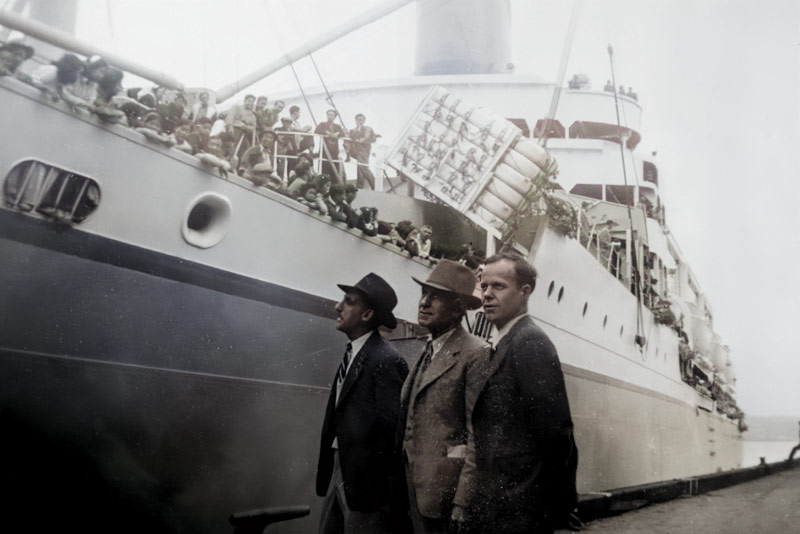
RCMP Corporal R.A. Davidson, C.W. Fisher and T.B. Pickersgill, commissioner of Japanese placement for the Department of Labour, watch as exiled Japanese-Canadians await their departure aboard U.S. Army transport USS General MC Meigs docked in Vancouver on June 16, 1946. [LAC/PA-119024]
Since the first Japanese immigrant to Canada was believed to have arrived in the 1870s, Nikkei endured animosity from Canadians, particularly in B.C., where most settled. Politicians in the fledgling province passed laws to limit Nikkei access to immigration, work, basic human rights, and entry into mainstream society. (In 1931, Nikkei Great War veterans became the only Asian people allowed to vote provincially and federally.) Nikkei were limited
to working in industries such as mining, forestry, farming and fishing, even if they had Canadian university degrees. They formed their own communities with Japanese churches, newspapers, stores and language schools.
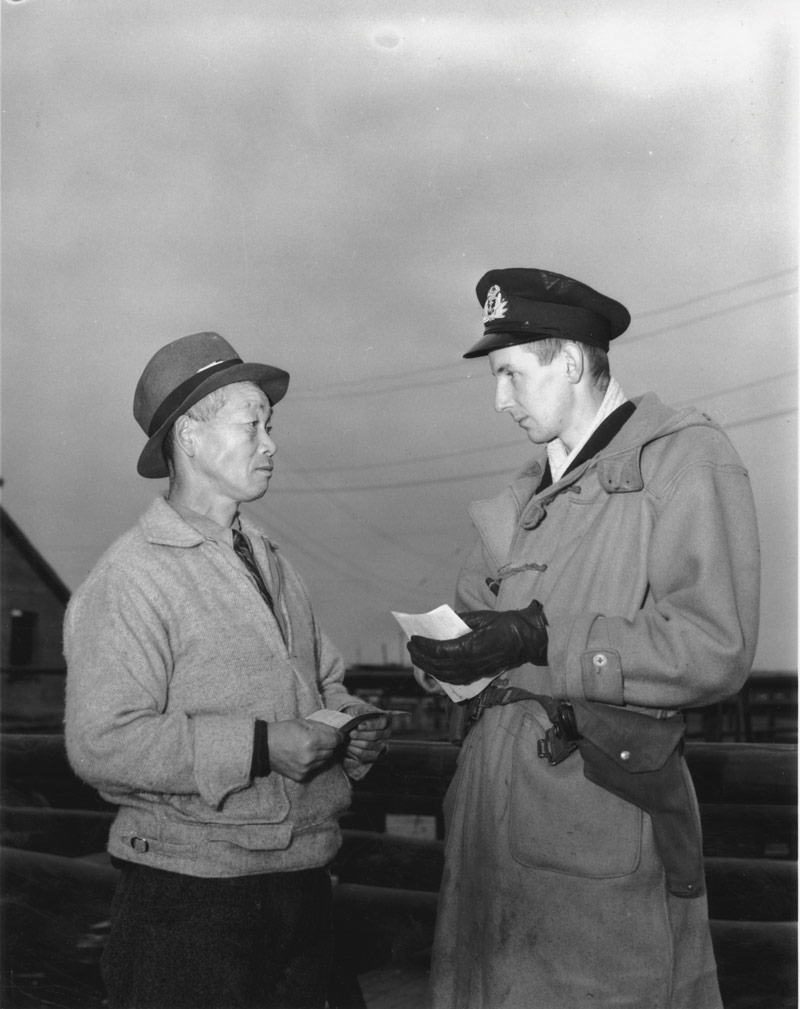
An officer of the Royal Canadian Naval Volunteer Reserve examines the papers of a Japanese-Canadian fisherman in Steveston, B.C., on Dec. 10, 1941.[DND/LAC/PA-170503]
In the 1930s, Japan’s aggression in Asia began to alarm western countries. Following Japan’s attacks on Pearl Harbor and Hong Kong on Dec. 7-8, 1941, fear and resentment toward Nikkei erupted in Canada. The actions of a country, which many Nikkei had never even visited, were used to justify the mistreatment of the entire community. Adding to the anti-Japanese sentiment that had already pervaded Canada for decades, many feared that Japanese-Canadians would help Japan attack the West Coast, despite RCMP intelligence insisting that the community posed no threat.
The repercussions were immediate. When Canada declared war on Japan on Dec. 8, the government ordered all Japanese-Canadians living within 160 kilometres of the Pacific Coast (a so-called “protected area”) to evacuate. More than 20,000 Japanese-Canadians (over 90 per cent of whom lived in B.C.), including war veterans, had their businesses and possessions confiscated and were incarcerated in prison camps, labour camps and on sugar beet farms. The interned Nikkei, all considered “enemy aliens” by Canada, included Japanese citizens, naturalized Commonwealth citizens and people born in Canada. Those who protested were shipped to remote prisoner-of-war camps in Ontario.
By the end of the war, interned Japanese-Canadians were demoralized, unemployed and impoverished. Everything they had worked to achieve was gone. And soon, some would be uprooted again.
The Canadian government was intent on expelling as many Japanese-Canadians as possible, supposedly disloyal to Canada or otherwise.
Unlike their Japanese-American counterparts, Canadian internees weren’t permitted to return to their homes. Instead, Prime Minister Mackenzie King, despite admitting in August 1944 that Japanese-Canadians had committed no acts of sabotage, announced a program to disperse the population throughout the country, and to exile to Japan those deemed disloyal to Canada.
By early 1945, many interned Nikkei had already left these camps for resettlement outside B.C. Those who remained were ordered to fill out a survey assessing their loyalty to Canada. Their choices were stark and unpleasant: either “repatriate” to Japan at a future date (and renounce their Commonwealth citizenship, even if they were born in Canada or had become naturalized) or immediately move east of the Rocky Mountains. While the government insisted internees’ decisions were voluntary, the options were presented to motivate them to choose Japan.
“The Canadian government essentially encouraged the Japanese to make this decision because the passage [to Japan] was paid and extra food ration coupons for buying basic foods were provided,” wrote Yoshimi Susan Maikawa in an article for DiscoverNikkei.org, a project to record and share stories of Nikkei worldwide.
This survey caused confusion, duress and disagreement among those still interned. About half of the Japanese-Canadian population signed the loyalty survey. Most remaining in the camps chose “repatriation” to demonstrate their anger at Canada for their treatment.
But by late summer 1945, following Japan’s surrender, many wanted to stay, saying that they had been intimidated into their previous decision. Rumours circulating about Japan, including the devastation caused by atomic bombs and terrible living conditions, frightened them.
The Canadian government was intent on expelling as many Japanese-Canadians as possible, supposedly disloyal to Canada or otherwise. Although the war had ended, the War Measures Act was still invoked. In December 1945, the government issued three orders-in-council permitting the deportation of Japanese-Canadians who had signed up for exile.
Between May 31 and Dec. 24, 1946, 3,964 interned Nikkei were exiled to Japan on five sailings. Of those on board, 1,943 were aging Issei (first-generation Japanese), 1,308 were Nisei (second-generation Japanese born in Canada) under 16 years of age, and 2,617 (66 per cent) were Commonwealth citizens by birth or naturalization, including 159 former inmates of the Petawawa and/or Angler prisoner-of-war camps in Ontario, seven WW I veterans, and 17 patients of psychiatric facilities (two were veterans, one of whom was deported without signing repatriation documents).
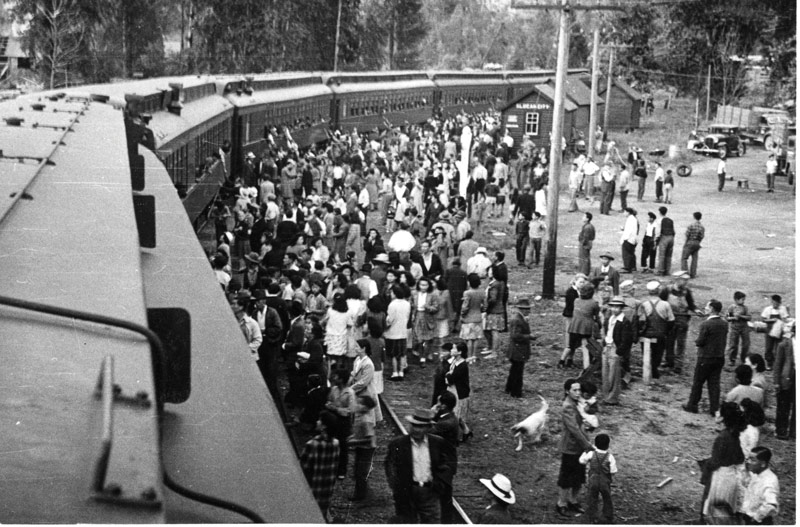
A train at the Slocan City, B.C., internment camp awaits Japanese-Canadians who had chosen to “repatriate” to Japan in 1946.[1996.178.1.37.a-c/Nikkei National Museum]
Their reasons for leaving Canada were varied; many were exhausted from the treatment they had endured in Canada. Moving yet again to unfamiliar locations east of the Rockies to face further prejudice and struggles for seemingly unattainable employment was not enticing. Some were anxious to reunite with family members living in Japan or stranded there by the war. Most Canadian-born teenagers and young adults wanted to remain in Canada, but felt obliged to stay with their parents.
Maikawa, who was born in Cumberland, B.C., in 1931, explained her family’s choice to return to Japan. “The most prominent factors were: no savings left, no jobs and no house to go to. Their cultural roots were in Japan. There also was a language barrier and there were the many restrictions and limitations placed on the children’s choices of entering most professions. All these factors made a future in Canada look rather bleak, so a painful decision was made to return to Japan.”
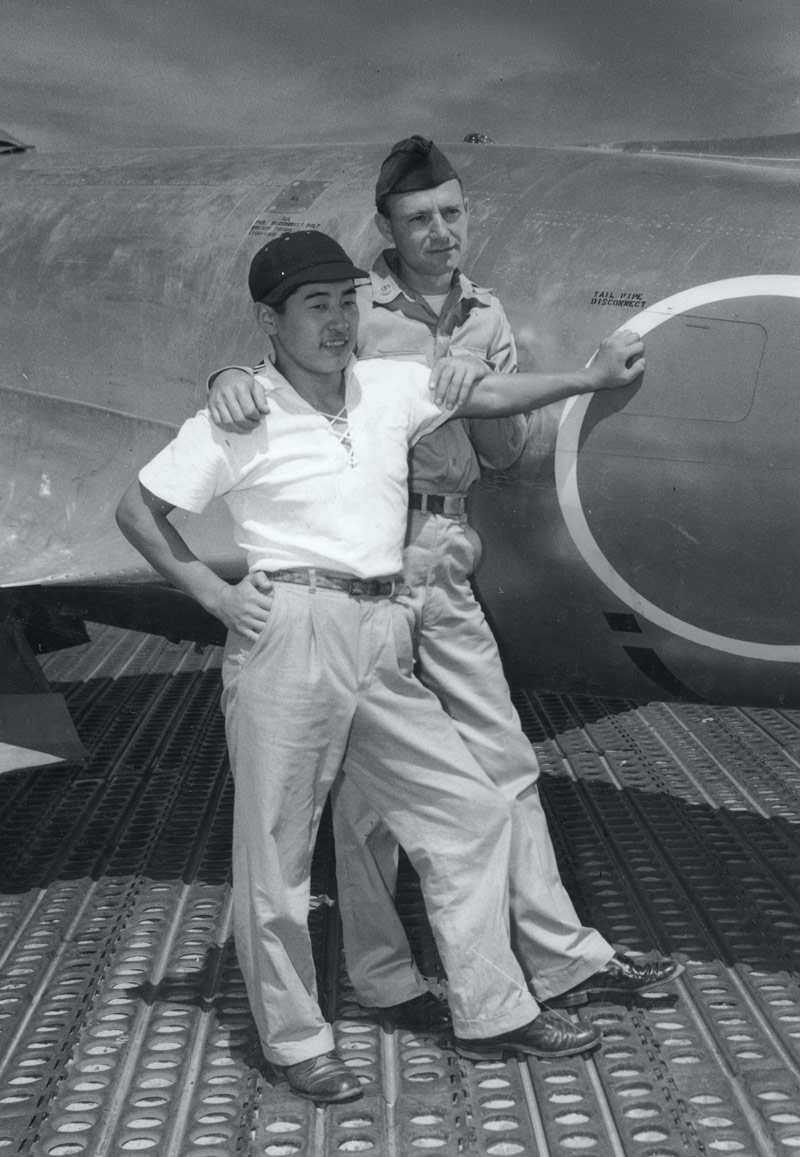
Roy Uyeda (left) at Tsuiki Air Base in Japan with an American officer. After deportation, many Japanese-Canadians used their English abilities to work with U.S. occupation forces.[TD1008.6.7.15/Nikkei National Museum]
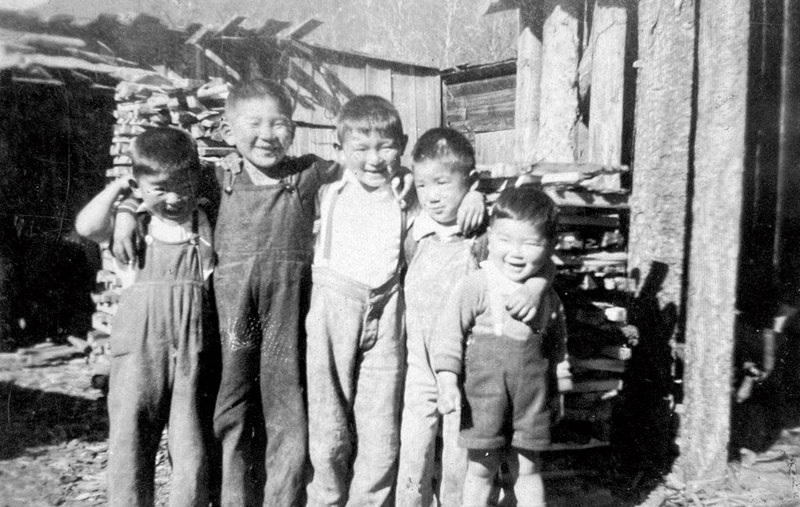
Mikio Ibuki (below, second from left) with friends at the Slocan City, B.C., internment camp. [Courtesy Mikio Ibuki and Stan Kirk]
Roy Uyeda, like many passengers, was seasick during the trip, but remembers that the food served on the ship was good and plentiful. Roy was born in Vancouver, and was 13 years old when he travelled to Japan with his widowed father and two sisters after internment at Slocan, B.C.
American women were giving balloons to children on the ship. When six-year-old Mikio Ibuki requested one, he was told, “‘This is for American children and not for Japanese.’ I was shocked and never forgot this,” recalled the second-generation Japanese- Canadian, born in Vancouver and incarcerated with his family at Slocan before exile in Japan.
Some passengers didn’t accept that Japan had lost the war until they saw the extensive damage from the U.S. bombing in Tokyo Bay. Large vessels were unable to enter Yokohama and Tokyo because of the sunken submarines, ships and planes in the bay.
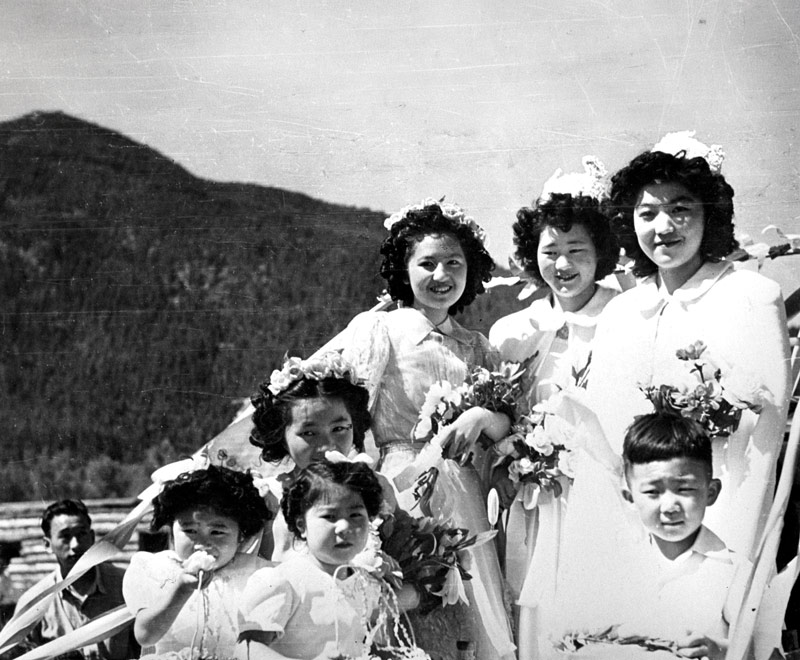
Meiko Bando (opposite below; top row, middle), sister of Yoshimi Susan Maikawa, celebrates May Day with Kikuye Mochizuki Komori (top row, right) at Lemon Creek internment camp, B.C., in 1946. [2010.23.2.4.1/Nikkei National Museum]
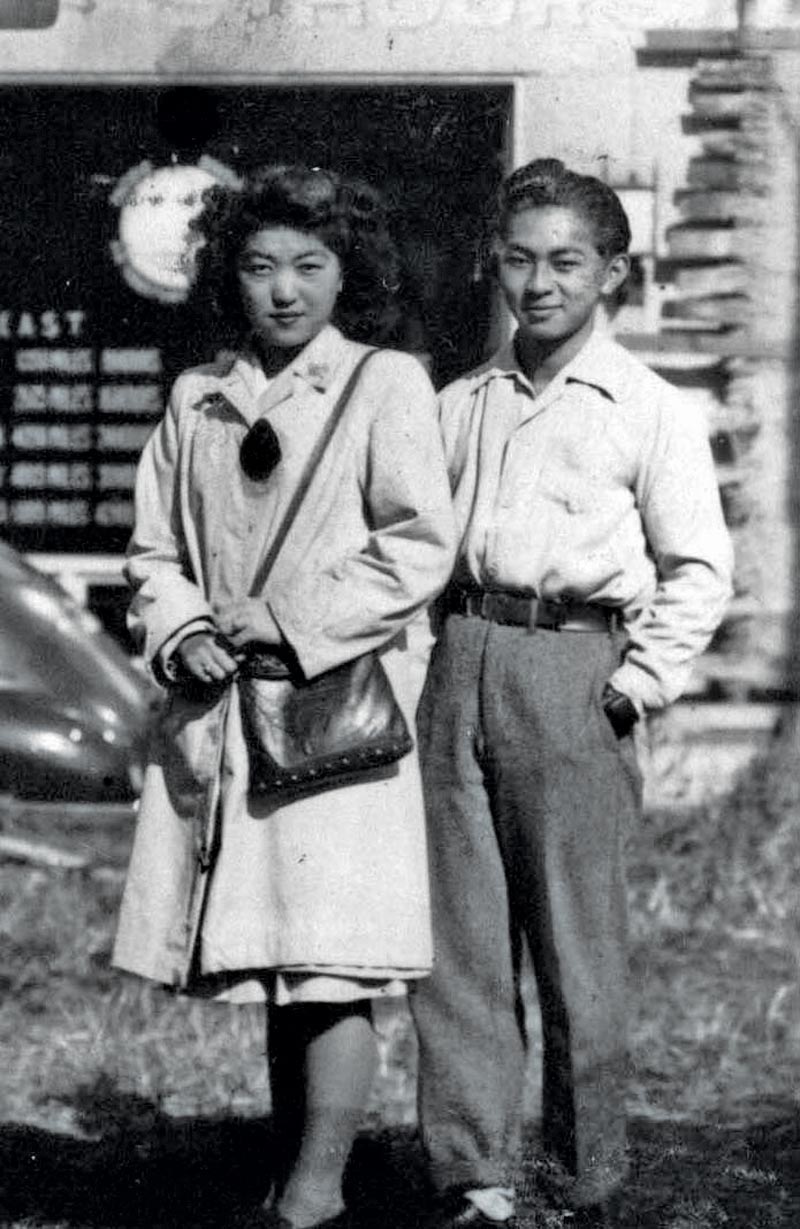
Deportee Kikuye Mochizuki Komori and her brother Yoshio in Japan. The pair returned to Canada in the 1950s, while their parents and two sisters remained in Japan.[Photo courtesy Kikuye Komori]
Yukiharu Mizuyabu recounted his deportation experience in the article Japanese Canadian Redress: the Toronto Story. “Indiscriminate bombing had flattened all the major cities, except for the ancient capital of Kyoto…. In addition, the military forces of the United States and her allies now occupied Japan.”
“Tokyo was just flattened. Nothing. Just huts with red tin roofs. You could see from one side of Tokyo to the other; it was a vast flat land of huts,” said Hiroshi Kumagai of his experience recorded on DiscoverNikkei.org.
As the deported Nikkei disembarked and moved to the repatriation centre at Kurihama, residents begged them for food. From Kurihama, they rode trains to their final destinations, typically their family’s ancestral villages. Some had to wait up to a month at Kurihama for space on a train and many recalled the poor quality of food there. Trains were slow and so full that people had to enter and exit them through the windows, while others missed their stops entirely. Theft was also a problem.
From the train, Margaret Eto saw people living in caves. At each station, beggars would swarm the cars.
At Hiroshima, Eto was frightened by atomic bomb survivors, “scarred, hairless, skeleton-like figures,” trying to board the train. Roy Uyeda said of Hiroshima: “Everybody’s mouth was agape—nobody said anything, because everything was completely flat except for a few rough lean-to shelters. The station was just rough timbers nailed together.”
“For everyone, Issei and Nisei, Japan was a shock,” wrote Roy Ito in Stories of My People: A Japanese Canadian Journal. “There was the terrible destruction of the bombing raids, the despair on the faces of the people. There was no special reception. The returning Japanese were another unwanted problem for the authorities.”
Besides being unwelcome in Japan, deported Nikkei from Canada encountered a perfect storm of postwar issues. Food, in particular, was hard to get, of poor quality and expensive. There were reports of exiled Japanese-Canadians dying of starvation or malnutrition in Japan, including Kikuye Urata, 13, who died in November 1947, and Kuniko Kawashita, whose family endured years of destitution.
Nikkei from Canada faced inflation, unemployment, poverty and diseases made worse by lack of sanitation and medical supplies. Yoshimi Susan Maikawa’s sister was likely saved by medicine sent from relatives living in Canada. The American occupying force employed DDT liberally in repatriation centres and schools to control vermin and prevent the spread of disease. Housing was scarce. Deported Nikkei arrived as 6-7 million Japanese soldiers and civilians from former colonies were returning to the country. Maikawa and Kikuye Mochizuki Komori, another deportee, noticed that foreigners of Japanese descent tended to support each other as they weren’t accepted in Japan.
At Hiroshima, Margaret Eto was frightened by atomic bomb survivors, “scarred, hairless, skeleton-like figures,” trying to board the train.
Shigeru Oue was a soldier from Vancouver working in Takamatsu in 1946. “He was shocked one night to meet a Nisei girl whom he had known in Vancouver, and who had been repatriated to Japan, working in a cabaret as a prostitute. When their eyes met, they were both embarrassed, and she turned away with an exaggerated air of not giving a damn,” according to his experience recounted in The Takimoto Oue Living Story by Glenna Theurer and Gerry Oue.
Some Japanese-Canadians arrived in their ancestral villages to conflict, alienation and resentment. The name-calling and harassment they faced in Japan mirrored their experiences as Asians in Canada.
“The Japanese were saying, ‘Why are they coming back here?’ Well, in a way you couldn’t blame them. A defeated country. They didn’t have enough food for their own people and we were coming out there from a country of plenty…. We were strangers to them, foreigners,” said one Nikkei from Canada interviewed in Years of Sorrow, Years of Shame – the Story of the Japanese Canadians in World War II by Barry Broadfoot.
During wartime, communication between Japan and Canada had been solely through the Red Cross and often the messages weren’t delivered. Haru Koyanagi’s family in Japan only found out that she had died in internment in Canada when her husband and nine children were exiled. Similarly, Maikawa’s brother in Japan tried to warn his parents about the desperate living conditions there, but they never received the message and chose repatriation. Mikio Ibuki’s mother only learned about her mother’s wartime death when she was reunited with her father at Yokosuka. And Roy Uyeda’s family arrived in Japan to learn that his brother, a Canadian forced into the Japanese army, had died in Burma.
For younger Japanese-Canadians, their experiences in Japanese schools were strongly influenced by their age and prior knowledge of the language. Older youth were at a disadvantage; their schooling had been interrupted and delayed by internment in B.C. Students unfamiliar with the language had to start from the first grade, regardless of age. Others with some Japanese knowledge were placed in grades with younger children. Those older than 16 couldn’t go to school.
Japanese-Canadian students’ size, speech, behaviour and western haircuts and clothing made them conspicuous. Many were labelled Americans and were associated by their peers with Japan’s wartime enemies. Students reported incidents of bullying, theft and other abuse, not only by their peers, but by teachers and other adults.
Despite having limited education in Japan, many Nikkei from Canada used their English abilities to work with U.S. occupation forces. The jobs offered generous pay and sometimes accommodations and food. As U.S. military bases began to close in 1952, some Japanese-Canadians moved to civilian jobs that made use of their English skills.
Meanwhile, Nisei unhappy with the living conditions in Japan couldn’t return to Canada because they had renounced their citizenship.
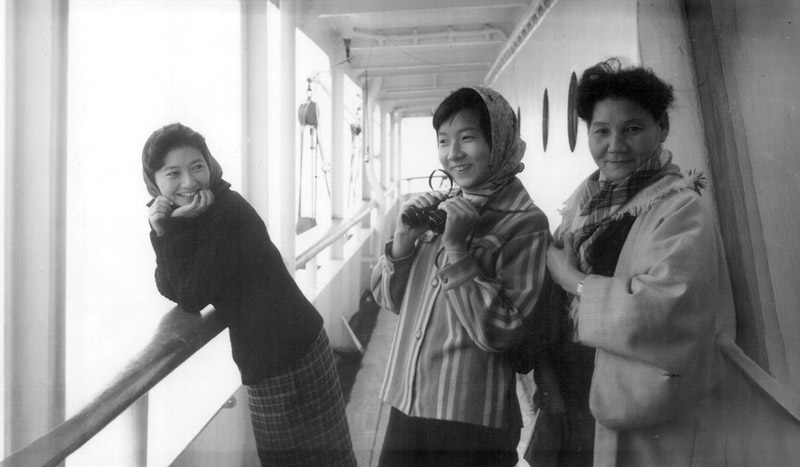
Margaret Eto’s sisters Akemi and Naomi and their mother Yasue Eto (below) return to Canada in 1958. [Photo courtesy Akemi Eto]
As the forced deportations continued, many Canadians became infuriated with the situation and some advocated against them, starting with the Co-operative Commonwealth Federation party, and other organizations, reinforced by journalists, civil libertarians and church groups. Under pressure, the government referred the orders-in-council to the Supreme Court of Canada, which ruled that Japanese citizens and naturalized Canadians (born in Japan) could be deported, but not their minor Canadian-born children and unwilling dependants of male deportees. Frustrated by this complication, Canada’s government sent the matter to the British Privy Council. In December 1946, the council ruled the deportation
orders were legal. In January, the federal cabinet, facing public backlash, revoked the legislation to deport the remaining interned Nikkei. By then, almost 4,000 people had been exiled to Japan.
In June 1948, Nikkei were granted the right to vote federally in Canada. In March 1949, they were granted full rights of Canadian citizenship, including the right to vote provincially in B.C.
Although deported naturalized Canadians had lost their citizenship, those born in Canada (mostly Nisei) had their citizenship reinstated. In the 1950s, Nisei began returning to Canada. Some again encountered racial discrimination back home.
Returning Japanese-Canadians had to apply for “clarification of citizenship” at Tokyo’s Canadian Embassy, with additional conditions placed on their return.
“This so-called clarification of Canadian citizenship still did not give me exactly the same rights as a European-Canadian residing outside of Canada,” said Yukiharu Mizuyabu. “For example, German-Canadians who had been abroad during the war were offered government-paid passage back to Canada if they had no funds of their own. There was no similar offer of financial aid to destitute Japanese-Canadians wanting to return to Canada. In fact, even after 1949 when Japanese-Canadians were supposedly given the same rights as other Canadians, any Japanese-Canadian who wished to return had to have someone act as a sponsor as an assurance that he or she wouldn’t become a public burden. Thus, we would be treated like new immigrants even though we were coming back to our native land.”
Thanks to the diligent work of the National Association of Japanese Canadians, the Canadian government formally apologized on Sept. 22, 1988.
Some found another way. Around 30 deported Nisei signed up from Japan to serve in the Korean War as Canadian soldiers. Since their families couldn’t afford to return, joining the military guaranteed decent pay and free return to Canada with their units.
Four sons of deported Great War veteran Ryoichi Kobayashi signed up in Japan for Korean War service, and all returned to Canada. Kobayashi himself was originally turned down when reapplying for his citizenship in 1957. The judge relented when he was shown Kobayashi’s war service insignia.
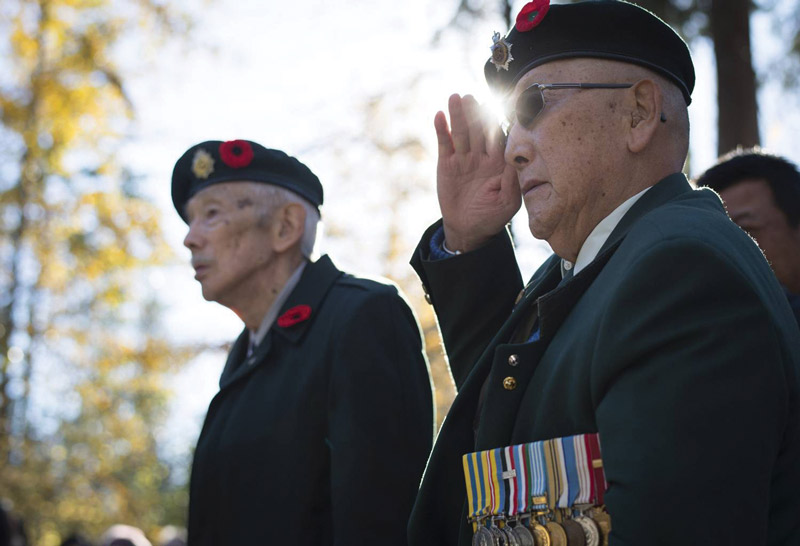
Korean War veterans Ray Nakamoto (left) and Karl Konishi during the Remembrance Day ceremony at the Japanese Canadian War Memorial in Vancouver’s Stanley Park in 2015.[John Lehmann/CP173556875/The Globe and Mail]
In 1977, Japanese-Canadians commemorated the centennial of the arrival of the first Issei in Canada. Out of this milestone grew a renewed pride and interest among Nikkei in their history, and a movement for redress took shape.
Thanks to the diligent work of the National Association of Japanese Canadians, the Canadian government formally apologized on Sept. 22, 1988, for the treatment of Nikkei during the Second World War. The apology included a compensation package for all surviving internees and funding for community projects. Exiled Japanese-Canadians who were still in Japan also received compensation.
Approximately half of the Nikkei deported to Japan remained there, most commonly because they had Japanese spouses and had raised children in Japan. Some had successful and stable careers or felt obliged to carry on the family estate. And some still resented Canada, which had treated them and their families so harshly. Among the half who returned to Canada were Yoshimi Susan Maikawa, Roy Uyeda, Yukihari Mizuyabu, Margaret Eto and Kikuye Mochizuki Komori.
This time, the decision was theirs to make.
Advertisement