

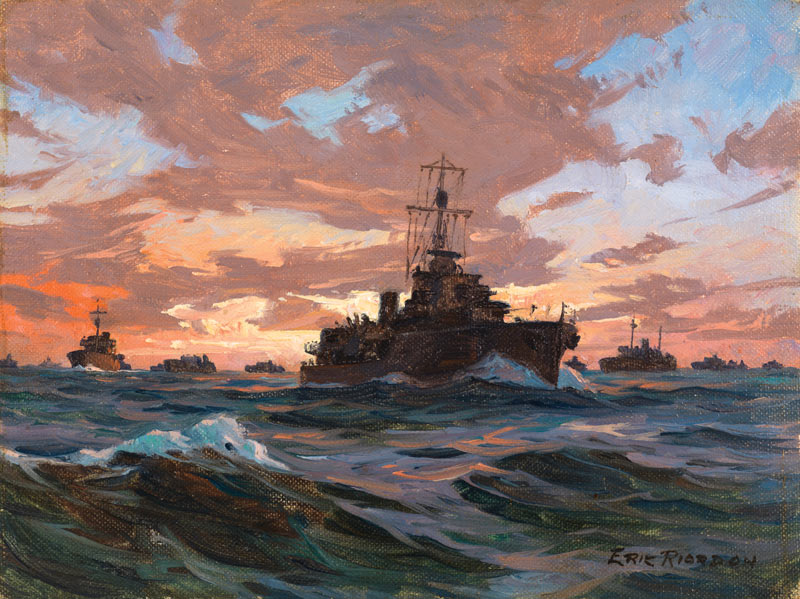
[Eric Riordon/CWM/19950104-014]
“This is the North Atlantic! All too frequently the sea under a roaring gale runs a forty and fifty foot swell, dwarfing the corvette, mast-head high, mighty waves that come hurtling out of the sky, and meeting the staunch little ship head-on they split angrily and fling seething tons of water upon her.”
So wrote Eric Riordon in his artist statement for “Heavy Going!” The piece was one of 34 exhibited as “North Atlantic Convoy”—first at the department store Jas. A. Ogilvy in Montreal through the summer of 1950, then across the country until 1952—depicting naval escort duty during the Second World War’s Battle of the Atlantic.
Riordon, a renowned Quebec-based landscape painter, largely put aside brush and canvas to serve Canada during the Second World War. He enlisted in the Royal Canadian Naval Volunteer Reserve in June 1940 and first went to sea aboard HMCS Fundy in late 1941. The minesweeper served in the Halifax Local Defence Force, responsible for guarding the reaches of Canada’s major East Coast port.
By late 1942, Riordon was first lieutenant on HMCS Kenora, which was assigned to the Western Local Escort Force. Ships in the group escorted convoys individually or as needed, mainly shepherding vessels to/from New York and Halifax and the western Atlantic hand-off location, the so-called Triangle Run. A Kenora log from the time reported that Riordon was “keen and works hard, reliable and should work up a good ship’s company.”
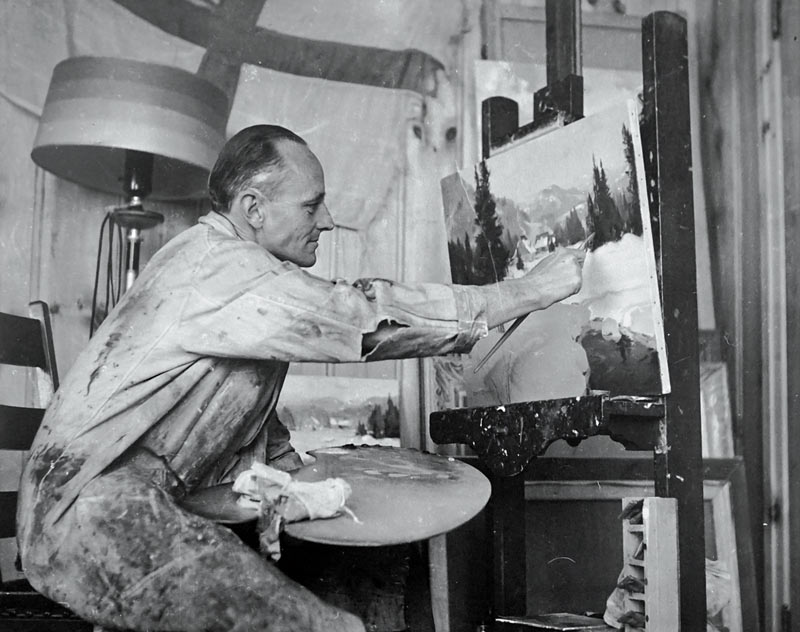
“Convoy at Sunset” (top) by Eric Riordon, at work circa 1947-1948 (above).
During the war, Riordon continued to have his works exhibited, though he produced very few inspired by his own service. One convoy-themed painting he did in 1941 appeared in a 1945 exhibition, while he produced 22 paintings to accompany the 1944 book Canada’s War at Sea by Stephen Leacock and Leslie Roberts.
Riordon resigned from the navy shortly after VE-Day and returned home to Montreal to resume his artistic career. Unfortunately, it wouldn’t last long. He died of throat cancer a little more than three years later, on Dec. 23, 1948.
Fortunately, he had found time to paint a record of his convoy experience from sketches, notes and personal experience, which his widow Mollie, along with others, staged in that North Atlantic Convoy exhibit. But, like the vagaries of battle at sea, as the works were sold off piecemeal after the exhibit, their provenance became as murky as North Atlantic fog.
Then, in 2020, Toronto-based art collector David Emmerson purchased a couple of Riordon paintings at auction. In ascertaining their origins, he learned that one was from the convoy series. In searching out others from the group, Emmerson discovered that the whereabouts of several were unknown.
“The incentive for me from the beginning,” Emmerson told Legion Magazine, “was to find all 34 paintings and to recreate, if only virtually, the original North Atlantic Convoy exhibition of May 1950.”
He subsequently created a comprehensive website (ericriordon.ca) dedicated to Riordon, his convoy series works and related topics. It has led to discovering the previously unknown owners of other paintings from the original exhibit, though 11 are still unaccounted for (Emmerson has, however, located images of five).
Herewith, a selection of works from Riordon’s North Atlantic Convoy series, both in celebration of them and in hopes of clearing the fog of war surrounding those lost to time.
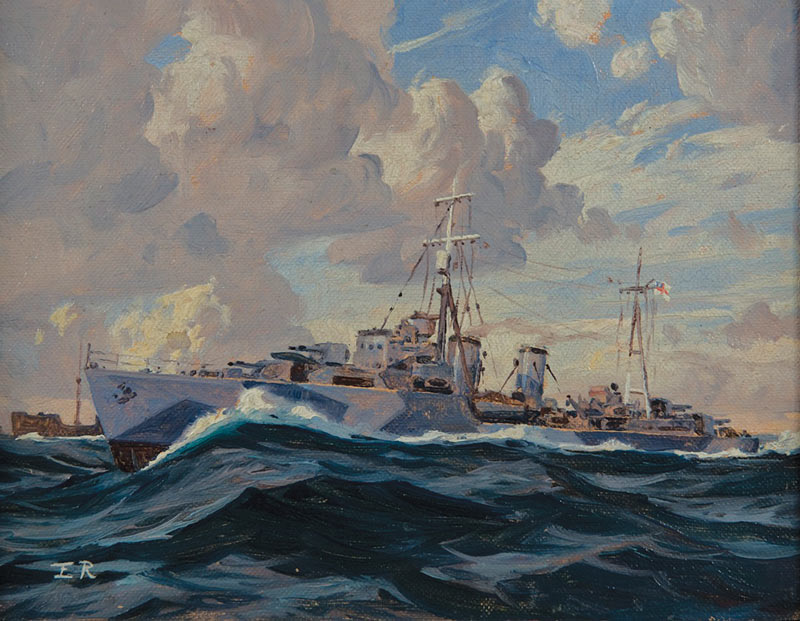
Riordon’s “Tribal Class Destroyer”[Eric Riordon/courtesy David Emmerson]
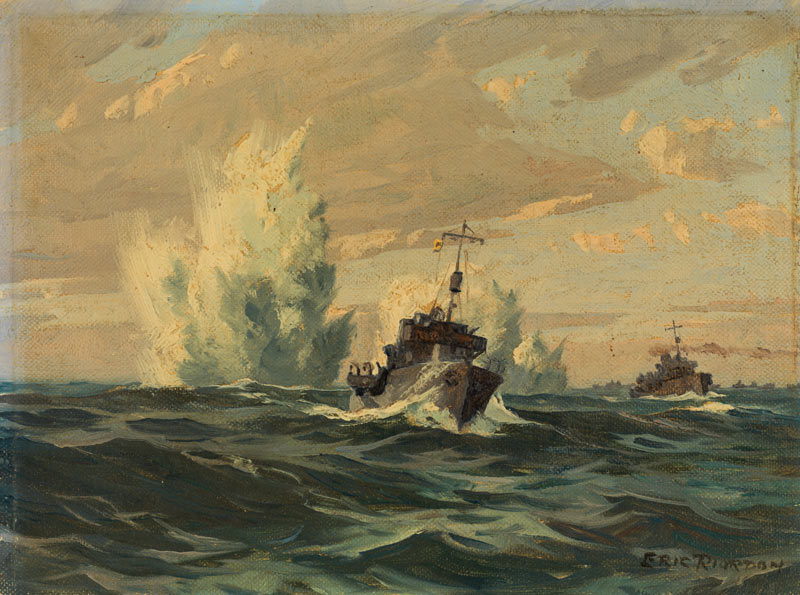
“Depth Charge Attack”[Eric Riordon/CWM/19950104-018;]
Riordon, a renowned Quebec-based landscape painter, largely put aside brush and canvas to serve Canada during the Second World War.
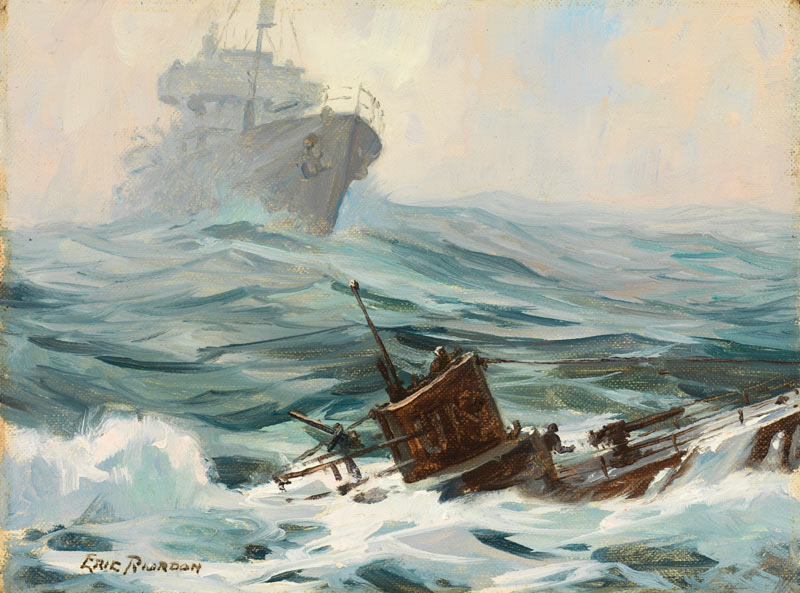
“Coming in for the Kill”. [Eric Riordon/CWM/19950104-013]
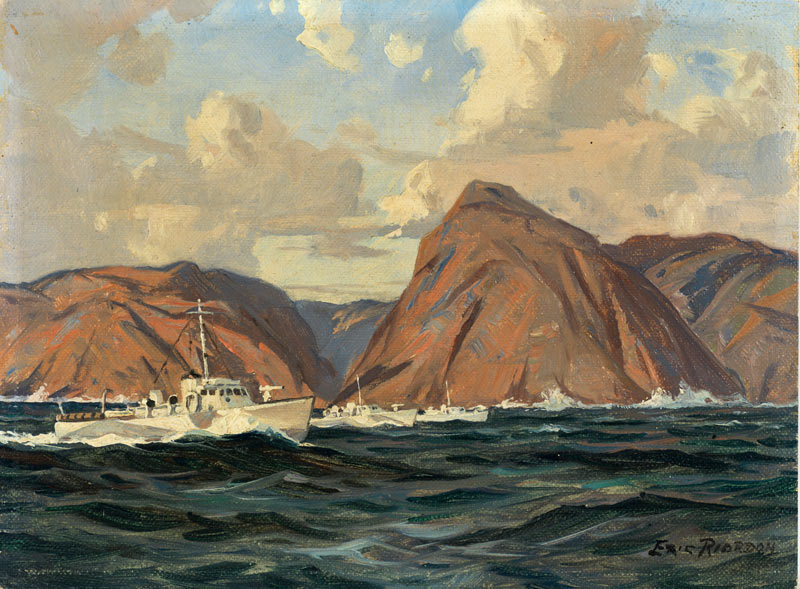
“Motor Launches off Newfoundland”[Eric Riordon/CWM/19950104-017]
Ships in the group escorted convoys individually or as needed, mainly shepherding vessels to/from New York and Halifax and the western Atlantic hand-off location, the so-called Triangle run.
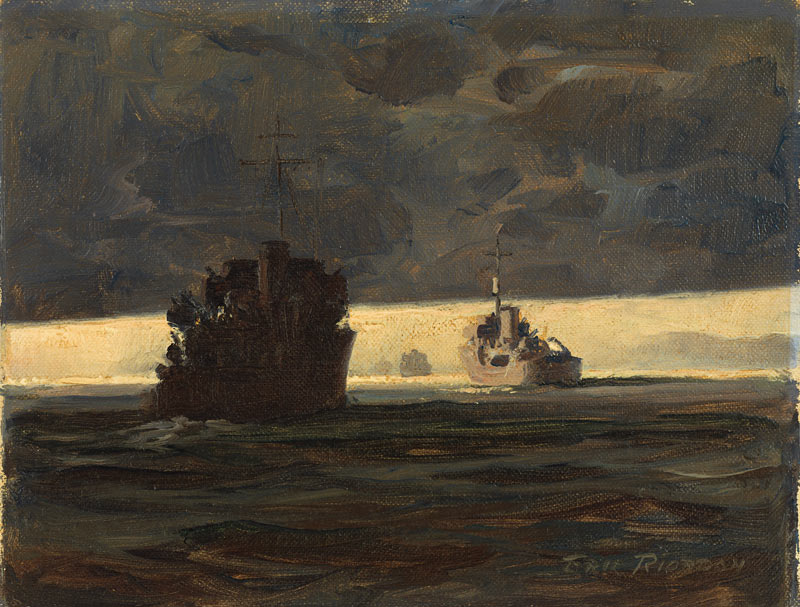
“Entering Harbour” [Eric Riordon/CWM/19950104-015]
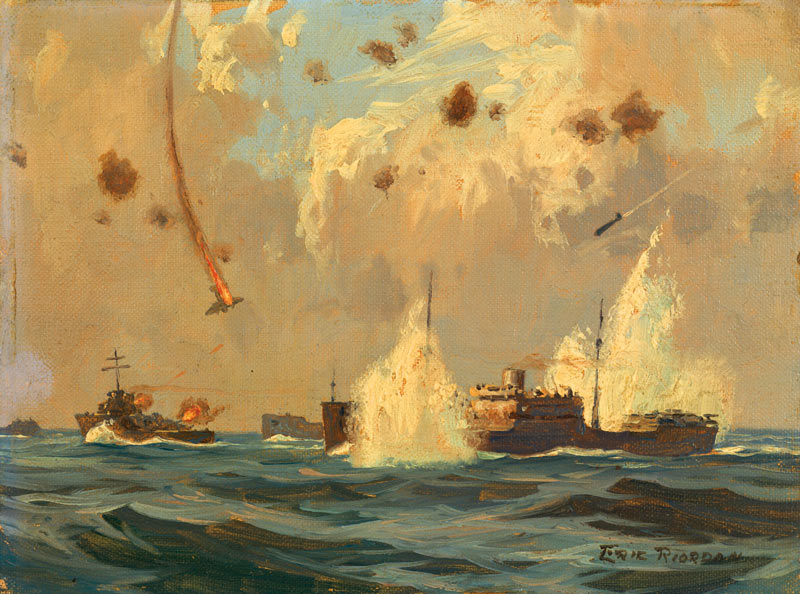
“Air Attack”[Eric Riordon/CWM/19950104-027]
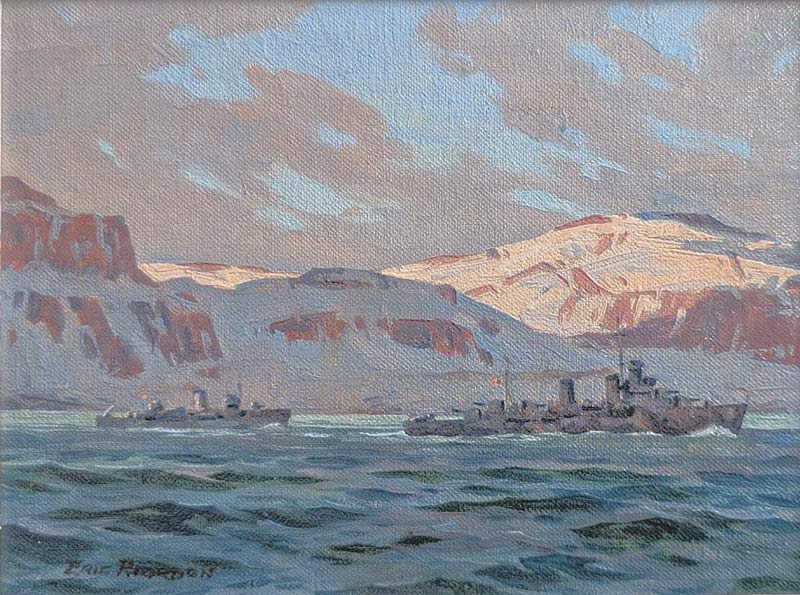
“Iceland” [Eric Riordon/courtesy David Emmerson]
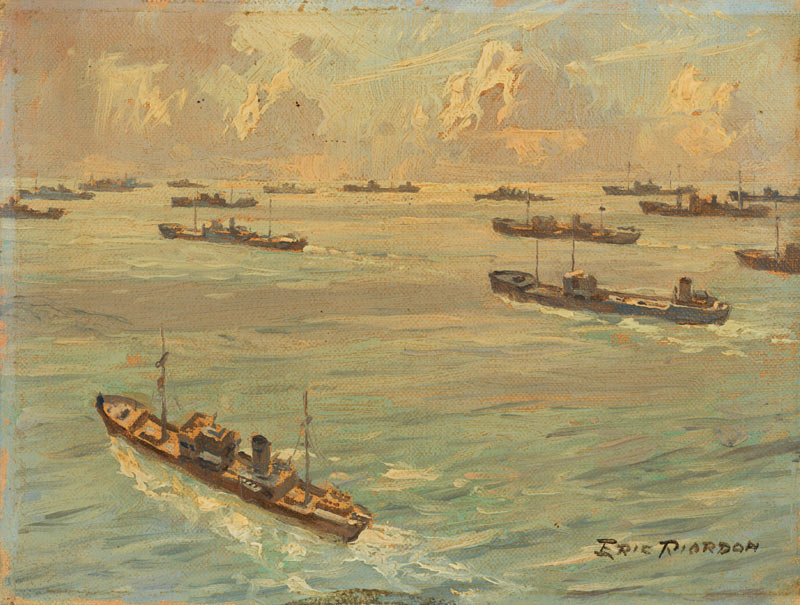
“Airview” [Eric Riordon/CWM/19950104-024]
Like the vagaries of battle at sea, as the works were sold off piecemeal after the exhibit, their provenance became as murky as North Atlantic fog.
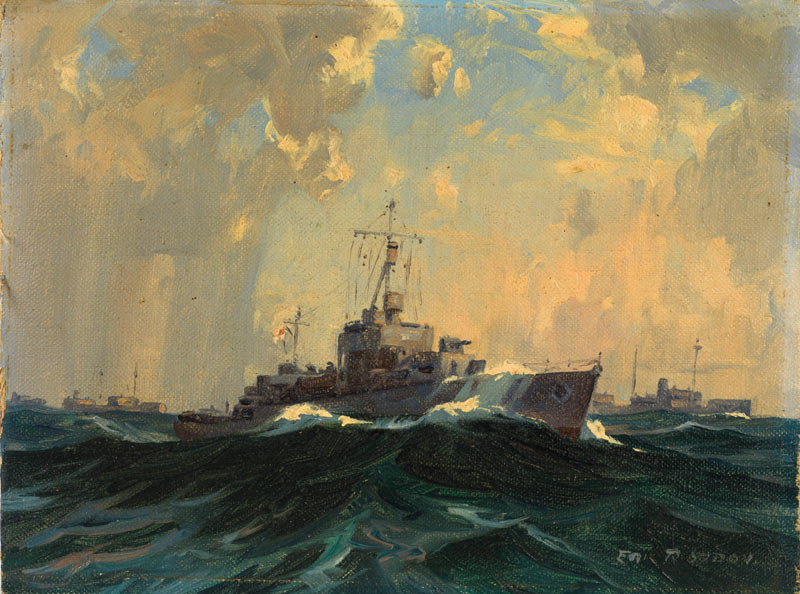
“Castle Class Corvette” [Eric Riordon/CWM/19950104-022]
Advertisement