

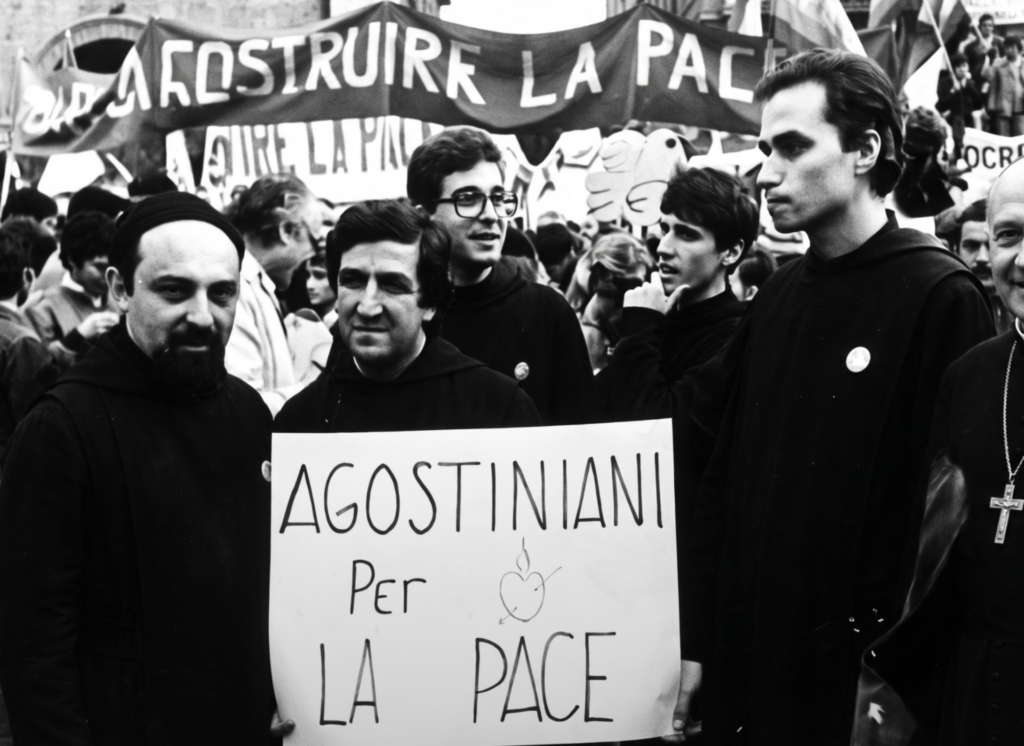
Robert Prevost (right), now Pope Leo XIV, at a peace rally in Rome in 1983 with fellow Augustinians. [Pax Christi Italia Archives/Wikipedia]
Beyond the extraordinary spectacle of a U.S. president attacking the leader of the Catholic Church, the quarrel shines a timely spotlight on the question of what is a just war?
The Pope has been condemning the moral conduct of the Trump administration for some time, first on immigration and now for its war on Iran. Leo described Trump’s April 7th threat to wipe Iran from the map— “a whole civilization will die tonight, never to be brought back again”—as “truly unacceptable.”
Leo also criticized the administration’s use of religious language to defend its conduct in the war. “Let those who have the power to unleash wars choose peace!” the Pope said at Easter.
In response, Trump attacked Leo as “WEAK on Crime and terrible for Foreign Policy” and accused the Pope of “catering to the radical Left.” He then claimed credit for Leo’s election as pontiff and posted a bizarre AI image of himself seemingly as Jesus Christ.
Putting aside Trump’s crude posturing, what’s most interesting about this episode is the useful reminder it provides of what constitutes a morally legitimate war, a question Leo’s own priestly order has been at the centre of since ancient times.

Donald Trump at the Republican Members Issues Conference in March 2026. [X.com/Wikimedia]
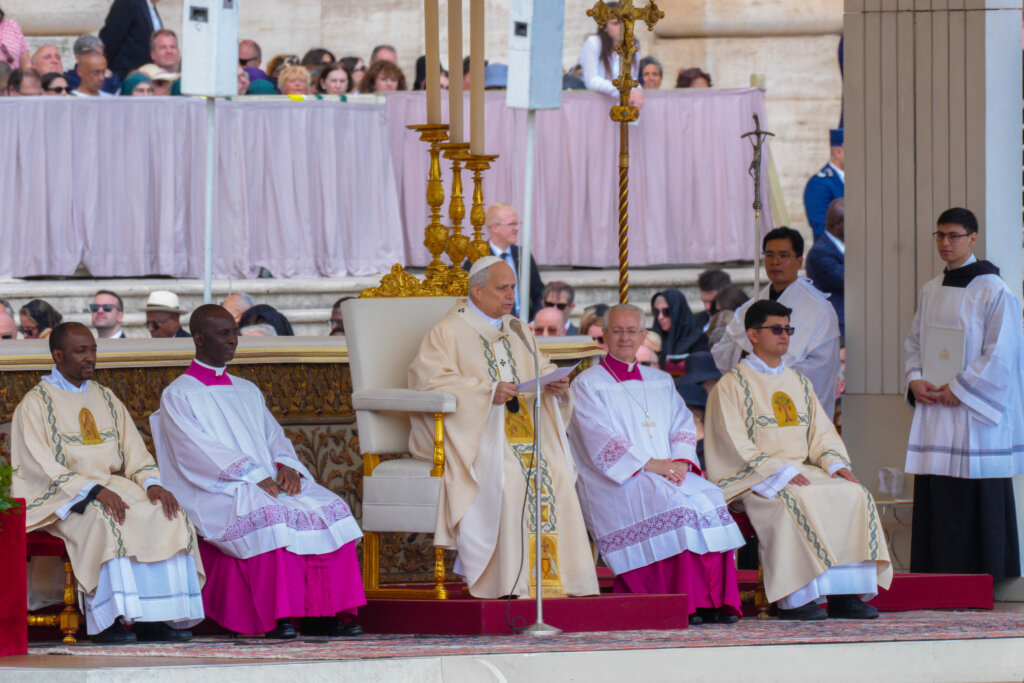
Pope Leo XIV gives the homily during his inauguration on
Saint Augustine formulated a just war theory that provided a biblical justification for war. Departing radically from the teachings of the early Christian church, it was aimed at persuading pacifist Christians—namely, those living in the Roman Empire under the first Christian emperors—that a soldier in the Roman army can fulfil a moral Christian purpose.
Saint Augustine’s principles evolved through modern times, were refined by other thinkers and are today reflected in the Geneva Conventions that form the basis of international humanitarian law.
The Augustine-inspired conditions of the modern just war theory come in two parts:
The first—jus ad bellum—address what is required for a morally legitimate war: self-defence in the wake of an attack or imminent attack (in other words, that the intention for going to war is good); competent legal authority to undertake war; the exhaustion of all peaceful alternatives; and reasonable hope of strategic success.
“A whole civilization will die tonight, never to be brought back again.”
The second part—jus in bello—describes conditions necessary for the moral conduct of the war: these require the use of force to be proportional (so that the evil created by the war does not outweigh the good of the cause) and that innocents or civilians shouldn’t be killed.
Two senior American Catholic leaders have said the Iran war fails to meet most of these conditions including, most concerningly, the lack of proper intention.
“One of the most worrying elements of these first days of the war in Iran is that our goals and intentions are absolutely unclear, ranging from the destruction of Iran’s conventional and nuclear weapons potential to the overthrow of its regime to the establishment of a democratic government to unconditional surrender,” said Washington, D.C., Cardinal Robert McElroy in the National Catholic Reporter last month.
“You cannot satisfy the just war tradition’s criterion of right intention if you do not have a clear intention.”
This lack of intention, McElroy added, raises “immense concern” that in the volatile Middle East, the war will spiral out of control.
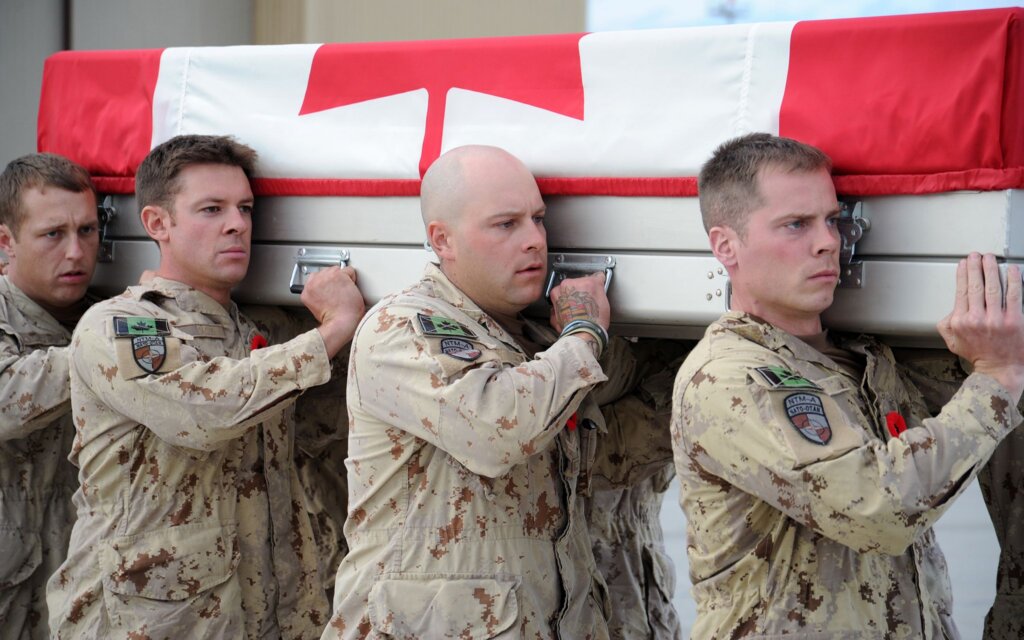
Canadian soldiers carry the remains of Master Corporal Byron Greff, killed by a Taliban attack while serving in Afghanistan, in 2011. [Senior Airman Kat Lynn Justen/US Air Force/Wikimedia]
The war in Afghanistan appears to meet most of the criteria. In the wake of the 9/11 attacks, Canada supported its neighbour and NATO partner in an internationally sanctioned war against a malevolent terrorist organization and the fundamentalist regime that sheltered it.
However, the mission in Afghanistan may have run afoul of the just war condition requiring a reasonable chance of success. Was Ottawa right to send soldiers to die in a country that had defeated foreign armies for centuries, fighting a counter-insurgency fueled by a duplicitous so-called ally in Pakistan, and without overwhelming support and military resources?
In the Korean War, Canada met its obligations as part of a UN-mandated international response to the aggression of North Korea. Our soldiers, sailors and airmen fought with a clear objective of defending the territorial integrity of South Korea.
How does Canada’s military history measure up against the high standards of just war principles?
Likewise, the Second World War presents a straightforward case. Canada declared war on Germany following years of failed diplomacy in Europe, extensive parliamentary debate at home, and the unequivocal moral imperative of supporting Britain, France and other allies in defeating the evils of fascism.
Just war principles are somewhat harder to apply to the First World War, which was in many ways a tragic consequence of too little diplomacy and a great power arms race. However, as a British dominion, Canada had little choice but to participate.
The moral case for doing so gained traction in 1914 after the Kaiser’s army marched into Belgium and France. It became even clearer the following year with Germany’s sinking of the civilian ocean liner Lusitania, killing more than 1,000 passengers and threatening the freedom of the seas.
The Boer War, the first time Canada, as a British dominion, sent troops overseas, fails the just war criteria on nearly all counts. In a frenzy of patriotic chest-thumping in 1899, Canada supported Britain in a war of imperial aggression against two small, independent republics in possession of the world’s largest known gold reserves. The war enlarged the British Empire, but at a cost of 60,000 lives—most of them civilians—including approximately 270 Canadian soldiers.
The future will certainly herald new wars, requiring Canadians to make hard choices about whether and how to participate. The country should proceed with care. A centuries-old road map illuminating the moral basis for going to war is available as a guide.
Advertisement