






[Royal Hamilton Light Infantry Heritage Museum.]
ALFRED BOOKER
On the night of May 31, 1866, about 600 Irish-Americans crossed the Niagara River from Buffalo into Canada West and occupied Fort Erie. They were the first of an anticipated 1,500 Fenians that would form one of a three-pronged raid spanning present-day western Ontario to the Atlantic seaboard. Only this first wave, however, materialized—the remainder being blocked by the arrival of the American gunboat USS Michigan.
Having failed to detect the Fenian threat, British military officials in Canada scrambled to respond with an operation
of their own. While Colonel George Peacocke advanced a force of about 1,700 British regulars and Canadian militia from Chippawa, Lieutenant-Colonel Alfred Booker was to bring 850 more militiamen to Port Colborne and reach Ridgeway by train. His troops would then march to Stevensville, about 12 kilometres from Fort Erie, where the two columns would attack the Fenians from opposite flanks.
Booker best understood where the Fenians were and although he proposed moving his troops to Fort Erie to attack their initial mustering point at Frenchman’s Creek, he was overruled. The wealthy auctioneer and devout Baptist, who had been commissioned into the militia in 1851, later wrote that, consequently, keeping “my appointment at Stevensville was my obvious duty.”
The Fenians ambushed Booker from behind a fence-rail barricade.
While Booker moved quickly, Peacocke delayed his departure, then followed a meandering route. This left him far from the juncture point when Booker and his men marched toward Stevensville. The Fenians, commanded by U.S. Civil War officer John O’Neill, ambushed Booker from behind a fence-rail barricade they had erected on Limestone Ridge overlooking the Canadian line of march just north of Ridgeway. Unable to withdraw, Booker’s militia met the attack with courage and steadiness until several Fenians on horseback appeared.
Fearing an imminent cavalry charge, Booker ordered his troops to form a defensive square, which exposed them to withering musket fire. Then, Booker’s attempt to conduct an orderly withdrawal failed as discipline disintegrated into a retreat to Port Colborne. Ten Canadians were killed and 38 wounded.
O’Neill’s Fenians withdrew to Fort Erie, then to Buffalo. Following the fiasco, several subordinate officers assigned Booker as solely responsible for the Ridgeway defeat. Even after he was cleared by a court of inquiry, some officers financed a malicious account of the battle still blaming Booker for the defeat. The account’s author, Alexander Somerville, later admitted that his writing was “blind to fair play” and “the work of Col. Booker’s personal enemies.”
Booker resigned his militia command on July 30, 1866, and died in Montreal five years later.
“My appointment at Stevensville was my obvious duty.”
—Lieutenant-Colonel Alfred Booker
[City of O’Neill, Neb.]
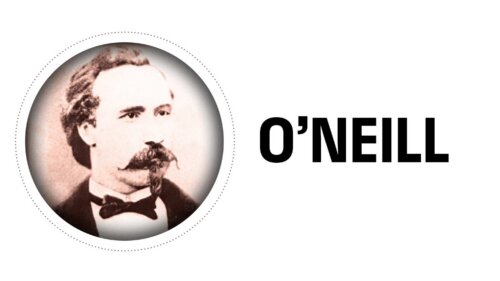
JOHN O’NEILL
The governing passion of my life apart from my duty to my God is to be at the head of an Irish Army battling against England for Ireland’s rights,” wrote Fenian John O’Neill. “For this I live, and for this if necessary I am willing to die.”
O’Neill had immigrated to America in 1848 during the potato famine and enlisted in the 2nd U.S. Dragoons in 1857. Shortly after, he deserted only to re-enlist in a California-based cavalry unit. Commissioned during the Civil War, O’Neill served with distinction. He was wounded in November 1863 and released the following year. In 1866, O’Neill and other Irish veterans joined the Fenian Brotherhood, which sought to liberate Ireland from Britain by seizing some or all of British North America to be exchanged for their homeland’s independence. They also hoped a series of incursions into Canada might trigger an American-British war that could also be exploited to free Ireland.
O’Neill’s advance to Ridgeway and the ensuing battle proved an unexpected victory and the only one the Fenians would achieve. “Although we had met and defeated the enemy, yet our position was still a very critical one,” O’Neill wrote later.
O’Neill’s advance to Ridgeway and the ensuing battle proved an unexpected victory and the only one the Fenians would achieve.
Knowing that Colonel Peacocke’s column would soon arrive and “not knowing what was going on elsewhere, I decided that my best policy was to return to Fort Erie,” O’Neill continued. Once there, he hoped to learn that other Fenian raiders were mustering in Buffalo. In that event, “I was willing to sacrifice myself and my noble little command…as I felt satisfied that a large proportion of the enemy’s forces had been concentrated against me.”
Receiving no word of other raids, however, O’Neill withdrew across the border to Buffalo. Here, along with some 600-700 Fenian volunteers, O’Neill was arrested by the Americans for violating U.S. neutrality laws.
He was soon released and thereafter referred to by the Irish independence movement as “General” O’Neill. His Ridgeway victory was lauded by Irish on both sides of the Atlantic.
Although support for further Fenian raids was lacking in the Irish-American community and few more army veterans volunteered, O’Neill persisted in the cause. He led a confused raid from Vermont in May 1870, then another from Minnesota in October 1871 before abandoning Fenianism in favour of encouraging Irish immigration to Nebraska. He died of pneumonia on Jan. 8, 1878.
“I was willing to sacrifice myself and my noble little command.”
—Lieutenant-Colonel John O’Neill
Advertisement