

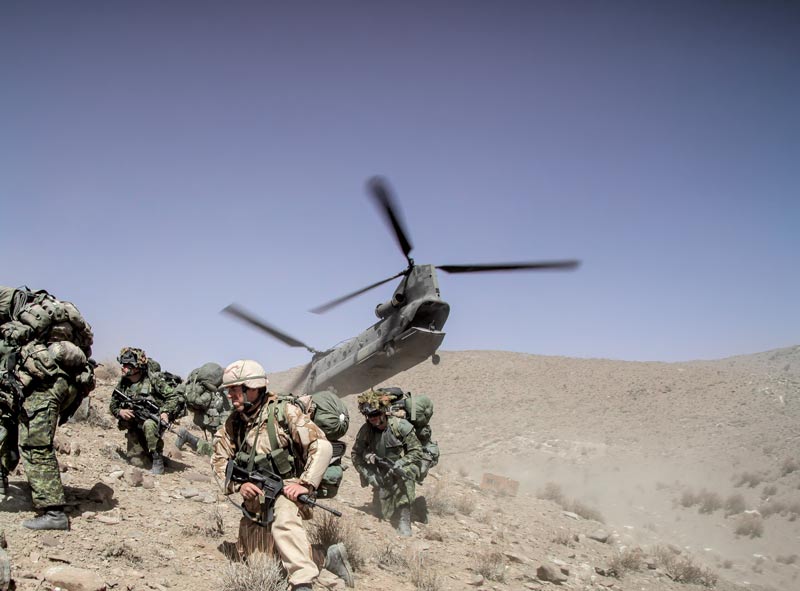
Recce troops and a sniper in British kit from 3rd Battalion, Princess Patricia’s Canadian Light Infantry, launch Canada’s first combat assault since the Korean War, on a mountain in eastern Afghanistan called The Whale on March 13, 2002.[Stephen J. Thorne/The Canadian Press]
Edmonton is a long way from the Shah-i-Kot mountains of eastern Afghanistan: more than 10,000 kilometres as the crow flies, but even farther in psychological terms. For Corporal Rob Furlong—squinting through his rifle scope at a group of enemy fighters one afternoon in March 2002—the forbidding Shah-i-Kot was a world away from home.
Only months earlier, in the wake of the 9/11 attacks, Furlong’s unit, 3rd Battalion, Princess Patricia’s Canadian Light Infantry (3 PPCLI), had been ordered to deploy from its base in Edmonton to the heart of al-Qaida’s stronghold in Afghanistan.
By March, U.S. and Afghan rebel forces had ousted the Taliban regime from Afghanistan’s capital, Kabul, and scores of displaced Taliban and al-Qaida fighters—possibly including 9/11 Saudi masterminds such as Osama bin Laden—were believed to be gathering for a final stand in the Shah-i-Kot, close to the border with Pakistan.
Five Canadian snipers from 3 PPCLI had been seconded to an ambitious American-led air assault aimed at flushing the enemy from the region. The Canadians were divided into a couple of three-man sniper teams: Furlong and Master Corporal Tim McMeekin were placed in one team, along with an American soldier whose job was to guard the Canadian duo as they carried out their tasks.
On the first day of the assault, the team was dropped off by helicopter in the mountains. They spent several days combing the snow-covered ridges and rocky spurs, seeking out targets and providing covering fire for U.S. and Afghan army forces in the valley below.
The enemy turned out to be more numerous than expected, with several thousand al-Qaida fighters giving stiff resistance. American helicopters were shot down and coalition casualties mounted. Sometimes under direct mortar and rifle fire themselves, the sniper team sighted and killed insurgents moving weapons through the valley or up into the mountain passes.
On about their sixth day, McMeekin spotted three enemy fighters through his rangefinder hauling mortars and other weapons in the valley, more than two kilometres away. It was a long distance for an attempted shot, even for elite snipers.
Lying prone on the rocky ground alongside his McMillan TAC-50 rifle, Furlong placed the fighter posing the most immediate threat—the one carrying a Russian-made machine gun—in his crosshairs. He checked the precise distance with McMeekin, adjusted his rifle’s elevation, calmed his breathing and settled his finger softly against the trigger.
“Stand by,” he said.
“Send it,” McMeekin responded.
The .50-calibre round spiralled through the air and slammed into the dirt just wide of the enemy machine-gunner. McMeekin called out a correction. Furlong reloaded, adjusted and fired again, this time hitting the target’s backpack.
Although the enemy fighters scrambled for cover, they remained exposed, unsure where the shots were coming from. Furlong reloaded and adjusted again, his third shot striking the target directly in the torso. McMeekin, eyeing the action through his rangefinder, confirmed the fatal hit.
Furlong had just shot a man from a distance of 2,430 metres, at the time, the longest recorded sniper kill in history.
It was a day of heavy meaning for Canada in Afghanistan—a precursor of not only the exceptional fighting ability of Canadian soldiers, but also of their country’s immersion in the long and treacherous war that lay ahead.
Canada’s political leadership was “rocked to its foundations on September 11, 2001,” wrote Janice Gross Stein and Eugene Lang in The Unexpected War: Canada in Kandahar.
For one, both Defence Minister Art Eggleton and Defence Chief General Ray Henault were in Europe on that infamous morning (Eggleton in Bulgaria, Henault at a meeting of NATO generals in Hungary). They watched in horror as al-Qaida terrorists flew airliners into the World Trade Center towers and the Pentagon, with a fourth hijacked plane crashing in rural Pennsylvania.
Canada was immediately thrust into the front lines. Not only were 24 Canadians among the nearly 3,000 people killed in the attacks, but airports across the country became emergency landing sites for more than 220 U.S.-bound flights. Local communities from Vancouver to Gander, N.L., provided comfort, food and shelter for tens of thousands of stranded passengers.
Amid the unfolding maelstrom, Eggleton and Henault hurried back to Ottawa, where the government of Prime Minister Jean Chrétien was coming to terms with a radically altered geopolitical world and scrambling to determine how Canada should respond.
“Members of the Chrétien government,” wrote Stein and Lang, “…had no idea what role Canada’s military should, could, or would play in Afghanistan. In fact, Ottawa struggled for months to devise an Afghanistan policy that would satisfy the core political objectives of the government and, at the same time, be acceptable to the Canadian public.”
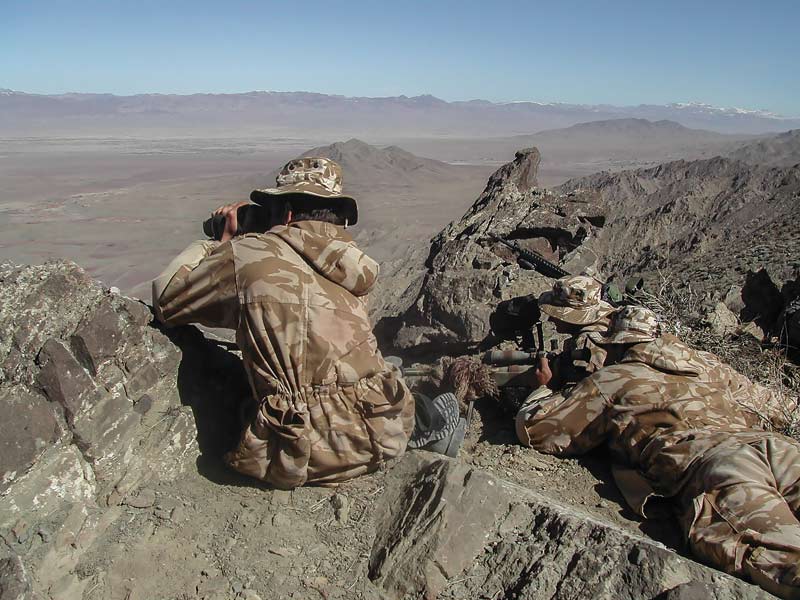
A Canadian sniper team from 3 PPCLI Battle Group, wearing specialized British fatigues, surveys the terrain near the Afghan-Pakistan border.[Stephen J. Thorne/The Canadian Press]
The Americans “were curious because they didn’t really know us,” one member recalled. “At the beginning people said, ‘Who the f— is JTF 2?’”
In the weeks prior to 9/11, the government had been preparing a federal budget focused on post-secondary education. That was swept aside, with a hastily revised budget devoted instead to national security, with an unprecedented $7.7 billion earmarked for intelligence and counterterrorism agencies. With security concerns focused domestically and not abroad, there was little new money for the military.
At the same time, the government understood that some kind of military contribution seemed unavoidable. This became especially clear in October when NATO invoked, for the first time in its 52-year history, Article 5 of the alliance’s founding treaty—stating that any attack on a NATO member was an attack on all. Canada was now legally obligated to participate militarily.
According to Stein and Lang, the cabinet and senior officials were divided among several approaches. Some wanted Canadian troops dispatched immediately to join U.S. forces launching attacks on the al-Qaida stronghold in the southern Afghan city of Kandahar. Others preferred a safer role for Canadian troops, possibly assisting European allies in the UN-mandated International Security Assistance Force (ISAF) being put together as a stabilization mission for Kabul. Meanwhile, some senior military officials, worried about the long-neglected and overstretched Canadian Armed Forces, favoured a token contribution to the coalition naval force taking shape in the Arabian Sea.
A week after NATO invoked Article 5, Eggleton announced Operation Apollo, Canada’s formal contribution to the U.S. military mission in Afghanistan. Apollo—the name of the American moon landing—was chosen as a deliberate effort to signal Canada’s solidarity with the U.S.
Except that Eggleton’s announcement made no mention of any Canadian troops putting boots down in Afghanistan. Instead, the navy would bolster the coalition fleet assembling off the coast of Pakistan, with HMCS Halifax ordered to divert from Spain—where the frigate was participating in NATO exercises—to the Arabian Sea. Nine days later, a full naval task force commanded by Commodore Drew Robertson departed from Halifax for South Asia. The warships sailed out of the harbour amid great fanfare, with thousands of well-wishers—and concerned naval families—waving from shore.
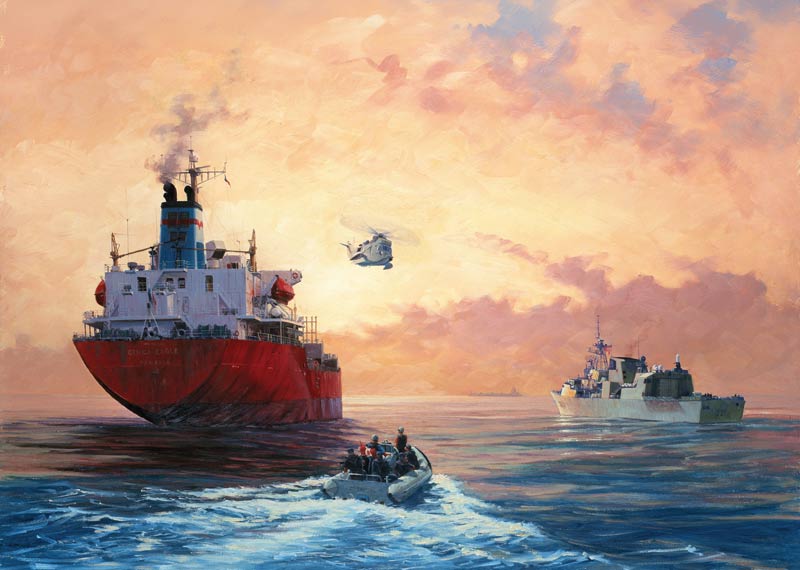
Artist John Horton depicts a Canadian boarding party approaching a merchant tanker in the Arabian Sea during the war in Afghanistan.[John Horton ]
Among the crowd was Laura Nurse, whose fiancé Able Seaman Scott Shaw was already en route to South Asia on HMCS Halifax. His ship and crew had been due home in a month from its NATO commitment, but were now deployed indefinitely to what U.S. President George W. Bush was calling the war on terror.
“If I had known back then he’d be going to war, I would have married my little sailor man the day he left town,” Nurse told the National Post at the time. “I’m scared I’m not going to see him again.”
By January, six Canadian warships were in the Arabian Sea, one third of the navy’s surface fleet. And during the next two years, a total of 16 Royal Canadian Navy destroyers, frigates, supply ships and more than 4,000 sailors joined the effort. They were protecting U.S. ships launching air assaults into Afghanistan, and patrolling the Arabian Sea and Gulf of Oman—boarding hundreds of suspicious vessels in the search for drugs or weapons or al-Qaida operatives seeking to escape from southwest Asia by sea.
What Canadians and many in the most senior levels of the federal government didn’t know is that by December 2001, in addition to the highly touted naval contribution, Canadian troops had been quietly dispatched to Afghanistan. A contingent of Joint Task Force 2 (JTF 2), Canada’s elite special forces, was on the ground supporting American special forces hunting Taliban and al-Qaida leaders.
About 40 JTF 2 soldiers joined operatives from Germany, Denmark, Turkey and elsewhere as part of Task Force K-Bar, an assortment of U.S.-led special forces focused on rooting out and arresting or killing enemy forces in southern Afghanistan. Initially operating out of Pakistan and later from a captured runway in Helmand province code-named Camp Rhino, K-Bar later moved to Kandahar Airfield, the former al-Qaida headquarters.
News that Canadians were fighting in Afghanistan only reached the Canadian public on Jan. 21, 2002, when newspapers published a wire photograph showing masked Canadians—wearing green camouflage fatigues in contrast with their U.S. counterparts who wore desert brown—escorting three enemy detainees off the ramp of an American helicopter in Kandahar.
The image caused an uproar in the House of Commons. Opposition MPs accused the government of misleading Parliament about Canada’s true involvement in Afghanistan and raised questions about the Canadian Forces’ apparent collaboration with controversial U.S. efforts to capture and send “unlawful enemy combatants” to the legally murky American prison in Guantanamo Bay, Cuba.
When Canadian special forces first arrived in Afghanistan, JTF 2 was an unknown among the tight-knit world of NATO specialized units. The Americans “were curious because they didn’t really know us,” one member recalled for the Toronto Star in 2010. “At the beginning people said, ‘Who the f— is JTF2?’”
The Canadians quickly proved their ability, carrying out a range of tasks including raiding suspected enemy compounds and hideouts, seizing senior Taliban officials and calling in air strikes from mountain observation posts. As with other K-Bar units, JTF 2 received the U.S. Presidential Unit Citation for “extraordinary heroism and outstanding performance of duty against the enemy in Afghanistan.”
While JTF 2’s heroics unfolded in secrecy, the Chrétien government continued dithering over how to support the war in Afghanistan in a more tangible way than the naval deployment. At first, Ottawa sought to join the British-led ISAF stabilization force, however the U.K. gave Ottawa the cold shoulder, saying that aside from an engineering component, a significant Canadian army contingent wasn’t needed in Kabul.
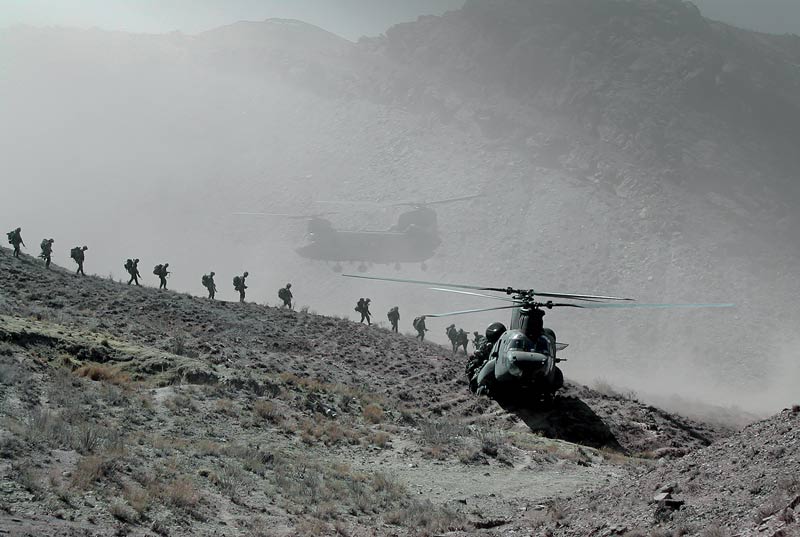
Canadian troops board a U.S. Chinook helicopter in the mountains of eastern Afghanistan on March 17, 2002, at the end of their first combat offensive since the Korean War. [Stephen J. Thorne/The Canadian Press]
Meanwhile, a request arrived from American war planners seeking a battle group in Kandahar. U.S. forces had their hands full hunting the Taliban and al-Qaida remnants in and around the city, and wanted help from Canada to protect Kandahar Airfield, a critically important base for operations across southern Afghanistan. Cabinet agreed and promised to have an infantry battalion in the city—on the ground in a hot war—by February.
The decision “signalled a major shift in political and military thinking in Ottawa,” wrote Stein and Lang. “It would be the first combat mission for the Canadian Forces since the Korean War, fifty years earlier.”
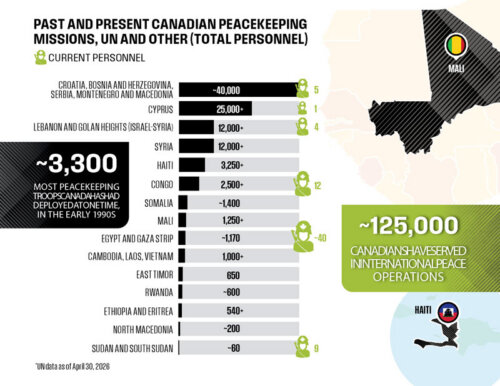
After decades of humanitarian or stabilization missions in the Balkans, Africa and the Middle East, this was also a long-awaited opportunity for the military “to show the public that they were a well-trained fighting force, and not just blue-beret wearing peacekeepers.”
The vanguard of Canada’s infantry commitment—a 3 PPCLI reconnaissance party under the command of Lieutenant-Colonel Pat Stogran—arrived at Kandahar Airfield on Jan. 14, 2002. Like most troops arriving in the city at the time, they were delivered on an American C-17 Globemaster transport corkscrewing down over the runway to avoid enemy fire, landing on a blacked-out tarmac amid the hulks of abandoned 1980s-era Soviet aircraft.
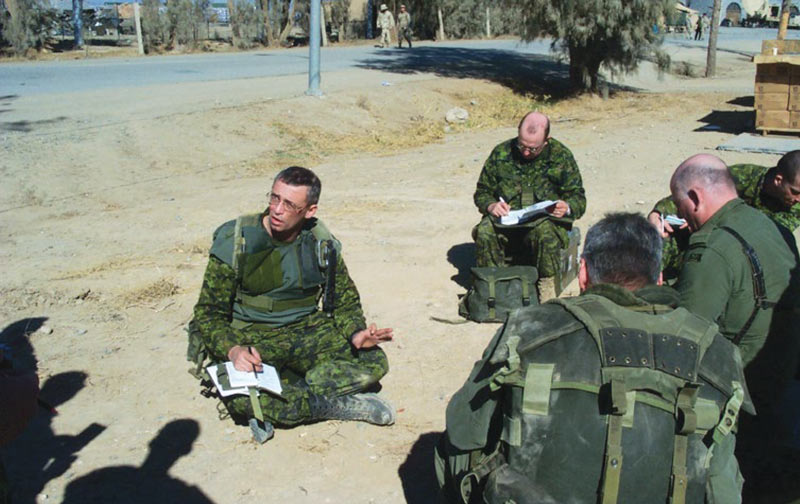
Lieutenant-Colonel Pat Stogran briefs his staff in Kandahar. [ DND/AP2002-5593]
“The trashed international terminal was lit only by the glow of burning 50-gallon drums, where heavily armed, toque-wearing, dirty U.S. Marines were hunched over the flames warming their hands,” wrote historian Sean M. Maloney in The Canadian Army in Afghanistan, a three-volume official history of the conflict, published in 2022. “It was a scene right out of a post-apocalyptic movie.”
“What tends to be forgotten is that the loss of the airfield or even its disruption would have been catastrophic and set back the coalition effort months, if not years.”
The rest of the 3 PPCLI battle group touched down two weeks later, taken to an empty patch of ground not far from the runway without any sandbags or other defensive works and told to make camp.
Altogether, Stogran commanded about 1,000 troops drawn mainly from Edmonton but also from units across Canada. In addition to logistics, signals and combat engineering capability, the battle group included three companies of light infantry, a squadron of Lord Strathcona’s Horse (Royal Canadians) equipped with Coyote surveillance vehicles, and a mortar platoon from 1st Regiment, Royal Canadian Horse Artillery.
Along with the small JTF 2 team already in place—which operated completely independently of Stogran’s group—the Patricias found themselves amid an international array of forces hailing from Norway to New Zealand, all using Kandahar Airfield as a crucial base.
In 2002, the airfield, one of only three major Afghan airstrips in coalition hands, was a somewhat clapped-out facility on the sandy outskirts of Afghanistan’s second largest city. It played a critical role as a secure, forward operating base supporting the war in the south. It fell to Stogran’s battle group, aided by the electronic surveillance capabilities of its Coyote vehicles, to protect the base, freeing up U.S. infantry battalions for missions farther afield.
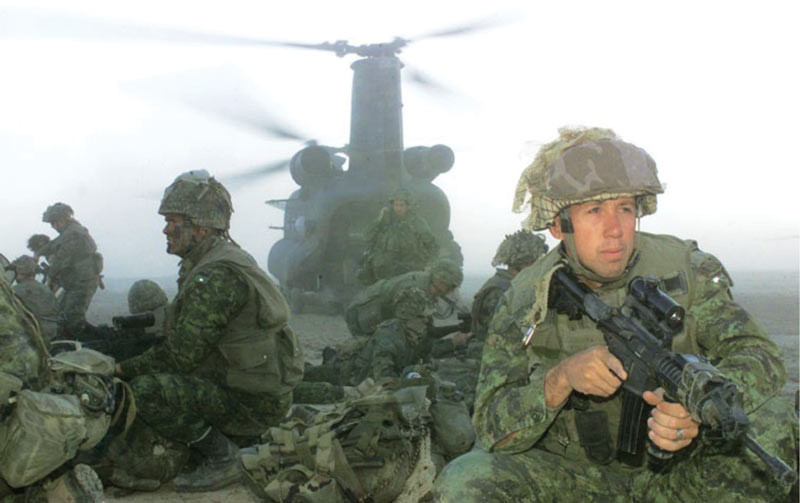
Canadian troops on The Whale. [DND/ISD02-9506]
With little enemy action in the immediate area, guarding the airfield was tedious work. Troops monitored the perimeter of the runway and lived in tents amid the constant din of aircraft coming and going, as well as scorpions, snakes and scorching heat in the spring and summer.
“It was an unglamorous task,” wrote Maloney, but a vital one. “What tends to be forgotten is that the loss of the airfield or even its disruption would have been catastrophic and set back the coalition effort months, if not years.
“Every conceivable item required by 5,000 troops had to be flown in by air, from vehicles to bullets to water, food and matches. And it all had to be stored and organized somewhere and then protected from the climate, looters and the enemy. Simply put, KAF was the lifeline and the brain for the coalition effort in southern Afghanistan.”
The war heated up for the Canadian battle group in early March. Operation Anaconda—the code name of the coalition air assault on the Shah-i-Kot region—was a welcome respite from guard duty for the battle group’s sniper teams, thrusting them into combat for the first time. The five PPCLI snipers distinguished themselves in the mountains with courage
under fire and with historic, record-breaking distance kills.
(In the wake of the operation, their achievements were tainted by accusations that some among their group had desecrated the corpse of a dead enemy fighter, including cutting off one of the deceased’s fingers as a souvenir. A lengthy probe by military investigators exonerated the snipers, each of whom—corporals Furlong and Dennis Eason and master corporals McMeekin, Arron Perry and Graham Ragsdale—received the Bronze Star from the U.S. military in recognition of bravery on the battlefield.)
Overall, Anaconda didn’t go well, with helicopters shot down, several Americans killed and hundreds of enemy fighters believed to have escaped from the Shah-i-Kot valley and into hiding in caves and ravines on The Whale, an escarpment along the west side of the valley. The regular infantry of 3 PPCLI got their own break from the tedium of guarding Kandahar Airfield when they were ordered to sweep the ridgeline for the elusive insurgents.
The Canadians were dropped off on the rugged, high-altitude landscape of The Whale by Chinook helicopters on March 13, the soldiers pumped with adrenaline and fully expecting the first major fight for the Canadian Army in decades. For five intense days, laden with heavy packs, they searched area caves and outcrops, finding small enemy ammunition caches, discarded documents and, occasionally, corpses. But the enemy—including possible al-Qaida leaders—had moved on, and the battle group returned to Kandahar.
“Members of the Chrétien government had no idea what role Canada’s military should, could, or would play in Afghanistan.”
A month later on April 17, tragedy enveloped the Patricias, not from enemy action but friendly fire from an American F-16 fighter. The battalion’s ‘A’ Company was conducting a night training exercise at a live-fire range called Tarnak Farm, outside Kandahar Airfield in preparation for an upcoming operation. A U.S. pilot, orbiting the airfield that night, mistook the flashes of Canadian small-arms fire for enemy guns.
The pilot dropped a laser-guided bomb on ‘A’ Company, killing Sergeant Marc Léger, Corporal Ainsworth Dyer and privates Richard Green and Nathan Smith, and wounding eight others. The four were the first Canadian soldiers to die in Afghanistan. Their deaths were met with an outpouring of grief in Canada, a country unaccustomed in 2002 to news of its soldiers getting killed overseas.
For three months following the incident, Stogran’s troops conducted a variety of other search and inspection missions outside Kandahar as the coalition continued to scour the country for al-Qaida and Taliban forces and hunt down the 9/11 leaders.
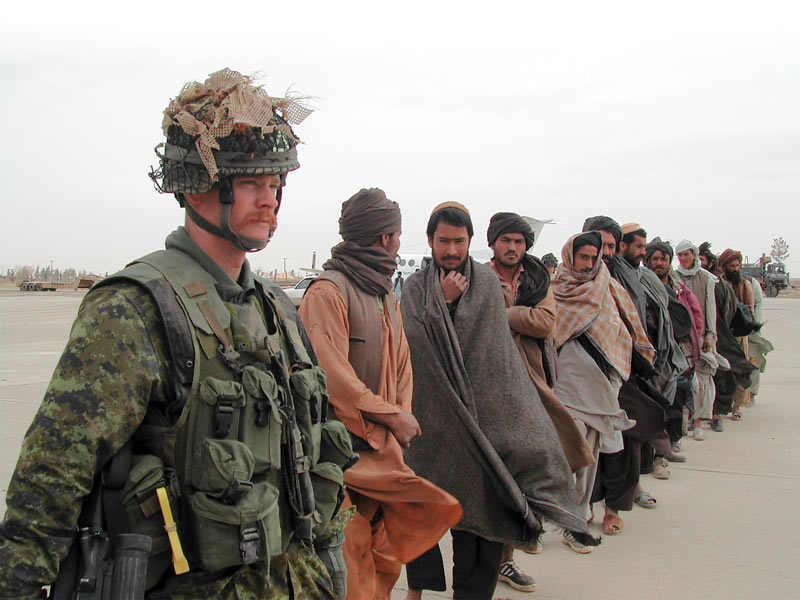
A Canadian soldier stands guard alongside Afghan workers as they wait to unload sacks of grain from a World Food Programme relief flight at Kandahar Airfield on Feb. 28, 2002.[Stephen J. Thorne/The Canadian Press]
In May, the Canadians participated in the exhumation of 23 recent graves in the Towr Ghar region of eastern Afghanistan, close to where coalition forces had battled al-Qaida during the Battle of Tora Bora in December. The Patricias had learned from local villagers about the presence of the burials, believed to contain the bodies of al-Qaida operatives, including a tall Arab man—possibly Osama bin Laden.
A platoon of 3 PPCLI led a team that included U.S. Army Criminal Investigative Division experts to the site. Examination and DNA sampling of the bodies, conducted with the co-operation of local Afghans, didn’t yield the remains of any known al-Qaida leaders. However, investigators determined that the dead had likely been members of bin Laden’s close protection team.
The 3 PPCLI battle group ended its mission in Kandahar later that summer, returning home to rest and recover, and to convey to the rest of the Canadian Army lessons learned. The navy, meanwhile, continued its presence in the Arabian Sea until the final vessel, HMCS Calgary, returned home in December 2003.
Although neither the government in Ottawa nor most Canadians knew it at the time, the end of Operation Apollo signalled only the beginning of Canada’s involvement in Afghanistan. When 3 PPCLI left Kandahar, the Taliban had been pushed from power, and any surviving al-Qaida forces had been chased across the border to Pakistan. But as Sean Maloney wrote, “the first wispy visages of the insurgency that would later engulf southern and eastern Afghanistan” had already started to emerge during the Canadians’ time in Kandahar.
In the ensuing decade, Canadian forces would be back in Afghanistan, first in Kabul then Kandahar, embroiled in a protracted, high-tempo and far more deadly guerrilla war.
Operation Apollo was the quieter, easier overture to all that. Yet, whatever it lacked in drama and spectacle, Canada’s opening foray in Afghanistan proved that Canada was a reliable NATO ally that could contribute effectively to global security. Perhaps most importantly, it shook Canadians out of their complacency toward the military and the true reason for having one.
“The conflict in Afghanistan was Canada’s first major shooting war since Korea in the 1950s and was also [Canada’s] first long term counterinsurgency campaign,” wrote Maloney.
“The war in Afghanistan reminded Canadians that the peacekeeping paradigm, which for so long dominated the Canadian worldview, reflected an earlier, even mythological golden age. Canada was now up against a new type of enemy.”
Advertisement