




Two years before the COVID-19 pandemic, Walter Cami left his home in Eeklo, Belgium, on a special mission.
He parked his car at the end of a country road on the edge of town, got out, pulled a small pair of scissors out of his pocket and started snipping. He was so engrossed that he didn’t notice a large shadow towering over him until a deep voice rang out.
“You are stealing my mother’s poppies!” a red-faced farmer announced.
Cami followed him across the road, where an elderly woman sat behind the large front window of her farmhouse. As soon as Cami stepped inside, she demanded to know why he had been stealing her precious flowers.
Cami calmly asked her if she had always lived on her farm in Eeklo. She said yes. He inquired if she remembered when they were liberated by the Canadians. She responded without missing a beat, “September 15, 1944.”
“I am picking poppies to dry them,” Cami explained. “I am sending them to cadets, young girls and boys in Canada, to be given out on Remembrance Day.”
The woman paused for a moment before turning to her son. “Show him the field behind the barn,” she barked. “There are hundreds of poppies back there.”
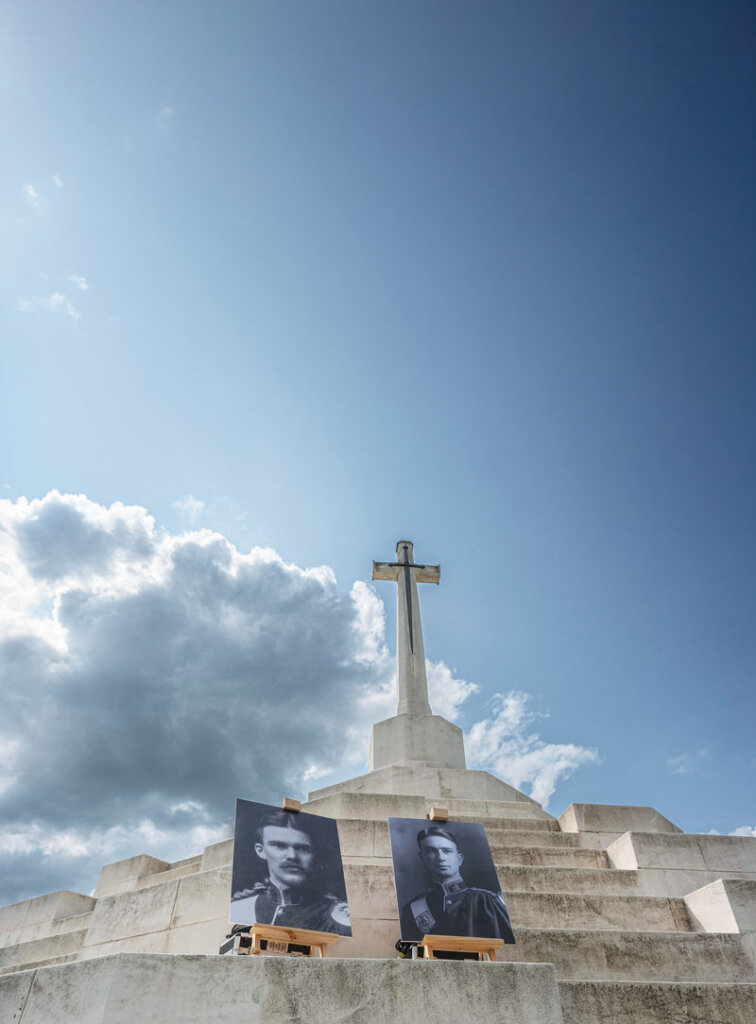
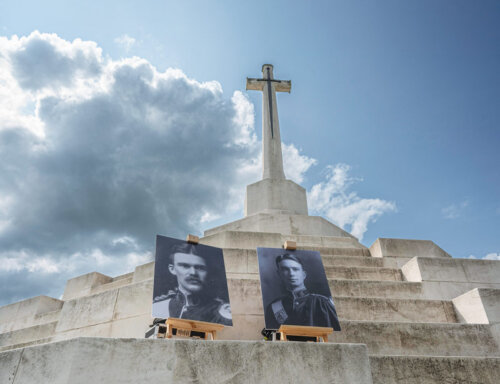
The portraits of Captain Trumbull Warren and Lieutenant Guy Melfort Drummond during their evocation by The Last Post Association at Tyne Cot Cemetery in Belgium. [The Last Post Association]
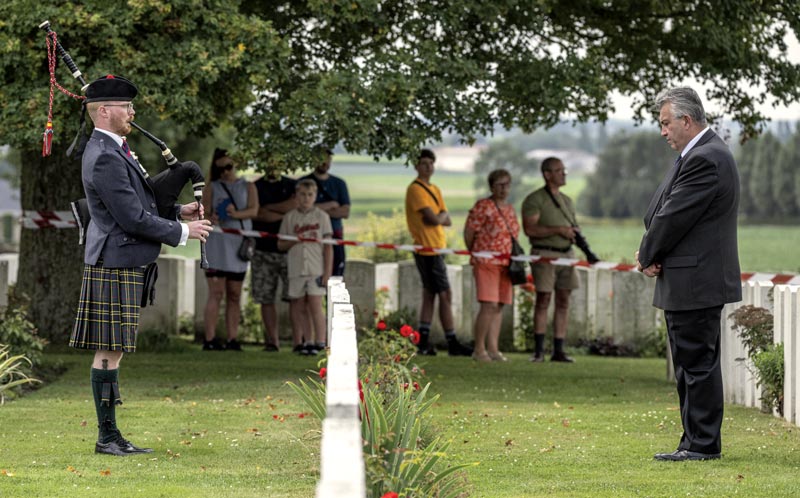
Walter Cami and a bagpiper during a ceremony at the soldiers’ tombstones. [Walter Cami]
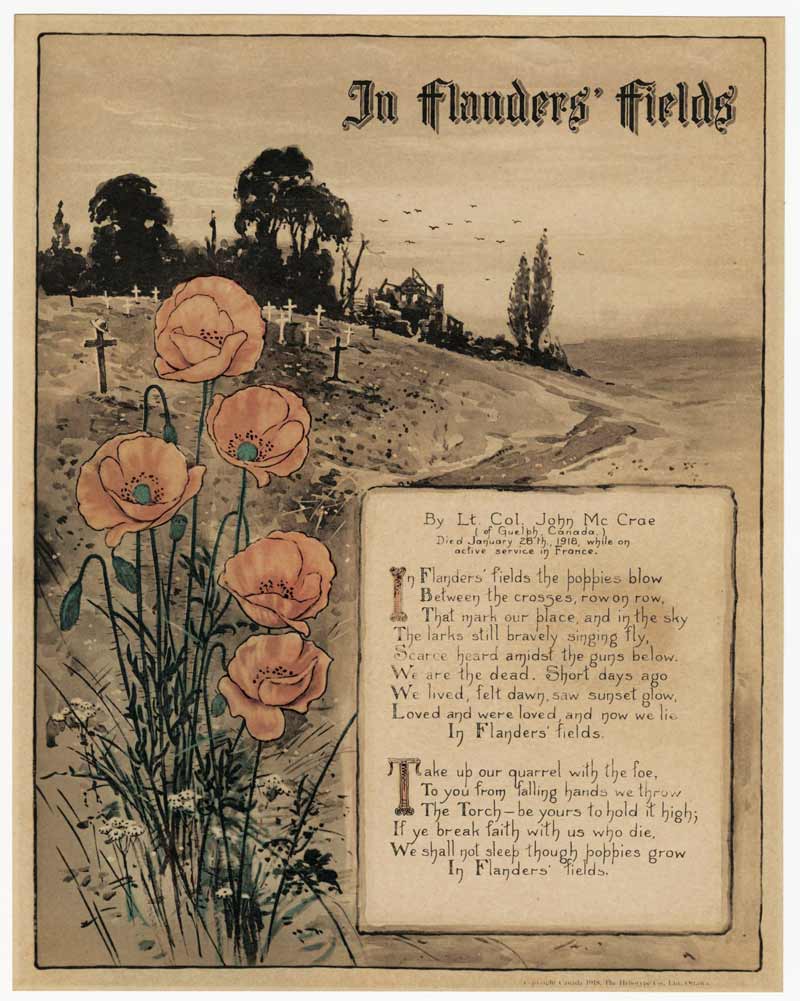
A 1918 print of Lieutenant-Colonel John McCrae’s “In Flanders’ Fields.” [CWM/20060073-001]
Eeklo is roughly the halfway point of the Canadian Liberty Route, which traces the path of the Canadian forces during the liberation of France, Belgium and the Netherlands in the final stages of the Second World War. More than 15,000 Canadians from both world wars are commemorated in Belgium, most of whom died while liberating the region of Flanders, including Eeklo, Furnes, De Panne, Nieuwpoort, Ostend, Knokke-Heist, Bruges and the northern suburbs of Antwerp.
In spring, you can find the corn poppy, Papaver rhoeas, blooming throughout the area. The flower was famously documented by Lieutenant-Colonel John McCrae who described a sea of crimson covering the graves of soldiers after the Second Battle of Ypres. His poem honoured his friend, 22-year-old Lieutenant Alexis Helmer, whose life was cut short soon after joining the fight.
Hundreds of Canadian cadets have donned a delicate poppy hand-picked by Cami, just one of the ways the Belgian has chosen to honour those who paid the ultimate sacrifice for his country’s freedom.
The lifespan of a wild poppy flower is less than a week, but preserved properly, a dried blossom can last a lifetime.
My phone rang in the early evening—2 a.m. for Cami (he says he’s a night owl). A soft-spoken man with a Flemish accent, he immediately apologized for his broken English, despite speaking it perfectly. Cami, 65, has dedicated 40 years to making sure Belgians never forget what the Canadians did for Europe.
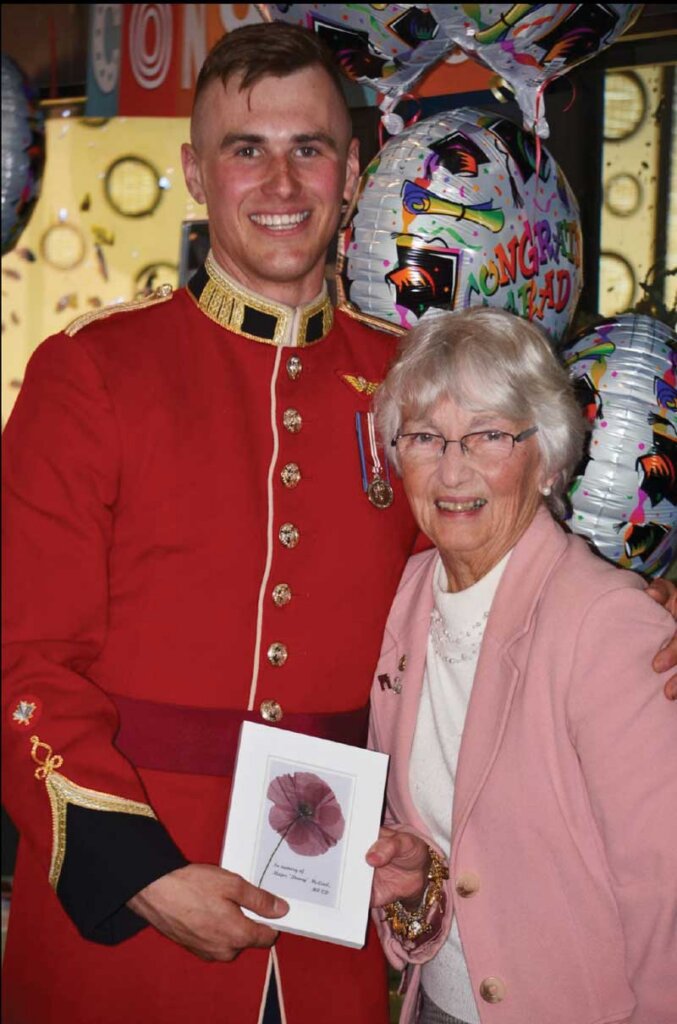
Sheila McLeod presents a framed poppy to cadet Second Lieutenant Kyle Alexander Ryan in memory of her late husband, retired major Danny McLeod in 2016. [Courtesy Sheila McLeod]
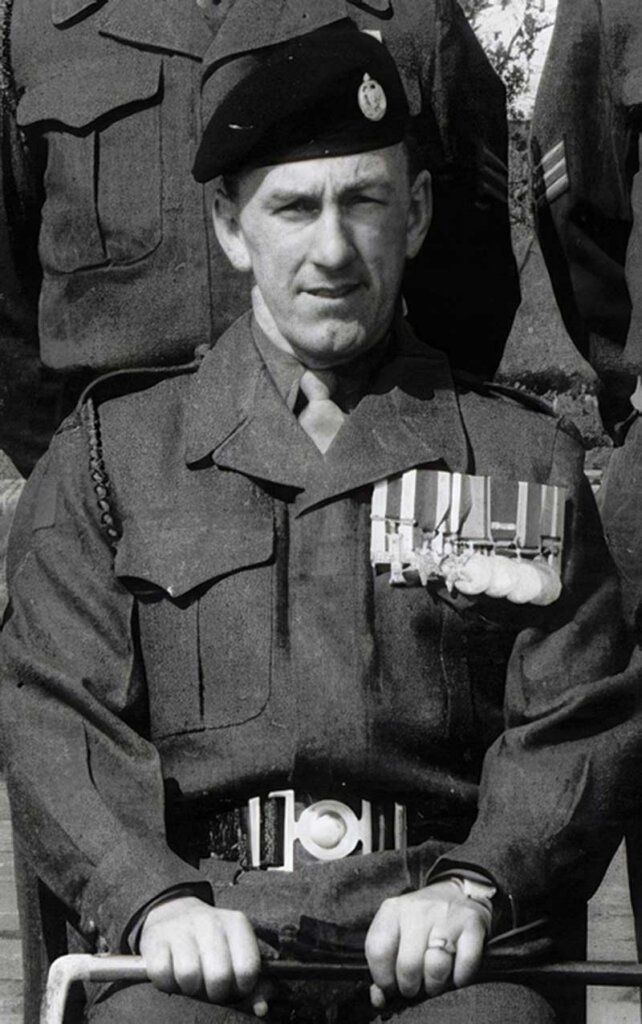
Retired major Danny McLeod. [benchedathletes.wordpress.com]
Cami and I have a mutual friend through my childhood neighbour, Danny McLeod. He was my surrogate grandfather, and a decorated war hero who drove the first tank into Bergen op Zoom, Netherlands, at the end of the Second World War. To this day, some locals in the town north of the Scheldt still refer to him as their liberator. Retired major McLeod was also one of the first Canadian veterans Cami met, and they developed a close friendship over the years.
On the phone, Cami told me McLeod was the first recipient of a poppy he picked in a Flanders field. He wrapped it tightly in tissue and sent it by regular post.
“I’ll never forget how grateful and joyful he sounded on the phone that day,” said Cami.
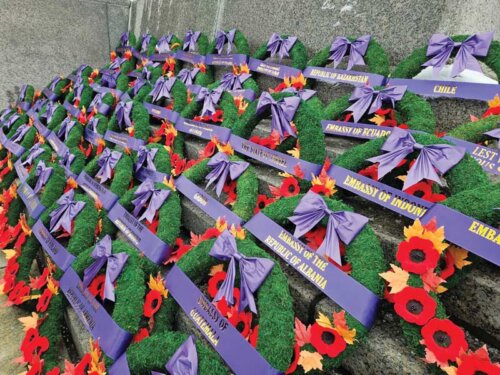
At McLeod’s burial in 2014, his wife Sheila placed the poppy in a box beside his urn. Cami then had the idea to send flowers to Canadian cadets, so they could have a piece of Flanders, too. For the centenary of the First World War, a group of young cadets proudly wore their bona fide Flanders poppies on Remembrance Day. Since then, Cami has sent hundreds of dried poppies to Canada.
In a tale as old as time, Cami knew little about the war other than what he learned in school. His father, head of criminal investigators for the District of Eeklo with the Gendarmerie, Belgium’s former national police force, wore his uniform only on Remembrance Day. In October 1983, when Cami was 23, he and his family were tasked with removing items from the hospital room where Cami senior spent his final days.
They came across a condolence card from the Committee of Patriotic Associations, an organization in Eeklo that honours veterans. The association had trouble finding a place to host their meetings, so Cami’s father arranged to have them gather at the Gendarmerie brigade headquarters. Cami started hearing from people who revered his father—many Belgian veterans and former political prisoners, mainly members of the resistance who survived Nazi concentration camps. Cami obsessed over learning as much as he could about the veterans and both world wars.
“My father had the greatest respect for those who liberated us,” he said. “In our case, that was the Canadians.”
The first remembrance project Cami undertook with a Canadian veteran was to upgrade the Sherman tank monument at the Balgerhoeke Sasbrug memorial honouring 4th Canadian Armoured Division in Eeklo, with the help of McLeod.
Next, he worked on upgrading a monument in Eeklo’s Canada Square called “The Soldier and the Girl,” commemorating the residents who were killed or went missing in the First and Second world wars. Beside the memorial are the names of 30 Canadian soldiers etched onto three marble plaques—men who died of wounds in Eeklo’s military hospital during Operation Switchback in October-November 1944.
In 2017, the original mould of the statue was inaugurated at city hall in Medicine Hat, Alta. Both monuments, one on each side of the ocean, represent the everlasting bond between Canada and Belgium.
In addition to mending memorials, Cami also organized tours of Belgian battlefields. Most recently, he has become the unofficial ambassador for people searching for their loved ones lost on Belgian soil.
He repeats the first and last names of the fallen to me over the phone. “I always like to mention their names so we remember them at that moment,” he said.
Cami tells me that several years ago, he was contacted by an Ontario woman who wanted to visit her uncle’s burial site while on a trip to Europe. Cami offered to take her to the battlefield where he was killed and the Belgian cemetery where he’s buried.
Private Kenneth Donald Duncanson of The Algonquin Regiment died during the Battle of the Scheldt. His remains were discovered by a metal detectorist in a field near Molentje, Belgium, on Nov. 11, 2014, and he was buried with full military honours in the Adegem Canadian War Cemetery between Bruges and Ghent. Cami got permission for Duncanson’s niece to visit the field where his remains were found, and they held a moment of silence together.
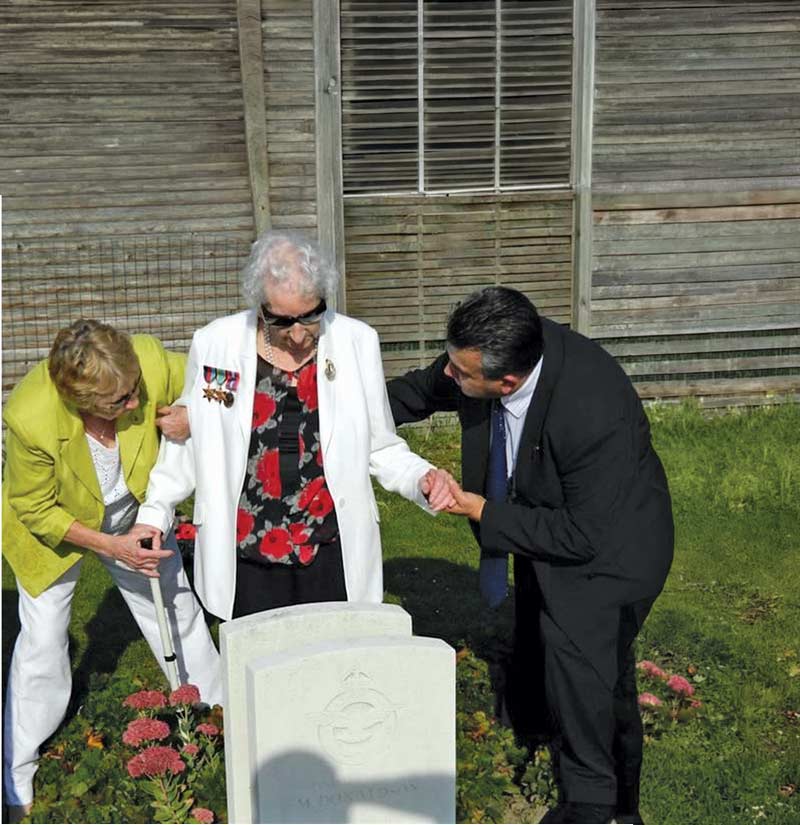
Enid Scillitoe finally visits the grave of her brother. [Courtesy retired air commodore Terry Davies, U.K]
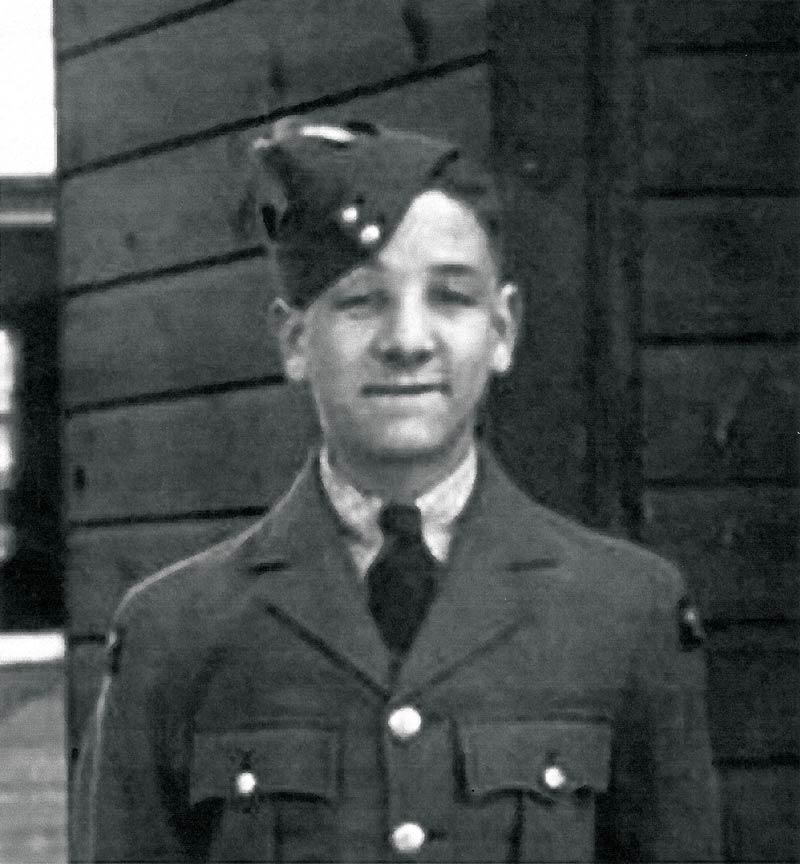
Sergeant Leslie Herbert Stride, lost in 1940. [Courtesy Walter Cami]
“I stay in the shadows, but I will take you to wherever you want to be and whatever you want to see,” he said about helping Canadians find their lost loved ones. “I will be with you from the first to last minute and my condition is that the only thing I will accept is a cup of coffee.”
Enid Scillitoe from Gloucester, U.K., last saw her big brother Sergeant Leslie Herbert Stride in the spring of 1940. They were only a year apart in age. Just a few months later, Stride’s Royal Air Force bomber, whose mission was to bomb an oil depot near Ghent, was shot down by the Germans. The plane crash landed in Lovendegem, Belgium—a 15-minute drive from Eeklo. Stride was just a couple of weeks shy of turning 20.
The young man was buried in Eeklo’s Communal Cemetery. Nearly 75 years later, in the fall of 2014, 92-year-old Scillitoe travelled from the U.K. to visit her brother’s grave for the first time.
Cami, with the help of Eeklo’s mayor at the time, was able to organize an intimate gravesite ceremony for Scillitoe and her British friends. But when she arrived and read the headstone, Scillitoe noticed something. The names listed included her father, mother, sisters and another brother. Hers was missing.
A few days after Scillitoe’s departure, Cami asked another friend, Terry Davis, a retired air commodore with the Royal Air Force, if he could lobby to place a new headstone for Stride.
“How he managed to do that will always remain a mystery to me, but sometime later Terry got the green light and I organized the ceremony,” said Cami.
On a warm afternoon in July 2015, four airplanes flew high above those who gathered to honour and witness the placing of a new headstone for Stride. One aircraft broke away from the rest, soaring straight up into the sky in what’s known as the missing man formation. Scillitoe passed away a few days after receiving the news that her name had been etched onto the headstone where her big brother was laid to rest.
One of the few details Swatty Wotherspoon of Toronto knew about his grandfather was that he was killed on the market square of Ypres during the First World War. Cami asked for his name and started doing research.
On April 20, 1915, a German shell from a giant 42-centimetre siege howitzer fell out of the sky in Ypres, shattering the Hotel de la Châtellenie and the surrounding medieval market, Cloth Hall, in a cloud of smoke. The blast killed 17 men, an unknown number of civilians and one officer standing 180 metres away in a grocery store.
Captain Trumbull Warren of the 48th Highlanders of Canada was purchasing supplies for his troop when a piece of shrapnel flew through a plate-glass window, piercing him in the lung. The 28-year-old from Toronto died in a friend’s arms.
The city erupted into black and yellow smoke every 20 minutes for the rest of the day. Artillery rained down in advance of a diversionary attack that took place two days later, when the Germans introduced a new weapon: chlorine gas. The Second Battle of Ypres began just five months after the first.
Wotherspoon’s grandfather was buried in what became Ypres Reservoir Cemetery in Belgium. Wotherspoon and his wife, Kitty, who have travelled to Europe many times, first met Cami in Eeklo in the early 1990s.
“For the last 10 years, on the anniversary of [my grand-father’s] death, Walter has driven three hours to the cemetery to put flowers on his grave,” said Wotherspoon. “That man is absolutely incredible—he goes above and beyond.”
Wotherspoon’s family story doesn’t end there.
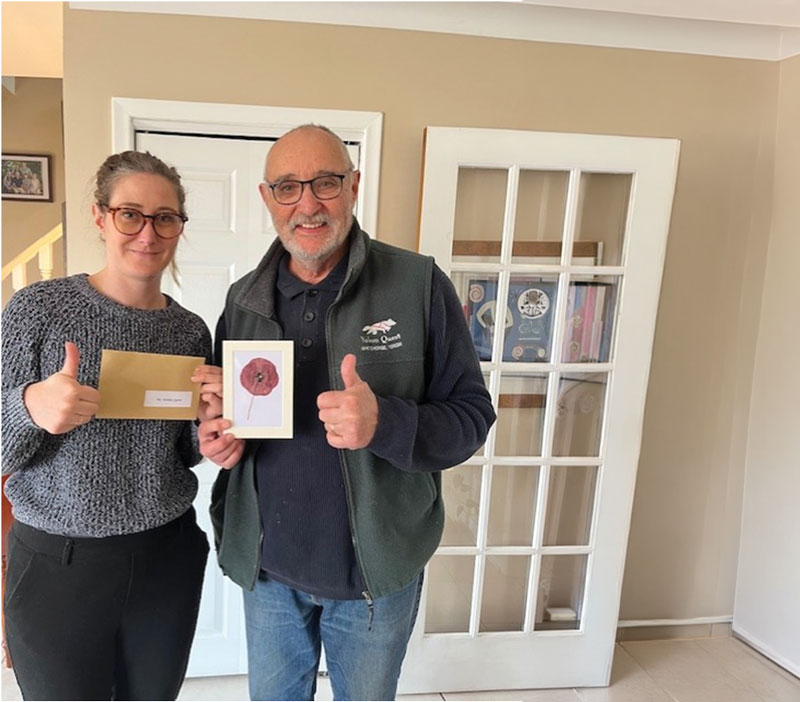
The writer and her father, John, with a poppy from Cami. [Susan Lyons]
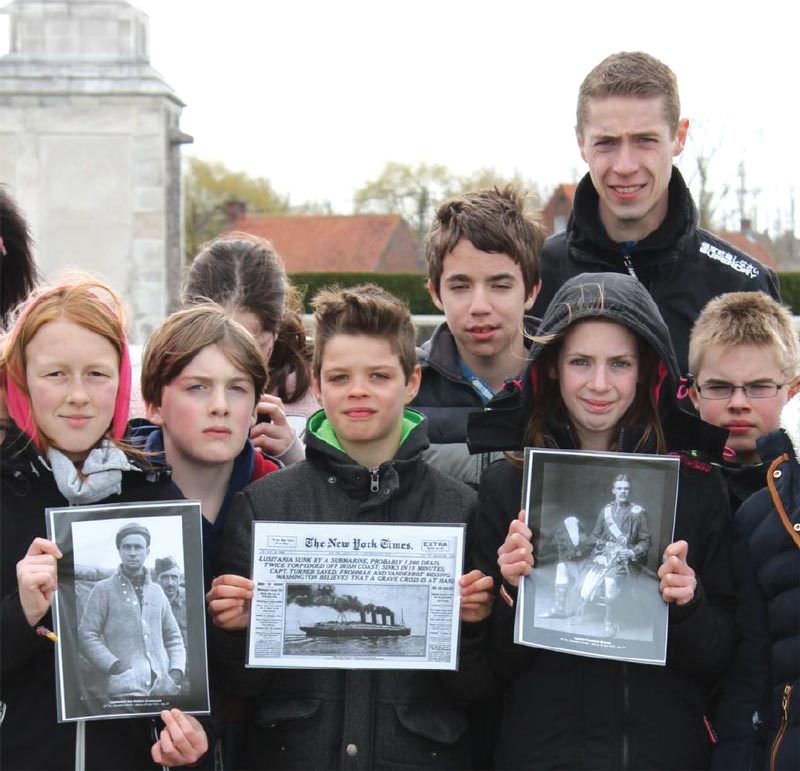
Students from Eeklo, Belgium, hold photos of Warren and Drummond, along with a news clipping about the sinking of the RMS Lusitania. [Courtesy Walter Cami]
Two nights after Captain Warren’s funeral, his brother-in-law, Guy Drummond, a member of Montreal’s 13th Battalion (Royal Highlanders of Canada), known as The Black Watch, was killed by a sniper on the Belgian front lines. Their wives, sisters living in London, had no other family nearby. The grieving widows’ father booked passage for their youngest sister from Canada to London to visit, but she never made it. She was aboard RMS Lusitania when it was torpedoed by a German U-boat.
When Cami caught wind that these stories were being recognized by the Last Post Association, he immediately felt compelled to contact it.
“He is one of those people who have really spent their lifetime making sure that the veterans are not forgotten, that their stories continue to be told and honoured.”
On Aug. 18, 2024, Cami was one of more than 800 people who attended the evocation (the storytelling of one or more soldiers accompanied by music and lyrics) at the Tyne Cot Cemetery near Zonnebeke, Belgium. The event was sold out.
The performance opened with, “Today we tell you the story of a pair of brothers-in-law.” Actresses played the parts of the wives of Warren and Drummond and retold their husbands’ stories. They included the tragic death of their younger sister, Dorothy Braithwaite, aboard the Lusitania.
“It’s all Walter’s doing,” said Wotherspoon. “If he hadn’t met this man who was the head of the Last Post Association and discovered they were going to use Guy Drummond and my grandfather as an example of the Canadian contingent in the First World War, they never would have known the full story.”
Cami continues to share their family’s story when he takes young people from Eeklo to that cemetery. He asks them to search for Drummond’s grave—one of nearly 12,000 burials in Tyne Cot.
“He is one of those people who have really spent their lifetime making sure that the veterans are not forgotten, that their stories continue to be told and honoured,” added Kitty. “The ceremonies have grown in numbers thanks to people like Walter who keep those things alive.”
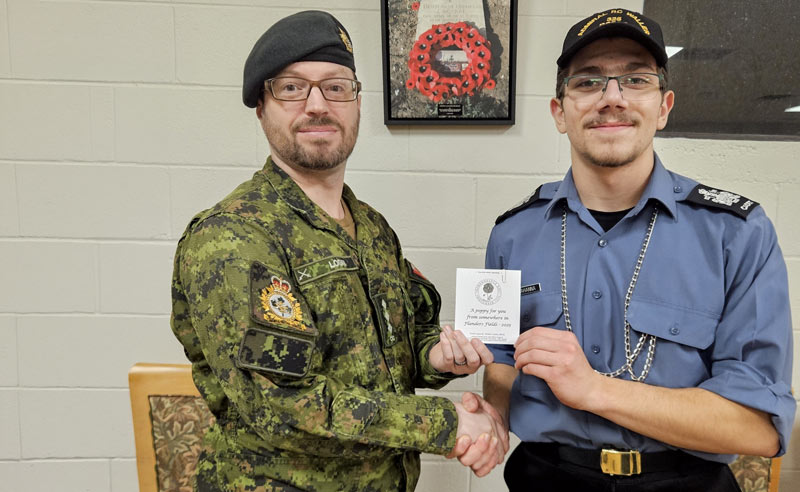
Captain Ken Logan poses with sea cadet Philip Almhanna of Sooke, B.C., and a Flanders poppy from Cami on Remembrance Day in 2025. [Courtesy 325 RCSCC Admiral RC Waller]
“Looking back over the past four decades,” said Cami, “I can only say: more than once it has happened that new friendships saw the light of day for the first time in front of a soldier’s grave.”
In July 2023, Cami attended a ceremony at the Canadian Embassy in Brussels—this time, to honour him. He was awarded the Governor General’s Meritorious Service Medal. Cami graciously accepted the recognition, but not for a moment has he thought about accolades or awards.
Cami intended to frame a dried poppy for the woman on whose property he had trespassed. When he returned, the farmhouse was empty. Like so many others who experienced the Second World War first-hand, she was gone.
Last year’s recipients of Cami’s poppies were a group of young sea cadets in Sooke, B.C., not yet 12 years old. As time passes, memories become lore. The poppies are just a small gesture of Cami’s commemoration to the fallen in the hopes that the next generation, and the one after that, will understand the true meaning of sacrifice.
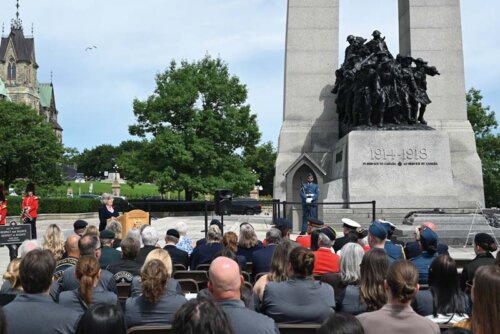
In May 2015, a senior cadet stood in a sea of hundreds awaiting the unveiling of John McCrae’s statue in Ottawa. Soon after, Cami received a copy of a letter written by the cadet to Major R.A. Derkson, commanding officer of 2308 army cadet corps in Port Alberni, B.C.
“I remember you gave each of us a dry poppy in a special folder that had been hand-picked for us in Flanders’ Fields by Mr. Cami. This had a particular meaning for me, as my great-grandfather, Private Appleyard, had been killed in World War One and is buried in a war grave cemetery in France.
“To me,” the cadet’s letter continued, “the poppy symbolized the sacrifice of my great-grandfather, and it helped steer me to fly to Ottawa to attend the unveiling of the John McCrae statue. Also, I think all the cadets got a better understanding of the meaning of Remembrance Day and what those soldiers went through.”
“These words,” said Cami, “that is exactly what it’s all about.”
Advertisement