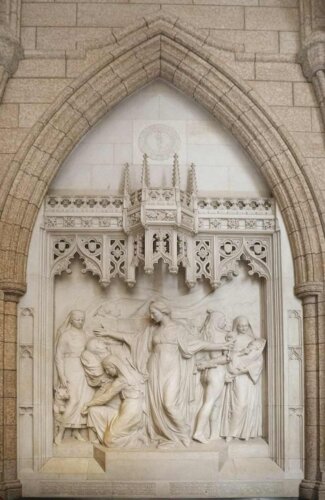





The crowd of 800 nursing sisters from across the country stood in silence in the Hall of Honour of Parliament Hill’s Centre Block on Aug. 24, 1926, as a marble memorial was revealed.
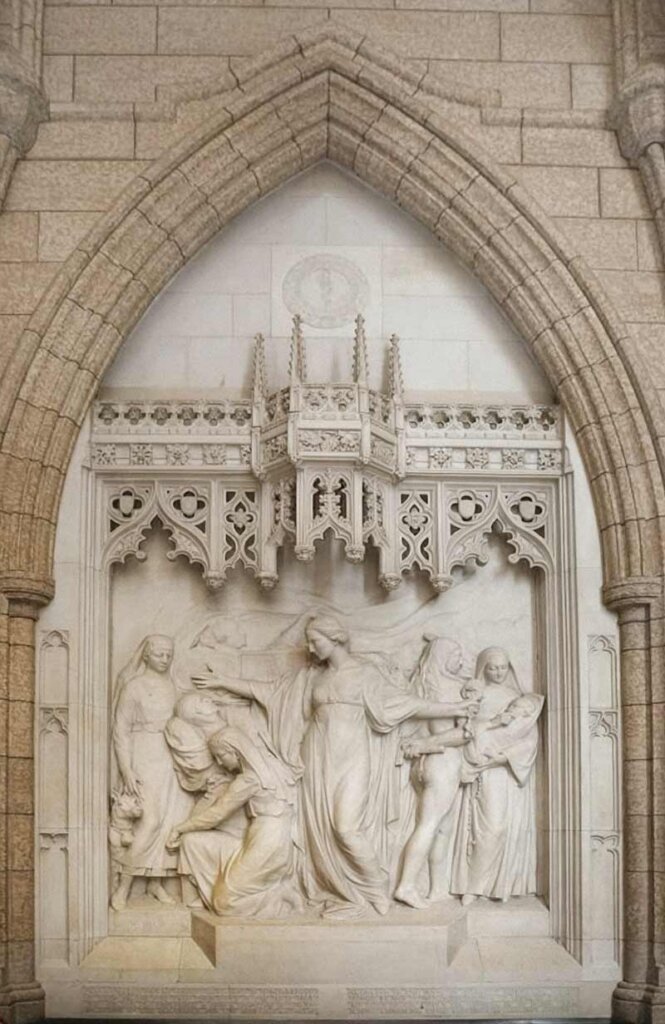
The 1926 unveiling of the Nurses’ Memorial. [Canadian Nurses Association/LAC/e003525007]
Speaking at the panel’s unveiling was Margaret MacDonald, matron-in-chief during the Great War and the first woman in the British Empire to attain the rank of major. That day was one of commemoration—honouring the 2,845 nurses of the Canadian Army Medical Corps, some 60 of whom had died in that conflict.
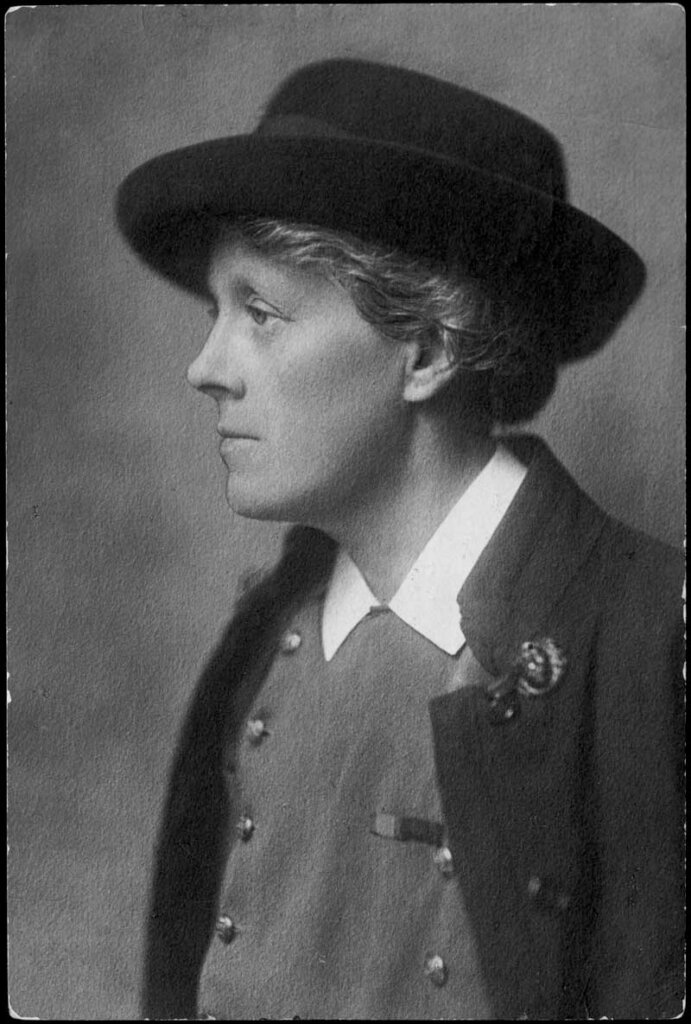
Margaret MacDonald, matron-in-chief during the Great War. [House of Commons (AI enhanced)]
The roughly five-by-three-metre sculpture—the funds for which had been raised over five years by the caregivers themselves to the tune of $32,000—originated from a single six-tonne piece of Carrara marble. Sculptor George William Hill had sourced the material himself.
The result recognized not only those who had served in the war, but spanned the entirety of Canadian nursing history, beginning in 17th-century New France. On the right side, relying on colonial iconography with racist connotations, Hill depicted a nun caring for an Indigenous baby as a Haudenosaunee warrior watches on.
On the left, meanwhile, two nurses tending to a wounded soldier represent sacrifice on the Western Front and beyond.
Bridging the eras is a female manifestation of humanity, her arms outstretched as she clasps a caduceus, the traditional emblem of medicine. Looming behind is a male embodiment of history, a personification that clings to the Book of Records from 1639 to 1918.
The memorial recognized not only those who had served in the Great War but spanned the entirety of Canadian nursing history.
“The War Memorial,” wrote feminist historian Kathryn McPherson, “reveals the contradictions faced by a female-dominated occupation trying to locate itself within a patriarchal health care system and body politic.”
Despite its complexities, the tribute continues to commemorate, in its own way, Canada’s Great War nurses a century later.
Advertisement