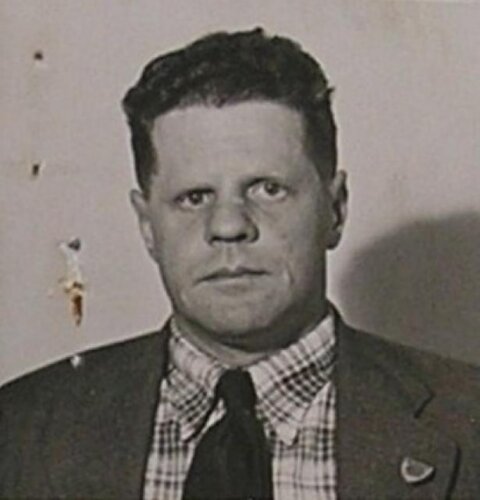


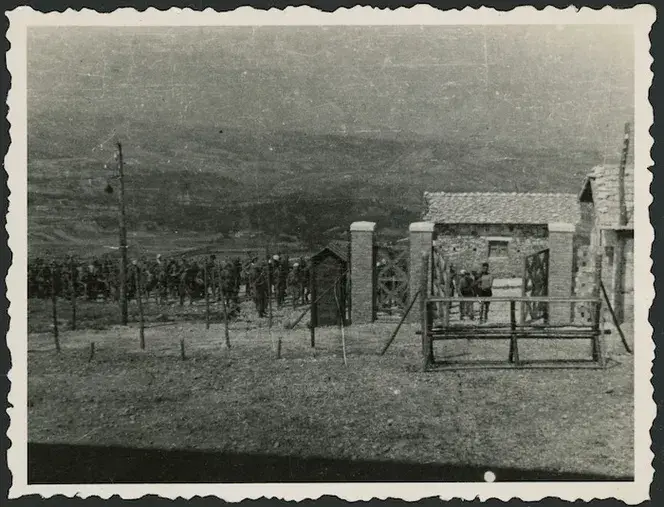
The main gate at Italian PoW Camp 78, from which Canadian captives Raymond Sherk and Don McLarty escaped in September 1943. [H.R. Dixon/Archives New Zealand/PAColl-1615-05]
When Canadian captives Raymond Sherk and Don McLarty saw an opportunity to escape Camp 78, a prisoner-of-war facility in the central Italian region of Abruzzo, they wasted little time. Despite the country having signed an armistice with the Allies in September 1943, the guards would soon be replaced by German troops already en route. The window to act was, in other words, closing—and fast.
“All men who escaped from there and camps like it had a similar experience,” said author Karen Farrington. “That was to go up the nearest mountain. It was the only way you could go.”
Sherk and McLarty did exactly that. For three weeks, the airmen sheltered in a cave roughly 13 kilometres from their former camp, hiding at high elevation as “their personal conditions went downhill.” Only in late October or early November 1943, largely thanks to the help of locals, did the dishevelled duo reach Allied lines.
Farrington admits that the specific exploits of Sherk and McLarty didn’t make it into her new book. Nevertheless, their experiences reflect the broader story she tells in The Great Italian Breakout—that of the estimated 50,000 Allied PoWs who took their chances beyond the barbed wire after the armistice. Many, like Sherk and McLarty, relied on the kindness of strangers—their once-enemies—during their bid for freedom. The less fortunate, meanwhile, instead confronted German patrols and an uncertain fate upon their recapture.
Here, in a Legion Magazine exclusive, Farrington offers insights into those “forgotten episodes,” highlighting various tales—Canadian or otherwise.

Author Karen Farrington. [courtesy Karen Farrington]
On the book’s origins
I visited Italy on several occasions and came across a plaque devoted to the Monte San Martino Trust. This is an organization that has collected accounts from prisoners who escaped in Italy from September 1943 and thereafter.
As you can do these days, I Googled them to learn more, and they related that after the armistice in Italy, there were some 50,000 escapees. I initially doubted that because I would surely know about that if it happened. But it did happen.
That’s what set me on the journey to write a book.

[Icon Books]
On the escape opportunity of September 1943
The story really begins on Sept. 8, 1943, when the Italian armistice was announced. It was an agreement for Italy to no longer treat the Allies as their enemies, but it didn’t really address what was going to happen with Germany, so the new Italian government was trying to delay the announcement.
In the end, it was the Americans who made the announcement—and Hitler was one of the few people not in the know that the armistice was about to happen. His response was not to withdraw to the other side of the Alps, as the Allies had hoped, but to flood troops into Italy.
It was in that short period—for some people, hours; for others, days—where there was chaos and confusion at PoW camps before the Germans arrived. When the Germans did arrive in great numbers to take over these camps, men who hadn’t escaped were simply transported to Stalags in Germany.
Those who did escape, on the other hand, had options.
On the options for escapees
One option was for them to go south to try and meet the advancing Allies, and many men tried this. The big inhibitor was the speed at which the Germans came south and the slowness with which the Allies went north due to ferocious enemy opposition.
If your camp was in the north and you were lucky to escape—noting that it was one of the first places that the Germans got to—you might look at the Alps and think you’d go to neutral Switzerland. Of course, going across the Alps would have been hugely treacherous. The armistice happened in September, and really, from November onward, the weather started closing in.
I don’t think it’s an exaggeration to suggest that the remains of men who tried and failed to make it across the Alps because the weather turned on them are still out there.
There were other, more organized attempts by the Allies to round up escapees and bring them back behind Allied lines. There were also organized escape lines in Rome and Milan to get people from safe house to safe house, and then to whichever route was chosen.
Some people got out by fishing boat. There was talk of rescue by submarines, but it’s never quite clear whether that happened. Some people went into France, or at least tried to, when the situation began to change there after D-Day.

Wing Commander Eric (Garry) Garrad-Coles of the Royal Air Force escaped an Italian PoW camp, then helped others escape for the remainder of the war. [courtesy Karen Farrington]
On successful escapes
Luck played a huge part. But how did people make their own luck? One of the biggest keys was if you spoke Italian, because you could engage locals—and the most important factor to a successful escape was the local population.
Most men found the level of help they got quite unexpected. The reality was that Italy was politically divided. Although it had had a fascist regime for 20 years, there had always been a big and healthy communist organization—especially in the north—that was very willing to help the Allies.
People at all levels of society—from the richest to the poorest—helped. The most famous were poor farmers, who had very little, but what they had they shared.
On the stakes for both escapees and Italian helpers
Obviously, as in any conflict of that nature, there were a lot of collaborators, and you couldn’t tell by looking at someone if they were a collaborator or friend.
Also, in general terms, soldiers were treated as prisoners-of-war. But if you were a soldier, airman or navy person on the run in Italy, you ditched your uniform. Most people who were recaptured were treated as prisoners-of-war, although there were some very grave and unfortunate exceptions.
The same couldn’t be said for the Italians. The Germans were very bitter toward them for changing sides, and there are numerous examples of Italians found to be sheltering PoWs who were dragged out of their houses, shot immediately and their houses burned down. Sometimes, whole villages were destroyed and residents killed for the help they gave to escaping PoWs.
The thing that outrages me now is the idea that people would ever call the Italians cowards. They certainly weren’t when they were occupied by the Germans. There was nothing cowardly about the way they came forward to help people.
On Canadian Captain Henry Judson Byrnes
Byrnes, who escaped Camp 122 near Rome, was one of the first Allied evaders to get to the Vatican [officially neutral in WW II]. It should be said that the pope of the era has been castigated for his wartime role, but he also had thousands of ex-prisoners who sought sanctuary with the church.
Byrnes was one of them. He was taken in by the Vatican and, as far as I’m aware, he ended his war there. He kept a record of the prisoners they encountered, which really helped in tracking where people were going to deliver money and aid, as well as in establishing safe routes out.
On her hopes for readers
I hope readers see that even at the heart of horrendous hostilities and atrocity, there is very often extraordinary bravery and kindness to be found.
When I call these men heroes, I also hope that readers will see that there’s a good reason for calling them that. I’m not just using it as a blanket term for anyone who was called up to the war. I think that they played a great hand with the deck they were dealt.
This interview has been edited for brevity and clarity.
Advertisement