





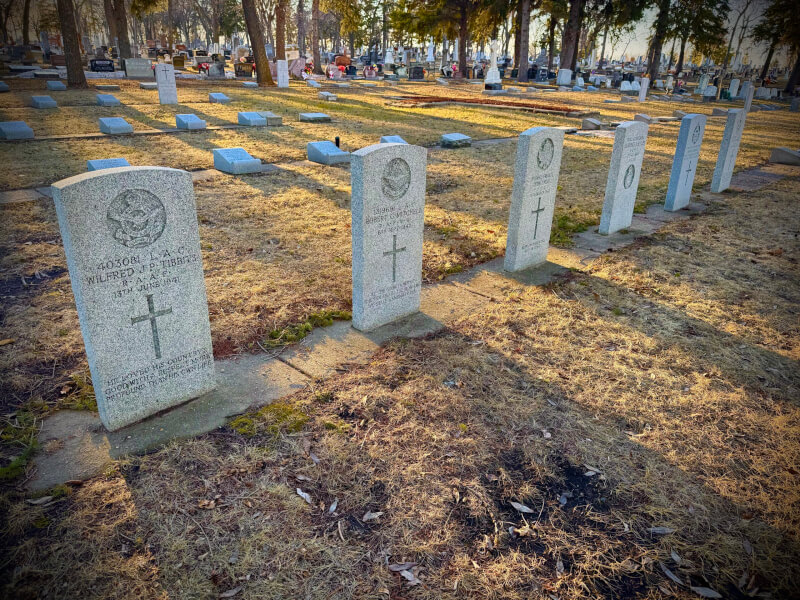
Commonwealth war graves at Yorkton Cemetery in Saskatchewan. The grave on the far left is that of Leading Aircraftman Wilfred Tibbits of the Royal Australian Air Force. [Courtesy Brittany Johnson]
For the past year, Johnson has been carefully tending the memories of 25 veterans buried in Commonwealth war graves in and around her home of Yorkton, Sask.
She regularly visits each grave across 10 cemeteries—some on remote stretches of prairie along the Manitoba-Saskatchewan border—to inspect, catalogue and clean the headstones of men, and one woman, who served their countries in the First and Second world wars.
As a volunteer caretaker with the Commonwealth War Graves Commission (CWGC), Johnson does this out of the goodness of her heart and a desire to give back.
“It’s peaceful work,” she told Legion Magazine. “Especially when you’re out in some of these country cemeteries alone. It gives you a lot of time to reflect and be thankful for everything that we have.”
Johnson is on the vanguard of the CWGC’s national volunteer program, launched in 2025 to recruit and train stewards of nearly 15,000 war graves across the country. This year, Johnson and more than 500 other volunteers will inspect and care for CWGC graves from Yukon to Newfoundland and Labrador.
Created in 1917, the CWGC works on behalf of six countries—the U.K., Canada, Australia, New Zealand, India and South Africa—to commemorate 1.7 million men and women from the Commonwealth who died in the two world wars.
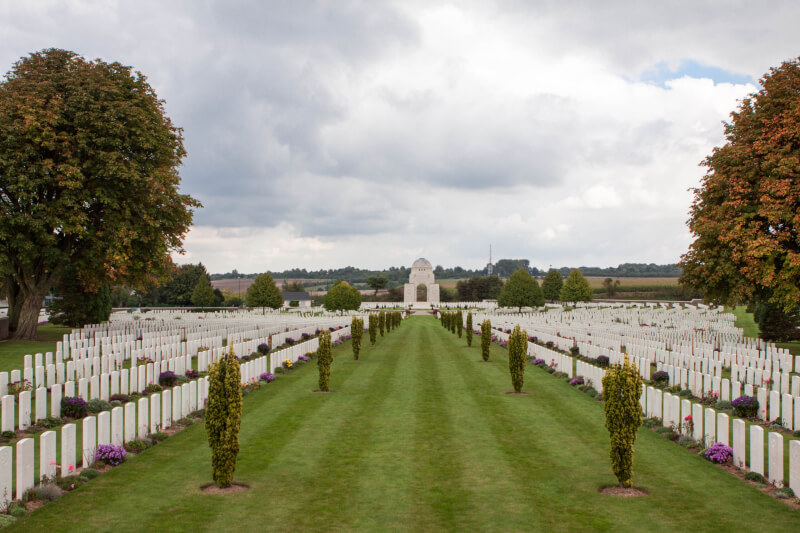
Cabaret-Rouge British Cemetery in Souchez, France, is an impressive example of grand Commonwealth cemeteries in Europe. [Wikimedia]
One of the hallmarks of the CWGC is its egalitarianism: it honours the dead equally, regardless of rank. Headstones are uniform, whether the veteran was a private or a general.
Lesser known are the thousands of graves the commission maintains in Canada, an obligation it shares with Veterans Affairs Canada. While VAC is responsible for the majority of veteran graves in Canada, the CWGC manages those of any Canadian or Commonwealth service members of the two world wars who died between 1914-1921 and between 1939-1947.
More than 18,500 Commonwealth veterans died in Canada during those two periods. Most have headstones located in municipal or civilian cemeteries in every province and territory except the Northwest Territories and Nunavut. Those without actual graves are remembered on CWGC memorials.
Many of those buried here from the First World War were veterans who returned to Canada and died soon after, either from their wounds or the 1918 influenza pandemic that ravaged the country.
“It’s peaceful work,” said Johnson. “Especially when you’re out in some of these country cemeteries alone. It gives you a lot of time to reflect and be thankful for everything that we have.”
Those commemorated from the Second World War were commonly sailors killed on convoy duty in the Atlantic or airmen who died training with the British Commonwealth Air Training Plan, which schooled tens of thousands of pilots and other aircrew in the 1940s.
CWGC graves in Canada aren’t always those of Canadians. For example, one of the headstones Johnson looks after—in rural Togo & District Cemetery—belongs to Private Robert McKay Simpson of the Scottish Gordon Highlanders. He died in Saskatchewan in 1920, aged 25.
Another grave, in Yorkton’s municipal cemetery, holds the remains of Leading Aircraftman Wilfred John Peter Tibbits of the Royal Australian Air Force. He died in 1941 at 21, while training at the Yorkton, Sask., airfield, a key centre in the British Commonwealth Air Training Plan.
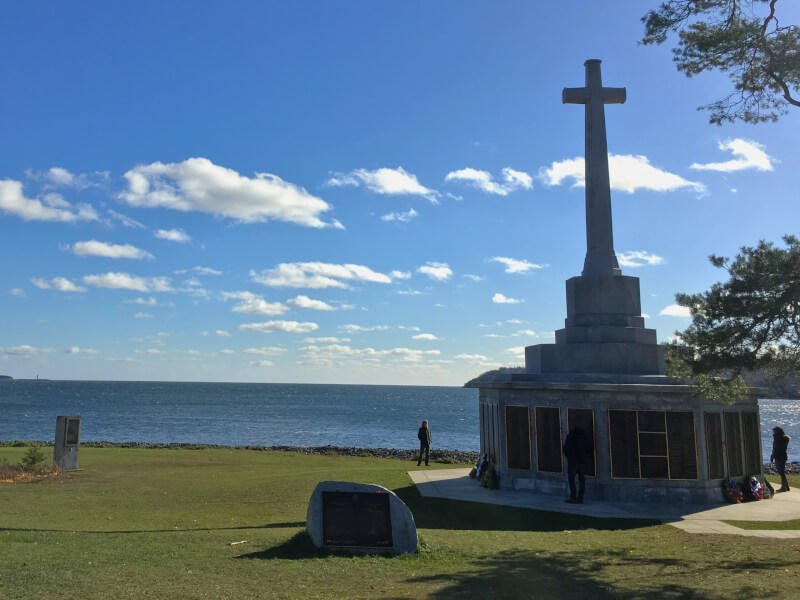
The Halifax Memorial was erected by the Commonwealth War Graves Commission to commemorate Canadian and Newfoundland sailors who died in both world wars and have no known grave. [Commonwealth War Graves Commission]
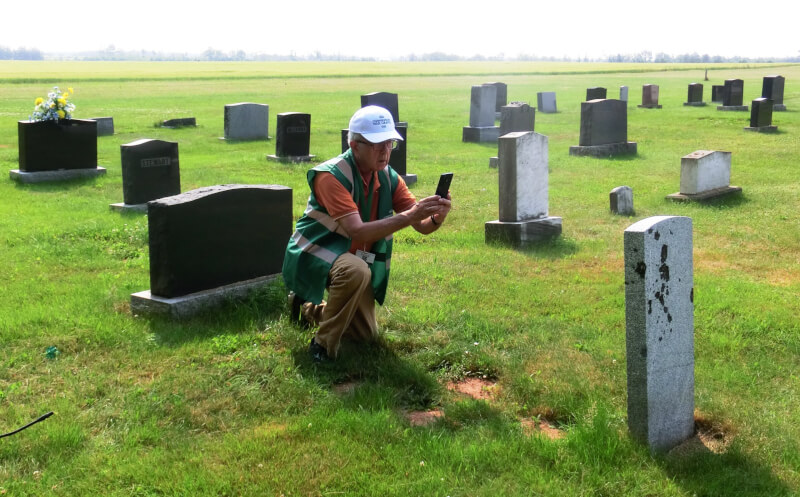
A volunteer snaps a photo of a war grave for the commission to assure its maintenance. [Commonwealth War Grave Commission]
“Ninety per cent of the markers in the U.K. are now inspected and maintained by volunteers,” said David Loveridge, the commission’s area director for Canada, Americas and Pacific region, in an April 2026 presentation to The Royal Canadian Legion’s Dominion Executive Committee.
Loveridge is seeking the Legion’s endorsement of the volunteer program in Canada—both as a means of spreading word of the program among local Legion members, and to back the CWGC’s bid for VAC to become a partner in the initiative.
“We’d like to see volunteers looking after all the veteran gravestones across Canada,” he said.
Currently, VAC hires contractors to maintain most of its roughly 220,000 veteran graves across the country. Loveridge said he intends to approach the department this spring about a common effort to establish volunteer caretaking of all veteran’s graves, regardless of which agency they fall under.
“If we can get Veterans Affairs Canada to come with us in a national volunteer program, that will be 240,000 graves managed by volunteers across Canada,” said Loveridge. “It’s a big step.”
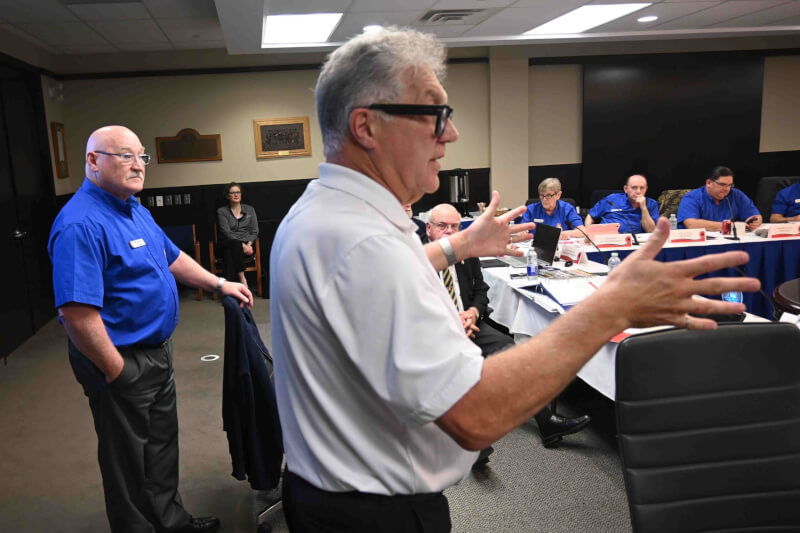
David Loveridge presents to the Legion’s Dominion Executive Committee in April 2026. [Richard Foot]
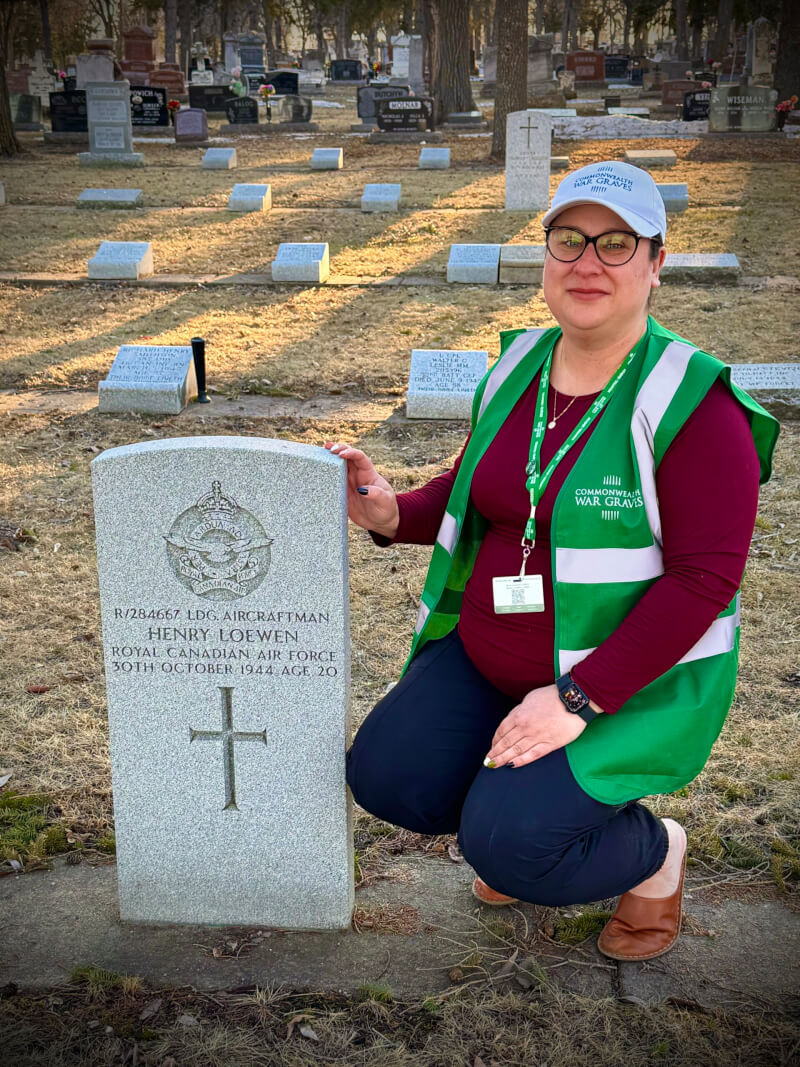
Brittany Johnson is pictured beside the grave of Leading Aircraftman Henry Loewen of the Royal Canadian Air Force. [Courtesy Brittany Johnson]
“I love history, I love the Legion and I love our veterans,” she said.
Johnson first encountered the CWGC’s cemeteries during a private trip to France in 2019, seeing Vimy Ridge, Dieppe and Juno Beach with her husband. She was so moved by the beauty of the cemeteries there that she returned home determined to plant a memorial garden within the veteran’s section of the Yorkton cemetery.
“I wanted to plant flowers in the same kind of fashion that they do overseas.”
Those plans have not yet germinated, but Johnson did find her way into the CWGC’s fledgling volunteer program, where she was trained to inspect and clean headstones assigned to her care.
“I love history, I love the Legion and I love our veterans,” she said.
At least twice a year, in spring and fall, Johnson drives out to each of the cemeteries on her list, sending photos of all 25 graves to the CWGC from an app on her phone.
If she thinks the headstones need repair—if the inscription has become illegible or the foundation is sinking, for example—an agency contractor is dispatched to the site. More typically, Johnson works alone, dry brushing the markers to remove moss and lichen (soap and chemicals are not used because they damage the granite) and tidying up any weeds or overgrowth around the stones.
“It’s a good way to give back, and to know you’re making a difference by caring for someone who, possibly—like some of these airmen from the U.K. or elsewhere—may never have been visited by their family because they’re buried in Canada. Just like a lot of our soldiers are buried overseas and may never have been visited by their families,” she said.
“It’s comforting to me to know that our soldiers overseas are cared for. I’m sure it goes the other way as well.”
Advertisement





So wonderful to read about these volunteers! Thanks you for honouring the memory of those who served in the world,wars