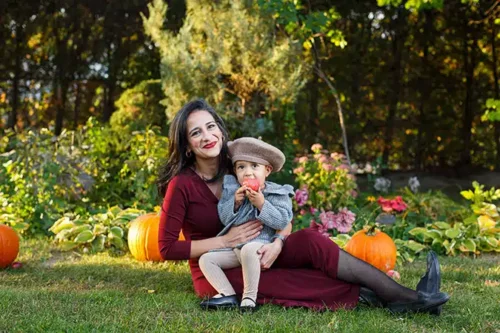


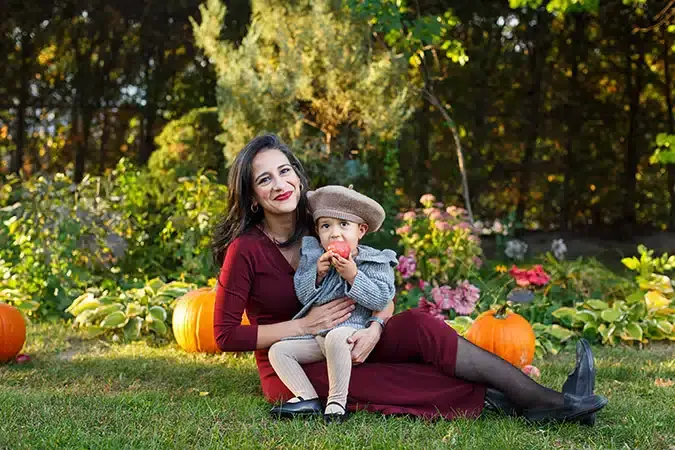
Canadian diplomat Bushra Saeed-Khan poses for a photo with her daughter a decade after surviving an improvised explosive device attack in Afghanistan. [Courtesy The Ottawa Hospital Foundation]
Canadian diplomat Bushra Saeed-Khan remembered the trees and the path that cut between them. The trail was initially “very simple” as she strode through the woods, acutely aware of every step. But slowly, gradually, “they would make it a little bit bumpier, minor inclines and declines.”
Despite the hurdles, to say nothing of the safety straps that held her in place, she recalled it being a “peaceful” scene.
Then she was in a city, a sprawling urban jungle surrounded by pedestrians on a crowded sidewalk. “You see other people walking around and past you,” Saeed-Khan said, “and that kind of throws off your balance when you’re not comfortable with your gait.”
It all served a greater purpose in the digital world she inhabited—practice, she affirmed, for when virtual reality became virtual no more.
On Dec. 30, 2009, then-25-year-old Saeed-Khan had been on assignment in Afghanistan when an improvised explosive device (IED) detonated under her light armoured vehicle (LAV). The blast killed five and left her with life-changing wounds that eventually required some 50 surgeries. Beyond the operating theatre, Saeed-Khan also faced the prospect of learning to walk again.
In time, that process brought her to The Ottawa Hospital’s computer-assisted rehabilitation environment (CAREN), a virtual-reality system installed in 2010 in partnership with the Canadian Armed Forces. One of only two such tools in the country, the CAREN lab combines a large projection screen with a moving platform and treadmill to simulate different scenarios in a safe, controlled setting.

For Saeed-Khan—who has a prosthetic right leg—the CAREN system proved critical in reclaiming her physical mobility, as well as her independence and confidence in navigating life outside clinical confines. “It’s such a multi-dimensional type of medical care,” she remarked.
Saeed-Khan shared her experiences with Legion Magazine.
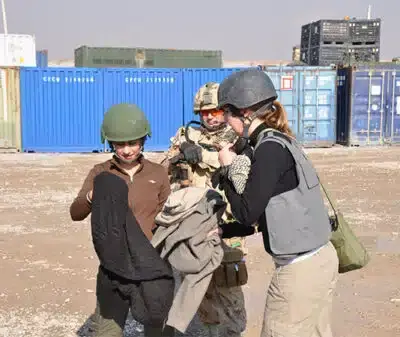
Saeed-Khan (left) in Kandahar, Afghanistan, in 2009. [Courtesy The Ottawa Hospital Foundation]
On her experience in Afghanistan
When the opportunity came up to go to Afghanistan for a one-year assignment, I really felt it was important from both a professional and personal standpoint, since my family is from the region and we had visited the border areas when I was a teenager.
I had been in Kandahar for a few months at the time. I had started in the fall, and I was working at Kandahar airfield, a large military base. I had an office and a bed there, as well as an office and bed at the Kandahar Provincial Reconstruction Team (KPRT) site.
I much preferred the KPRT because it had just a couple hundred people, mostly Canadians, and it was a nicer, smaller effort where we were able to engage with the local Afghans more deeply. I was embedded with the military there working on governance issues, counternarcotics and tribal issues.
On the day she was wounded
We were out to meet with locals to see why they had been displaced and try to get a better sense of what their needs were. We had made two stops, and at the second, we had to take the route we had taken in the past. It was about 4 p.m. when the IED was detonated remotely while we were in one of two LAVs. There were 10 of us in ours—five passed away immediately, and five of us survived.
The LAV was blown about 20 or 40 feet up into the air, then flipped over. But luckily, the back door had been smashed open in the blast. I was able to start getting out. The fellas from the other LAV pulled me out and did all the necessary medical interventions—putting on a tourniquet and getting all the injured people into a safe location before the helicopter came.

Saeed-Khan in hospital in Germany. [Courtesy The Ottawa Hospital Foundation]
On her evacuation and early medical care
I went first to Kandahar Airfield, then to Bagram [airfield in Afghanistan’s Parwan Province], then off to Germany, and eventually back home to Canada. I was in a medically induced coma for a lot of it. Luckily, however, I had been fully aware of most of my injuries when it first happened, meaning it wasn’t too much of a shock when I woke up from my coma. I was just happy to see my family at that point.
I knew that I had lost my leg—or at least I thought I had lost my leg. If I had only had the amputation, I would have only been in hospital for a couple of months, but it was all the other things that took years to recover. My hearing was one thing. I was on a feeding tube for a couple of months, so I had to learn how to eat again. I had a lot of injuries to my abdomen, too, then my left leg was the cause of most of my hospital time because they had to do significant grafting to save it. I had about 50 per cent of it blown off, so they had to move things around to cover the bone and the muscles and rebuild the arteries and veins and things like that.
So, injuries were kind of everywhere.
For the first couple of months, memories faded in and out. But as odd as it sounds, they weren’t all bad. Obviously, going through my injuries—both physical and mental—was devastating. But the rehabilitation centre itself almost became a home away from home where I felt safe and protected. There were some members of the Canadian Forces there as well, so we were able to share stories and support each other, figuring out what happened and what the future held.
It was a slow process to get back into a routine where I could really start doing more physical activities. I was still finishing surgery, so there was very much a two-steps-forward-and-one-step-back type of thing.
On considering virtual reality for her rehabilitation
Virtual reality was completely new to me, and it was so funny because the timing was just impeccable. We had been hearing about this big initiative that was going to change physiotherapy, and they were making it in this room at the back of the rehab centre.
The medical team asked me if I was interested, but I was too deep in my rehab, surgeries and care to really pay attention for the first few months until I almost felt like I started to stagnate a little bit in my recovery. I wanted to go home and back to work, but there was still this fear of being back in the community because I was so comfortable at the rehab centre. It was accessible. It was safe. And the rest of the world outside just wasn’t. I needed something to help me transition back into the real world—and that was the CAREN system.
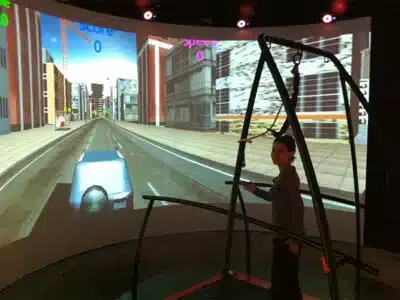
Saeed-Khan using the CAREN system. [Courtesy The Ottawa Hospital Foundation]
On the CAREN system
I remember walking into this big black room with a huge screen and this massive device. It’s a big hole in the ground with a treadmill platform. This was many years ago, when virtual reality and AI weren’t so much of a thing. And you saw these students who were so keen trying to explain what this thing was, and I just didn’t get it until I was fully strapped in.
This thing really helped me jump from the plateau of my physical therapy that I had reached, and it really pushed me in a way that I would never have been able to do safely in any other capacity.
Initially, we were just walking and getting used to the treadmill. Having the screen was really great because it helped to visualize the area you’re in, but it wasn’t until I’d been on it a few times that I was able to say, “Okay, let’s try to practice walking fast or on an area of ground that isn’t stable, like on a boat or train.”
The ways that the CAREN system helped me were threefold: it helped me figure out what I’m capable of mentally outside of the hospital environment; it helped me figure out the full extent of what my prosthetic leg could do; and it helped me figure out how to respond to different situations in a way that’s safe, as well as knowing my limits.
On her greatest motivator
At the back of my mind, I always wanted to become a mother and have children. Everything I did at the rehab centre, every surgery, every exercise, I asked myself how it would affect my chances of bearing children. I wanted to get back to work. I wanted to get back into the community, to live a normal life. But what I really, really wanted was to be able to have children—not only physically, but to be able to play with them and engage with them.
The CAREN system showed me that was possible, that I could play catch and dodge things and be in different terrains, such as the playground, with them. Though it ended up being quite the struggle to get pregnant—and stay pregnant—my greatest joys by far, and by any measure, are now my little babies, my children. They’re just so adorable and so naughty, and it’s so nice being able to view life through their eyes.
They’re like mini CAREN systems—they’ve just got to push you sometimes.
This interview has been edited for brevity and clarity.

[Courtesy The Ottawa Hospital Foundation]
Advertisement