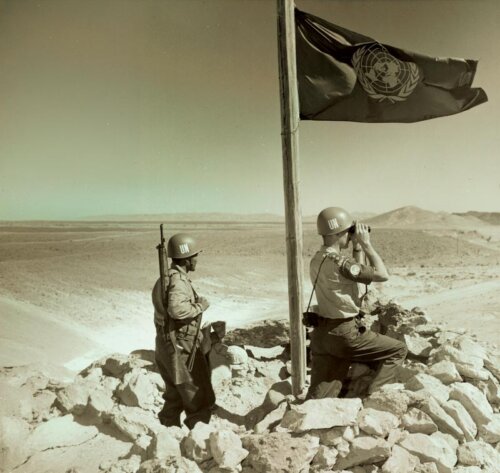


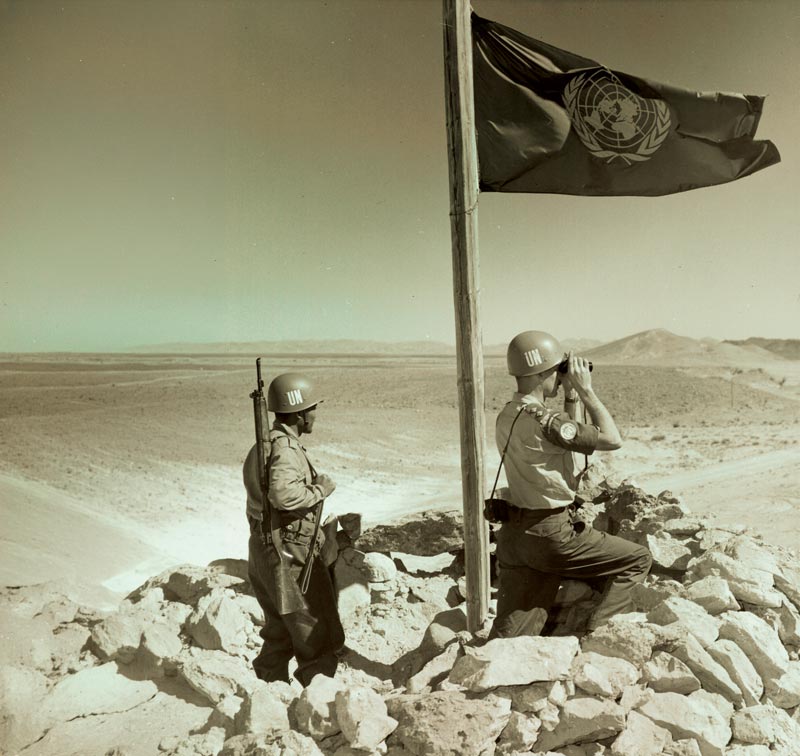
Canadian soldiers of the United Nations Emergency Force guard an outpost in the Sinai Desert. [CWM/19910238-130]
On Nov. 6, 1956, British Prime Minister Anthony Eden received a letter. Within the missive from Moscow, the ailing statesman learned, was a threat of nuclear annihilation.
As his cabinet members read the words with dismay, fearing that the Cold War was about to turn very, very hot, Eden himself was outwardly unperturbed. It would take more than Soviet brinkmanship, it seemed, to dissuade him from the course he had set in motion.
Just 24 hours earlier—in what countries around the world perceived as the desperate gasps of dying Empires—Britain and France had joined Israel in invading Egypt. Their objective: to reclaim neo-colonial control over the Suez Canal and oversee the toppling of Eden’s nemesis, Egyptian President Gamal Abdel Nasser—all in the supposed name of peace.
Militarily, the prime minister felt that victory was within reach. Politically, the situation was as grievous as the worn faces that surrounded him.
And it wasn’t only the U.K.’s ranking enemy snatching at its heels. Its most powerful ally, the U.S., was implementing plans that could ruin the realm economically, and several UN members were likewise moving against its interests. And, with the Commonwealth on the cusp of tearing apart at the seams, Britain stood largely alone, more so than it had ever considered itself during the darkest moments of the Second World War.
Not even oh-so-loyal Canada had come out in any forceful defence of the moves. But it would be a Canadian who would help bring this expedition to an end.
The Suez Canal, a roughly 193-kilometre waterway running through Egyptian territory to connect the Mediterranean and Red seas, had served as a bastion of Empire since its formal opening in 1869. Once the dream of French diplomat Ferdinand de Lesseps, it was built, at least in part, on the back of forced labour and quickly became a commercially viable shortcut for Europeans venturing east.
In 1875, Britain purchased a hefty stake in the French-operated Compagnie universelle du Canal Maritime de Suez that administered the channel. The colonial power then cemented its authority when, in 1882, it invaded and occupied Egypt, thereby seizing de facto control over the country, too.
Some 60 years later, despite Britain’s waning influence after the Second World War, the nation’s continuing presence throughout the Suez region was framed as financially and strategically vital. Military bases operated beneath the Union Jack in what became known as the Canal Zone, facilitated by the Anglo-Egyptian Treaty of 1936. Such postings were typically unpopular amid widespread disease and a harsh climate. Worse for the stationed British troops, a significant rise in Egyptian nationalism risked boiling into outright revolt.
In October 1951, the Egyptian government declared the 1936 agreement void. Britain ignored subsequent demands to leave, labelling the move invalid. In response, Egyptian officials actively encouraged violence against the occupiers, resulting in heated demonstrations, individual attacks against soldiers and riots. The increased hostilities culminated in a battle between British forces and local police holed up in an Ismailia barracks in January 1952; some 50 Egyptians and several attackers were killed in the skirmish.
In its aftermath, further unrest in Cairo claimed the life of Canadian Trade Commissioner J.M. Boyer. Egypt’s relationship with vast swaths of the West appeared to be quickly deteriorating.
This fresh anger, however, soon turned on the country’s own monarchical regime, overthrowing it in a near-bloodless coup master-minded by then-colonel Nasser on July 23.
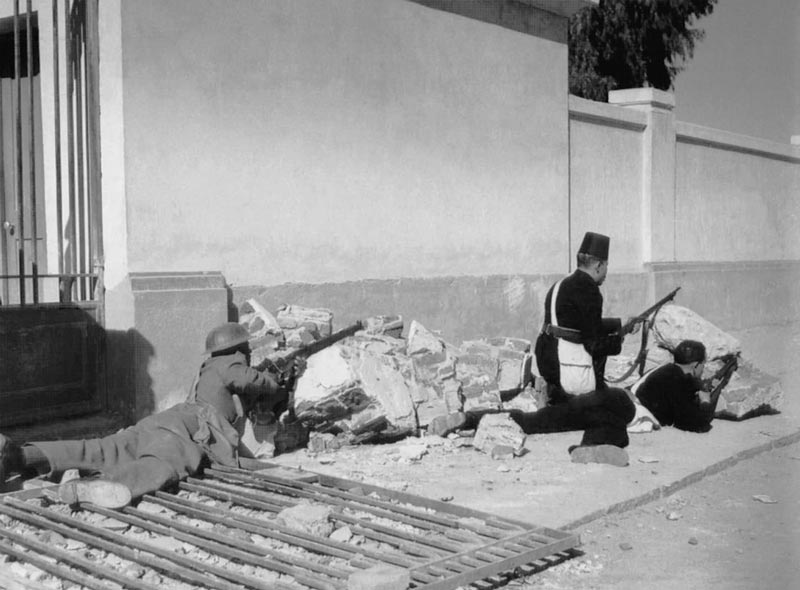
Egyptian police fight off British troops in Ismailia in January 1952. [Wikimedia]
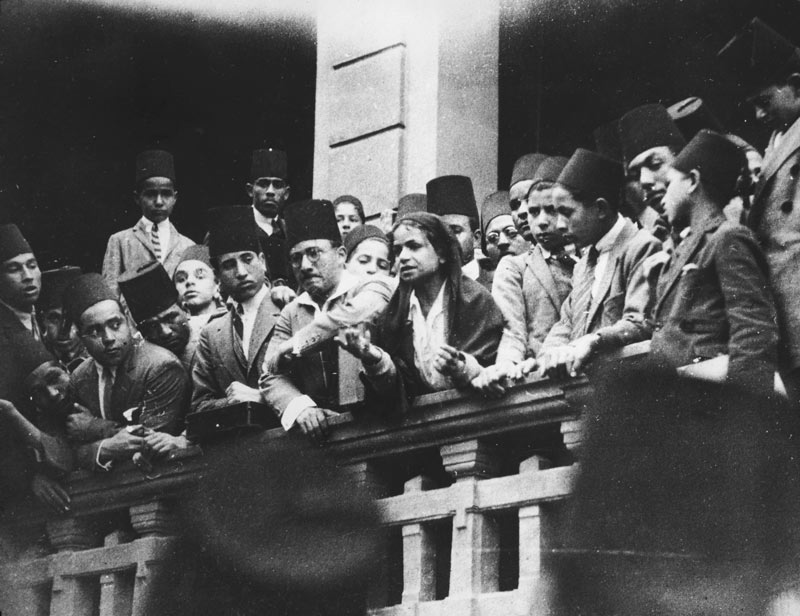
An Egyptian youth addresses a crowd during protests following the signing of the Anglo-Egyptian Treaty of 1936. [General Photographic Agency/Stringer/Getty Images/52473974]
British authorities, meanwhile, remained on the sidelines, striving to navigate the new political landscape until it became blatant that Egyptian nationalism was stronger than ever. Calls to depart the Suez Canal Zone resumed shortly thereafter.
“We are up against a determined anti-British movement,” wrote one imperial official. “The young [Egyptian] officers think we are on the decline as a Great Power; they have a real hatred politically for us in their hearts. No amount of concession or evacuation on our part will evoke the slightest gratitude in return. Whoever Egypt may want in the future as an ally, it will not be us.”
Far more alarming to the West was who that friend might be. In September 1955, it emerged that Egypt had purchased arms from U.S.S.R.-controlled Czechoslovakia. Nasser, now prime minister, intended to play Cold War adversaries against each other, taunting the British that, “if the Soviet Union attacks us, we will ask you to help us. And if you attack us, we will ask the Soviet Union to help us.”
No amount of western courtship proved adequate to steer the former military man beyond Moscow’s increasingly influential reach. That the British had agreed to evacuate their troops by June 1956 mattered not. Nor did the promise of Anglo-American funding for Nasser’s dream project, the Aswan High Dam. Egypt’s prime minister even went as far as recognizing Communist leadership in China, infuriating Washington and London.
The final, fateful manoeuvre by the British and U.S. governments came when both rescinded their financial backing of Nasser’s dam. As its construction was already in the works, he needed to offset the loss. Nasser had an idea.
Standing before a colossal crowd in Alexandria on July 26, 1956, Nasser railed against a foreign establishment that had loomed over Egypt for decades. The charismatic ruler, wearing a dark suit and a disarming smile, repeatedly invoked the name of Ferdinand de Lesseps, the 19th-century architect behind the Suez Canal.
It was all part of the plan.
Nasser, addressing his citizens, announced that the Suez Canal Company had just been seized and nationalized. Cheers promptly rang out.
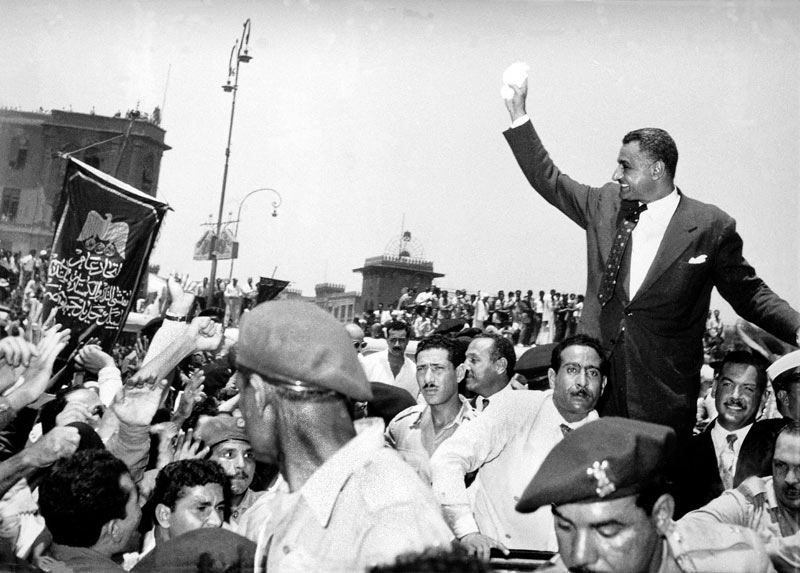
Egyptian President Gamal Abdel Nasser greets the crowd after announcing the nationalization of the Suez Canal on July 26, 1956. [Keystone-France/Getty Images/104402388]
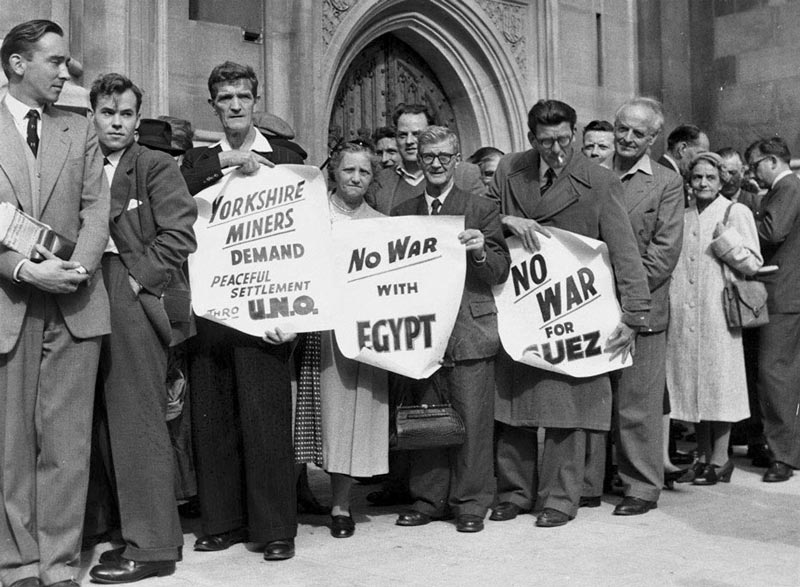
Brits protest tensions over the Suez in London in September 1956. [U.K. National Army Museum]
A short distance from the waterway itself, Egyptian military operatives listened to the speech on radio, waiting for a code word. And there it was, “de Lesseps,” their signal to move against the canal’s Franco-British offices. At gunpoint, startled workers were informed that they now served Egypt.
Nasser, still addressing his citizens, announced that the Suez Canal Company had just been seized and nationalized. Cheers promptly rang out.
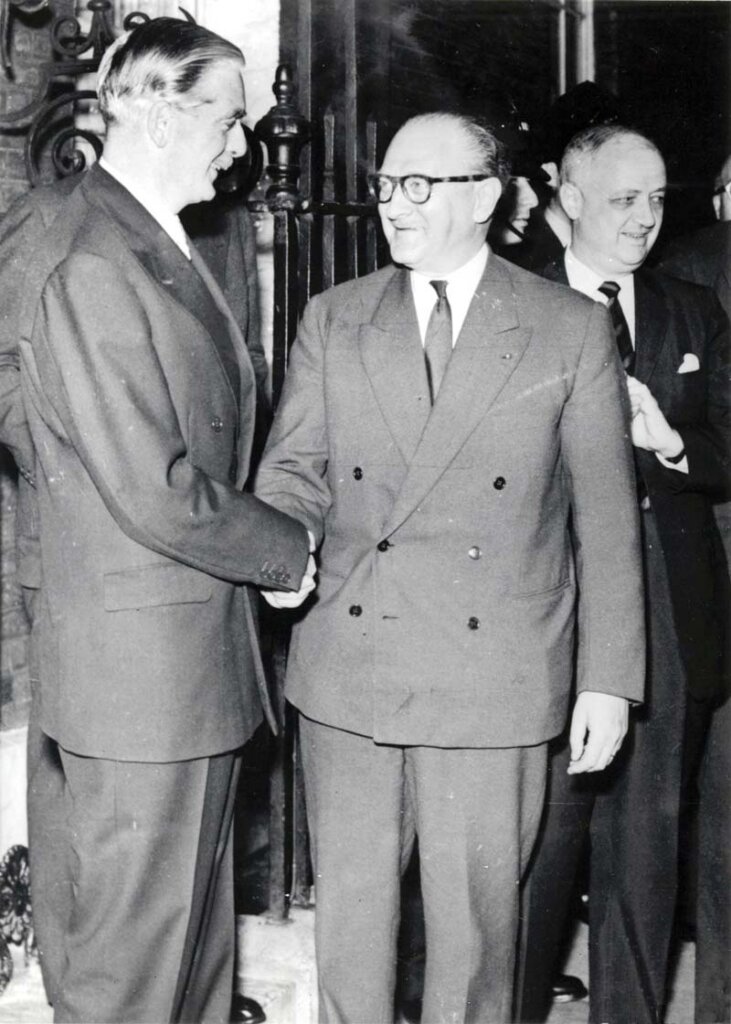
British Prime Minister Anthony Eden and French Premier Guy Mollet meet to discuss the Suez Crisis. [National Archief/Wikimedia]
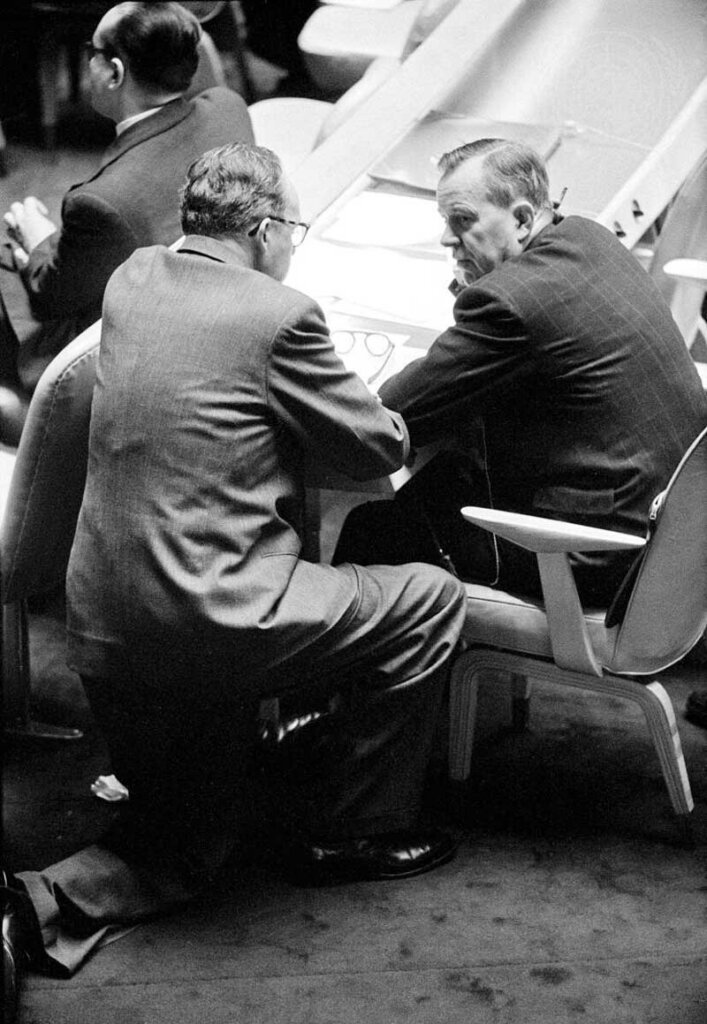
Canada’s Lester B. Pearson at an emergency session of the UN General Assembly in November 1956. [UN]
The news was anything but celebrated in London and Paris. More than half of Britain’s oil imports travelled through the Suez; were Nasser to block those shipments, it could pose an existential threat.
Prime Minister Eden wasted little time conjuring a plan of his own. The British forces pulled out of Egypt weeks earlier would be remustered for an invasion. And he would solicit accomplices. French leaders had more than one motivation for joining Eden: the company running the Suez Canal had been headquartered in Paris and Nasser was supporting Algerian rebels seeking independence from France. The Egyptian president was likewise assisting guerrillas infiltrating Israel as well as blocking Israeli shipping in areas of the Middle East.
While humouring the U.S. with diplomatic overtures, the three co-conspirators met secretly in Sèvres, France. In a stunning display of geopolitical theatre, it was agreed that the Israeli military would commence an assault as Eden and French Premier Guy Mollet expressed shock and, crucially, ignorance on the world stage. The ostensibly surprise invasion would then afford the two European powers a pretext to intervene under the guise of peacekeepers, whether the Egyptians wanted them or not.
So, on the morning of Oct. 29, 1956, 16 Dakota transport aircraft airdropped 395 Israeli paratroopers into Egypt, followed by ground forces and armour that steamed across the Sinai peninsula.
The Suez Crisis had begun.
Lester B. Pearson, Canada’s secretary of state for external affairs, found himself walking a geopolitical tightrope. With Israeli tanks traversing Egypt and with Britain and France due to land their own forces, the repercussions transcended borders.
At the UN, the rifts created by the crisis were already being laid bare. A meeting of the Security Council triggered a vote on a resolution calling for a ceasefire, curiously supported by both U.S. and Soviet officials, only for the British and French to veto it. Proceedings shifted to the General Assembly to circumvent the initial stalemate, yet further hardships awaited—exacerbated when the U.K. and France began bombing Egypt on Oct. 31.
Pearson, a middleman from a middle power, sought the middle ground. He had no desire to outright condemn two of Canada’s most important allies, but he also didn’t want to alienate the U.S., lest the western rift expand. In doing so, however, he surprised Paris and London in not coming out explicitly to their defence, as had Australia and New Zealand.
Peace was paramount for Pearson. If he could achieve it while allowing the aggressors to save as much face as possible, all the better. The question was, what de-escalatory measures, brought to a new vote
in the UN General Assembly, could secure a broad consensus? A fresh U.S. resolution for a ceasefire would, as relayed by biographer Antony Anderson in The Diplomat: Lester Pearson and the Suez Crisis, achieve little more than “returning to the status quo.” Canada’s representative felt that the UN could—and should—think bigger.
In controversially abstaining from the widely supported American resolution vote, Pearson argued that “a ceasefire will be only of temporary value at best. Surely we should have used this opportunity to link a ceasefire to the absolute necessity of a political settlement…for the Suez. We need action, then, not only to end the fighting but to make the peace.”
After exhaustive discussions and lobbying behind the scenes, Pearson advanced his own proposal: that the UN create its first large-scale, multinational peacekeeping force of lightly armed military personnel to supervise the cessation of hostilities and oversee the invaders’ withdrawal. It was a bold vision—if not an entirely new concept—and Canada was, Pearson affirmed, prepared to contribute men and materiel to the cause.
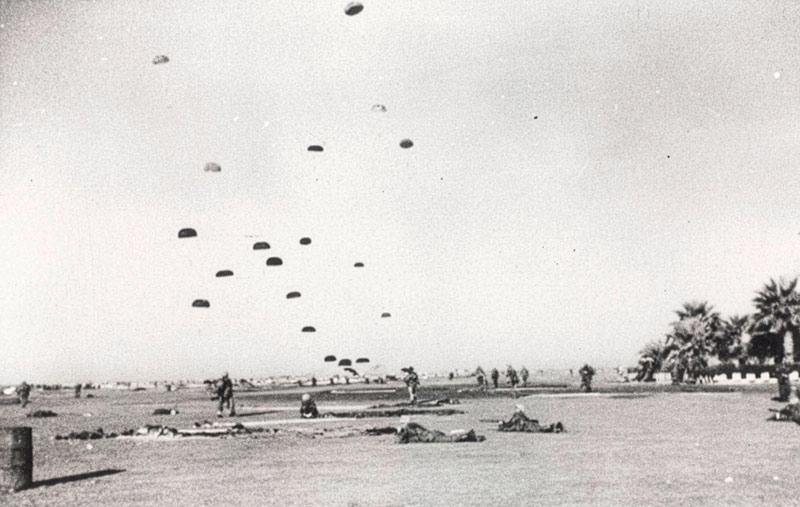
British paratroopers arrive at Egypt’s El Gamil airfield on Nov. 5, 1956. [U.K. National Army Museum]
At emergency meetings of the UN General Assembly on Nov. 4-5, the proposal was put to a vote, winning the approval of 57 countries. Notwithstanding a total of 19 abstentions—the warring fact-ions among them—the Canadian resolution received the two-thirds majority required to pass. With it would come the eventual formation of the United Nations Emergency Force (UNEF), commanded by Canadian Major-General Eedson L.M. (Tommy) Burns.
Pearson had helped achieve a historic milestone, a precedent-setting feat still playing out across the world today. Yet, the triumph had been tempered by terrible news. The governments of Britain and France, claiming that their impending intervention remained necessary until UNEF could deploy, intended to persist with their operation.
“And so,” wrote Anderson in his 2015 book, “in the midst of the debate to establish a UN command for the proposed force, Pearson learned that London and Paris were proceeding with their military expedition in Egypt, despite all of Ottawa’s clear but measured appeals over the last four months, despite the anger generated in the Commonwealth and throughout the Middle East, despite the strain inflicted on the Western alliance, despite all of his inspired and politically costly diplomacy at the United Nations.”
The Suez Crisis wasn’t about to abate.
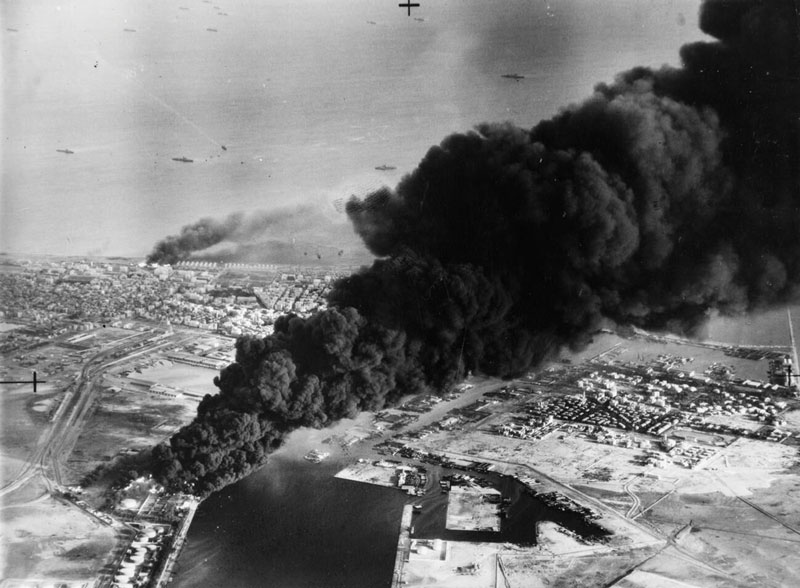
Smoke rises from oil tanks along the Suez Canal at Port Said during the Anglo-French assault. [Imperial War Museums/MH 23509/Wikimedia]
The soldiers came first from the skies, 688 British troops of 3rd Battalion, The Parachute Regiment, descending on Egypt’s El Gamil airfield on Nov. 5, 1956. With much of the opposing air force already neutralized by Canberra and Valiant bombers, it wasn’t long until the men gained a foothold near Port Said at the northern entrance to the canal.
Elsewhere, about 500 French personnel of 2e Régiment de Parachutistes Coloniaux captured key bridges, firing indiscriminately at “every living thing ahead of us,” reported one combatant.
It was but the beginning—little more than a taste of what the 80,000-strong invasion force had in store starting at dawn the next day, when a great Anglo-French armada began bombarding the beachhead. Royal Marine commandos, supported by tanks and additional armoured vehicles, soon landed at Port Said.
On the other side of the canal, the French stormed Port Fuad, engaged in urban warfare against a determined enemy defending their homes, their families, their communities. Any resistance, uniformed or otherwise, was crushed, freeing the attackers to continue their drive along the canal.
The ensuing halt order came not from any martial necessity
but parliamentary prudence, hastened by international outrage. The U.S.S.R. was baying for British blood with threats of nuclear devastation. The U.S., under the newly re-elected administration of President Dwight D. Eisenhower, was obstructing London’s loan request from the International Monetary Fund that would have cushioned its faltering economy.
Prime Minister Eden had no other choice than to concede political defeat and accept a ceasefire.
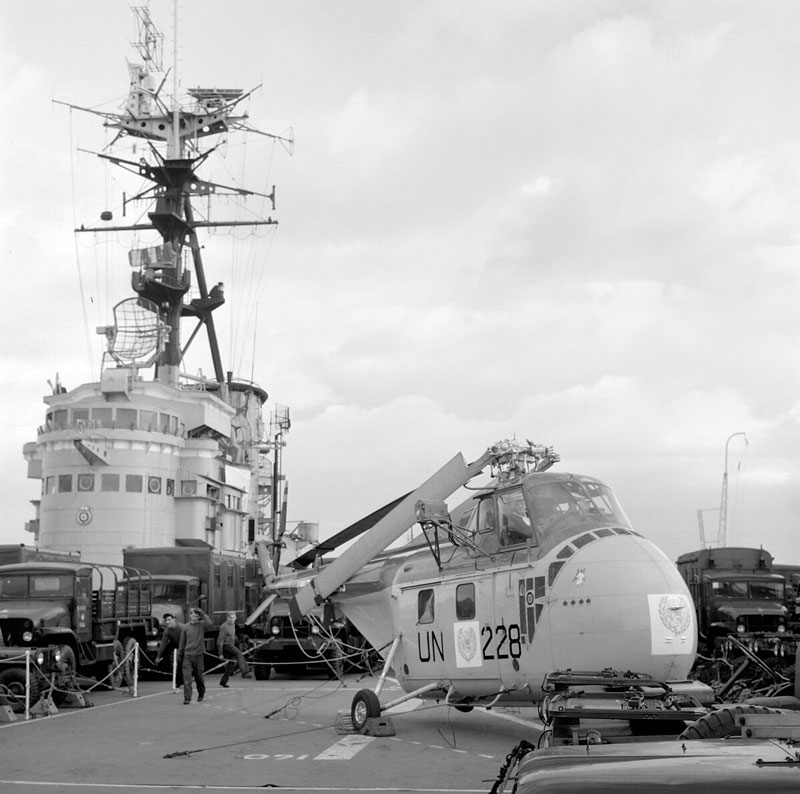
HMCS Magnificent arrives in Port Said, Egypt, on Jan. 11, 1957, with Canadian soldiers, vehicles and supplies for the UN Emergency Force. [UN]
“I’ve just never seen great powers make such a complete mess and botch of things,” remarked Eisenhower of the Suez Crisis. “I think that Britain and France have made a terrible mistake.”
It was also a painful lesson for both countries that, without approval from the White House, their global supremacy dwindled.
Eden’s days at 10 Downing were numbered; he tendered his resignation on Jan. 9, 1957, as his loathed Egyptian adversary, Nasser, solidified his power. In Paris, arguments have been made that the conflict contributed to the fall of the French Fourth Republic.
Such humiliations may have been worse had it not been for the efforts of Pearson. Through his and colleagues’ initiatives, the first soldiers for UNEF arrived in mid-November 1956, eventually mustering units from Colombia, Brazil, India, Sweden, Denmark, Norway, Finland, Indonesia, Yugoslavia and, ultimately, after complications and compromises—namely related to the optics of an Anglo-influenced military—Canada.
“We need action, then, not only to end the fighting but to make the peace.”
The UNEF monitored the French and British departure from Suez, which was completed on Dec. 22. Israel, which refused to host any blue-helmeted personnel in its controlled territory, withdrew in March 1957.
That the warring factions had ceased the bloodshed at all was considered worthy of recognition, with Pearson deemed the worthiest of recipients. At a Dec. 10, 1957, ceremony in Oslo, the future prime minister received the Nobel Peace Prize, having embodied the ideals on which the UN was founded.
Alas, the UN’s first major peacekeeping presence would come to an end in May and June 1967, when Nasser, as was his prerogative according to the terms of the agreement, revoked the neutral body’s right to reside on Egyptian soil. The Six-Day War with Israel broke out before the last UN troops had vacated.
Although lasting regional peace failed to materialize, Pearson’s original proposal had shown potential. It had also shown the world what Canadian middle power could do.
Advertisement