

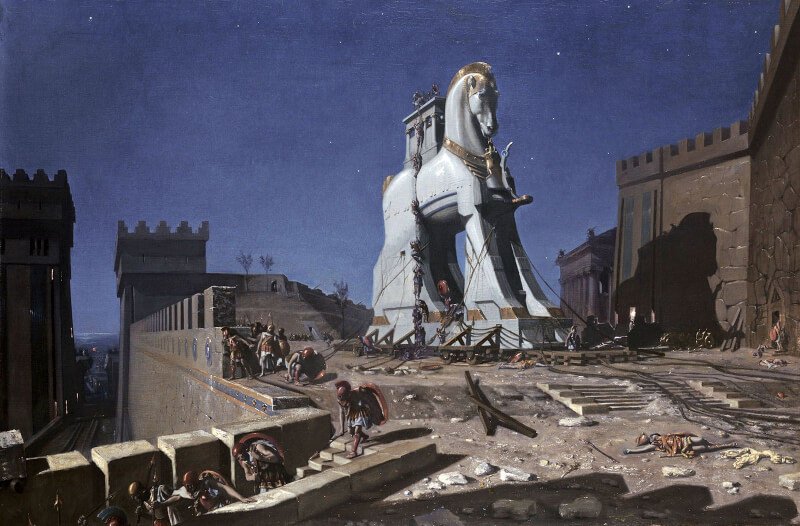
An 1874 painting by Henri Paul Motte depicts the Greek myth of the Trojan Horse . [Wadsworth Atheneum Museum of Art/Encyclopedia Brittanica]
Everyone seems to be talking about The Odyssey, this summer’s cinematic blockbuster based on Homer’s ancient poem. Among other things, the film portrays the story of the Trojan Horse, that legendary symbol of warfare deception.
The hero Odysseus and his Greek army are camped on a beach outside the gates of Troy, having laid siege to the city without success for a decade. To break the stalemate, their army pretends to sail away, while secretly retreating to a nearby island. Outside the gates of the fortified city, they leave behind a large and mysterious wooden horse.
Believing it to be a gift, the Trojans haul the horse into Troy, allowing Odysseus and other warriors hidden inside to emerge through a trap door, open the gates to their waiting army and destroy the city.
The Trojan Horse may be a myth, but it represents a potent tactic in the real-world military playbook. History is filled with examples of surprise and deception in war. One of the most famous was the fictitious “dummy” army the Allies built in southern England ahead of the D-Day landings to trick the Germans into thinking the coming invasion was aimed at France’s Pas-de-Calais region, rather than Normandy.
Canada has its own great story of wartime surprise that bears a remarkable resemblance to the tale of the Trojan Horse. In this case, an invading force had also laid siege to a walled city whose forces refused to fully engage in battle outside its gates. The invaders—like the Greeks, the dominant military power of their time—had also come by ship, waiting outside the fortified city for months in frustration, unable to break the stalemate.
The situation was ultimately decided, in this case, not with a wooden horse but with a daring amphibious assault that caught the besieged defenders by surprise. It happened in Quebec City in 1759.
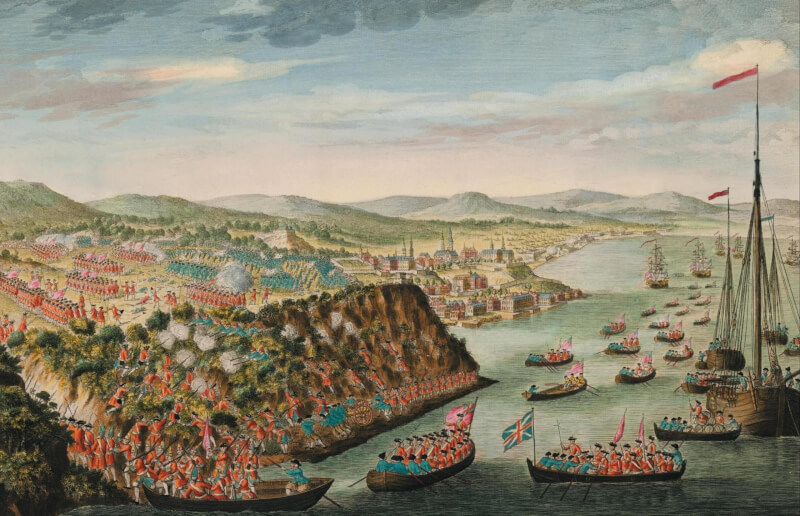
An engraving shows the British forces’ surprise attack on Quebec City on Sept. 13, 1759. [DND/Wikimedia]
In June that year, in the midst of the Seven Years’ War, a British fleet sailed up the St. Lawrence River and landed at Île d’Orléans, outside Quebec City, the capital of New France.
Quebec City was protected not only by the walls of its fortress but by the imposing cliffs upon which it stood, overlooking the river. All through the ensuing summer, British army forces commanded by Major-General James Wolfe skirmished with the French, probing their defences, even burning and destroying farms and settlements as part of a terror campaign in the surrounding countryside.
But whatever provocations he tried, Wolfe couldn’t entice the French commander, Lieutenant-General Louis-Joseph de Montcalm, to leave the ramparts of the capital and face Wolfe’s troops in open battle.
Winter was approaching. For the British, time was running short.
In late August, with Wolfe recovering from illness and unsure how to proceed, his brigadiers proposed a bold—some might say reckless—plan: sail upriver behind the city, scale the high cliffs where they were least expected and assault the town from the west, thereby cutting off its food and other supply lines and forcing Montcalm into the open to fight the British on their terms.
Wolfe agreed to the plan. A handful of British ships then slipped past the city’s batteries and navigated upstream through the currents, anchoring about three kilometres west of the town. The natural barrier of the cliffs meant that the shoreline there was lightly defended.
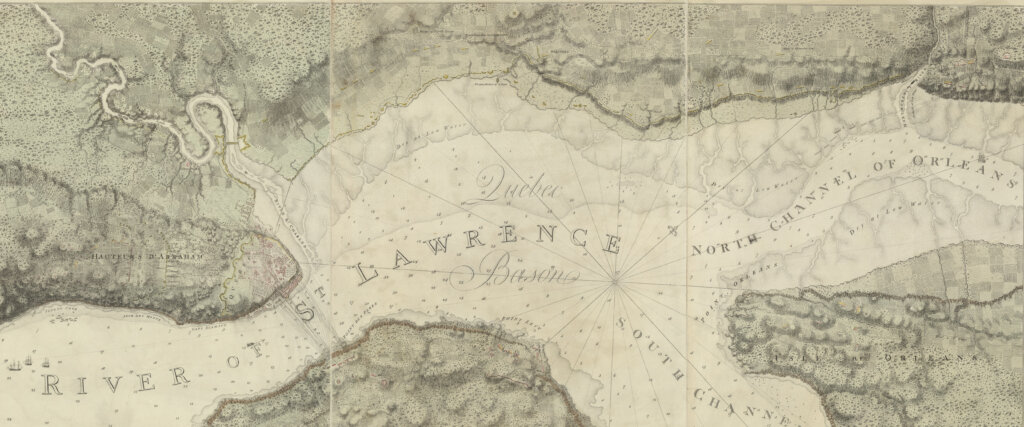
A military plan of Quebec City and environs in 1759, showing the city’s defences and the operations of the British forces. [State Library of New South Wales/Wikimedia]
In the pre-dawn darkness of Sept. 13, Wolfe sent 4,500 infantrymen in small boats into the cove at L’Anse au Foulon. The troops silently disembarked and climbed the escarpment. The first group of redcoats to reach the top were led by Lieutenant-Colonel William Howe, who would later command British forces during the American Revolutionary War.
“Everything depended on achieving surprise, for in the face of serious opposition a landing at the Foulon would be quite impossible,” historian Charles P. Stacey wrote in his entry on Wolfe in the Dictionary of Canadian Biography.
“But surprise was achieved,” Stacey wrote, in part because small boats from other British ships, still lying at their original anchorage off Île d’Orléans, staged a diversionary feint against the shoreline further east.
On the heights above L’Anse au Foulon, Howe’s men overcame the few French sentries awaiting them, and not long after daybreak were joined by Wolfe’s full force atop the Plains of Abraham, a series of farm fields stretching toward the fortified town.
A surprised Montcalm, hearing about the British landing that morning, rushed his forces out onto the plains, hoping to disrupt the enemy before they had a chance to get established.
Montcalm also commanded about 4,500 troops, many of them Canadien militiamen and First Nations warriors unaccustomed to fighting in European-style pitched battles in open country. Wolfe’s soldiers, meanwhile, were professional infantry.
The advancing French force began firing at the British from about 120 metres distance. Wolfe ordered his men to hold their fire—and their nerve—until the French were within 40 metres, at which point they unleashed a series of co-ordinated volleys.
“Hereupon [the French] gave way, and fled with precipitation, so that by the time the cloud of smoke was vanished our men were again loaded, and, profiting by the advantage we had over them pursued them almost to the gates of town,” wrote British Captain John Knox in his diary that day.
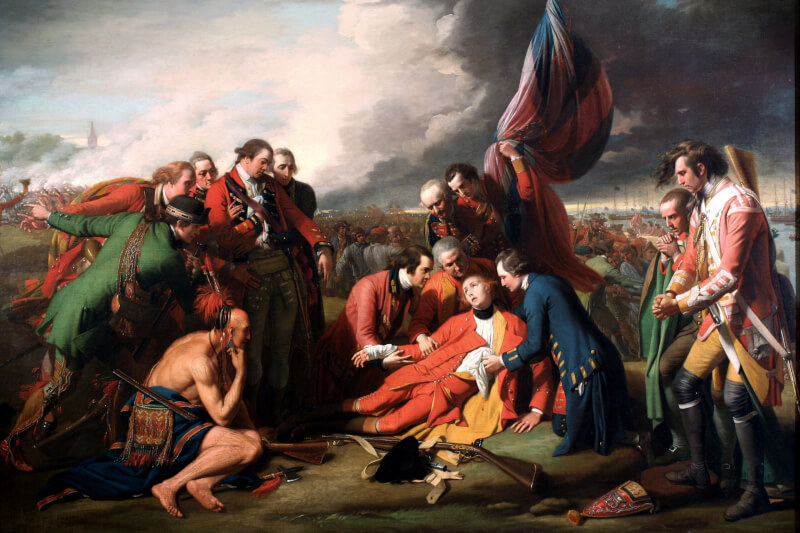
A 1770 painting by Benjamin West depicts the death of Major-General James Wolfe on the Plains of Abraham. [National Gallery of Canada/Wikimedia]
The British triumph was marred by the death of several senior officers, including Wolfe himself, who was shot three times.
Montcalm was wounded as the French force retreated behind the walls of the town. He died the next morning, allegedly expressing relief that he would not suffer the indignity of living “to see the British in Quebec.”
The British, now under the command of Brigadier-General George Townshend, laid siege to the town from their entrenchments on the plains. Quebec surrendered on Sept. 18.
The following summer, Montreal also fell to a British invasion force and the governor of New France, the Marquis de Vaudreuil, surrendered the entire colony. The Conquest of New France, as it became known, was formalized in the 1763 Treaty of Paris that ended the Seven Years’ War.
Today, the view from the heights of Quebec City across the St. Lawrence is just as breathtaking as it must have been in 1759—the steep cliffs a testament to an audacious act of stealth and surprise that changed the course of Canadian history.

A modern day view of the St. Lawrence River from the citadel. [JEFF FRENETTE Photography/Quebec Cité]
Advertisement