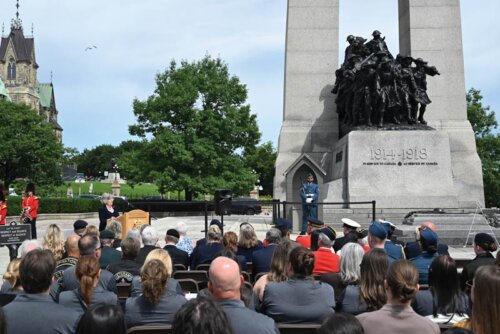


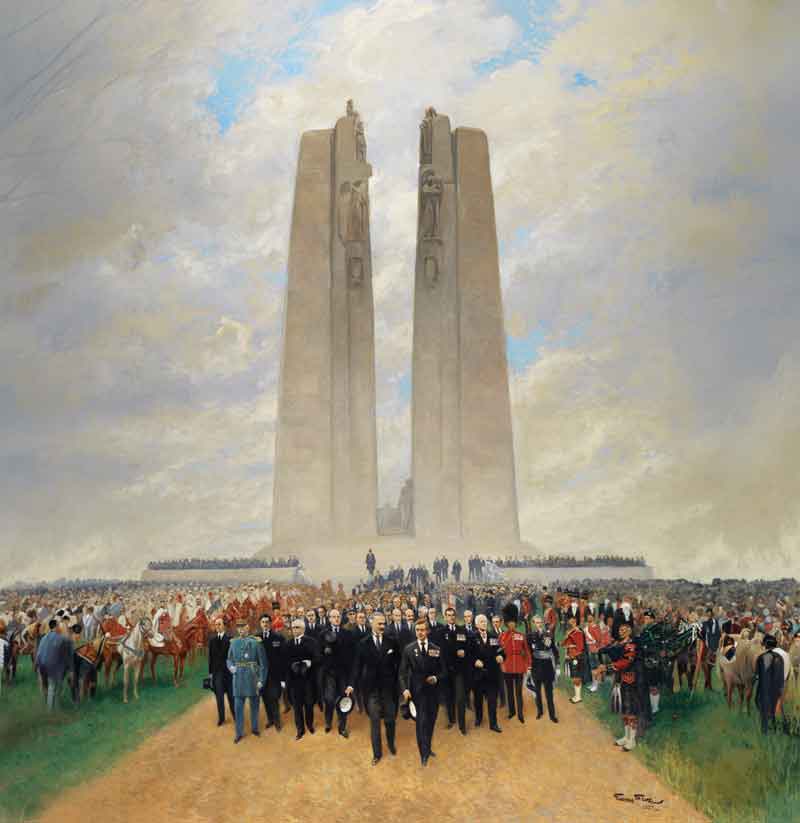
Artist Georges Bertin Scott depicts the unveiling of the Canadian National Vimy Memorial in July 1936. [Georges Bertin Scott/CWM/19670070-014]
To old soldiers, it may have seemed like history repeating itself. Certainly, as the crowds gathered beside the Montreal docks on July 16, 1936, it at least rhymed.
The thousands of well-wishers, cheering above the sound of brass bands and fireworks, bade farewell to five departing ocean liners that collectively carried roughly 6,400 Great War veterans and their families. Had it not been for the presence of mothers, wives and children next to them, the former warriors, many in their 40s and 50s, might have felt like they had travelled back in time.
Then as now, the waving throngs on land were awash with patriotic fervour. Then as now, the laden convoy was bound for faraway Europe. Yet these were not men and women destined for a Western Front of mud, wire and horror, the sights of which lived only in minds. No, these were guests of honour to a long-liberated France, pilgrims embarking on a journey of remembrance—and closure.
Vimy beckoned once more, a timeless battleground that loomed as large in Canada’s consciousness as the same seven-kilometre ridge where the country’s sons had spilled so much blood. Gone was the mud, the wire and the horror; in its place now, a memorial stood.
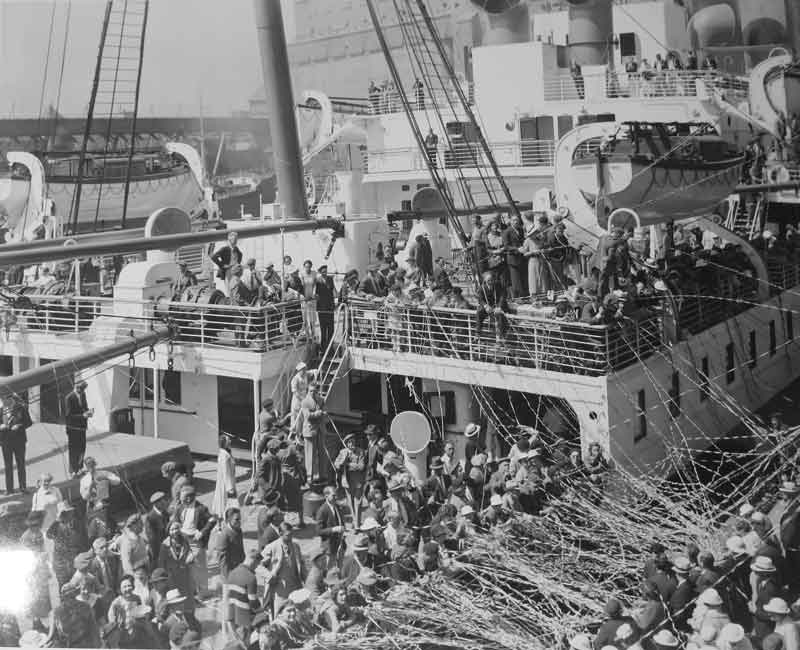
Canadian attendees of the event depart the country. [LM Archive]
Before the guns had fallen silent and the detritus of war was swept away, the need to mark the April 9-12, 1917, Battle of Vimy Ridge galvanized countless survivors. There, after all, the four divisions of the Canadian Corps, totalling some 100,000 troops, had fought together for the first time, seizing the mighty escarpment—Hill 145. There, too, an estimated 3,600 Canadians died in securing victory, a sacrifice that warranted special recognition.
So it was that numerous makeshift memorials, often extolling the exploits of individual units, were erected prior to the Nov. 11, 1918, Armistice. Nevertheless, resolve to create a national monument at Vimy, alongside other tributes scattered throughout Belgium and France, endured.
The process began with the identification of eight battle sites deemed most revered by Canadians. Aside from Vimy, those on French soil included Bourlon Wood (Canal du Nord), Le Quesnel (Amiens), Dury (Second Arras) and Courcelette (the Somme). Across the Belgian border, meanwhile, Dominion soldiers had participated in epic clashes near St. Julien (Second Ypres), Hill 62 (Sanctuary Wood and Mount Sorrel) and Passchendaele (Third Ypres).
With the memorial locations selected, the Canadian government eventually negotiated the transfer and purchase of land. But, questions remained concerning the form the monuments would take and who would design them.
In April 1920, a special committee was established in the House of Commons to finalize plans. Renowned architect Percy Nobbs argued that the chosen sites should boast similar memorials, although one could be singled out with a “more imposing design than the other seven.” Vimy quickly became the favourite—but not everybody agreed.
Chief among the dissenters was the Canadian Corps’ own General Arthur Currie, who, despite not yet being in command in April 1917, ascended to the position shortly afterward as its inaugural Canadian-born leader. As far as the former officer and national icon was concerned, “I do not think it was the most outstanding battle, or had the greatest material or moral effect on the winning of the war.”
Currie would be overruled in due course, but in the meantime, the notion of having identical
monuments persisted.
From September 1920, the newly founded Canadian Battlefields Memorials Commission took charge, launching a competition for designs. Organizers received upward of 160 submissions, later shortlisted to 17 entries that were reproduced as models.
A jury reviewed the maquettes the following year when it became clear that many artists had envisioned monolithic structures imbued with deep national pride. One, however, stood strikingly apart: a large base topped with two soaring pylons representing Canada and France—countries that had paid a towering price in the war. A vacant sarcophagus, emblematic of boundless loss, rested below the memorial while, from high above, the maternal statue of Canada Bereft mourned her dead.
The 19 other allegorical figures—embodying values such as honour, justice and peace—populated the white stone tribute, which seemed almost inexhaustible in its symbolism. This wasn’t a monument to martial prowess, the jury realized, but a testament to sorrow and remembrance.
On Oct. 4, 1921, its esteemed creator, Toronto architect and sculptor Walter Seymour Allward, was announced as the competition’s winner. The commission conceded, however, that Allward’s memorial had a “design of such individuality and complexity that its character precludes it from the possibility of repetition.” The runner-up, a still-impressive submission by Frederick Chapman Clemesha fated to be known as the Brooding Soldier, was thus picked for the seven other sites—that is, until it was also deemed too unique to replicate after being unveiled at Ypres in 1923. Officials settled on a third cube-like design for the six remaining locations, all modest yet potent in carrying commemorative weight.
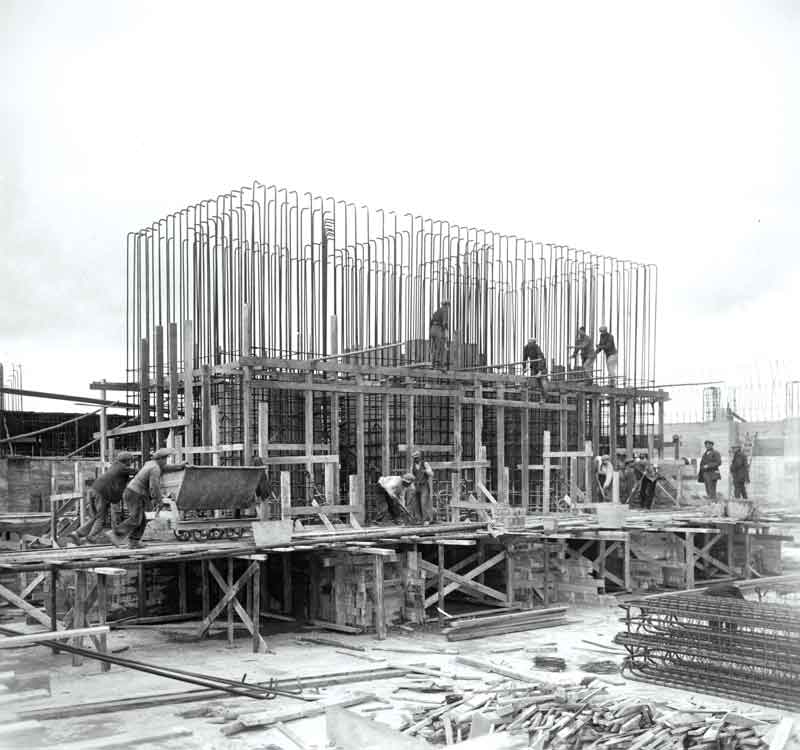
Construction underway on the memorial’s base.[Walter Seymour Allward/LAC/R10248-1-2-E (2)]
Arguably more pressing were the unresolved matters surrounding Allward’s future masterpiece. For starters, where should it be erected? While the commission initially suggested the monument be placed at Hill 62 in Belgium, the Vimy Ridge site had a somewhat surprising and improbable proponent in Prime Minister Mackenzie King. The Canadian statesman hadn’t served in the war, for which he had been ridiculed during his 1917 election campaign. In advocating for Vimy, King strove for a dutiful tone in the absence of having worn the uniform. His cause proved successful, proclaiming that, “History will look upon the battlegrounds of the Great War as the places of sacrifice. Among the number, no altar will be more conspicuous through the years than that of Vimy Ridge.”
With the decision made, and about one square kilometre of local land gifted to Canada by France for memorial use (without transferring territorial sovereignty), Allward could at last see his vision brought to life.
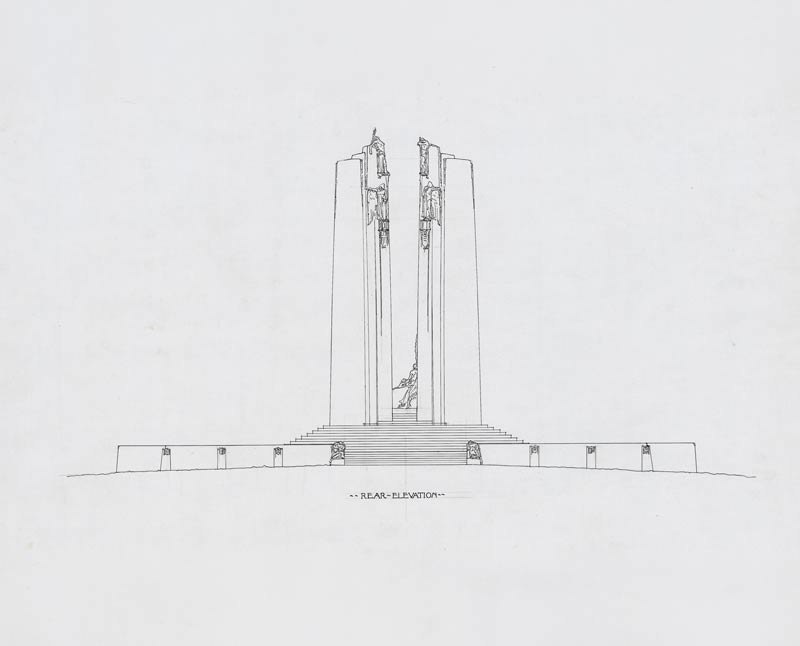
Architectural drawings of the monument produced by Walter Seymour Allward.[DND/LAC/e002852545]
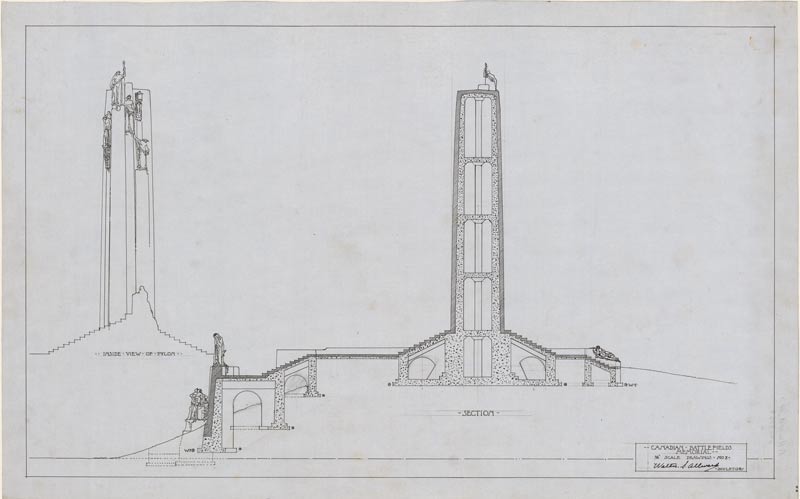
[DND/LAC/e002852545]
“I had gone into a troubled sleep after thinking of all the muck and horror over there,” recalled Allward of a wartime dream that inspired his memorial. “I found myself overlooking a tremendous battlefield. Division after division of our army was being swallowed up in this smoke, din and destruction. Everything was disappearing, but as I looked down a long avenue of poplars lining one of the main roads, I saw armies of the white dead coming out to relieve the dying armies of the living.
“When I awoke, and for long, long afterwards, the poignant impression remained and finally became a part of this work.”
A nightmare transformed into sublimity, Allward’s dream came to life as the memorial’s foundation took shape in 1925. But amid the construction of memory, far more tangible reminders of war emerged from the soil during the site’s preparation.
“Vimy Ridge was in appalling shape,” wrote historian Tim Cook in Vimy: The Battle and the Legend of the scene that greeted crews, “with all of the roads leading up the ridge severely damaged, the terrain pocked by millions of shell craters, and a mass of unexploded high-explosive, shrapnel, and chemical shells buried in the earth.”
Added to the devastation was the abundance of bodies, fathers and sons long swallowed by the mud, but since returned to the surface.
Volatile ordnance could be pinpointed with detectors and probes, dugouts could be filled with concrete, and human remains could be recovered, with great dignity, by the Imperial War Graves Commission (later the Commonwealth War Graves Commission). But there were other delays.
Roughly 65,000 tonnes of soil, chalk and clay were extracted from the site, an arduous process not without critics. The monument foundation itself required 15,000 tonnes of steel-reinforced concrete. Far more distressing for Allward, whose already distinguished sculpting career revealed perfectionist tendencies, was his search for the right stone.
No quarry, scattered across the likes of France, Italy, Spain and England, had rock that suited the architect’s uncompromising demands, which frustrated the commission in Ottawa. Allward, often labelled a mercurial artist behind closed doors, continued his years-long search while, at Vimy, work came to a grinding halt.
Increasingly idle, labourers found ways to stay occupied, resorting to reconstructing the nearby front-line trench system that had fallen into disrepair. Concrete-filled sandbags and mats created a strange sense of permanency, a battleground frozen in time. Much of the same was true of efforts to stabilize parts of the Grange Tunnel some 10 metres beneath the surface.
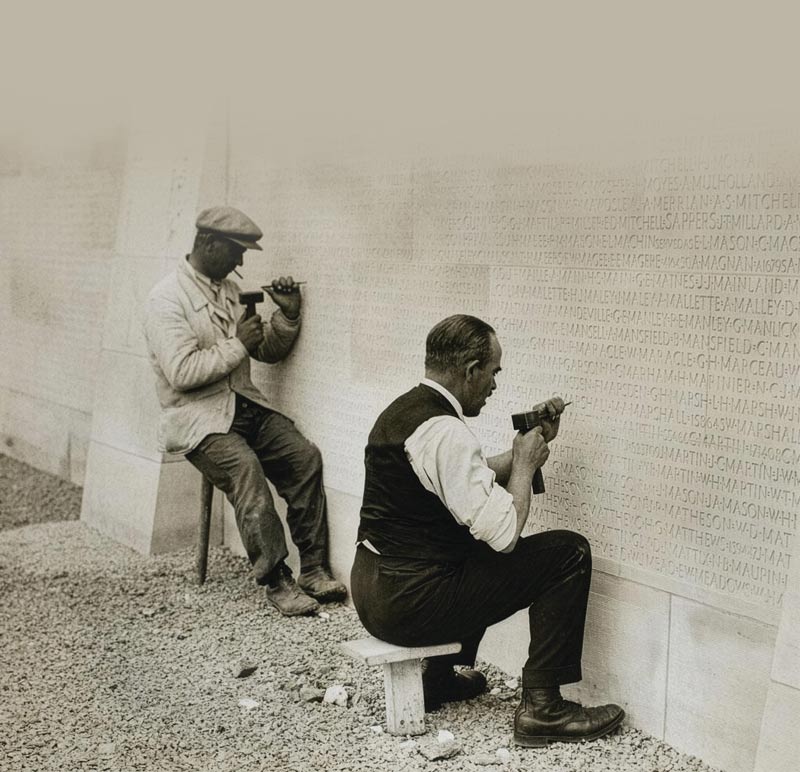
The names of 11,285 of Canada’s WW I dead with no known grave in France are inscribed. [VAC/Wikimedia]
With no end in sight for Allward’s structural woes, the sculptor confronted another complication. When he got his stone, where was he to inscribe the 11,285 names of Canada’s dead who fell in France and had no known grave? Allward agonized over their placement, at first resisting the idea of having them on the memorial walls for fear that they would “look like a huge sign board.” He ultimately relented, offering space along the monument’s facades and up the staircase, under the conditions that names run continuously in a single alphabetical sequence (unlike Belgium’s Menin Gate, where they’re arranged in separate panels by regiment and service) and that he would design his own lettering.
Of course, before that could transpire, Allward still needed his basic building material. A breakthrough came in 1926, when he zeroed in on an ancient Roman quarry near Split, Yugoslavia (modern-day Croatia). The limestone was known as Seget—durable, versatile and elegant when weathered. It was perfect.
By June 1927, more than 6,000 tonnes of the cream-coloured rock had arrived at Vimy Ridge. Finally, the most fundamental work could begin.
Under Allward’s eye, sculptors studied his maquettes to carve stone figures twice the size, utilizing a pantograph to ensure precision. Engineers and labourers toiled to transform blocks into beauty until two pylons ascended above the Douai Plain. To guarantee the same level of craftsmanship during the miserable winter months, temporary studios shrouded the site to shelter those immersed in artistry and industry, neither one more important than the other.
No detail was too small. No finish was too fine. But slowly, surely, a monument was built.
At last, after myriad delays that stretched the project out 11 years—not to mention having surpassed initial cost estimates to reach $1.5 million—Allward announced the memorial’s completion in 1936.
All that was left was to unveil it.
Walking the ground of old battlefields—perhaps laying bare old wounds—wasn’t without precedent when the towers of Vimy took form. Tours of the Western Front commenced shortly after the Armistice, with veterans and civilians from Britain and continental Europe embarking on such journeys for deeply personal reasons. While morbid fascination with the war existed for some, the vast majority came to pay their respects, often to a lost loved one or friend.
Canadians and Newfoundlanders had fewer opportunities, especially after the 1929 stock market crash that plunged the world into the Great Depression. A mere year earlier, however, the Canadian Legion (now The Royal Canadian Legion) had passed a unanimous resolution to organize a pilgrimage, as it would be called, to Belgium and France that might coincide with the monument’s unveiling. The trip was ambitious, particularly with record-high unemployment and abject poverty on a global scale.
The plan proceeded nonetheless, largely percolating behind the scenes until July 1934, when The Legionary magazine (the forerunner of this publication) announced that the pilgrimage would “definitely” happen.
Responsibility for the official delegation and program fell to Ottawa. Getting more than 6,000 veterans and family members to the memorial was down to Legionnaire co-ordinators, who calculated the price for a three-and-a-half-week trip at $160 per person—too much for some, even with minor offsets. Still, many would tighten belts to afford the cost.
Those fortunate enough would return to a Europe again in turmoil. Spain appeared on the cusp of civil war (and it was, just one day after the pilgrims departed Canada). Italy’s fascist dictator Benito Mussolini had committed atrocities in Ethiopia. And then there was Hitler’s stranglehold on Germany, its Nazi regime having reoccupied the Rhineland and increasingly hell-bent on another war.
International uncertainty cast a dark shadow, but optimism prevailed when the memorial unveiling date was confirmed for July 26, 1936. King Edward VIII would preside; his presence was regarded as an honour among many attendees. The absence of General Currie, who had passed away in 1933, and Prime Minister King, who never felt comfortable around veterans, was conspicuous, yet the mood remained one of anticipation and, above all else, reflection.
The old soldiers were going back—and ghosts awaited them.
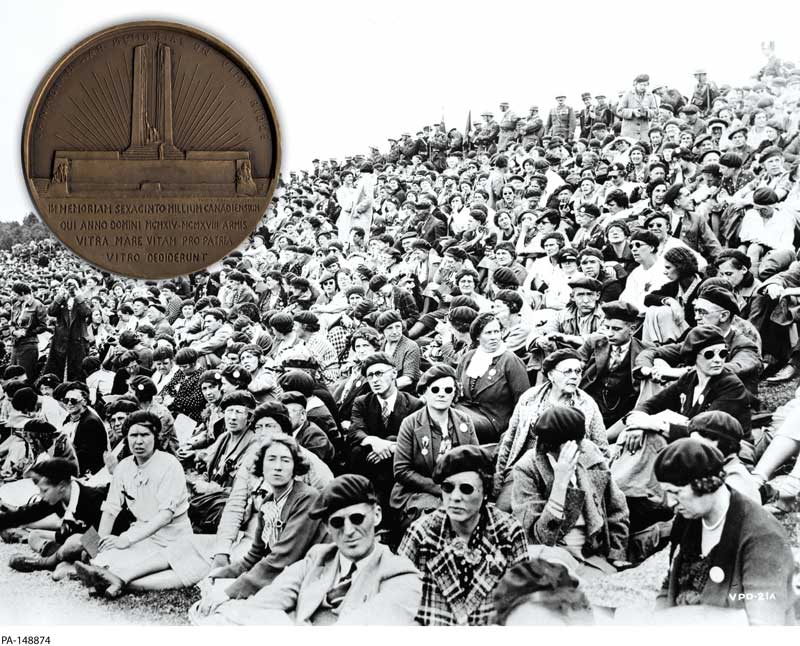
The reverse of the commemorative medallion struck for the 1936 pilgrimage (above). Canadian attendees at the memorial’s unveiling. [Walter Seymour Allward/CWM/19680100-002; NFB/LAC/PA-148874]
The five ships crossed the Atlantic with considerable ease, their
decks overflowing with reunited comrades. HMCS Saguenay, a Royal Canadian Navy destroyer, escorted the convoy across calm ocean waters. Meanwhile, passengers were issued haversacks, berets—khaki for veterans and blue for other attendees—identification discs, event guidebooks and cherished Vimy Pilgrimage Medals.
Nine days later, on July 25, French and Belgian welcome parties, jostling for space around the ports of Le Havre and Antwerp, offered the delegation as warm a reception as they had received leaving Canada. Guests then boarded trains and, once closer, some 235 buses with an additional 1,365 Canadians who had travelled from the U.K., bringing their total number to about 7,500 pilgrims.
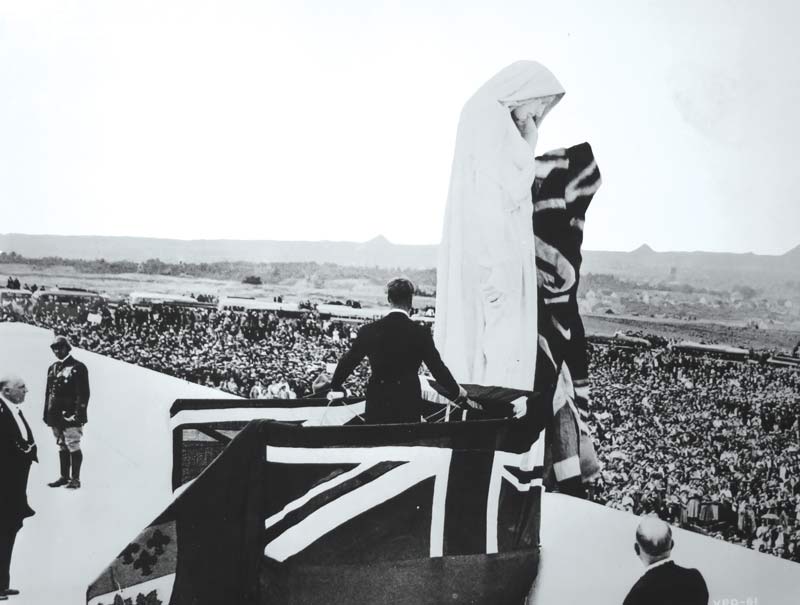
King Edward VIII unveils the monument’s Canada Bereft statue. [NFB/LAC/PA-148880]
There were other commemorations throughout the trip, other occasions for veterans to pause and remember sacrifices on now-green and fertile fields, but the next day, July 26, would stand as the tour’s defining moment. It was a Sunday, warm and sunny, affording pilgrims the chance to see Allward’s monument at its finest.
“The memorial on Vimy is a beautiful and impressive structure,” expressed pilgrim Mary Botel, noting that “it seemed to dominate the landscape for miles and miles.” Another veteran observed that its towers “soared up gleaming white into the blue sky, a mighty picture in stone. The effect left one almost breathless.”
The awestruck reactions were many, and they would be shared by the estimated 50,000 French spectators, maybe more, who descended on the site for the afternoon’s grand ceremony, all intent on honouring their liberators.
The pilgrims, divided into groups of beret-wearing veterans and civilians, were escorted to what Allward characterized as the amphitheatre in front of the monument. With military meticulousness, veterans formed up to the sound of the Royal Canadian Horse Artillery Band and composite ensembles from several Canadian Highland regiments. The mixture of excitement and earnestness could be felt through the airwaves as the Canadian Radio Broadcasting Commission (precursor to the CBC) shared the event back home and around the world.
The electric atmosphere only heightened when the King’s entourage arrived at 2:15 p.m., the monarch adorned in a black suit on which a distinctive gold Vimy Pilgrimage Medal was pinned. Once he had taken his place, the formal ceremony began with speeches from religious and government officials. Surprisingly missing from the oratory roster was Allward, who, at 59, had seemingly aged ahead of his time after the 1934 death of his son. Despite such realities, the omission appeared striking. This was Allward’s masterwork that people had ventured across an ocean to see. Here, at the memorial’s unveiling ceremony, the voice of its maker would be silent.
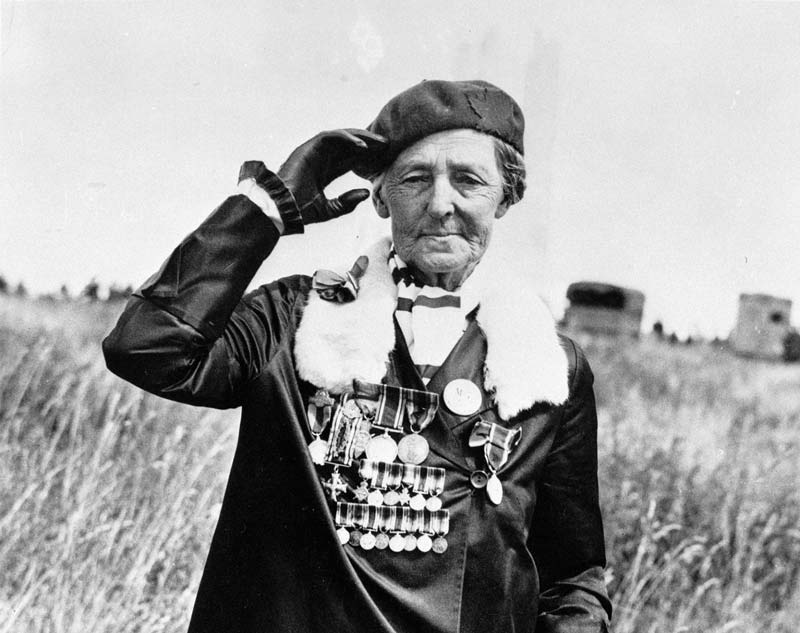
Memorial (Silver) Cross Mother Charlotte S. Wood poses for a photo at the 1936 event. [NFB/LAC/PA-148875]
Beyond the still-apt pomp and pageantry, even Edward VIII recognized that the day belonged to veterans, declaring that the monument “crowning the hill of Vimy is now and for all time part of Canada.” None, of course, disputed the sentiment—not when the words rang true for swaths of a healing country that sought meaning in its collective sacrifice. What couldn’t have been fully comprehended was the extent to which Vimy would permeate through a country’s mythos—born and reborn in new lights, interpreted and reinterpreted through the century.
The memorial embodied that greater ideal—but it hadn’t created it alone. Vimy’s legend existed not in a vacuum. Nor did it lie solely at the foot of Canada Bereft when the King pulled the draped Union Jack from her grieving eyes.
With the ceremony drawn to a close, pilgrims began to inspect the chiselled limestone. Names of the dead were found and spectres, as Allward had envisioned, joined the living once more.
Whether united in sorrow or a sense of closure—or perhaps both—dozens of Memorial (Silver) Cross Mothers walked among the crowds, sharing a poignant moment when they removed their crosses, each representing a child or children killed in service, and stacked them at the monument. The women then formed a circle and stood in silence.
One, Charlotte S. Wood of Winnipeg—who lost five children to the war—had earlier spoken with King Edward. Holding his hand, she questioned what it had all been for: “Oh, sir, I have been looking at the trenches and I just can’t figure out why our boys had to go through that.” The monarch had only one message: “Please God, Mrs. Wood, it shall never happen again.”
Advertisement