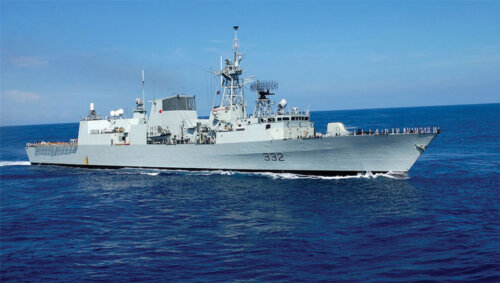


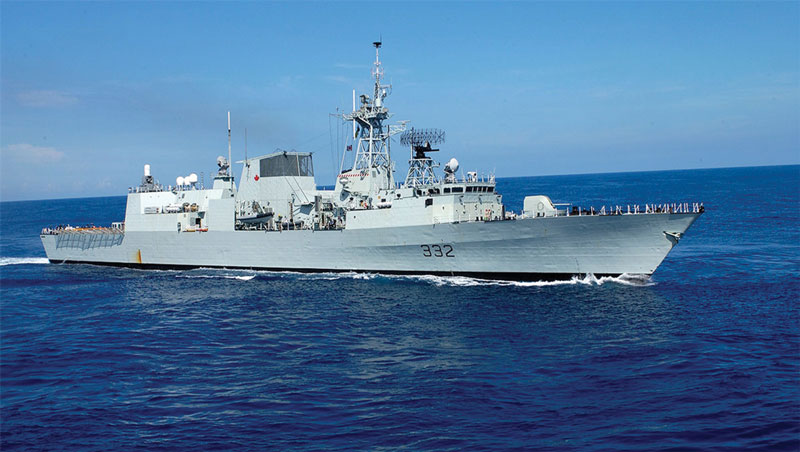
HMCS Ville de Québec is the Royal Canadian Navy’s only ship designated as a French-language unit, though many of its crew aren’t francophone. [Government of Canada]
Quebec is a maritime province. It has 9,000 kilometres of saltwater coastline (excluding islands) and 400 years—at least—of rich nautical history and traditions. Travelling along the Gulf of St. Lawrence and the river would convince anyone that shipping and seafaring is a part of life for many Quebecers.
The gulf is Canada’s gateway to the St. Lawrence Seaway, the Great Lakes and the country’s industrial heartland. Montreal is home to Canada’s second-largest container port, and immense amounts of resources such as iron ore and forestry products ship from provincial ports including Quebec City, Saguenay, Sept-Îles and Baie-Comeau. Plus, one of Canada’s largest shipyards is across the St. Lawrence from Quebec City.
Critically, given these perilous geostrategic times, Quebec is also a near-Arctic province, with its Ungava peninsula bounded by Hudson Strait and Hudson Bay and located at the eastern entry to the Northwest Passage.
But where is the Royal Canadian Navy’s presence in the province? There are no permanent naval bases in Quebec and, surely, it’s time to consider one. In February 2026, Vice-Admiral Angus Topshee, the plain-spoken RCN commander (since promoted to vice chief of the defence staff), told Montreal daily Le Devoir that naval recruiting in Quebec was far weaker proportionately than the other services. Topshee wondered if a permanent naval base in the province might heighten local naval awareness and encourage enlistment.
“The reality is that the navy has no operational base in Quebec nor in any French-speaking part of Canada,” he said in an interview conducted in French. Topshee suggested that Quebec City, Rimouski and Baie-Comeau would be suitable locations for a new naval facility.
The federal government has promised hundreds of billions in domestic defence investments, emphasizing the need to more robustly protect Canadian sovereignty. Hopefully this will lead to serious consideration of Topshee’s idea.
For decades, parsimonious governments and other operational commitments precluded investing in a more visible military presence in Quebec. But times have changed—for the worse. Canada’s 12 Halifax-class frigates, four remaining Kingston-class coastal defence vessels and four problem-plagued Victoria-class submarines are now some 30-plus years old and the navy’s devoted sailors have been doing more with less for far too long. Canada needs enhanced naval protection in the Gulf of St. Lawrence and in the Arctic.
Help is on the way with 15 advanced destroyers to be delivered in the next decade and two modern supply vessels to be completed in the next year or two; plus, Canada is negotiating a contract for 12 new submarines. Six Harry DeWolf-class patrol vessels are now operational and this past April the government indicated interest in acquiring 16-20 new corvettes, smaller warships best suited to littoral warfare, but that pack a big punch.
Canada desperately needs heavily armed naval vessels capable of deterring adversaries and defending its coasts.
But who will crew these vessels? Although armed forces recruiting reported its highest enrolment in more than 30 years this past spring, the RCN is still short of personnel (by estimates of up to 25 per cent in some occupations), a situation that decreases operational readiness and adds to crew strain. Topshee’s replacement, Vice-Admiral Dan Charlebois, stated in June that the navy’s growth means that 40 per cent more sailors will be needed in the coming years.
A strong naval presence in French Canada could result in an influx of French-speaking Canadians into the navy. Despite a seafaring tradition, French-speaking Canadians haven’t historically enlisted in the RCN in numbers equivalent to their proportion of the population. A likely reason? Until the 1950s, the navy was unilingual.
During the Second World War, it largely operated in close co-ordination with the British Admiralty, was particularly British in its orientation and sailors had to speak English, the language of command and almost all administration, education and training. Fewer than 10 per cent of Second World War sailors were French Canadian, with most in trades requiring minimal training and responsibility. There were very few francophone officers. Understandably, there was little interest in the RCN in French-speaking Quebec—even with a very visible naval wartime presence in the province.
Following the war and the subsequent Cold War expansion of the fleet that began in the early 1950s, there was some slow movement toward accommodating the French language in the RCN, but English remained overwhelmingly the language of work and shipboard routine.
Despite a seafaring tradition, French-speaking Canadians haven’t historically enlisted in the RCN in numbers equivalent to their proportion of the population.
Still, the navy “Canadianized” and, by the mid-1960s, bilingualism expanded, increasingly becoming compulsory for senior officers. In 1968, there were enough francophone officers and ratings for the navy to designate HMCS Ottawa as its first French-language unit. Nevertheless, there were still up to 30 unilingual anglophones aboard working in specialist trades. To keep the ship fully functioning in French, by its own estimate, the navy needed to recruit at least 340 French speakers annually. Francophone enrollment remained stable for decades.
But that was then. Today, only nine per cent of the navy’s 8,500 regular personnel identify as francophone compared to 24 per cent in the forces overall. Only one of the navy’s 12 frigates, HMCS Ville de Québec, is designated as a French-language unit and still many of its crew aren’t francophone.
Meanwhile, six of Canada’s 24 Naval Reserve divisions are in Quebec: HMCS Donnacona in Montreal; HMCS Montcalm in Quebec City; HMCS Radisson in Trois-Rivières; HMCS Champlain in Saguenay; HMCS d’Iberville in Rimouski; and HMCS Jolliet in Sept-Îles. Five of these are overwhelmingly francophone, ranging from 92 to 100 per cent. Donnacona is the exception—it’s officially bilingual, with just more than half of its ranks French speaking.
Additionally, the Naval Reserve Headquarters in Quebec City was relocated there from Halifax in 1985 to increase the naval presence in the province. Roughly half of its personnel are French speakers. Indeed, 23 per cent of all naval reservists are francophone. This bodes well for Topshee’s hope of finding more recruits in French Canada since there appears to be interest in part-time service in those communities with strong links to the water.
Obviously, English remains essential in a navy that operates closely with NATO partners, especially the U.S. navy. Still, unilingual francophones can train and serve in French. Of course, like English speakers, they need to become functionally bilingual to serve as senior officers, and the forces do offer advanced language training.
In the end, however, a naval base reasonably close to home, coupled with the likelihood of serving in a French-speaking urban centre, might be the most effective means of recruiting francophones. This is a major consideration since many might feel isolated in Halifax or Esquimalt, B.C, where French-language cultural and educational opportunities are limited. Establishing a naval base in Quebec would help cement the navy into the socio-cultural fabric of the province.
Because they are potent symbols of national power, it’s said that warships make the best ambassadors. Highly visible Canadian naval vessels operating from a major—and permanent—Quebec base, plying the province’s coastal waters, protecting Canadian sovereignty, and ensuring the safety of the country’s shores would encourage local recruiting.
Build it, and they will come.
Advertisement