



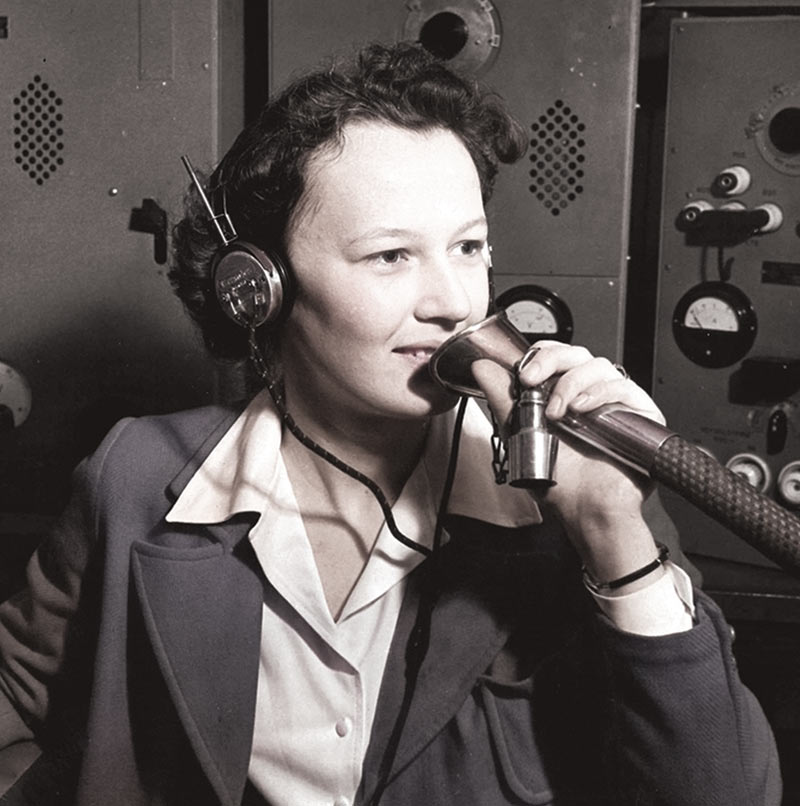
After taking a night class at the Radio College of Canada, Fern Blodgett became the first woman to serve as a wireless operator at sea when she got a job aboard Norwegian merchant vessel M/S Mosdale. [Courtesy Fern Sunde Sletten]
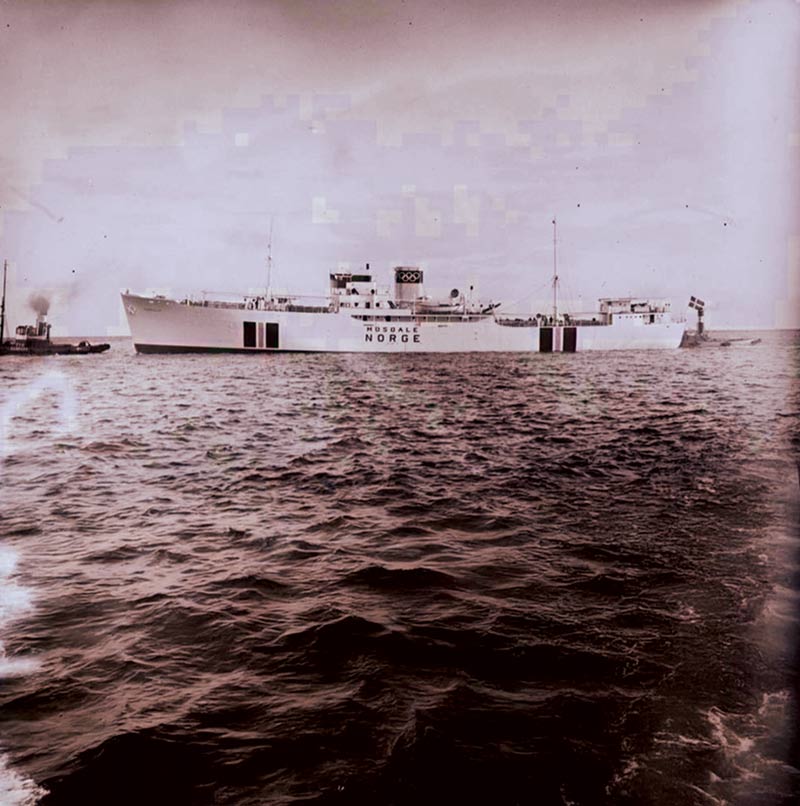
[digitalmuseum.org]
I’m not superstitious,” wrote Canadian Fern Blodgett of her unlikely war. “Otherwise I might have worried about starting the biggest adventure of my life on Friday the 13th.”
That morning in June 1941 had been like any other. Weeks shy of her 23rd birthday, the Toronto-based stenographer had caught the streetcar to work at an insurance office, where “I settled down to my familiar routine—taking dictation, typing, bookkeeping. There was nothing to indicate that this day would be one I would never forget. And then I was called to the telephone.”
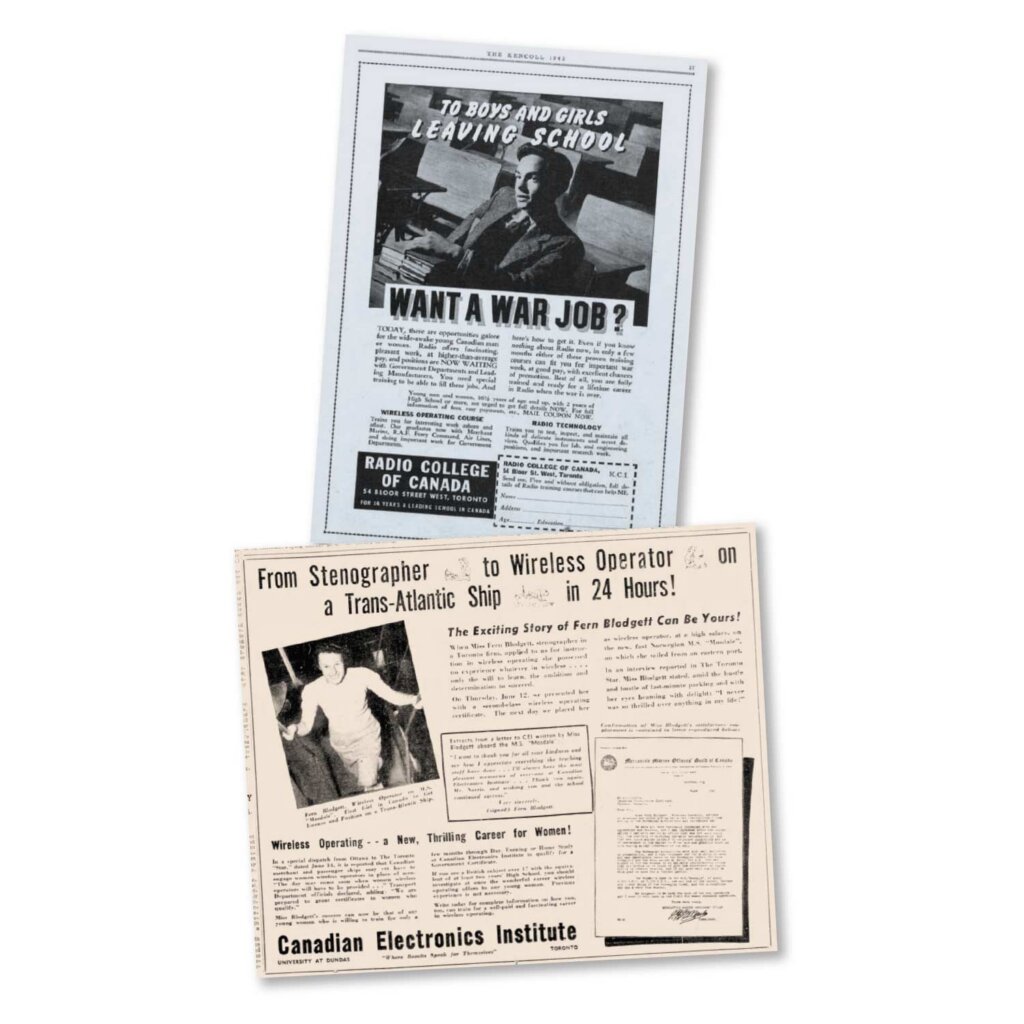
It was “Mr. Norris,” the school principal of the 18-month commercial radio night class that Blodgett had graduated from less than 24 hours earlier. Now, as the first Canadian woman to earn a second-class wireless operator’s certificate, she was being asked the improbable, perhaps the impossible.
“Miss Blodgett,” said Norris, “you told me you would like to go to sea as a wireless operator on a ship. Were you joking, or did you mean it?”
[yorkvilleu.ca; Toronto Star]
It had indeed been no laughing matter.
“How soon could you be ready to leave?” the principal asked.
She could leave at once.
On a train bound for Montreal, Blodgett struggled to sleep as she processed the responsibilities she would soon have, not only of being the first woman believed to perform such duties at sea—her second historic feat in as many days—but also the more immediate concern of ensuring a merchant navy crew’s safety in war.
It clearly took no superstition to fret over immense perils amid the Battle of the Atlantic, of waters infested with German U-boats and surface raiders, of a capricious ocean with its capricious weather.
“What if I lost my nerve in a crisis?” she asked herself. “What if I failed?”
Born in Regina on July 6, 1918, Fern Blodgett’s seabound journey began after her family moved to Cobourg, Ont. There, living just a short walk from Lake Ontario, the young girl stood at the shoreline to watch the vessels pass by, insatiably fascinated.
“I wished in those days,” she penned in a 1942 Star Weekly newspaper article, “that I had been born a boy, so I could become a sailor. I would dream about rounding the Horn, and harpooning whales, and standing at the wheel of a sailing vessel, in a North Atlantic gale, bellowing orders at the men in the rigging.”
Blodgett read the sea stories and watched the motion pictures, her dreams continuing until “I’d have to wake up to the fact that I wasn’t a little boy, but a little girl, and go back to my dolls.”
Life certainly seemed like it had conventional plans for her, at least initially. In 1936, Blodgett trained as a nurse only to discover it wasn’t her calling. She then moved to Toronto in 1938 and took a business class. Landing a job as a stenographer may have been fulfilling for many, but Blodgett wanted more.
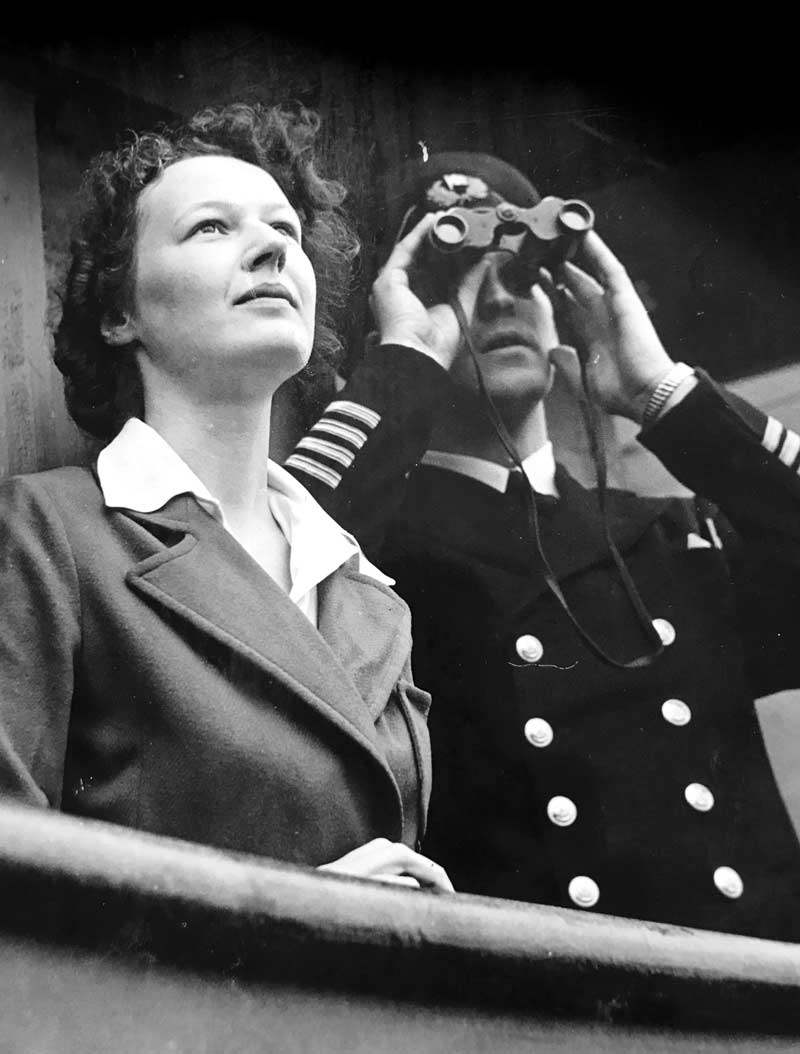
The recently married Blodgett Sunde and her husband, skipsfører Gerner Havig Sunde, aboard M/S Mosdale in 1943. [Courtesy Fern Sunde Sletten]
A war was now on. “I thought that I ought to do something to help,” said Blodgett, who resolved herself to write “three schools where radio was taught.” Two, she recalled, promptly replied that “they had never had a girl in their radio operators’ class and did not contemplate having one now.” The third agreed.
Blodgett knew almost nothing about radio, admitting that her previous knowledge was little more than “how to turn the dial on a receiving set and tune in on my favorite dance band.” Nevertheless, she committed herself to the trade, attending class three evenings a week and studying on the remaining nights at home.
The aspiring member of the “sparks”—the nickname bestowed on wireless operators due to the spark-gap transmitters they used to send Morse code messages via radio frequencies—sailed through her examinations with high marks. No longer a novice, she finally “knew the codes, could do minor repairs on radio sets, knew the principles of electricity and many intricate mechanical devices,” reported a 1942 Montreal Gazette column on Blodgett.
The next leg of her voyage awaited.
“I wished in those days that I had been born a boy, so I could become a sailor. I would dream about standing at the wheel of a sailing vessel.”
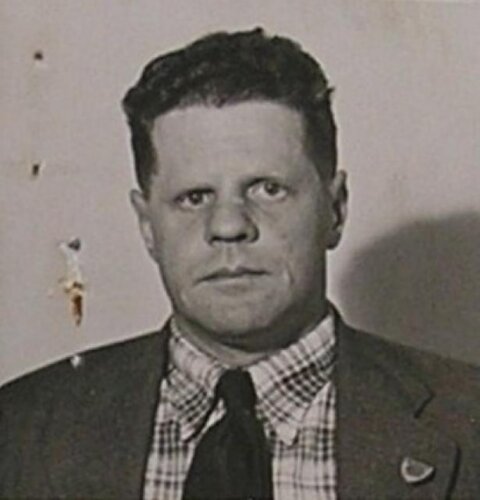
Norwegian skipsfører (ship captain) Gerner Havig Sunde was impatient and frustrated as he stood aboard his 3,022-ton vessel, M/S Mosdale, docked in drizzle- and fog-drenched Montreal—impatient because he wished to depart with his usual 35-strong crew (with room for 12 passengers); frustrated because their wireless operator had abruptly resigned for an easier existence on the Great Lakes.
Tall, blonde and nearly 30, the experienced seaman had served aboard a number of other ships before the war. Now, having only recently ascended to skipper in a period of considerable jeopardy for his country, Sunde was, perhaps understandably, on edge.
Germany had invaded neutral Norway on April 9, 1940, the latter laying down arms on June 10 that year. When Norwegian politician Vidkun Quisling—a Nazi collaborator—demanded that more than 1,000 of the country’s merchant vessels at sea return home to serve the Third Reich, not one obeyed. Both the king and legitimate government went into exile, forming the Norwegian Shipping and Trade Mission—or Nortraship—to oversee the merchant navy as part of the Allied war effort.
So it was that the 1939-built Mosdale, en route to Colombia for a banana shipment when the occupation took place, joined the cause. So it was that a frustrated and impatient Sunde stood ready to receive a replacement wireless recruit to continue the fight.
Accounts have it that the skipsfører was surprised to learn that “F. Blodgett” was a woman as she clambered up the wet gangplank toward him. According to the wireless operator herself, Sunde was aware.
“I knew you were going to be a woman,” he reportedly remarked, “but I expected somebody older.”
Regardless, the persisting ambiguity over whether Blodgett could actually serve under regulations still needed to be addressed. Neither Canadian nor British vessels permitted female merchant navy crew members. Norway, though, had no such rules.
With Mosdale fully loaded and due to sail for England, the decision was left to Sunde, who determined that Blodgett could don the ship’s radio headset at $170 a month “plus board,” becoming the fourth—yet only female—Canadian sailor on the roster. It was a good thing she wasn’t superstitious, doubly so since many seamen believed that women brought ill luck on deck. She was wholly untested, moreover, confessing to having never been on any vessel larger than a rowboat.
Few expected her to make the return voyage, but for now, here she was, cruising along the St. Lawrence River on Mosdale—one of six similar Norwegian fruit carriers—bound for the unknowns of the Atlantic.
For now, here she was, a krigsseiler—a war sailor.
“Who would want to get married and wash shirts and dishes and stand over the stove cooking when she could do this?” Blodgett asked herself as she got familiar with the ship’s wireless instruments, the instructions for which were written in a different language.
Alas, at least on her inaugural transatlantic passage, she swiftly wondered if she had spoken too soon after becoming overcome with seasickness, “so seasick [that] I’d have promised to wash shirts and dishes for the rest of my days if only I could get back on land.” Blodgett persevered—she had no choice.
With a bucket by her side, an all-but-permanent fixture throughout her tenure on open waters, Mosdale’s green wireless operator changed into slacks, a sweater and a jacket—believing the merchant navy officer’s blue uniform to be “too stagey”—and carried on with her duties.
Blodgett’s daily routine as a sparks consisted of eight hours, with “two hours on and two hours off.” It was her job, among other obligations, to maintain links between ships and land-based stations, sending and receiving navigational aids and weather information—as well as reports of enemy sightings—through continuous wave signals, keyed in via Morse code. The deliberately complex format of those encoded messages changed frequently; a single mistake or misinterpretation could result in a costly catastrophe.
In the event of such attacks, should there be a possibility of the code books falling into enemy hands, the onus was on the sparks to dispose of them, fast.
Off duty, Blodgett made herself known to the crew (having at first expected them to “toss me overboard”) in addition to Mosdale’s steady stream of passengers (“correspondents, technical experts, an African explorer, servicemen, [and] merchant seamen who had been torpedoed”) whose spirits she sustained playing the onboard piano.
Ultimately, the self-confessed landlubber found that her Norwegian comrades, whom she labelled a “grand bunch” while appearing “very loyal and heart-broken at losing their country,” didn’t treat her “any differently than they did the others.”
That may have been the case, but the press, as it was so blatantly prone to in the 1940s, did. “Then came an important question,” wrote one reporter during an interview with Blodgett, “What does your boy friend think of all this?”
She didn’t have one, responded the war sailor with a tactful smile.
In another newspaper article, asked if she would surrender her seafaring service “to settle down in domesticity, Fern, who looks more like a model of size 12 dresses than a wireless operator, laughed…”. Her response: “The fact that I am a woman doesn’t alter the situation.”
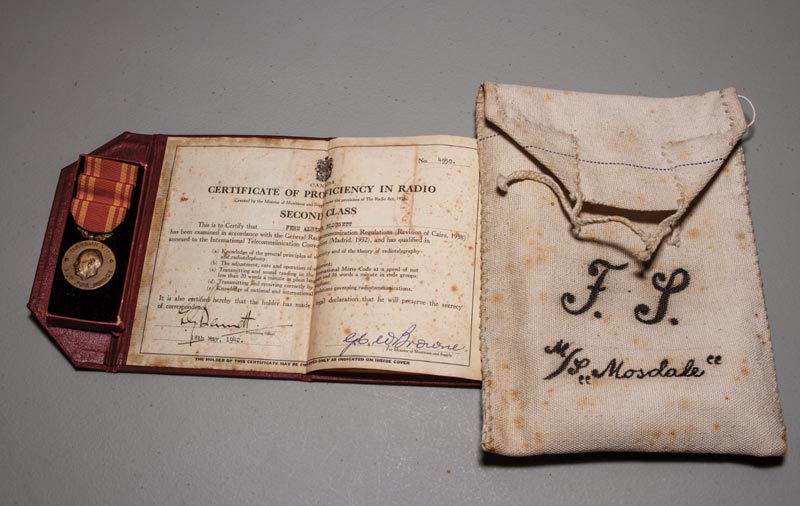
Blodgett Sunde’s wireless radio certificate and the pouch in which she carried her identification at sea.[ Fern Blodgett Sunde/facebook.com; Courtesy Graham Beer]
Even so, the thought had once crossed her mind. “I wondered whether I would be a woman or a wireless operator if we were torpedoed,” she recorded. “As a woman, I could be expected to head for the lifeboats. As a wireless operator, as the ship’s ‘sparks,’ I’d be expected to remain on duty.
“I decided I’d be a wireless operator.”
Blodgett still hoped that her dilemma would never be tested.
It was a hope seldom more apparent than amid one gauntlet-running voyage, when “a seaman came rushing” into the room where she was relaxing in search of the captain. A German U-boat had been sighted off the starboard bow.
Ordered to her station, Blodgett “bent over [her] wireless key, frantically tapping out a code message [they had] for just such occasions,” expecting “any second to hear the terrific explosion of a torpedo smacking [their] ship.”
The wireless operator was infected with fear as she struggled to listen. She quickly snapped herself out of it.
“When I did remember to listen in,” Blodgett continued, “I found [the signal] had been picked up and relayed by a coastal station.
“I was the first woman ever to send out a message giving the location of an enemy submarine in wartime.”
The incident ended without an attack, and the U-boat submerged beneath the waves. Perhaps, Blodgett theorized, “it had no torpedoes left.” Perhaps Mosdale’s speed capabilities, gliding through the water at up to 15-16 knots, not to mention its armament and its wireless operator’s communiqué, had deterred the would-be assailant.
Such was the ship’s adeptness at outpacing undersea lurkers that it often travelled alone across the Atlantic. In solitude, though, came some of the greatest dangers, be they shadowy figures on the horizon, uncharted minefields or Mother Nature. Notwithstanding the untold risks, crew members were said to prefer relative isolation over infrequent convoy assignments, where Mosdale could sail only as fast as the slowest freighter.
No material advantage could guarantee safety, of course. “We are more afraid of bombers than submarines,” furthered Blodgett, especially as Mosdale straddled the British coast. On Feb. 4, 1943, an adapted German Focke-Wulf 200 accosted the ship, forcing Norwegian gunner Ingvar Tautra to open fire from the Oerlikon 20mm cannon. Once more, fortune found the crew after the “aircraft departed without having caused any damage,” according to a war sailor online database.
Thousands of kilometres away, in Peterborough, Ont., where Blodgett’s father ran a hotel, the wireless operator’s family worried. “My mother and sister sometimes tried to persuade me to stop going to sea,” she noted. “I couldn’t. I liked it too much.”
But Blodgett also felt that it went deeper than that. “Until the Nazis are defeated,” she wrote, “this is where I belong.”
Besides, it was the blackouts in British ports, not Atlantic confrontations, that Blodgett dreaded most. Even in the absence of air raids, a few days spent in shoreside comfort usually left her pining for “where I can hear the waves lapping against the side of the ship as I go to sleep.”
Blodgett had another reason for staying by that point. Months earlier—on July 20, 1942—the krigsseiler had married her skipsfører in Saint John, N.B. She was now Fern Blodgett Sunde, her honeymoon spent at sea.
By VE-Day, M/S Mosdale had, in a sense, earned two sobriquets.
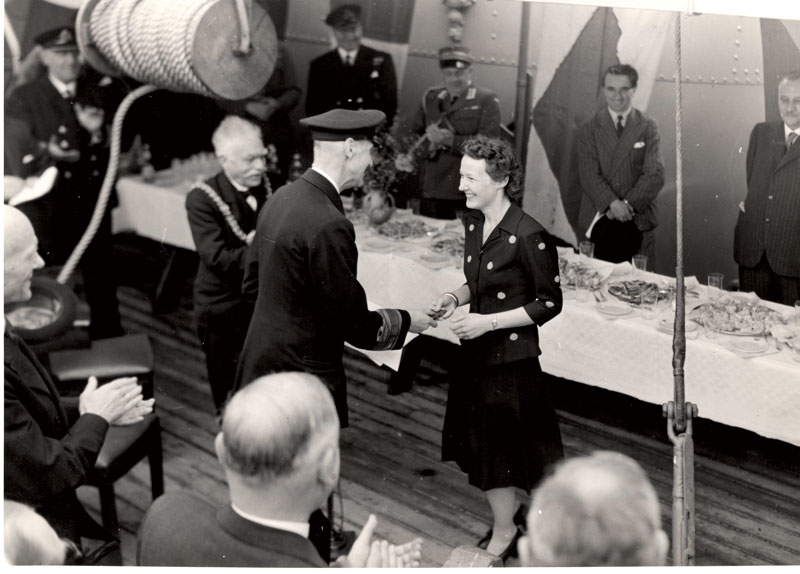
King Haakon VII of Norway presents Fern Blodgett Sunde with the Norwegian War Medal in 1943. [Courtesy Fern Sunde Sletten]
The first related to its acclaim “bringing over 120,000 tons of meat and bacon to England” in its refrigerated holds, thus acquiring the light-hearted moniker of “pork boat.” The second spoke to the fact that Mosdale was never sunk—unlike its five sibling freighters—to become the “lucky ship.”
The odds had been stacked against it. Of Norway’s merchant seamen—including those who trained at Camp Norway in Lunenburg, N.S.—an estimated 4,000 perished without ever seeing their country’s shackles removed. There was likewise the sheer number of transatlantic crossings that the once-record-breaking Mosdale made, amounting to 96 voyages. Blodgett Sunde was aboard for 78 of them, first as the sole sparks, then as chief operator of two new recruits.
The Canadian war sailor’s influence extended far beyond those under her command. Blodgett Sunde’s exploits, reads one biography, “became an unexpected beacon, leading to a small sisterhood of Sparks at sea. Twenty-one Canadian women followed in her footsteps, serving as operators on Norwegian merchant ships during the war.” More still served in the war’s aftermath until “new technology in the 1980s and early 1990s replaced wireless radios.”
Her service didn’t go unrecognized. In July 1943, when the proverbial tide of the Atlantic campaign appeared to be turning in the Allies’ favour, Norway’s King Haakon VII decorated Blodgett Sunde with the Norwegian War Medal, making her the first woman to receive the prestigious honour. Etched into the accolade’s façade was the monarch’s motto, “Alt for Norge”—All for Norway.
Finally, in 1945, with Norwegian liberation secured, the majority of the ship’s crew yearned to be reunited with their loved ones whom they hadn’t held for half a decade. Mosdale steamed into Oslofjord shortly after the war’s end and at last docked in its freed homeland. Crowds thronged the streets, cheering its arrival. Not only did the vessel’s crew members—Blodgett Sunde among them—deserve a hero’s welcome, within its holds was a long-delayed shipment of fresh bananas.
It was a fitting conclusion of sorts, a full-circle moment for Mosdale’s esteemed career in conflict. For Blodgett Sunde, however, her love affair with the sea intermittently prevailed until 1952, when she retired to her husband’s childhood town of Farsund. There, the former sailor tended to her garden and helped raise two daughters, Fern and Solveig Ann.
Tragedy struck just 10 years later on Jan. 4, 1962, when Gerner Sunde died of a heart attack at sea; he was 50. The late skipsfører’s widow never remarried, insisting that, “There will always just be one true love for me.”
Blodgett Sunde passed away on Sept. 19, 1991, at age 73. Her legacy has since been immortalized in bronze. On Oct. 17, 2020, a life-sized memorial of the trailblazer was unveiled in Cobourg, Ont. Created by sculptor Tyler Fauvelle, the art installation—located on the same shoreline that a young Blodgett Sunde watched the ships pass by—is entitled “Make Waves.”
Its name is multifold, explained the Sudbury, Ont., artist, affirming that its depicted “wave symbolizes the wave of social changes which came for Canadian women in the storm of war. It also evokes radio waves, as well as the waves of the sea.” The monument, he continued, portrays Blodgett Sunde “stepping forward, with one foot emerging from the wave, but she’s also looking back. Forward is her persistence in breaking barriers, looking back is for remembrance.”
On May 8, 2025—the 80th anniversary of VE-Day for many countries, as well as Liberation Day in Norway—an identical memorial was unveiled on the water’s edge of Farsund, where Blodgett Sunde’s seabound journey ended.
From Lake Ontario to her final fjord, the krigsseiler remains on watch.
The monument portrays Blodgett Sunde “stepping forward, but also looking back. Forward is her persistence in breaking barriers, looking back is for remembrance.”
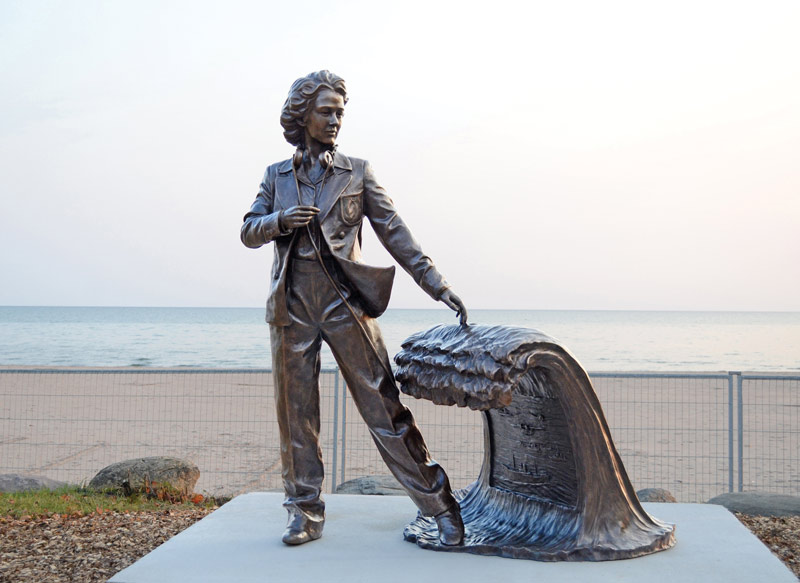
“Make Waves” sits at the waterfront in Cobourg, Ont., and Farsund, Norway.[Tyler Fauvelle/canada.ca]
Advertisement






What a story! And what a terrific, well-placed monument to commemorate not only her service during the war but also remind us that our greatest strength can be our imagination.
My mother was doing welfare work in Liverpool during 1941. Early that year she started going out with Captain Sunde whenever the Mosdale was in port. The romance ended towards the end of the year. She told me about this in her 80’s as we came out of the museum in Scalloway , Shetland, that has exhibits about the Norwegian resistance. “HE MARRIED HIS WIRELESS OPERATOR !” she said , glumly.
After her death I read her diary for 1941 (very eventful ) and found out the full story on the internet from the clues I found.
In 2016 I did the Pilegrimsleden pilgrimage hike. Arriving in Trondheim I went to the Norwegian Merchant Navy museum. The curator showed me the book ” Lyklyke Mosdale” which was a best seller in Norway in the 1950’s, telling the story.
No Allied ship did more Atlantic crossings. Fern was very brave.