

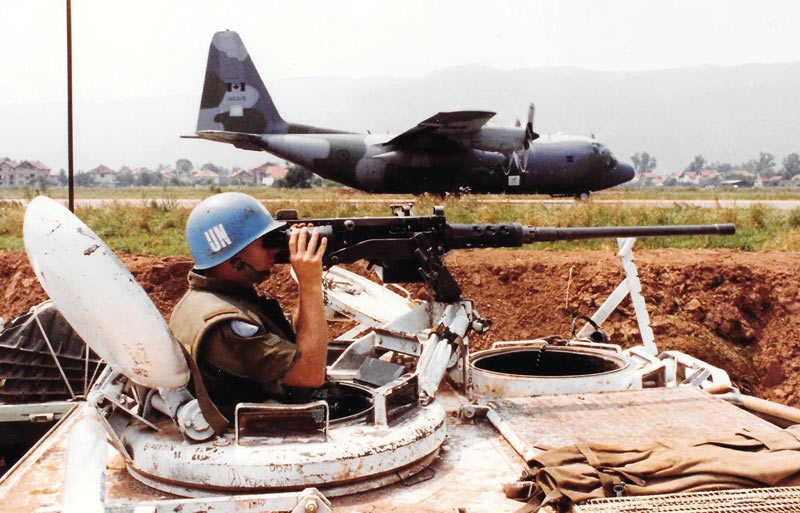
An unidentified member of the Royal 22e Régiment eyes the landscape from an M113 armoured personnel carrier near a Canadian Armed Forces C-130 Hercules at the airport in Sarajevo, Bosnia and Herzegovina, circa 1992. [Balkans35.ca]
If you saw what I see for the future of Yugoslavia, it would scare you.” How prophetic was Yugoslavian President Josip Broz Tito in 1971?
A little more than 10 years after his death in 1980, the country Tito had helped create and had led since the end of the Second World War quickly descended into a morass of bloody civil wars. Paradoxically, the system Tito left in place—equality among the country’s six republics and two autonomous regions—produced the conditions for the eventual breakup of the Federal Republic of Yugoslavia, beginning in 1991.
During those wars, the world was introduced to a new phrase: ethnic cleansing, a literal translation of the Serbo-Croatian expression etnicko ciscenje, the forced removal of ethnic, racial or religious groups from a given area. The fragmentation of Yugoslavia resulted in atrocious human rights violations and the deaths of up to 140,000.
Forces of European countries, the United Nations and NATO became involved in various attempts to prevent ethnic cleansing. Canada participated in these from the beginning, sending Canadian Armed Forces members and civilian police. At one time, up to 2,000 CAF personnel were serving in the wartorn country.
The breakup of Yugoslavia began on June 25, 1991, when the republics of Slovenia and Croatia declared independence. Two days later, the Yugoslav People’s Army (JNA) marched into Slovenia. Fierce fighting followed for the next two weeks but, by the end, Slovenian militia defeated the JNA. Representatives of the European Community (the forerunner of the European Union) negotiated a ceasefire and established the European Community Monitoring Mission in the Former Yugoslavia in July 1991. On Sept. 1, the agreement was extended to include JNA withdrawals from Croatia.
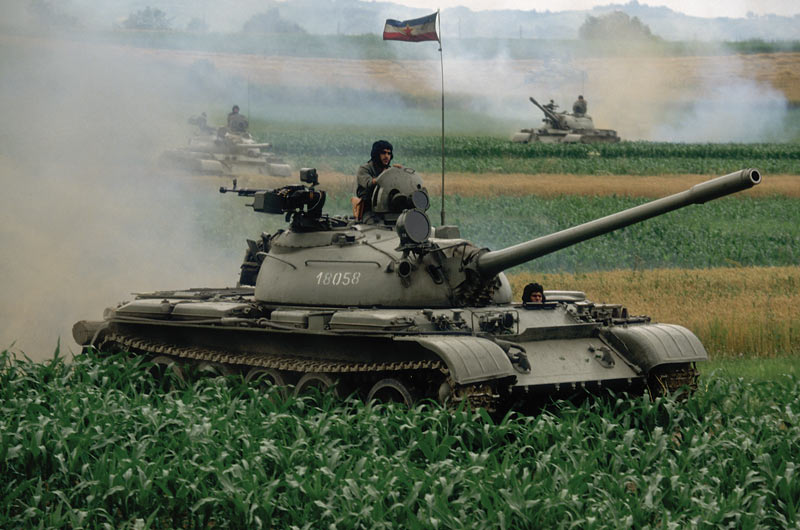
Yugoslavian tanks roll through Slovenia (above) shortly after the republic declared its independence on June 25, 1991. [DND/LAC/4113927]
Under the code name Operation Bolster, the CAF provided 10 officer monitors and two support staff on each of six rotations between September 1991 and late August 1994. Canadian officers held a disproportionate number of supervisory positions, including at the monitoring mission’s headquarters in Zagreb, Croatia, and regional centres.
In the July 1993 issue of the Maritime Engineering Journal, Lieutenant-Commander Bryan Leask described his experiences on the mission. In the beautiful medieval walled city of Dubrovnik, Croatia, a local family had invited his team into their home, but already, “it was sad to see from the attitude of the children that another generation of hatred was being bred.”
Colonel Fred Noseworthy served on the mission between September 1992 and April 1993, double-hatted as chief operations officer and Canadian contingent commander. In a recent interview with Legion Magazine via email, he noted: “Canada’s roles in the former Yugoslavia, particularly during the early stages of the conflict(s) was a sobering test of its theretofore proud peacekeeping heritage and identity, revealing the limitations of traditional approaches to conflict resolution in the face of a savagely brutal ethnic conflict.”
“And to be honest,” Noseworthy continued, “we weren’t nearly as well prepared for what we encountered on a daily basis as might be the case today…lessons were learned but PTSD became all too prevalent for those who returned.”
In mid-1994, Canada withdrew from the monitoring mission because of increasing UN commitments.
Due to the ongoing conflict, UN Protection Force (UNPROFOR), consisting of 12 battalions, support units and civilian police, was established in February 1992. Its mission was to ensure three UN protected areas in Croatia were demilitarized.
Canadian Brigadier-General (soon to be major-general) Lewis MacKenzie was the UN force’s chief of staff. A veteran of several previous peacekeeping missions, MacKenzie was an ideal choice, as neither the Indian lieutenant-general commander or the French major-general deputy had previous UN experience.
To the consternation of the three senior officers, the UN directed the force to establish its HQ in Sarajevo, the capital of Bosnia and Herzegovina, while it was deployed in Croatia, hundreds of kilometres away. It made no sense. But it did provide an opportunity for MacKenzie to appear in living rooms around the world on the nightly news.
In April, the CAF provided a battle group of 860 infantry soldiers based on 1st Battalion, Royal 22e Régiment, with ‘N’ Company from 3rd Battalion, The Royal Canadian Regiment attached. Both units were from 4 Canadian Mechanized Brigade Group based in Germany.
Known as CANBAT, the unit operated checkpoints, conducted patrols and monitored the activities of opposing military forces. The CAF also provided an engineer regiment from April 1992 to March 1993, a logistics battalion from September 1992 to March 1995 and 12 forward air controllers from July to November 1993. The latter two were subsequently absorbed into the battle group.
“That vicious circle of retaliation was one of the major problems with this particular war.”
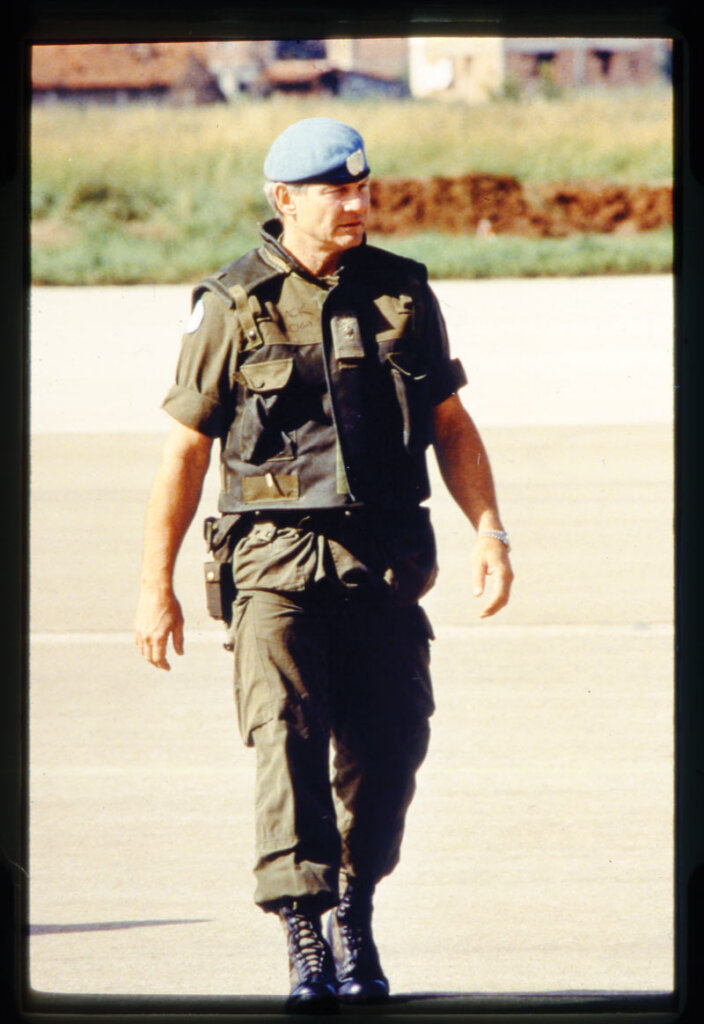
Canadian Brigadier-General Lewis MacKenize, served as chief of staff of the UN Protection Force. [CWM/20180249-007]
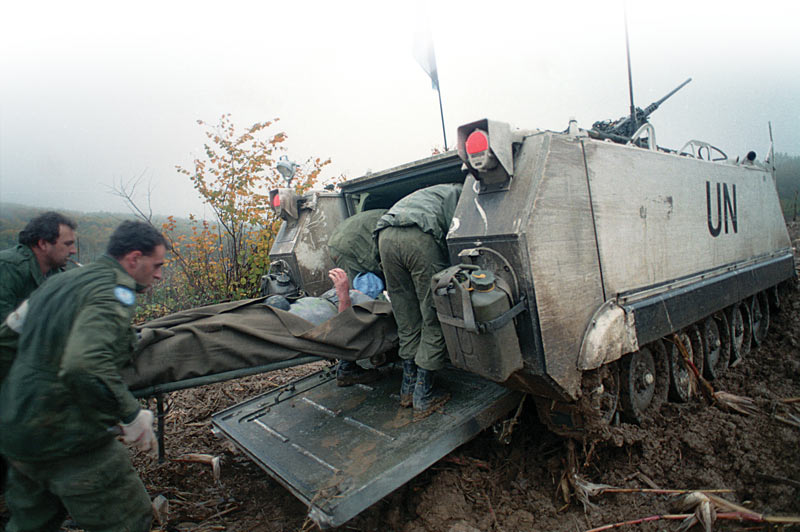
A medical evacuation at a Canadian base in Croatia. [Langevin Jacques/Sygma/Getty Images/607444736]
In June 1992, the conflict intensified and spread into neighbouring Bosnia and Herzegovina when Sarajevo came under sustained attack by Serbs. MacKenzie persuaded his superiors to expand UNPROFOR’s mandate and strength to ensure the security and continued operation of the city’s airport. This mission also included delivering humanitarian aid in the area.
It took CANBAT 48 hours to complete its move to Sarajevo after a day-long holdup by Croatian forces. In the capital, the battalion faced additional difficulties in dealing with Serbs and Bosnians. MacKenzie spent hours journeying from one side to the other as he tried to convince the belligerents not to fire on each other, UN soldiers or humanitarian aid workers.
“That vicious circle of retaliation was one of the major problems with this particular war,” MacKenzie noted in his book Peacekeeper: The Road to Sarajevo. He resorted to the power of the media to try to embarrass Serbs and Bosnians to adhere to the agreements they had signed. This worked to a degree, but sporadic sniping and shelling remained a constant threat.
Between 1992 and 2010, about 40,000 canadians served in the region of the former Yugoslavia, with a handful still working in Kosovo today.
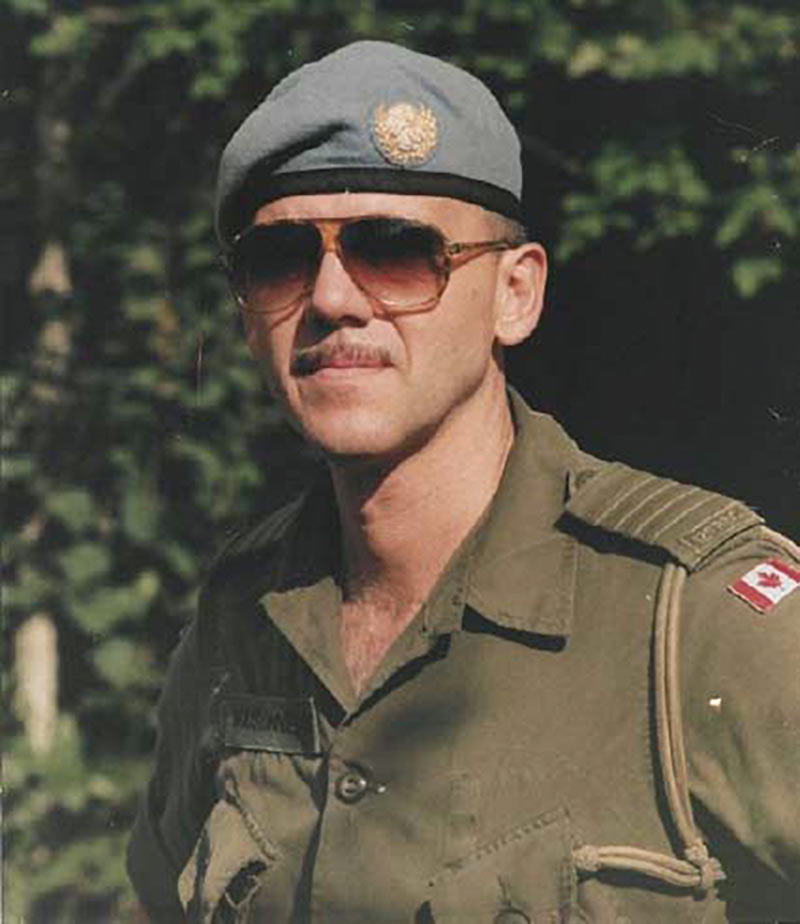
Canadian Colonel Michel Maisonneuve (above) served as chief of operations at the UN Protection Force headquarters. [pk75.ca]
Later that year, the UN mission expanded into Bosnia. Canada provided a second battle group, known as CANBAT II, consisting of a mechanized infantry battalion, with an attached armoured squadron. It deployed to Visoko, Bosnia and Herzegovina, a powder keg where all three warring factions vied for control.
The battle group struggled to get aid convoys through, forcing National Defence headquarters (NDHQ) to change its composition to two armoured squadrons, a mechanized infantry company and an engineer company in November 1993.
Despite the presence of UN troops, the combatants continued to snipe, shell and attack each other. Serbian forces took Canadians hostage twice, once subjecting them to mock executions. In Croatia, Serb Krajina forces shelled Croat army positions from high ground near Medak. On Sept. 9, Croat forces began an operation to capture the position. Several days of intense combat followed before yet another ceasefire was arranged. The agreement required all belligerents to withdraw from the so-called Medak pocket, which Croatian units had captured.
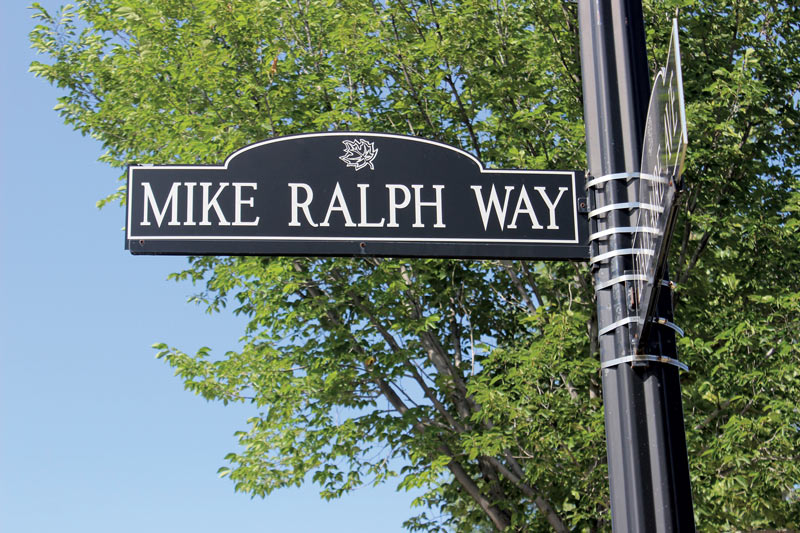
The first Canadian killed in the former Yugoslavia was Sergeant Mike Ralph, a combat engineer from Canadian Forces Base Gagetown, N.B. On Aug. 17, 1992, Ralph returned to double-check a Croatian minefield that had been cleared the previous day. As he drove a truck through the area, it hit a mine and Ralph died in the subsequent explosion. Canadians were shocked; peacekeepers were not supposed to die from the actions of the people they were trying to help. The Sgt. Ralph Bridge in Gagetown’s training area and Mike Ralph Way in Calgary (above) are named in his honour. Twenty-two other Canadians died in the area before the various missions ended. [VAC]
Colonel (later lieutenant-general) Michel Maisonneuve was the chief of operations at UNPROFOR headquarters. He and a French colleague had drafted the Medak pocket agreement but knew they would need to deploy forces to implement it.
“Of all the forces available…the two Canadian battle groups were [two of the few from] 29 troop-contributing nations that I could deploy in any demanding scenario,” Maisonneuve told Legion Magazine.
“The Brits, French and Canadians,” he continued, “had deployed proper battle groups…equipped and trained for general purpose warfare.”
Maisonneuve recommended deploying the newly arrived battle group from 2nd Battalion, Princess Patricia’s Canadian Light Infantry (2 PPCLI), along with two French mechanized companies, to northern Croatia to UNPROFOR’s commander. He agreed.
On Sept. 15, UNPROFOR ordered 2 PPCLI (44 per cent of whom were reservists), with French support, to move into the Medak pocket and oversee the withdrawal. The Croats fired on UN forces with machine guns and artillery to try to drive them back. But the Patricias stayed. They constructed a fortified position, returned fire and drove off night attacks by the Croats during a 16-hour battle.
When the Croatian commander realized the Canadians and French were not moving, he agreed to a ceasefire and withdrawal. But on Sept. 16, the Croats held the Canadians up at a heavily fortified roadblock as they attempted to advance into the pocket.
Lieutenant-Colonel Jim Calvin, the Patricias’ commanding officer, held a spontaneous news conference during which he accused the Croats of having something to hide. Around 6 p.m., the Croatians withdrew. When the Canadians finally advanced into the pocket, they found evidence of Croatian ethnic cleansing of local Serbs. But the actions of the Canadians had prevented further deaths.
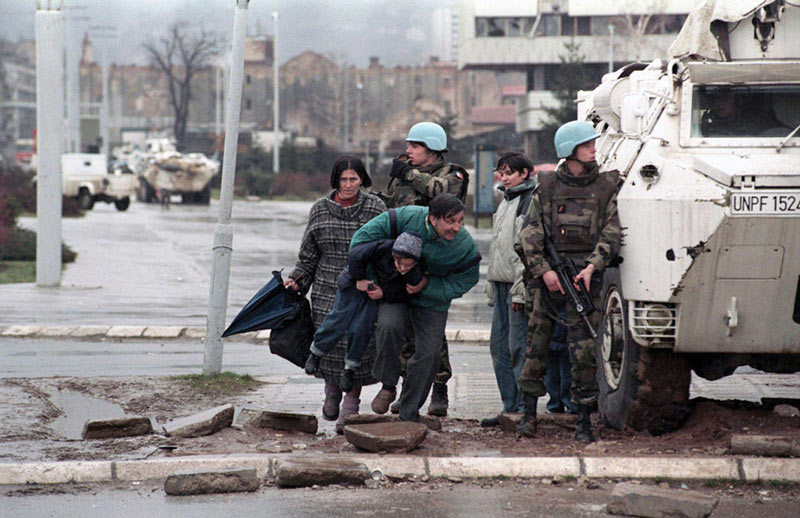
Locals take cover behind a UN armoured vehicle in Sarajevo in 1993. [Danilo Krstanovic/Reuters/Alamy/2D1GJ5]
Former defence chief Wayne Eyre was a captain commanding 2 PPCLI’s reconnaissance platoon at the time. He led his soldiers into the razed village of Licki Citluk. During the next few hours, Eyre and his men discovered several mutilated bodies. No Serbs were found alive in the village.
“The smoke, the flames, is something I will never forget,” Eyre told the CBC in 2023.
The battle was not publicized by the Canadian government at the time, as it conflicted with the public perception of peacekeeping. Yet the standoff resulted in four wounded Canadians and was the toughest action faced by the country’s soldiers between service in Korea and Afghanistan.
It was not until 2002 that information about the battle began to surface. This culminated in the first-ever award of a Commander-in-Chief Unit Commendation to the battalion. In an address, Gov. Gen. Adrienne Clarkson noted: “Your actions were nothing less than heroic and yet your country didn’t recognize it at the time.”
In March 1995, the UN Security Council restructured UNPROFOR into three separate but related operations. UNPROFOR remained in Bosnia and Herzegovina, while the UN Confidence Restoration Operation in Croatia and UN Preventive Deployment Force in Macedonia were created. These three missions operated under a new joint theatre command in Zagreb, Croatia, known as UN Peace Forces Headquarters (UNPF-HQ).
In mid-July 1995, one of the worst incidents in the war occurred when Bosnian Serb forces rounded up more than 8,000 Bosnian Muslim boys and men and executed them in Srebrenica, Bosnia and Herzegovina.
Colonel Rick Hillier (later general and defence chief) was serving as director of operations at UNPF-HQ at the time. “In the aftermath of Srebrenica it became overwhelmingly clear the United Nations’ approach to the crisis was dysfunctional and that its presence was tolerated by the warring parties only as long as each could manipulate it for partisan gain,” he wrote in his book, A Soldier First: Bullets, Bureaucrats and the Politics of War.
The atrocity was the catalyst for the escalation of NATO’s efforts to end the war in Bosnia and led to the signing of the Dayton Accords in December 1995. NATO launched Operation Joint Endeavour to ensure compliance with the agreements. It was the alliance’s first crisis response deployment and resulted in a heavily armed, 60,000-person Implementation Force (IFOR), which operated for a year.
Most NATO members, along with a few non-NATO countries, notably Russia, contributed to IFOR. Operating under Chapter VII of the UN Charter, IFOR’s rules of engagement permitted the use of deadly force to achieve the mandate’s aims. UNPF-HQ was phased out in January 1996, following the creation of the two new UN missions in Bosnia and Herzegovina and Croatia, as well as positive developments in the former Yugoslavia.
“In the aftermath of Srebrenica it became overwhelmingly clear the United Nations’ approach to the crisis was dysfunctional.”
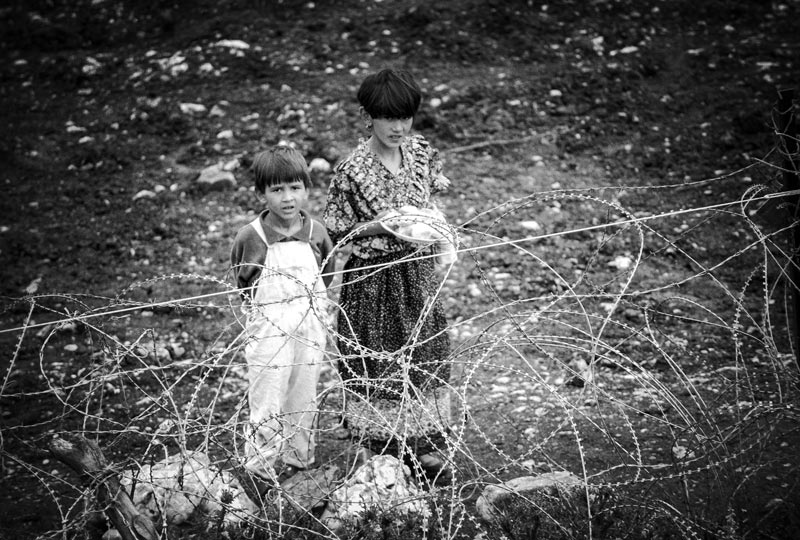
Orphaned children stand outside the gate of a UN Protection Force compound in Srebrenica, Bosnia and Herzegovina. [Betastock/Alamy/2A3WB7K]
Shortly after IFOR was created, Canada announced it would provide soldiers to it—two, six-month rotations of about 1,000 troops to be part of a multinational brigade under Canadian command. Operation Alliance, as it was known, was the first operational deployment of a Canadian formation headquarters since the Korean War. Perhaps more noteworthy, it marked the first high-profile mission since the Somalia Affair, the 1993 peacekeeping scandal.
The first rotation was based on 2 Canadian Mechanized Brigade Group, commanded by Brigadier-General Bruce Jeffries (later major-general), out of Petawawa, Ont. Among its many tasks: establishing freedom of movement; supervising the withdrawal and separating the combatants; patrolling ceasefire lines and supervising the removal of landmines and unexploded ordnance.
The contingent was known as 2 Canadian Multinational Brigade (2 CAMNB). It consisted of a brigade headquarters and signals squadron, an armoured reconnaissance squadron, an infantry company, engineer squadron, national support element, advanced surgical centre and a military police platoon. The infantry company also included a support weapons platoon, with mortars, anti-armour missiles, pioneers and reconnaissance elements.
In theatre, Jeffries grouped the infantry company with a British armoured regiment to form a small but potent battle group. The Canadians joined Multinational Division Southwest, led by 3 (U.K.) Division. A Czech mechanized infantry battalion rounded out 2 CAMNB.
Jeffries singled out two key components of 2 CAMNB to Legion Magazine: engineers and military police. He referred to the former as “the Swiss Army knives of the profession of arms—capable of fixing, building, protecting, destroying, maintaining mobility and making like infantry when push comes to shove.”
The military police, meanwhile, “performed a multitude of tasks and acted with economy of force. Such was their utility that I requested NDHQ to increase our establishment with two additional sections.” It was approved.
When 2 CAMNB’s six-month tour ended, it was replaced by units from 5 Canadian Mechanized Brigade Group based out of Valcartier, Que. Elsewhere, Canadian ships had been supporting IFOR by participating in a naval blockade in the Adriatic Sea, while Canadians in NATO’s Airborne Early Warning and Control Force helped enforce a no-fly zone.
When IFOR ended in December 1996, NATO replaced it with a Stabilization Force (SFOR). SFOR was another multinational operation aiming to bring lasting peace to Bosnia and Herzegovina and to transition its responsibilities to an EU force. SFOR helped maintain a secure environment and facilitate the country’s reconstruction after the devastating 1992-1995 war.
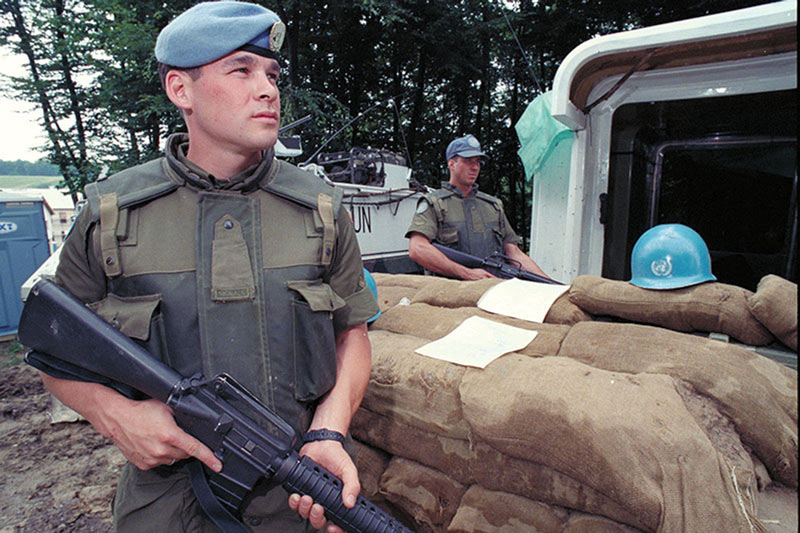
Canadian corporals Darrell Houle and Daniel Proulx guard a Canadian base in Croatia. [DND/VAC/balkans35.ca]
Canada’s overall contribution to SFOR was known as Operation Palladium and included 1,200 Canadians. The country’s contingent was labelled Task Force Bosnia-Herzegovina. Its headquarters and support base were both located in Velika Kladuša, a town in northwestern Bosnia and Herzegovina near the Croatian border. CAF units rotated every six months.
Lieutenant-Colonel Tim Grant (later major-general) commanded the Strathcona Battle Group in SFOR from fall 1997 to spring 1998. Pre-deployment training in Canada had been completed successfully, except for civilian-military co-
operation (CIMIC) teams. Before deploying overseas, however, the battle group had been sent to Winnipeg to assist with major floods in the area.
Grant told Legion Magazine that during that experience his CIMIC teams “proved their worth as they made connections with politicians and first responders throughout the city, which allowed me to deploy forces where needed most.” In the end, said Grant, “the experience was just what the CIMIC teams needed to confirm their readiness for deployment.”
The Canadian task force was part of Multinational Brigade Northwest. The brigade’s headquarters was in Banja Luka and brigade command rotated through the three contributing countries: Canada, Britain and the Netherlands.
On March 24, 1999, NATO launched Operation Allied Force, a 78-day air campaign to force Serbia to cease military actions against the Kosovo Liberation Army, as Serbian operations had caused a humanitarian crisis in the breakaway region. Canada eventually provided 18 CF-18 Hornets, which flew a total of 678 combat sorties as part of this mission.
Once the air operations ended, soldiers were required to enforce the ceasefire and NATO established Kosovo Force (KFOR) on June 10 in Kosovo and Macedonia. Canada’s contribution was known as Operation Kinetic. Canadian Task Force Kosovo (TFK) consisted of an infantry battle group, an armoured reconnaissance squadron, a field engineer squadron, a tactical helicopter squadron, plus national command and support elements.
KFOR’s mission was to facilitate the safe return of refugees and to provide them with immediate humanitarian assistance. TFK carried out patrol and observation operations and provided aid. The CAF completed two six-month rotations between June 1999 and June 2000 before TFK ceased operations.
In September 2000, Major-General Hillier took command of SFOR’s Multinational Division Southwest, comprised of 4,000 NATO troops. His derisive assessment of the UN after Srebrenica was reinforced in Bosnia; Hillier noted the organization’s “inability to accomplish anything other than to use resources and get in the way of people who were actually trying to do something….
“The UN,” he continued, “could not have performed more dismally than it did in Bosnia.”
Once NATO had successfully implemented the military aspects of the Dayton Accords in 2004, the stabilization operation became a European Union mission, which Canada left in 2007. Other smaller missions were established in the region, to which the CAF also provided personnel and resources. Between 1992 and 2010, about 40,000 Canadians served in the region of the former Yugoslavia, with a handful still working in Kosovo today.
When French General Jean Cot commanded the original UN protection force in the region, he often asked chief of operations Canadian Michel Maisonneuve and senior Canadian visitors why Canada was participating in the mission. “Because a Canadian invented peacekeeping,” said Maisonneuve, “and we are good international citizens who pull their weight.”
Advertisement