

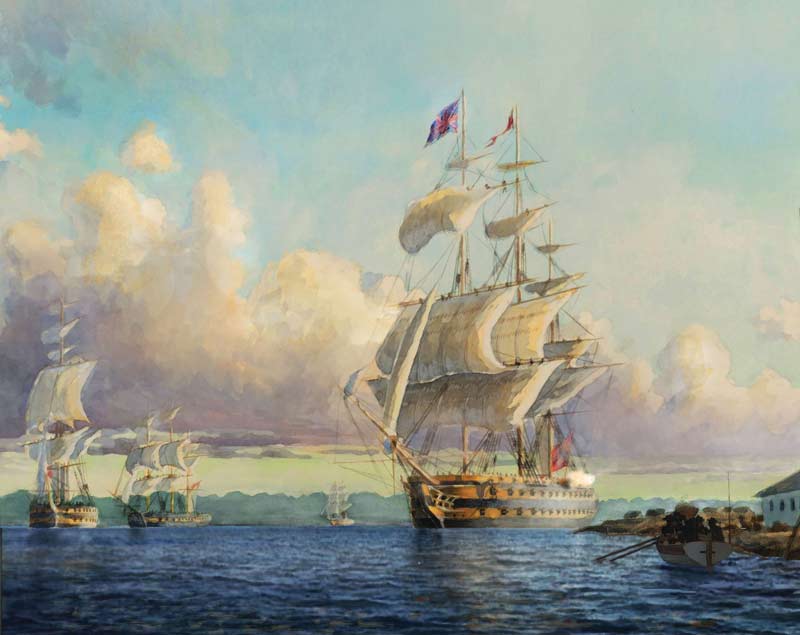
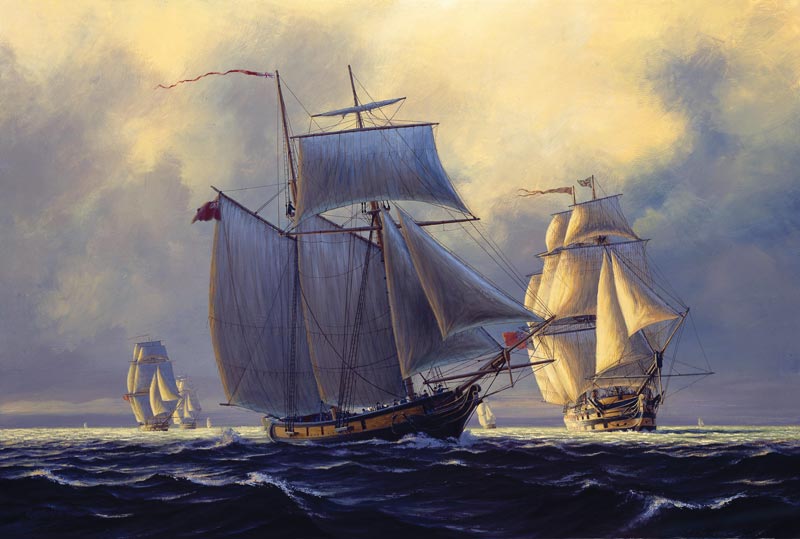
Artist Peter Rindlisbacher depicts HMS St. Lawrence with other British warships on Lake Ontario during the War of 1812.[Peter Rindlisbacher]
During the War of 1812, naval control of Lake Ontario was vital. An American victory on Lake Erie in September 1813 rendered the British positions around Sandwich (present-day Windsor, Ont.) untenable; a similar defeat on Lake Ontario would have endangered the British hold on the Niagara peninsula, while also threatening bases on the northern side of the lake.
From September 1812 until the end of the war in 1814, Commodore Isaac Chauncey directed the American naval effort on lakes Erie and Ontario. His headquarters were at Sackets Harbor, N.Y. Upper Canada’s naval defences, meanwhile, initially consisted of the Provincial Marine, an extension of the Quarter-Master-General’s Department, which combined transport and combat duties. In May 1813, however, the Royal Navy assumed responsibility for British lake warfare, with Commodore James Yeo exercising overall command on the Great Lakes and direct command on Lake Ontario. Yeo’s headquarters were at Kingston, long the chief naval base in Upper Canada.
Regardless, there were relatively few naval engagements on Lake Ontario during the war. The waterbody’s strategic importance was so great that neither commander was willing to risk an all-out battle that might cost him his fleet. Naval actions were limited to seizing schooners and bateaux belonging to opponents and occasional exchanges of cannon fire between warships that studiously avoided closing to effective range.
Both Yeo and Chauncey attempted to win the war in the shipyards by building ever-bigger vessels that might intimidate the enemy, even if their guns were never fired. Chauncey’s flagship in 1813 was USS General Pike, armed with twenty-six 24-pounder cannons. In spring 1814, Yeo countered with HMS Prince Regent and HMS Princess Charlotte, the two ships mounting a total of fifty-four 24-pounder guns, thirty-six 32-pounders and eight 68-pounder carronades. By midsummer, though, Chauncey was back on top with USS Superior, boasting some 58 guns, and USS Mohawk with 42.
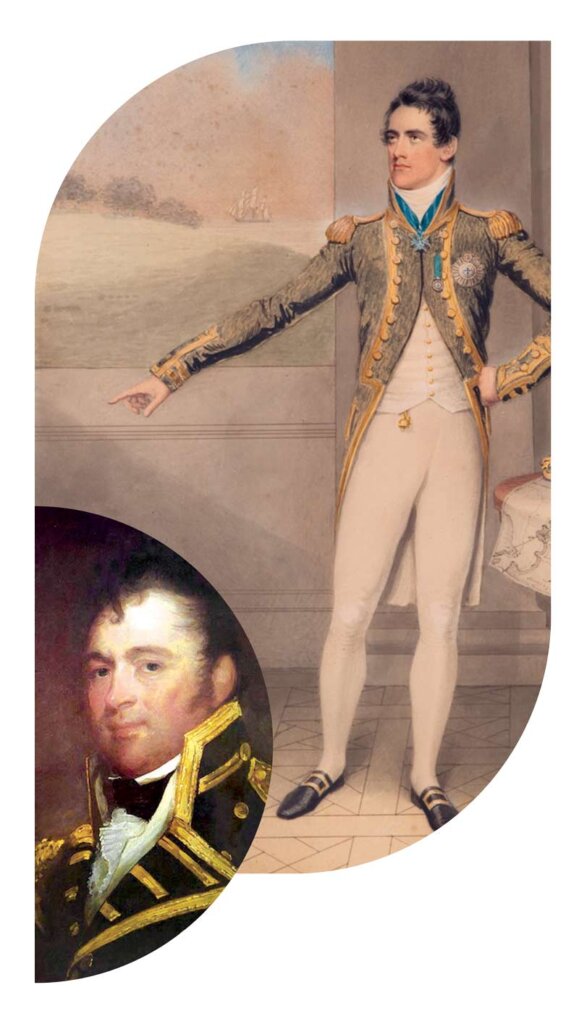
In May 1813, Commodore James Yeo (top) assumed overall command of the Royal Navy on the Great Lakes. His American counterpart on lakes Erie and Ontario was Isaac Chauncey (below). [Adam Buck/Wikimedia; Gilbert Stuart/Naval History and Heritage Command/Wikimedia]
Yeo, however, had decided in winter 1813-14 to outstrip the Americans with one master stroke: HMS St. Lawrence, a regular ship-of-the-line or, in modern parlance, a battleship. It was the largest warship launched on the lakes during the war, larger even than HMS Victory, Admiral Horatio Nelson’s flagship at the 1805 Battle of Trafalgar.
Yeo hadn’t been authorized to build such a huge ship. But, he was a commander on an overseas station far removed from his superiors in London, which allowed him considerable latitude. No adverse comments were ever directed at him on this score.
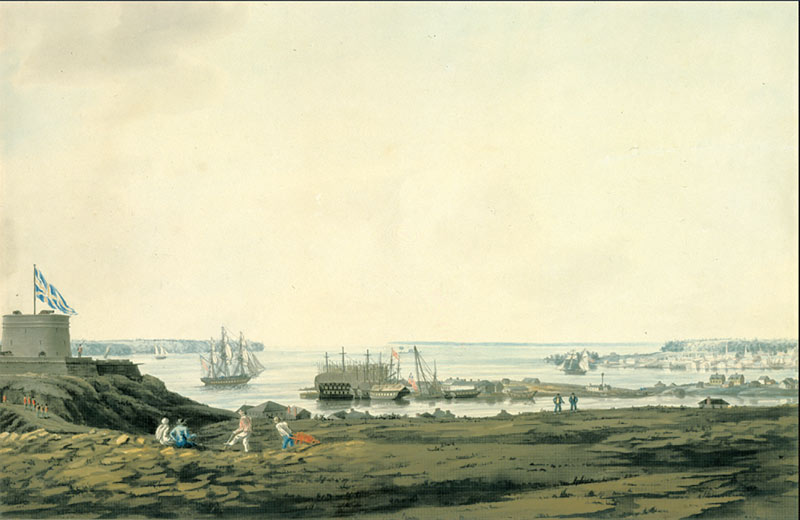
Artist Robert Irvine depicts the Kingston dockyard in 1815 (below), likely similar to how it would have appeared during the war.[Robert Irvine/LAC/2962465]
In January 1814, advertisements began to appear in the newspapers of Upper Canada requesting unprecedented quantities of timber to be delivered to the Kingston dockyard. Early in February, similar ads called for “artificers wanting employment.” On June 2, the Kingston Gazette carried another government plea, this one requesting 50 labourers and as many carpenters as could present themselves. Later that month, the call went out for “shipwrights and sawyers,” with promises of one month’s pay in advance.
The monster that took shape on the stocks was a three-deck vessel, displacing 2,305 tons. Its keel was 52 metres long, while the gun decks ranged up to 59 metres, and its beam was 16 metres. Originally planned for 102 guns, the armament was increased during construction and fitting until the vessel carried 112 guns: twenty-seven 32-pounders, forty-one 24-pounders, three 68-pounder carronades and forty-one snub-nosed 32-pounder carronades.
To operate the ship, a crew of at least 640 officers and men was required. The Royal Navy was routinely short of men—the North American station could easily have absorbed 3,000 additional sailors—so, naval transports arriving at Quebec were skimmed for personnel to serve aboard St. Lawrence, while naval units on the upper Great Lakes were starved in favour of the great vessel. The pace of manning increased as construction progressed. On Sept. 8, 1814, the Montreal Gazette reported that 355 seamen had recently arrived, destined for Kingston.
On Sept.10, the vessel was launched, accompanied by a salute fired from the local batteries. The event came at an opportune time, for news was spreading of a British naval defeat on Lake Champlain, near Plattsburg, N.Y.
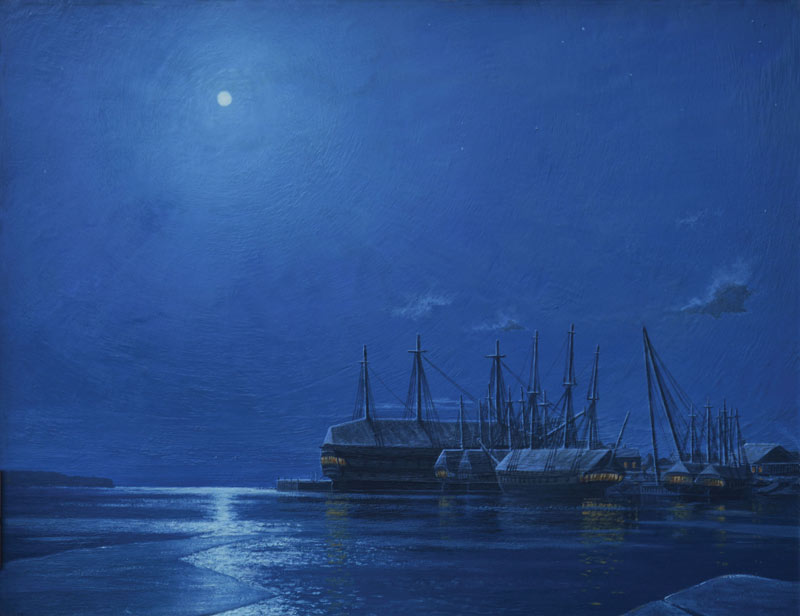
Artist Peter Rindlisbacher depicts the Kingston dockyard on Christmas Eve 1814. St. Lawrence is centre, prepped for winter.[Peter Rindlisbacher]
Both attempted to win the war in the shipyards by building ever-bigger vessels that might intimidate the enemy, even if their guns were never fired.
On land, British arms were receiving further reverses at Fort Erie. And a British victory at Lundy’s Lane (near present-day Niagara Falls, Ont.) had been so costly that it scarcely seemed like a win. The only completely satisfying war news was from the Atlantic seaboard, where a British expedition had burned Washington in late August. The launch of St. Lawrence, then, provided a cheerful tonic for the populace of the Canadas.
The ship, however, was far from ready for battle; it still had to be fitted with masts, sails, guns and the hundreds of small items needed to complete its interior and topside. This was complete by early October and the process of loading stores destined for the Niagara peninsula began.
It soon became evident, though, that St. Lawrence was too big to realize its full potential. Writing on Oct. 11, General George Prevost (commander-in-chief of British forces in North America) noted that the ship was drawing 6.4 metres of water with only a partial load—little more could be put aboard without causing the vessel difficulty entering or leaving lake harbours. Prevost was disappointed that St. Lawrence had been so late in completion, leaving little opportunity to exploit the Royal Navy’s newfound superiority.
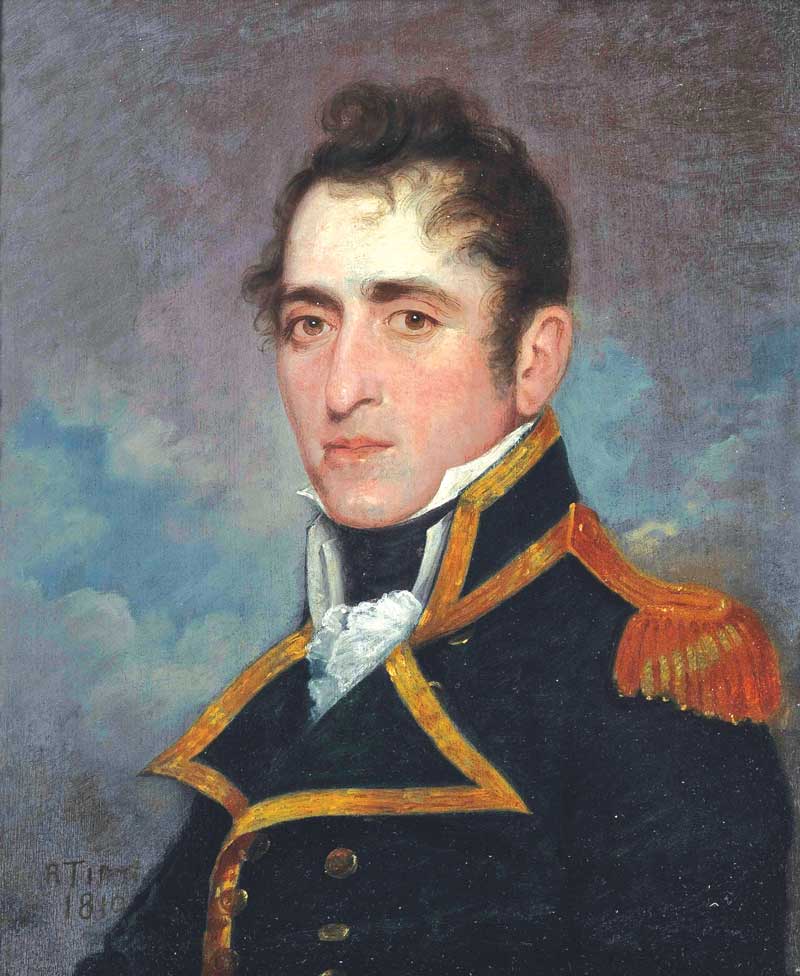
Peter Rindlisbacher depicts St. Lawrence, under command of Captain Frederick Hickey (top), on Lake Ontario surrounded by other British warships (bottom). [Gilbert Stuart/Wikimedia]
[Peter Rindlisbacher]
Still, Yeo was confident that he could overpower any American warship. On Oct. 16, he sailed St. Lawrence in convoy with four other vessels. While Yeo was aboard as naval commander, St. Lawrence was under the charge of Captain Frederick Hickey. The task was to carry troops and supplies to the Niagara peninsula, a front from which American forces were withdrawing.
St. Lawrence arrived at Niagara on the 20th; the only major incident occurred the previous day, when lightning shattered the maintop gallant mast. Within five days the ship returned to Kingston. One further voyage followed, again delivering stores to Niagara and York, before the ship was laid up for the winter.
These transport duties were the only belligerent acts committed by the great ship. St. Lawrence was destined never to fire its guns in battle, for its very size was enough to send Chauncey’s vessels scurrying to port. “Our superiority on Lake Ontario, we believe, is no longer disputed by the American Commodore,” boasted the Kingston Gazette on Nov. 12.
While St. Lawrence didn’t encounter U.S. ships in action, it is believed that the enemy contemplated destroying the ship in Kingston while it was still being fitted out. According to some reports, an American midshipman named McGowan, accompanied by riverman William Johnson (the hero of the St. Lawrence or the pirate of the St. Lawrence, depending on which side was describing him) attempted to slip a small boat into Kingston’s Navy Bay, with the aim of attaching a mine (then called a torpedo) to St. Lawrence. The plan reportedly failed because the ship had sailed from Kingston one day before the proposed attack.
St. Lawrence marked the climax of what historian Thomas Raddall described as “an endless and largely bloodless war of carpenters and riggers on both sides of Lake Ontario.” American writer John K. Mahon referred to the naval building race as “grotesque.”
It soon became evident that St. Lawrence was too big to realize its full potential. Still, Yeo was confident that he could overpower any American warship.
Such judgments may be unduly harsh. Yeo and Chauncey hadn’t simply supervised the construction of huge vessels, they had created major dockyards at the edge of a wooded frontier, with all the attendant facilities for rigging and provisioning their ships. Small armies of skilled shipwrights had been recruited, assembled and fed. Prodigious efforts had been made. Indeed, only five months elapsed between laying the keel and launching St. Lawrence.
During the building race, the respective commanders had gambled that uncured pine, cut from virgin forests, would be translated into durable warships. That they were correct in their judgment is proven by the subsequent durability of the hulls.
Whatever the case, the Americans were determined not to relinquish naval superiority to Yeo. At Sackets Harbor, they laid down two super ships of their own: Chippewa (62 metres long, officially rated as a 74, but carrying closer to 130 guns) and New Orleans (65 metres long, 120-130 guns). The British, in turn, laid down two more large ships, Wolfe and Canada, intended to carry 104 and 112 guns.
None of these ships was ever launched, though. The Treaty of Ghent, signed on Dec. 24, 1814, which effectively ended the war, made them redundant. Chippewa was broken up around 1833, and New Orleans rotted on the stocks, though it remained on the register of American naval vessels until 1883, when it was sold for scrap.
HMS St. Lawrence, however, was already afloat. Together with lesser warships, it rode at anchor in Kingston’s Navy Bay. Initially, the vessel was a social centre for the base. An elegant ball was held aboard on March 4, 1815, and on April 11, the officers entertained their old adversary, Chauncey, who was greeted with a 13-gun salute.
Uncertain what to do with St. Lawrence, authorities took down its masts and boarded up the ship. A warehouse was built in 1819 to house its sails and rigging—the building survives today as part of the Royal Military College of Canada, where it has been known to cadets as the Stone Frigate.
Following the war, the 1817 Rush-Bagot Agreement virtually demilitarized the Great Lakes. The various warships in Kingston, built at great expense (St. Lawrence alone was reputed to have cost as much as 500,000 pounds) slowly deteriorated, ghostly skeletons, much commented on by travellers who passed through the city.
Eventually, it was decided the ships would be sold. Newspapers announced that on Jan. 18, 1832, an auction would be held to dispose of St. Lawrence, Kingston, Burlington (formerly Princess Charlotte) and Montreal, the frames of Wolfe and Canada, and all the rigging from the completed ships. On the day, however, only St. Lawrence found a buyer—Robert Drummond, a Kingston ship owner, contractor and brewer, who paid 25 pounds for the hulk. The sails and rigging, sold separately, were considered far more valuable, accounting for most of the 1,400 pounds realized by the Crown.
HMS Canada was eventually dismantled on the stocks. On July 24, 1832, a violent thunderstorm reduced Wolfe to a pile of kindling. Most of the remaining warships were deliberately sunk in Navy Bay and nearby Hamilton or Deadman bays.
There’s no contemporary account of HMS St. Lawrence being towed from Kingston’s Royal Naval Dockyard. Moreover, its subsequent fate has been variously described. One story has it that it was blown ashore in a storm, coming to rest some five kilometres west of Navy Bay. Another account describes the ship as having been deliberately run aground at that same spot, to serve as a wharf for a distillery.
Regardless, it’s clear the mighty warship came to an ignominious end.
Advertisement