




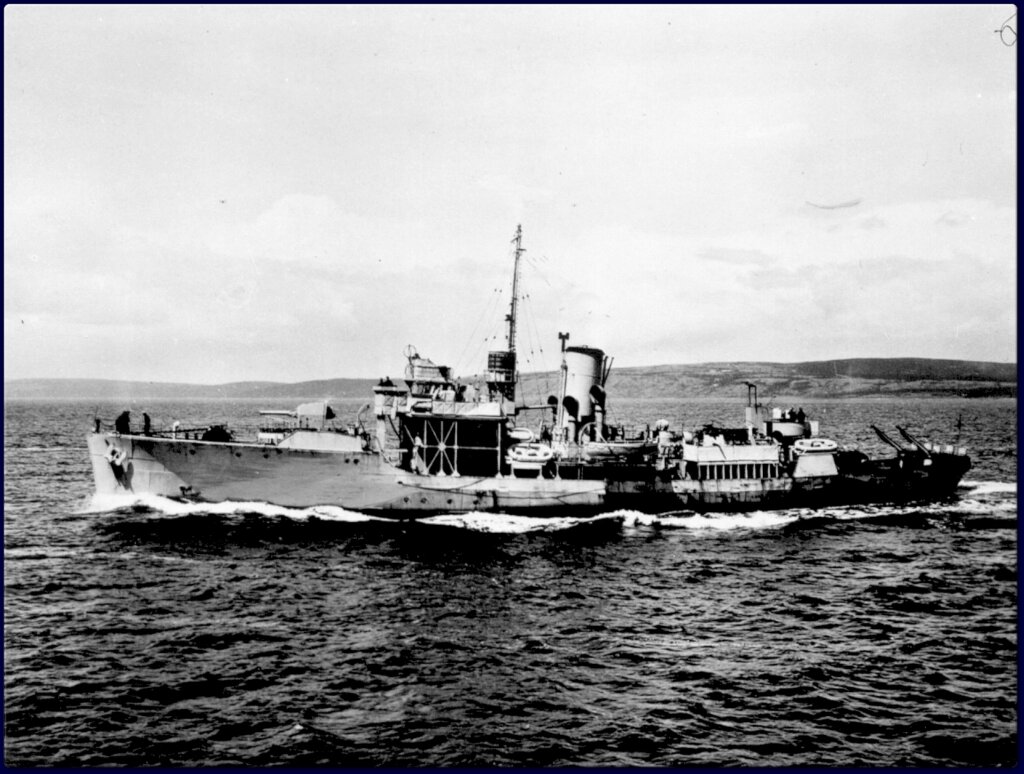
HMCS Alberni circa 1943-1944. [DND]
“We’re a museum of stories,” said Alex Fitzgerald-Black, the Juno Beach Centre Association’s executive director. “We’re not necessarily a big collections museum.”
The Canada-based charity head, whose efforts support those at the main site in Normandy, France, nevertheless stressed that artifacts still have a vital place in those tales—especially when they provide a tangible link to the past.
Two of the centre’s most recent acquisitions, the bell and shipbuilder’s plate from the Second World War-era HMCS Alberni, offer just that. But for Fitzgerald-Black and other custodians, it’s also critical that such artifacts are safeguarded. These new Alberni items had originally been removed from the more than 80-year-old wreck in British waters by independent divers, who subsequently put them up for auction in June 2025.
Now in the museum’s safe hands, the development follows a similar incident reported last year, when a British diver removed the bell from the wreck of HMCS Trentonian before returning it to Canadian authorities. In that instance, the artifact was eventually taken into the stewardship of the Naval Museum of Halifax.
U.K. officials have since introduced new measures to strengthen protections of certain Canadian war graves within its maritime boundaries, although the move comes too late for wreck sites already disturbed. Alberni is one, yet the Juno Beach Centre Association hopes that its intervention will ensure continued preservation of items brought to the surface, where their stories can be told.
Here, Fitzgerald-Black shared details in a Legion Magazine exclusive.
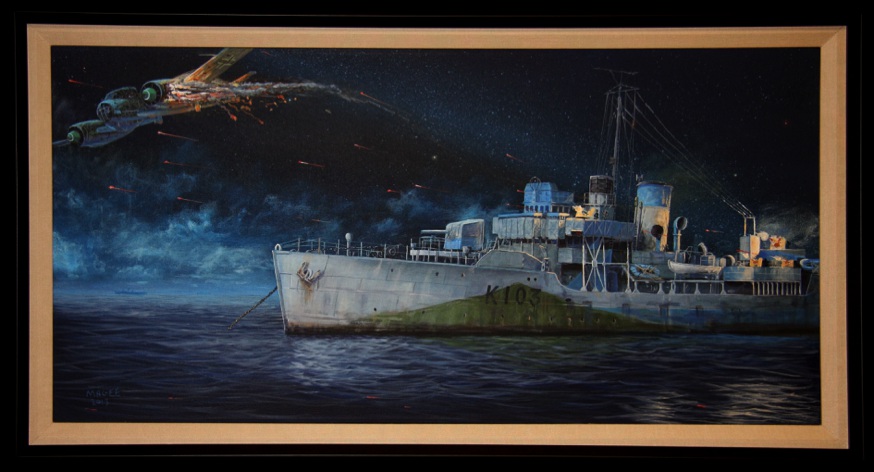
Artist Marc Magee depicts Alberni in action. [Marc MaGee/The HMCS Alberni Memorial and Museum]
As many of us now know, the Royal Canadian Navy played an outsized role in the Second World War, primarily in the Battle of the Atlantic. But what’s interesting about HMCS Alberni is that it served almost everywhere the RCN served in at least the European theatre.
Alberni was commissioned in February 1941, built at Esquimalt in B.C., and was named after the town of Port Alberni on Vancouver Island. It was one of the first orders of RCN corvettes built in Canada to support the convoys and to battle against U-boats.
Canada didn’t really have big shipyards to build cruisers, aircraft carriers and battleships, necessarily, but we did have smaller shipyards that could take something like the design of a whaling vessel, which was what Flower-class corvettes were based on, and change it into a military vessel.
In early 1941, Alberni transited the Atlantic coast and, on May 23, was sent to St. John’s, Nfld., to form part of the Newfoundland Escort Force. Their escort duties would take them from Newfoundland to Iceland, where they would hand-off convoys to forces from the British Isles. Later, they ended up doing the entire crossing.
In late 1942, Alberni was sent with a number of other RCN corvettes to the Mediterranean to help with the landings in North Africa, fighting Italian submarines and German U-boats, as well as Italian and German aircraft.
It then continued its convoy escort duties until early 1944, when Alberni and other warships were sent to the U.K. to work with the invasion fleet being built up for D-Day, so it’s part of that effort to support the Allied landings on June 6, 1944.
When Alberni was sunk on Aug. 21, 1944, it was heading out from the Isle of Wight area down into the English Channel for an anti-submarine patrol. Somewhat ironically, it was then hit by a U-boat torpedo, sinking quickly. Mostly only those sailors on the upper decks and above survived; out of a crew of around 85 or so, 59 were killed.
On the importance of the removed artifacts
The bell is a really important part of any warship, and is, in many ways, the ship’s centrepiece. It’s used multiple times throughout the day to mark the watches, for example, telling sailors when they need to report for duty on board.
It’s a very sentimental part of the ship when it comes to traditions. One, which I can’t say for certain applied to Alberni, was the baptism of sailors’ children with water consecrated in the bell.
The builder’s plate is important too because it tells the story of the expanded shipbuilding industry in Canada during the Second World War and connecting the home front to the battlefront.
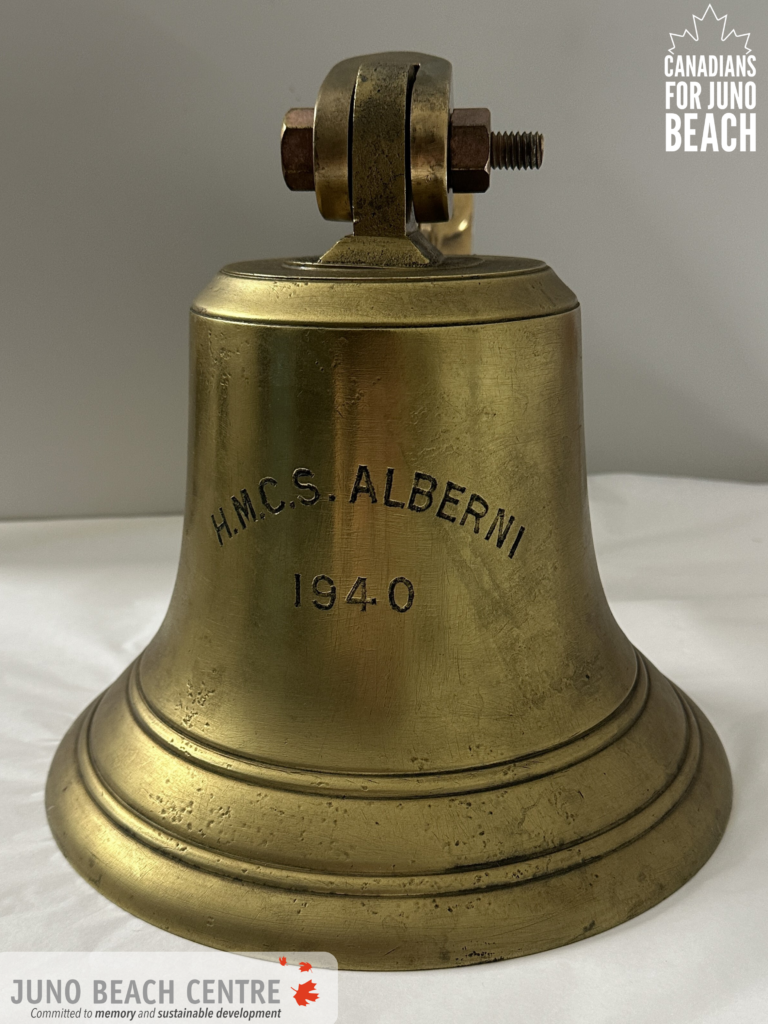
The bell from HMCS Alberni. [Juno Beach Centre]
On acquiring the bell and shipbuilder’s plate
We don’t know exactly when these artifacts were removed from Alberni. Nor do we know who, exactly, brought them to the surface. There’s a diving community out there, some of whom are perhaps more respectful of these war graves than others.
There’s a debate around whether these artifacts are better down with the people who were lost or brought up and shared with people. The Juno Beach Centre Association had nothing to do with bringing the bell or the shipbuilder’s plate up, but they ended up in a private collection. We then bought them from a third-party militaria dealer.
At that time, we weren’t 100 per cent sure whether they had originated from the wreck, or if they had been taken off during a refit at some point before it sank. We’re now pretty sure, based on our communications with the HMCS Alberni Museum and Memorial in Courtenay, B.C., that they were, in fact, taken off the sunken vessel at some point in the last couple of decades.
When these artifacts became available, the Juno Beach Centre Association jumped at the chance to acquire them to make sure they didn’t disappear again into a private collection. Because the ship was lost during the Battle of Normandy, it felt quite fitting that the Juno Beach Centre would take these items on because we’re located on a D-Day landing beach.
It’s unfortunate that they were taken off a war grave, but at least now we can make good of a bad situation, sharing these incredible artifacts with Canadians and other visitors to tell the story of Alberni.
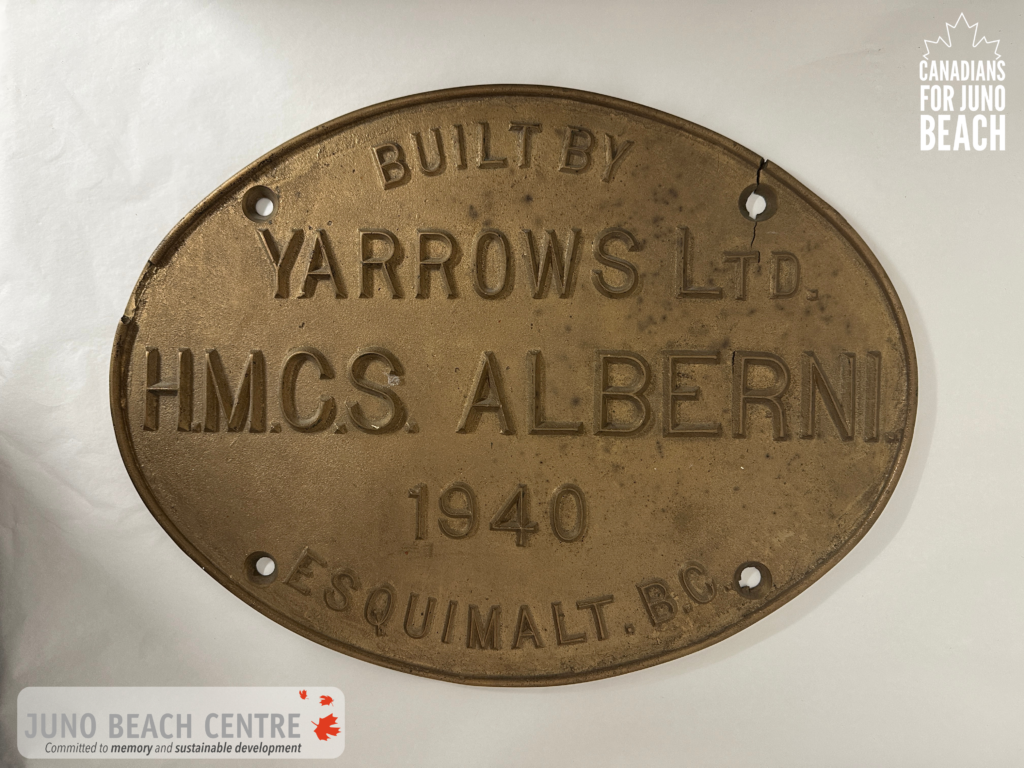
The shipbuilder’s plate from HMCS Alberni. [Juno Beach Centre]
On the museum’s display plans
We’re looking for a space in the permanent displays that makes sense. The other option is that we always have rotating temporary exhibitions, so we could include them in one of those if the theme fits.
What we would really like to do, and what we’re hoping to raise some money for, is to get proper high-quality 3D scans of the items. That way, we can display them on our website for a digital exhibition where people from around the world can explore them. We’ll hopefully be doing that in partnership with The HMCS Alberni Memorial and Museum.
On his hopes for visitor engagement
I hope they take away just how vast Canada’s war effort was in the Second World War. The Canadian Army tends to get much of the limelight, and to some extent, the air force, as well. But the navy fought a very hard and long campaign, and it absolutely deserves to be remembered for the expansions it went through, the achievements it made, and the challenges it overcame.
I also hope they remember some of the individual stories of those sailors who served on Alberni during the war, especially the names of those 59 sailors resting at the bottom of the English Channel.
This interview has been edited for brevity and clarity.
Advertisement




As ex-wartime Navy & an historian who has written the story of ALBERNI’s loss, this is an interesting choice – leave (or even return) the 2 artifacts with her hull below the beaches near Normandy, or mount them as memorials, to be seen, at Juno. Since those killed can’t speak for themselves and the 31survivors have presumably also have died 72 years later, I’d say retain those two items to commemorate the 59 men lost. Where later generations can see them … and remember why the former gave their lives for those viewers. It’s pretty impersonal ‘remembering’ lost Seamen when all the items they dealt with are miles away under 110 feet or more of the Channel’s waters.