




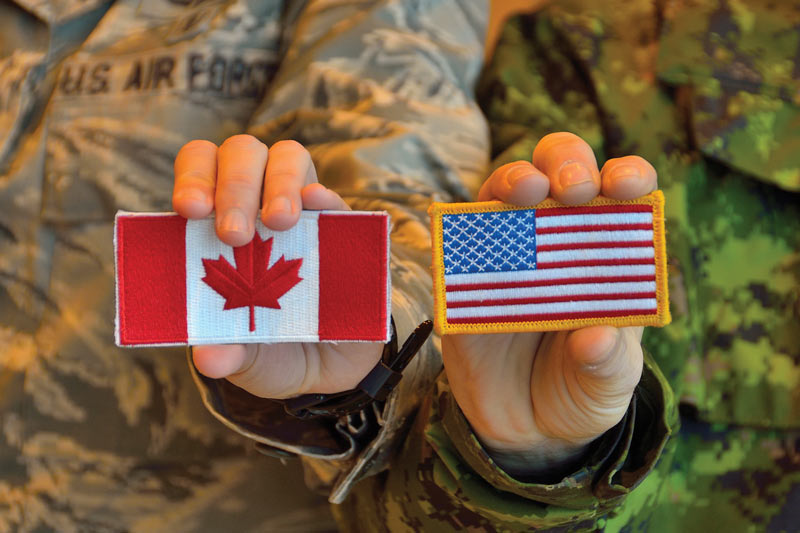
Canadian and American military members exchange their flags during an exercise in Goose Bay, N.L. [Master Corporal Kirsta Blizzard/5 Wing Publice Affairs/GB2016-10-215/Combat Camera]
Canada-U.S. relations are arguably at their lowest point since the 19th century, spurred on by bluster and tariffs from the Trump administration. The Carney government, riding a wave of resurgent nationalism in the wake of the provocations, has made great fanfare of its efforts to revitalize Canadian security and, in particular, the defence of the Arctic. Part of this is rooted in the government’s stance that Canada can no longer rely on the U.S. as a strong ally, and that the country needs to reassert its sovereignty to thwart any perceived aggression from Washington.
Despite the divergence between the two states’ foreign relations, there’s clear symmetry in their defence priorities. The U.S. national security establishment has become increasingly concerned with the state of continental defence due to obsolete, late-20th-
century sensor architecture and new threats. This was reflected in recent spending announcements for new detection systems, missile interceptors and advanced networking. Canada’s decades-long flat or decreasing defence spending and an increasing reliance on U.S. capabilities became significant irritants in bilateral affairs.
Trump’s second administration has placed even greater priority on continental defence, hailing it as a centrepiece of its security policy. Its focus is collectively known as the Golden Dome for America (GD4A), which includes several new systems and strategies. The best indicator of the administration’s prioritization of GD4A is evident in the U.S. government budget request for 2027: U.S. Space Force, the lead in developing and deploying the majority of its capabilities,
is in line for a 124 per cent increase in year-over-year spending—nearly double that of any other service.
Driving this change is a dramatic rise in potential threats. Arms control initiatives such as the New START and the Anti-Ballistic Missile treaties ended during a period of substantial growth in the quantity and variety of strategic weapon capabilities. It’s estimated that China will complete a five-fold increase in its nuclear weapon stock this decade, from approximately 200 warheads to 1,000 by 2030. Russia, which already possessed a large strategic nuclear force of land- and submarine-launched ballistic missiles, has started diversifying its delivery systems, and now has an impressive cruise-missile capability.
Beyond traditional strategic systems, many adversaries also now have asymmetric capabilities, such as drone swarms. Russia has demonstrated its willingness to use such weapons in the airspace of NATO allies. And there are maritime- and cyber-domain technologies that can also be employed to attack targets in North America. Both Canada and the U.S. are facing more diverse and lethal threats.
The momentum behind a bilateral modernization program isn’t new. It reflects how co-operation is essential to continental security. Canada doesn’t have the economic resources or technological means to defend its vast territory, much less the entire continent. Similarly, the U.S. can’t effectively defend all of North America from its adversaries without working with Canada, which buffers the lower 48 states. Functionally, the bilateral relationship remains extremely strong, as both sides understand the importance of their mission and what each has to contribute.
Belatedly appreciating its importance to bilateral relations, Canada unveiled a $38.6-billion Norad modernization plan in 2022. This has come to include several initiatives: acquiring 88 F-35 fighters; building four over-the-horizon radar sites to cover the North; acquiring eight CC-330 Husky aerial refuellers; and, in the future, adding early warning aircraft. Canada has also stated its willingness to be a part of an integrated air-and-missile defence, essentially abandoning its Paul Martin-era opposition to such a system. As these efforts are implemented, they will enable Canada to shoulder a more equitable share of the continental defence burden.
The Trump administration has similarly outlined an ambitious vision for continental defence within GD4A, including more missile interceptors and sensor systems. However, the signature program is undoubtedly the space-based initiative that envisions a permanent capability to defend North America from intercontinental ballistic missiles. Details about the system’s cost (estimated at more than $500 billion), schedule and feasibility remain in question, but the concept itself reflects the administration’s ambition in this area.
As these efforts are implemented, they will enable Canada to shoulder a more equitable share of the continental defence burden.
Overall, the guiding approach for these new systems has been affected by an ongoing broader defence strategy referred to as multi-domain battle or joint all-domain command and control. This involves interlocking sensors combined in a unified network that are analyzed by advanced AI algorithms to increase Norad’s ability to detect, track and identify, and potentially respond to, the diverse threats the continent now faces. The key to any part of this system will be the ability to exchange data seamlessly, which will provide each capability with greater battlefield awareness. This is a critical reason why the Royal Canadian Air Force selected the F-35, and it continues to guide the acquisition of new Norad systems.
In this vein, perhaps the most critical program for Norad’s future is the airborne moving
target indicator (AMTI), a planned constellation of satellites that will initially provide continuous, real-time airborne early warning below Arctic latitudes. While AMTI potentially heralds a revolution for air domain awareness, it hasn’t been without controversy. The Pentagon wants to divest itself of its existing fleet of early warning aircraft, the nearly half-century-old E-3 Sentry, without a direct replacement since AMTI is intended to provide a similar capability. This is potentially an opportunity for Canada to develop an alternative that would bridge the gap, especially if AMTI is delayed and no U.S. early warning aircraft replacement is forthcoming.
Despite the Trump administration’s hostility toward Canada and the plummeting attitude of Canadians toward the U.S., there’s likely to be significant impetus in the future to continue and even enhance Norad’s capabilities. While other aspects of Canada-U.S. relations may be turbulent going forward, the alignment on security and defence that underpins Norad will ensure the 70-year-old defence organization endures. Even if the space-based interceptor or AMTI don’t fully materialize in the coming decades, other programs will eventually encompass a much more capable and robust defence capability that’s able to meet the new and emerging threats of the 21st century.
Advertisement