

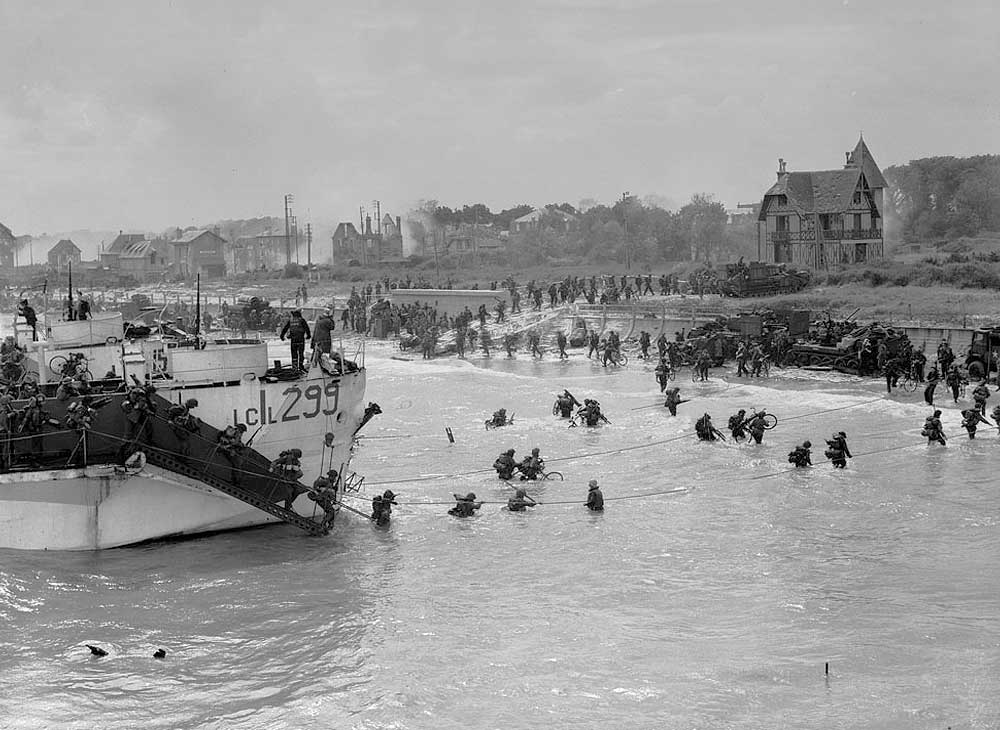
Troops of the 9th Canadian Infantry Brigade head ashore from Landing Craft, Infantry at Bernières-sur-Mer, France, on D-Day. [LAC/3408540]
The 1944 Normandy Campaign was a turning point in the Second World War. The only way that Nazi Germany could be beaten—short of a total Soviet victory or using atom bombs—was to land a large army in France and advance to Berlin. Indeed, everything cherished about Europe since 1945, not least its peaceful development and prosperity, depended on its success.
Europeans understand this intuitively, more so now given the threat of Russian expansion. The British and the Americans do, too. The U.S. recognized it in 1956 with a national memorial at the Normandy American Cemetery near Omaha Beach. And Britain completed a national memorial to its role in Normandy at Ver-sur-Mer in 2021.
The only major Allied participant not to acknowledge its role in this critical campaign with a national memorial is Canada. It’s time it did.
Of course, there are tributes to Canada’s role scattered across lower Normandy. Two cemeteries, one at Bény-sur-Mer near the coast and another at Bretteville-sur-Laize, hold the remains of predominantly Canadian dead, more than 5,000 killed in action. The sites, however, are maintained by the Commonwealth War Graves Commission (CWGC) and, apart from maple leaves on the headstones, they are largely indistinguishable from any other CWGC graveyard—as was the intent.
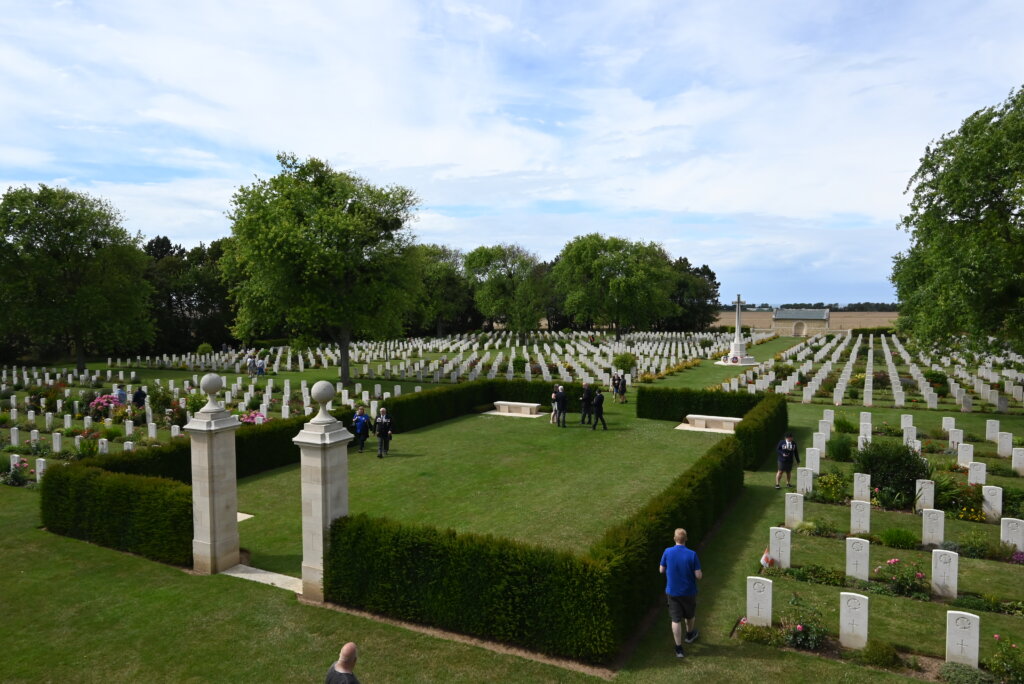
Bény-sur-Mer Canadian War Cemetery. [Aaron Kylie/LM]
General recognitions of Canada’s role in the Allied assault existed in the area since the 1950s. Regimental monuments, typically placed by units with wealthy benefactors, honour the contributions of some units in the campaign. Most recently, The Royal Regina Rifles erected a splendid statue in Bretteville l’Orgueilleuse. And many French towns and villages have small memorials acknowledging their liberators.
During the last 30 years, the Canadian Battlefields Foundation (CBF) has also built some important monuments. The Canadian Memorial Garden, co-sponsored by the federal government, is tucked away on the grounds of the Mémorial de Caen. It was officially opened in 1995 by Prime Minister Chrétien. Since then, the CBF has created memorials on prominent features such as Hill 67 south of Caen and near Hill 117 overlooking Saint-Lambert-sur-Dive, as well as erecting other tributes and interpretive panels.
The largest and most prominent of similar such private initiatives is the Juno Beach Centre (JBC) in Courseulles-sur-Mer. Opened in 2003, it was conceived by a group of veterans and has been sustained by donations. The JBC’s mandate is to preserve the legacy of all Canadians who served in the Second World War through education and remembrance. It has been enormously successful. With the help of the federal government, it recently acquired adjacent property that was slated for development.
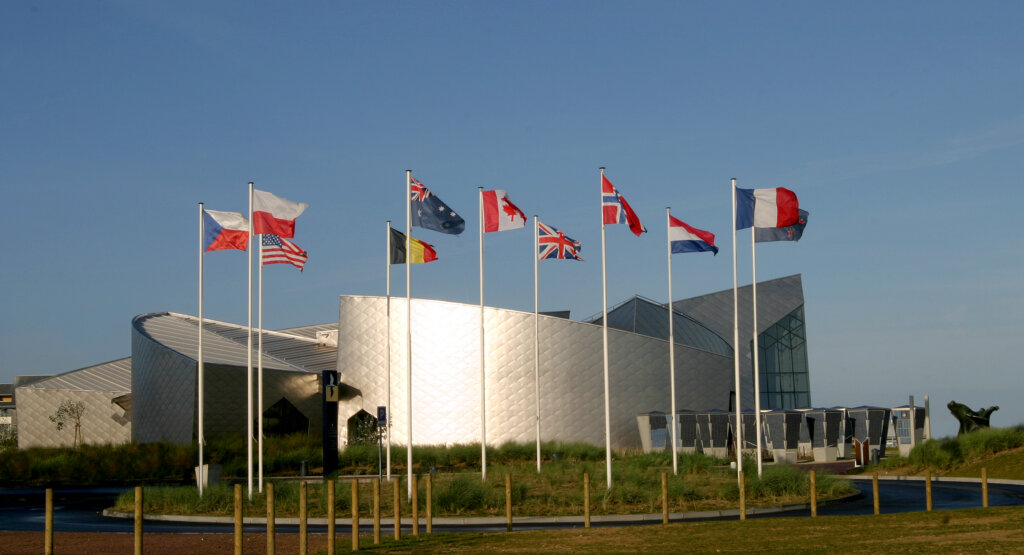
The Juno Beach Centre. [courtesy Juno Beach Centre Association]
But none of these is a national memorial. Postwar, the expectation was that there would be one. After all, Canada had erected no less than eight national monuments in the aftermath of the Great War. The most famous is the Canadian National Vimy Memorial, which is so striking that it became an icon of remembrance not just for Canada but for the entire Western Front. The St. Julien Canadian Memorial near Ypres, meanwhile, boasts the brooding soldier. The other six monuments are simple stone altars commemorating battles at Hill 62, Passchendaele, Courcelette, Le Quesnel, Dury and Bourlon Wood. Nothing like these exist in Normandy.
Colonel Charles P. Stacey, the Canadian Army’s Second World War historian, imagined there would be a national memorial in Normandy. Writing of the fighting south of Caen in late-July 1944, Stacey reflected on but one example of Canada’s sacrifice:
“Three miles or so south of Caen the present-day tourist, driving down the arrow-straight highway that leads to Falaise, sees immediately to his right a rounded hill crowned by a farm buildings [sic]. If the traveller be Canadian, he would do well to stay the wheels at this point and cast his mind back to the events of 1944; for this apparently insignificant eminence is Verrières Ridge. Well may the wheat and sugar-beet grow green and lush upon its gentle slopes, for in the now half-forgotten summer the best blood of Canada was freely poured out upon them.”
The rationale for Stacey’s lament, and for traditional appeals for commemoration, was the sheer cost of the campaign in lives. Of the roughly 40 Allied divisions that fought in Normandy, only two were Canadian, but their losses were enormous. 3rd Canadian Infantry Division landed on D-Day and stayed in the line for virtually the entire campaign; it had the highest casualty rate among Allied divisions. The second highest Allied casualty list went to 2nd Canadian Infantry Division.
Canada had erected no less than eight national monuments in the aftermath of the Great War. The most famous is the Canadian National Vimy Memorial, which is so striking that it became an icon of remembrance not just for Canada but for the entire Western Front.
But Stacey also understood that Canada’s role in the Normandy Campaign was uniquely important. First Canadian Army was critical in the propaganda push that threatened the opening of a second front in France from 1941 onward. That small army, the equivalent of six divisions and dubbed “McNaughton’s Dagger” after its commander, General Andrew McNaughton, was key to a British plan to land a small, highly mechanized force to advance on Berlin once Europe descended into rebellion against the Nazis. The infamous Dieppe Raid in August 1942 was part of that deception.
McNaughton was often discussed openly as the likely commander of any landing in France, while First Canadian Army was the most fully complete and staffed army available in Britain in 1943. So, when serious planning for the second front got underway that year, the Canadians were at the heart of the Allied plan. If Brigadier Freddie Morgan, chief of staff to the supreme Allied commander, had had his way, D-Day would have been an American-Canadian operation with 2nd British Army landing sometime later.
In fall 1943, politics intervened to rob First Canadian Army of its central role in Operation Overlord. Under pressure from Canadians to get the country into the fight, Prime Minister Mackenzie King’s government lobbied successfully to have a corps of two divisions and an armoured brigade committed to Italy.
McNaughton’s detractors, of whom there were many, thought that would make him quit. But he didn’t. So, the defence minister, Colonel James L. Ralston, went to England in November and fired him. It was a sordid affair that reflected badly on everyone; hardly the stuff that Stacey could tackle in his official history. This much he knew.
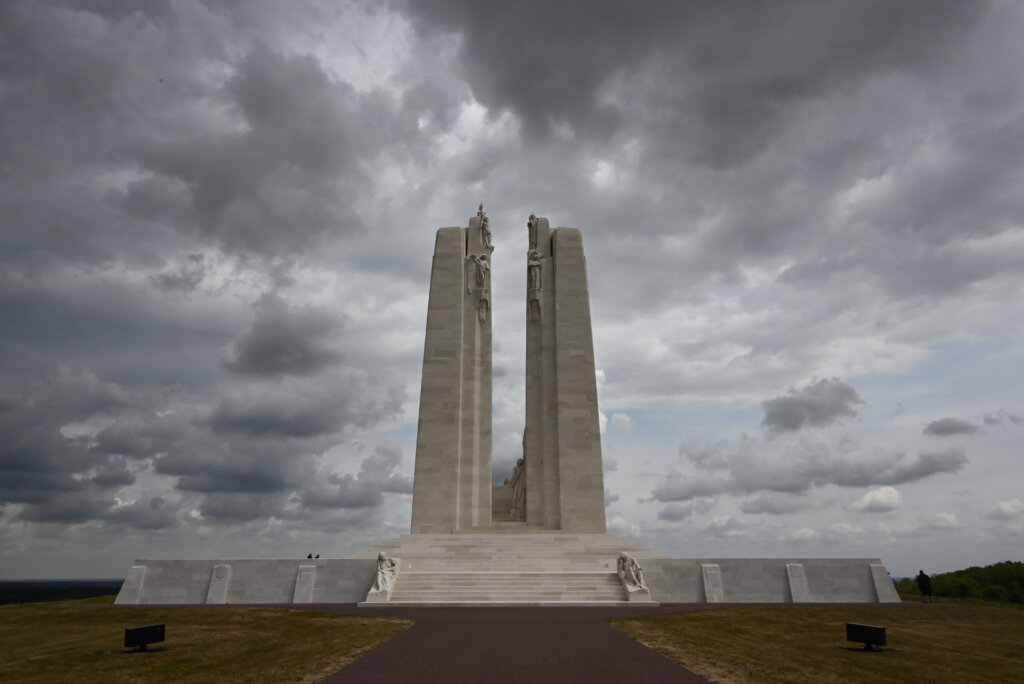
The Canadian National Vimy Memorial serves as an iconic monument to the country’s role in the First World War. [Aaron Kylie/LM]
But Stacey didn’t know that First Canadian Army continued to play a key role in the Normandy deception operation in 1944. And, since he never got to see the actual Overlord plans, it appears he was never fully briefed on the role of 3rd Canadian Infantry Division in the initial assault. So, Canadian historians missed an enormously important part their country’s army played in ensuring the success of Operation Overlord.
In spring 1944, First Canadian Army, still identified by the Germans as the lead Allied formation in the opening of a second front, was (along with 3rd U.S. Army, which was still forming) part of the notional First U.S. Army Group. Its task was to have the Germans focus on Pas-de-Calais as the site of the main assault. This was orchestrated as part of Operation Fortitude, the massive deception mission designed to cover the landings in lower Normandy. Anglo-Americans believe—without a shred of evidence—that U.S. General George Patton was behind the success of Fortitude. But the Germans had no idea where Patton was or what he was doing until May 31, 1944, when it was leaked that he was then in command of First U.S. Army Group. They refused to believe it until June 12.
Until then, the key to the Allied deception operation covering the landings in Normandy was McNaughton’s Dagger. It was based in Kent—directly opposite Pas-de-Calais—and II Canadian Corps was First U.S. Army Group’s designated assault formation. 3rd U.S. Army, meanwhile, concentrated in Essex as the follow-on force.
The key to the Allied deception operation covering the landings in Normandy was McNaughton’s Dagger.
The directors of Fortitude gave the threat credibility by real and false unit movements, fake wireless traffic, contrived leaks by secret agents and press reports. Among the activities was a series of amphibious training exercises by 2nd Canadian Infantry Division in the Medway River in the days immediately following D-Day.
Muddy and tide swept, the Medway is very much like the Scheldt River just across the English Channel, which played to German assumptions of a landing to take Antwerp. When the exercises finished on June 8, 2nd Division water-proofed its vehicles and marshalled them for loading onto landing craft. The Germans were allowed to notice. Individual Canadian officers may well have been privy to all this secret deception, but Canadian historians weren’t.
The other key role that Stacey and his colleagues missed was the task assigned to 3rd Canadian Infantry Division in the D-Day assault. Conventional accounts claim the Canadians were to advance to the Caen-Bayeux highway at Carpiquet and Putot-en-Bessin astride the Mue River and hold. Had Stacey and his team been able to access the chief Allied planning documents, they would have known that the Canadian task was more than just staking out territory. The ground astride the Mue was where General Erwin Rommel planned to launch the Panzer counterattack to destroy the Allied landings. He hoped to have four Panzer divisions assembled there by May 1944.
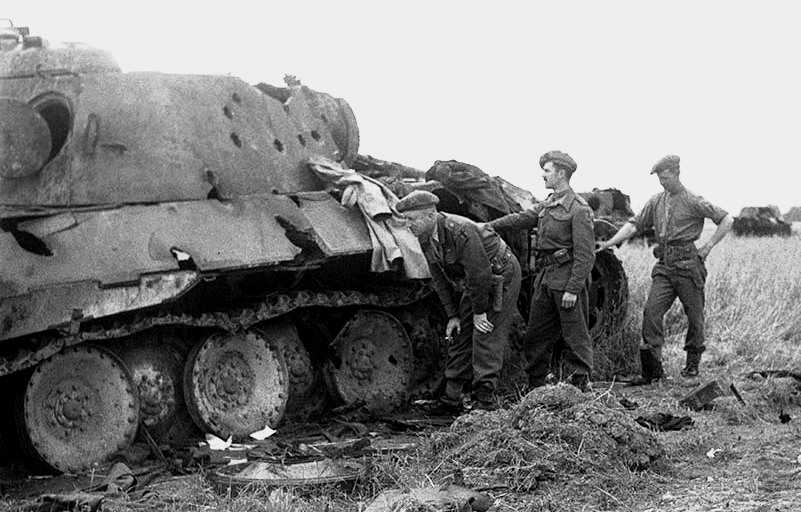
Canadian soldiers examine a German tank they knocked out of action near Norrey, France, on July 8, 1944. [LAC/3226737]
So, 3rd Division went ashore as the most powerful Allied formation on D-Day. In addition to its own three regiments of field artillery and one anti-tank regiment, the Canadians commanded three additional field regiments, a medium artillery regiment, and I British Corps’ heavy anti-tank regiment of towed and self-propelled 17-pounders. Four of the field regiments operated 105mm M7 self-propelled guns for the landing, and all their command and observation post elements were mounted in Sherman tanks—giving the division the equivalent of another full armoured regiment. 3rd Division was also supported by a squadron of 90mm howitzers from the Royal Marine Armoured Assault Regiment and the three armoured regiments of 2nd Canadian Armoured Brigade.
Not all this panoply got ashore on D-Day. Rough seas prevented many of the anti-tank guns from landing for several days, and the British medium regiment and two British field regiments equipped with towed guns were also delayed. So, 3rd Division fought with what it had. It proved enough.
Elements of 21st Panzer, especially its heavy anti-tank battalion, made its presence felt at Juno Beach on D-Day. By the next day, 12th SS Panzer Division, one of Germany’s elite and most powerful formations, was on the battlefield west of Caen. It stopped 9th Canadian Infantry Brigade’s advance to Carpiquet. And by June 8, Panzer Lehr—another elite formation—had arrived in front of 7th Canadian Infantry Brigade at Putot. That meant three Panzer divisions were in front of the Canadians by D+2.
Not surprisingly, the first place Rommel went in Normandy was to the Canadian front. From June 7-10, these formations of I SS Panzer Corps tried to drive the Canadians back and establish a start line for an assault on the Allied landing forces. The fighting was close, intense and, at times, savage.
But the Canadians refused to budge. According to Lieutenant-Colonel Freddie Clifford, commander of 13th Field Regiment, Royal Canadian Artillery, the Canadians’ training, doctrine and equipment worked superbly, and their enormous firepower crushed German assaults.
This may be the only time ever that Canada altered the course of global history. That, alone, warrants a national monument.
Postwar, the commander of Panzer Group West, Leo Geyr von Schweppenburg, lamented that when the Panzers failed to break through on June 8, the Germans “had missed the bus.” He didn’t think the two Panzer divisions en route (to make a total of five) were enough to dislodge the Canadians. Hubert Meyer, chief of staff of 12th SS, and later the division’s historian, wrote that their failure was due to the courage and determination of the Canadians, “who were ready for defence and well equipped.”
Many years later, a British historian of I SS Panzer Corps, Brigadier Michael Reynolds, described the Canadian defence of Bretteville and Norrey as “one of the finest small unit actions of the Second World War.”
Meanwhile, the two Panzer divisions ordered to join the attack were suddenly diverted to Pas-de-Calais. The reason? On June 9, the Germans confirmed and accepted the Allied deception that a landing in that area was imminent. “For this German,” international radio announced that day, “specially trained Canadian troops are in readiness,” supported by airborne and tank divisions. The story was carried in British, Canadian and American newspapers on June 10.
In a confidential postwar British government report on Operation Fortitude, Roger Hesketh considered the diversion one of the critical moments of the Normandy Campaign. Had these Panzers arrived when the landings were still consolidating, they might have tipped the balance. American historian Thomas L. Cubbage considered Hesketh’s position so important that he went through all the surviving material related to the operation held by the British National Archives. Cubbage’s conclusion: the false threat of an imminent landing in Pas-de-Calais, “changed the course of history.”
Cubbage was, by all accounts, unaware that 3rd Canadian Infantry Division’s stalwart defence against repeated attacks by I SS Panzer Corps had already thwarted Rommel’s plans. But if we accept Cubbage at his word, then the fate of the decisive campaign of the war in the west was determined by the hard fighting 3rd Division and those “specially trained Canadian troops” poised to land in the Pas-de-Calais. This may be the only time ever that Canada altered the course of global history. That, alone, warrants a national monument.
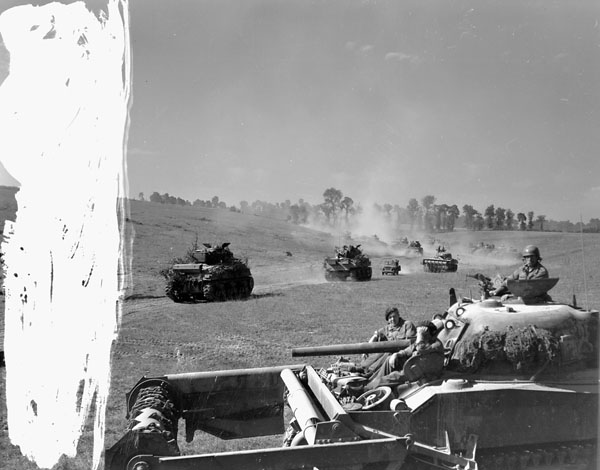
Sherman tanks of The Fort Garry Horse advance near Bretteville, France, on Aug. 14, 1944. [Donald I. Grant/DND/LAC/PA-113659]
But the rationale for a national monument in Normandy goes well beyond the campaign’s first week ashore. The Canadians remained in the thick of the fighting throughout the invasion, usually against Germany’s elite SS Panzer forces. While some historians often lament the apparent futility of the Canadian capture of Carpiquet in early July or the seemingly pointless operations on the slopes of Verrières Ridge later that month, they do matter. The former, for instance, made the German hold on the key city of Caen untenable, and much of it was taken just a week later by a major Anglo-Canadian attack.
That set the stage for the Anglo-American one-two punch in late July that broke the Allies out of the cordon the Germans had built around them. The timing of this combined assault was crucial: on July 18-19 the tide and moon phase were ideal for a landing in Pas-de-Calais, so the German 15th Army remained there in anticipation of an attack rather than moving to Normandy.
On the 19th, British and Canadian troops advanced to the slopes of Verrières Ridge south of Caen. But the American Operation Cobra, slated for July 20, was delayed by ammunition shortages, then by heavy rain. In the meantime, II Canadian Corps kept up the threat in the Caen sector. For three days, in drenching rain that resembled the conditions at the Battle of Passchendaele, the Canadians pushed and prodded along the slopes of Verrières Ridge.
That pressure convinced Field Marshal Gerd von Rundstedt, the German supreme commander, that the breakout would come along the highway to Falaise. To reinforce that, II Canadian Corps launched Operation Spring on July 25: two Canadian infantry divisions attacked six Panzer divisions on open ground.
Soviet liaison officers who witnessed it thought it was madness. The operation ended in a bloody shambles and a revolt among several battalion and brigade commanders.
But when Operation Cobra began later that day, it struck a weak German force. Rundstedt spent the 25th and 26th in front of the Canadians, where he still believed the main attack was imminent. The July 20-25 Canadian sacrifice on Verrières Ridge therefore bought the Americans time to prepare and prevented the Germans from shifting Panzer forces west to counter it.
Canada paid dearly for the U.S. success. Casualties were so high that the British Commonwealth’s scale for describing casualty rates—quiet, normal or intense—added a fourth, double intense. During those five days, II Canadian Corps suffered roughly 3,000 casualties, including about 1,000 dead.
By the time II Canadian Corps reached Falaise on Aug. 17, it had suffered 100 more casualties per battalion on average than the British. But the Canadians plowed on into the Falaise gap where the local German armies were being encircled.
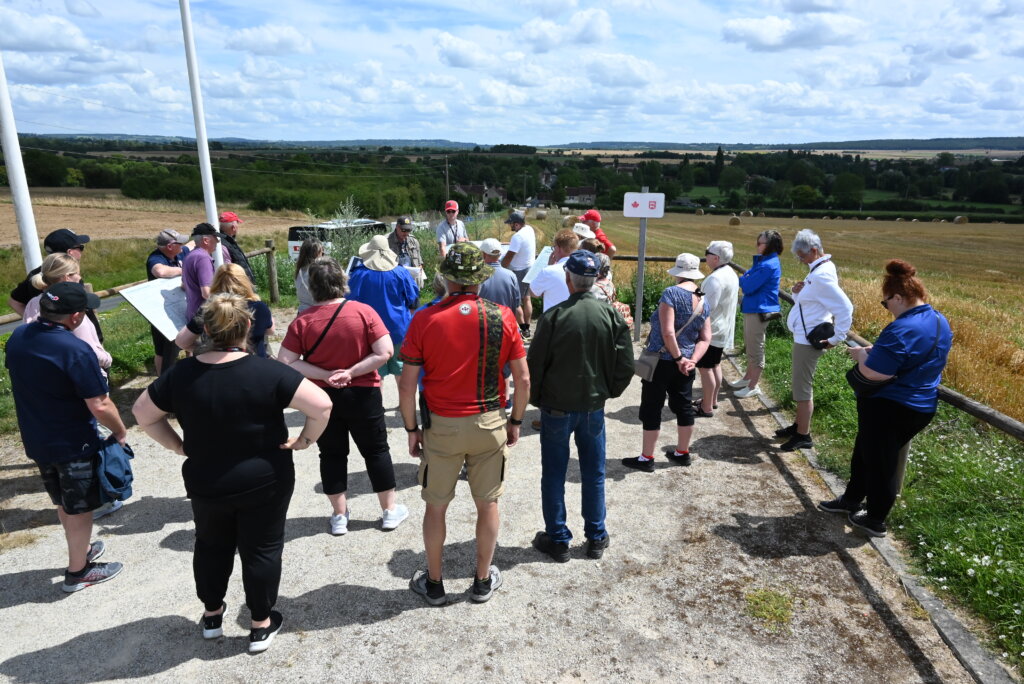
Tourists visit interpretive panels highlighting Canada’s role in the Normandy Campaign on a hill overlooking St. Lambert-sur-Dives, France, in 2024. [Aaron Kylie/LM]
1st Polish Armoured Division led the charge to close the gap, and the Canadians followed down the road to Trun, Saint-Lambert and Moisy to block the crossing points of the Dives River. No one else was willing to do so. 2nd British Army, which had helped push the retreating Germans into the area, largely stopped fighting due to personnel issues. And when the newly arrived 2nd French Armoured Division was ordered to take Trun, its commander flatly refused, saying it was too dangerous and his division would be destroyed. The Americans, meanwhile, had been ordered to advance into the gap but hesitated for two days, then stopped to the south and fired at the retreating Germans.
So, while the Poles dug in on Hill 262, Canadian efforts to close the gap at Saint-Lambert and Moisy fell to 4th Canadian Armoured Division. Initially, this meant a squadron of its recce regiment, the South Alberta Regiment (SAR), led by Major David Currie, and a company of the Argyll and Sutherland Highlanders of Canada. More Argylls and SARs arrived, as did most of New Brunswick’s 103rd Anti-Tank battery. They and the Poles were like fingers in a dike that was about to explode. Allied ground forces commander General Bernard Montgomery—and most Anglo-American historians—declared the Falaise gap closed on Aug. 19 when Polish and American patrols met briefly in Chambois. But no one bothered to tell the Canadians, the Poles or the Germans it was over.
On Aug. 20-21, some 65,000-75,000 Germans swept across the Dives between Trun and Chambois, the majority—it seems—between Saint-Lambert and Moisy. At the same time, II SS Panzer Corps counterattacked from the east to maintain an escape route. The Poles fought with grim desperation, firing their machine guns until the barrels exploded. They were saved by a cordon of exploding shells fired by II Canadian Corps. On one occasion, when it looked like the Poles were about to be overrun by Panzers, fire from 5th Medium Regiment, Royal Canadian Artillery, virtually annihilated the German tanks. Lieutenant Jake Summers, in the valley along the Dives, recalled that “it was like trying to stop a buffalo stampede.”
The Allied artillery was devastating. The concentration of dead and dying men and horses was unprecedented. Water in the area remained unpotable for two decades. The Polish heroism at Hill 262 was honoured by a national monument in 1994. The South Alberta Regiment erected a plaque at St. Lambert-sur-Dives in 1992 to honour David Currie, who earned a Victoria Cross for his action, and the Canadian Battlefield Foundation built interpretive panels overlooking the village near Hill 117. There is no Canadian national monument.
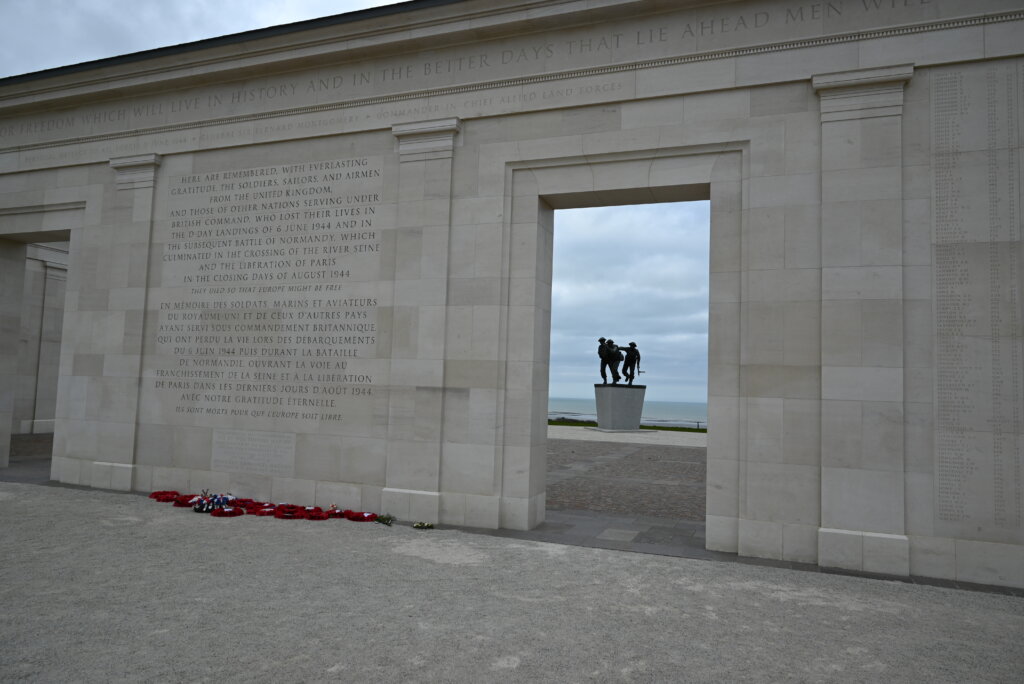
The British Normandy Memorial near Ver-sur-Mer, France, was unveiled on June 6, 2021. [Aaron Kylie/LM]
Some may argue that the time for honouring what early times Greek historian Herodotus called “the great and glorious deeds” of Canada’s soldiers has passed. The British obviously didn’t think so when they expanded their memorial at Hill 112 south of Caen in 2000 or built their new national monument at Ver-sur-Mer in 2021. And the Americans never tire of proclaiming how they won the Battle of Normandy in books, documentaries, TV drama and feature films.
If Cubbage is right, Canada’s effort “changed the course of history.” As such, it’s long past time to honour Canada’s role in Normandy with a national monument.
There is also, sadly, a practical contemporary reason. It’s time to remind Canadians, Europeans and the world that Canada played a critical role in establishing and maintaining peace in Europe. A Canadian national monument in Normandy would be a timely reminder that the country has been there when needed, often punching above its weight.
The effort therefore ought to be a whole of government one, including Veterans Affairs, the Defence Department, International Trade, Foreign Affairs and the Prime Minister’s Office at a minimum. Canada’s allies need to be reminded of the county’s commitment and sacrifice. If Canada can’t do this for those who already paid the ultimate cost, what gratitude and recognition can those who now serve expect?
Read more about the Normandy Campaign in author Marc Milner’s 2025 book Second Front, published by Yale University Press.
Advertisement