

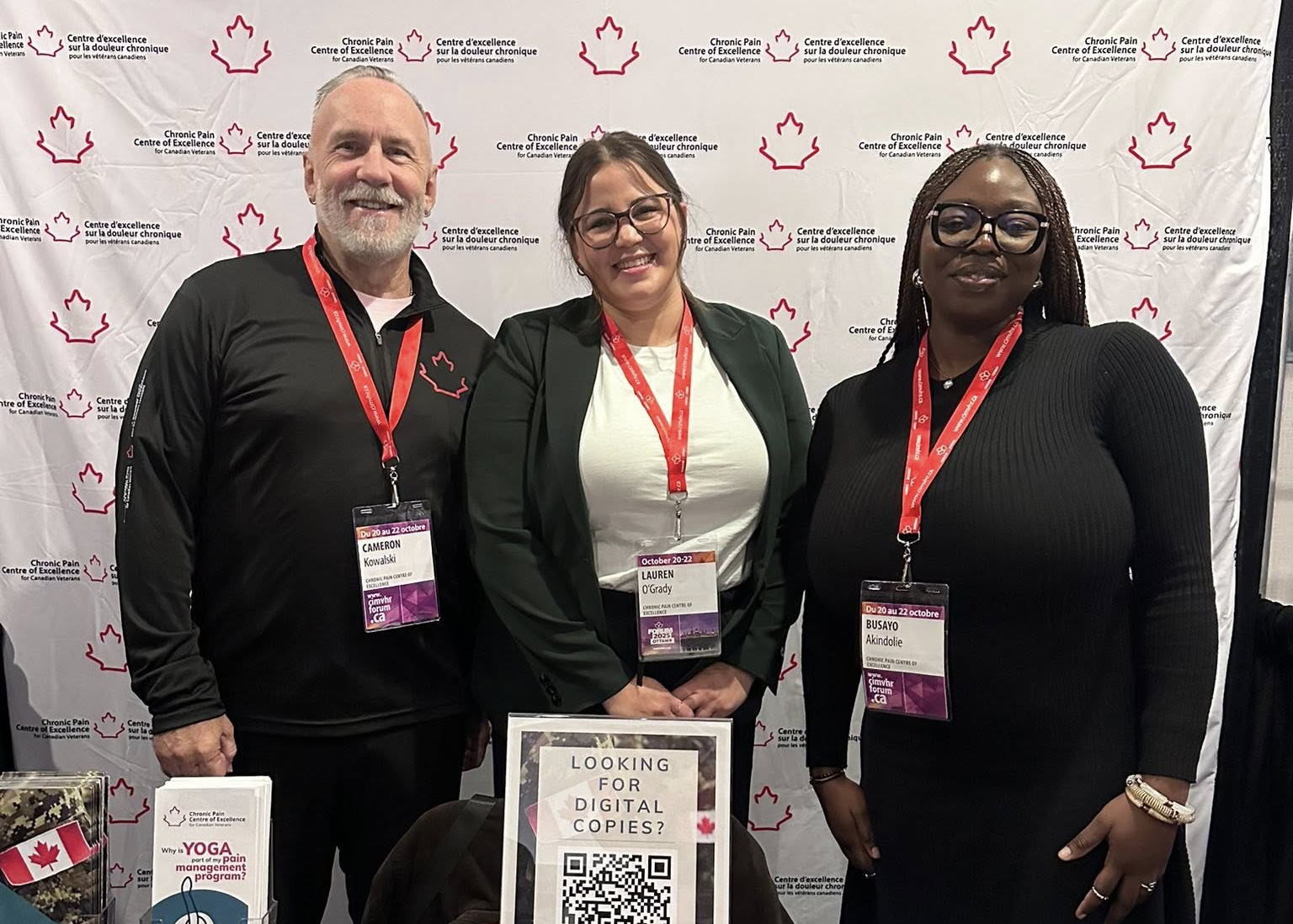
Cameron Kowalski (left), director of operations for the Chronic Pain Centre of Excellence for Canadian Veterans, with colleagues. [Courtesy Cameron Kowalski}
Caring for either mental or physical health shouldn’t be a choice—not least among those who have served. The same goes for funding related projects, insists Cameron Kowalski, director of operations for the Chronic Pain Centre of Excellence for Canadian Veterans.
A 34-year veteran of the RCMP prior to retiring in 2018, the Hamilton, Ont., native is an inner wellness advocate. “A lot of money goes toward mental health, and it should,” explained Kowalski, “but chronic pain is equally important. It’s a comorbidity of mental health.”
The figures speak for themselves. According to Veterans Affairs Canada, 63 per cent of former personnel living with chronic pain also encounter mental health challenges. Despite this, noted Kowalski, “you’ve got the Bell Let’s Talk day, but you don’t have something similar for chronic pain.”
For too long, the more physical hardships of life after service have “almost been an afterthought of studies,” the pain centre executive argues. Not so there. By uniting science with lived experience, the institution strives to address the most pressing questions asked by veterans in need.
Kowalski detailed key answers in a Legion Magazine exclusive.
On veterans living with chronic pain
About 20 per cent of the general population suffers from chronic pain. When you’re talking about Canadian Armed Forces and RCMP veterans, about 40 per cent suffer from chronic pain. And when you break it down further, you find that 50 per cent of female veterans suffer from chronic pain.
It’s extraordinary to know that four in 10 veterans experience this, and it becomes five in 10 when you’re talking about women [veterans]. These individuals are looked after by medical teams within the Canadian Armed Forces when they’re in. But when they transition out, they have to jump in the queue for a family doctor just like everybody else, which can be difficult. Even when they get a family doctor and get into the provincial health-care system, veterans can be complicated patients because of chronic pain and mental health [challenges], because of the way they get broken, in a sense, through training and equipment and wear and tear.
That’s how I got to the position that I’m in, wearing a 16- or 18-pound duty belt, a vest and all that equipment for 12 hours a day, four days a week, for 25 years—that wears on your body.
We often push through the pain, and that can make it chronic. You’re like, “It doesn’t matter how I feel. I’ve got to support my team. I’ve got to get from here to there, whatever the mission says I need to do.” That’s what leads to chronic pain and mental health conditions, because you put that all aside and continue on. It’s an extraordinarily huge burden to carry, but we carry it because we want to serve.
On the pain centre’s origins
Our organization just celebrated its fifth anniversary last summer [2025], so that was a big milestone. We’ve been around since about 2019, although it was 2020 that we officially registered as a not-for-profit, 100 per cent funded by Veterans Affairs Canada.
Our mission is to improve the well-being of veterans and their families living with chronic pain. To do that—and this is the uniqueness of our organization—we have an advisory council of veterans, [currently] 15 former members of the Canadian Armed Forces with lived experience both in the field and with chronic pain. They are the ones who guide us, who come up with what we’re researching each year. Everything we do is veteran-informed and evidence-based.
On the research
In the five years that we’ve been formed as an organization, we’ve funded over 60 projects that are related to chronic pain. When we fund someone’s research through the centre, there are two things that are critical to identify. Firstly, the researcher has to have a veteran partner so that when they’re doing the research, they have a person with lived experience working with them as a co-principal investigator. That then speaks to the credibility of the research once it’s completed.
Secondly, once the research is complete, the researcher has to create a knowledge mobilization product. This is something that consolidates the research into a tangible, digestible item, whether it be a paper, a trifold document, a video or something else that the veteran community can absorb better than having to read a 180-page dissertation.
At the end of the day, [veterans] just want to get better, to feel better. They’ll look to any research that will explain how to alleviate chronic pain. Nothing that we research will say that this is the magic bullet that will take away your chronic pain, but it will help you live with it and manage it.
On the pain centre’s podcast
[“The Most Painful Podcast”] was created almost at the inception of the organization by veteran Tom Hoppe, who is the host. We look for people who have a story to tell related to chronic pain. Throughout the years, we’ve had veterans, researchers, clinicians and politicians. We’ve had a multitude of guests who simply come and tell their story.
Our listenership is growing, and we reach people who’re in other countries. We reach audiences that may not have heard about us or don’t yet understand what we do, so it’s an opportunity for them to look and listen to what the centre does and hear some of our success stories.
On a vision for the future
We need to find those folks who feel hopeless, because people can get into a chronic pain hamster wheel where they think that nobody is looking after them, that nobody understands what they’re going through.
My vision is to get organizations such as the CAF and RCMP to understand the implications of chronic pain within the veteran community and do something to manage that while they’re still serving. I’d like to see a call to action so that we can modify things to bring those [case] numbers down.
We also need to continue to move the yardstick, to spread awareness and to help those who don’t understand that there are solutions—not in a cure but in a management sense—to their problems. The more people who understand what we do, and the more research that gets done, the better off the whole veteran community is going to be.
Advertisement