

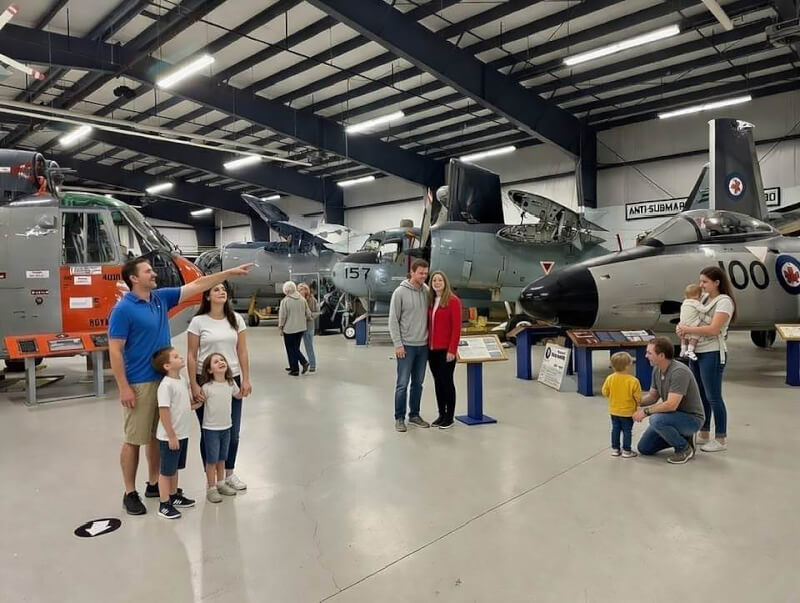
Visitors explore Nova Scotia’s Shearwater Aviation Museum. [Tourism Nova Scotia]
“Specializing in naval air history is our claim to fame,” affirmed Christine Hines, manager of the Shearwater Aviation Museum. Situated within the military base of 12 Wing Shearwater across the harbour from Halifax, the facility is, according to its caretaker of 24 years, “kind of niche.”
It’s in that uniqueness, however, that the museum thrives, a site to celebrate and commemorate a long-underrepresented facet of national identity and heritage.
“Our mandate,” said Hines, “is Shearwater’s history, which is all naval in nature, no matter what element of service operated here—whether it’s the United States Navy, the Royal Canadian Air Force or the Royal Canadian Navy.”
Beyond military branch specifics, Hines’ team of volunteers—including Cold War veterans who once flew aircraft identical to those displayed in its hangars—instead take immense pride in telling little-known stories.
From the shaky foundations of the Royal Canadian Naval Air Service—established (if briefly) in 1918—to subsequent iterations in more modern conflicts, the overarching narrative surprises many, as Hines herself recognizes.
“Most of our visitors,” she said, “aren’t aware that there was ever such a thing as a Royal Canadian Naval Air Service, that Canada had aircraft carriers, or that we even had aircraft that deployed from ships.”
Speaking to Legion Magazine, Hines shared other highlights of the museum’s collection.
On the museum’s history
We’ve been around as a historical collection pretty much since the 1950s, but by 1978 we had enough material to do something more formal. By June 1979 we had accreditation with the Directorate of History and Heritage at the National Defence Headquarters. We’ve been operating successfully ever since.
Back in the late 1970s, we were in a small room at the bottom of the accommodation block. As we grew, like most museums do, we developed a professional hoarding tendency. By the mid-1990s, we took over Shearwater’s old CANEX military store.
We’re all under one roof now, with everything pretty much in the same spot.
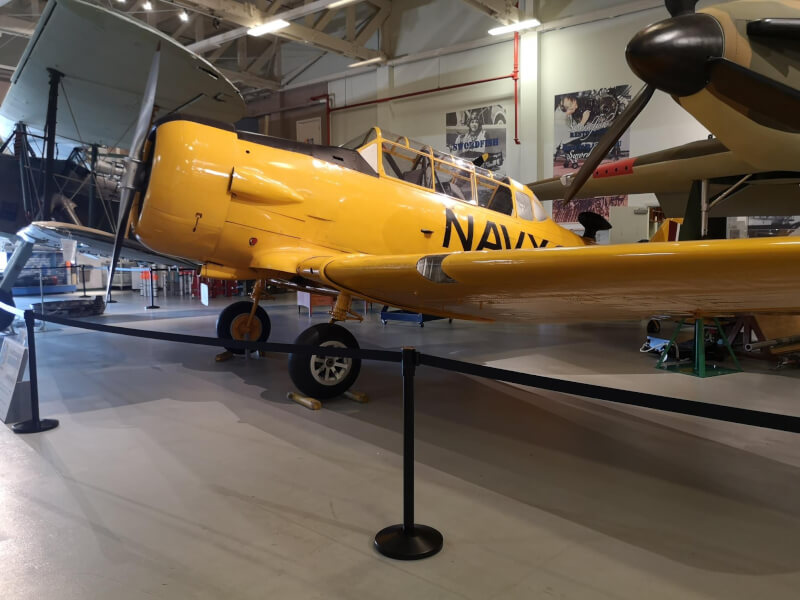
A Harvard Mark II at the Shearwater Aviation Museum. [Tourism Nova Scotia]
On conducting tours
My route is probably a little different than some of my veteran guides, but I recommend that visitors start in a space we call the time capsule, which is a permanent display area in a long and narrow room. We’ve got representations of Shearwater’s history there, divided into chapters that demonstrate what we’re all about. It also talks about what happened here, as well as the impetus for putting an air station—naval or otherwise—in Shearwater in the first place.
When you come out of that room, you’re at the back of the museum. We now have our oldest aircraft, the most special one we have, located there: our Fairey Swordfish. There’s also a beautiful display on Eastern Air Command that talks about the convoys—not just the RCN or Merchant Navy stories, but the air component, too.
We then transition into a bit more information about the Second World War. We don’t have a lot of WW II aircraft. We have the Swordfish, a Harvard—with RCN markings on it—and a replica of a Hawker Hurricane.
We have 24 aircraft, though a couple are beyond our collecting scope, so we’re working to find them a new home.
I think the Sea King helicopters are very much appreciated by many people. They’re my favourite. It’s very easy to see inside one of them because we’ve put plexiglass around the doors. It’s a very up-close experience for visitors.
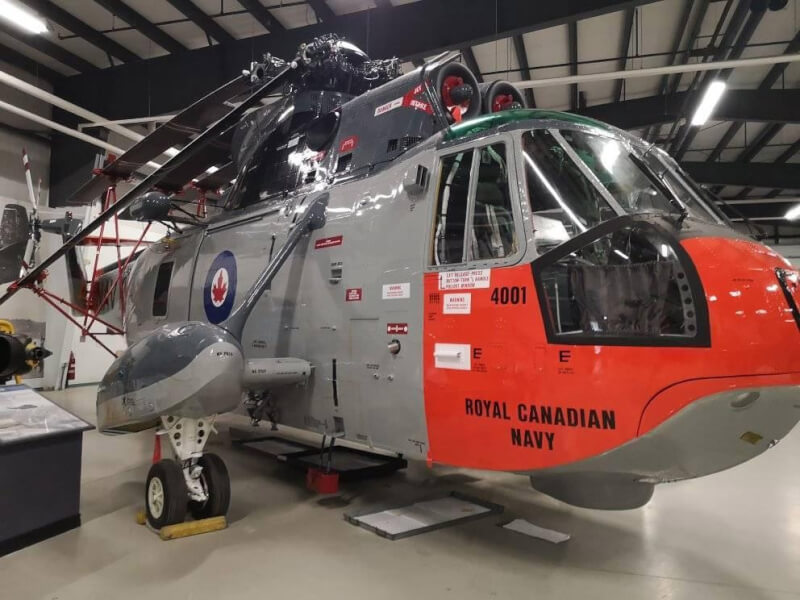
One of the museum’s Sea King helicopters, a favourite among visitors. [Tourism Nova Scotia]
On the HMCS Bonaventure diorama
It’s really important to us for a lot of reasons. Namely, it gives us the chance to talk about aircraft carrier technology and the fact that Canada even had any aircraft carriers.
We have two smaller-scale models of aircraft carriers HMCS Warrior and HMCS Magnificent in our time capsule display, but the Bonaventure model is a bigger scale. It’s a lot easier to talk about how they worked—and how Canada phased out aircraft carriers altogether.
On highlighting human stories
Aircraft are important, and we do our best to interpret them. But I think personal connections are critical as well.
Take the story of Lieutenant Barry Troy, a Cold War warrior and unfortunate training casualty [on Feb. 25, 1958]. The display is positioned next to the Banshee [an example of the aircraft he flew], so it showcases that personal cost. We’re not talking about a gallantry award recipient. We’re talking about an average naval aviator who went on an average training exercise and was lost on it. I knew his brother, a bishop in my hometown who confirmed me as a girl. I even went to the same university that Troy did. It means a lot to me.
Without the personal stories, I think the aircraft are a little dim.
On the symbolism of the museum’s location
From a visitor’s perspective, it’s maybe a difficult place to have a museum because we’re not a history property, and don’t really get the same traffic. But I think taking Shearwater Aviation Museum out of Shearwater is a non-starter. It has to be here, because the story is here.
This interview has been edited for brevity and clarity.
Advertisement