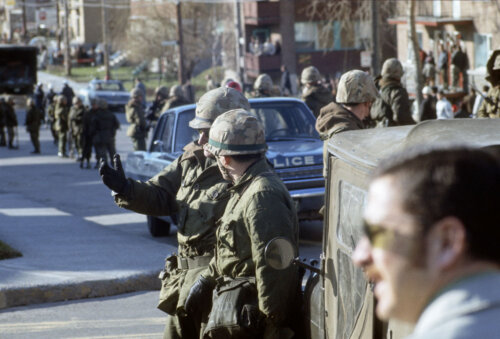


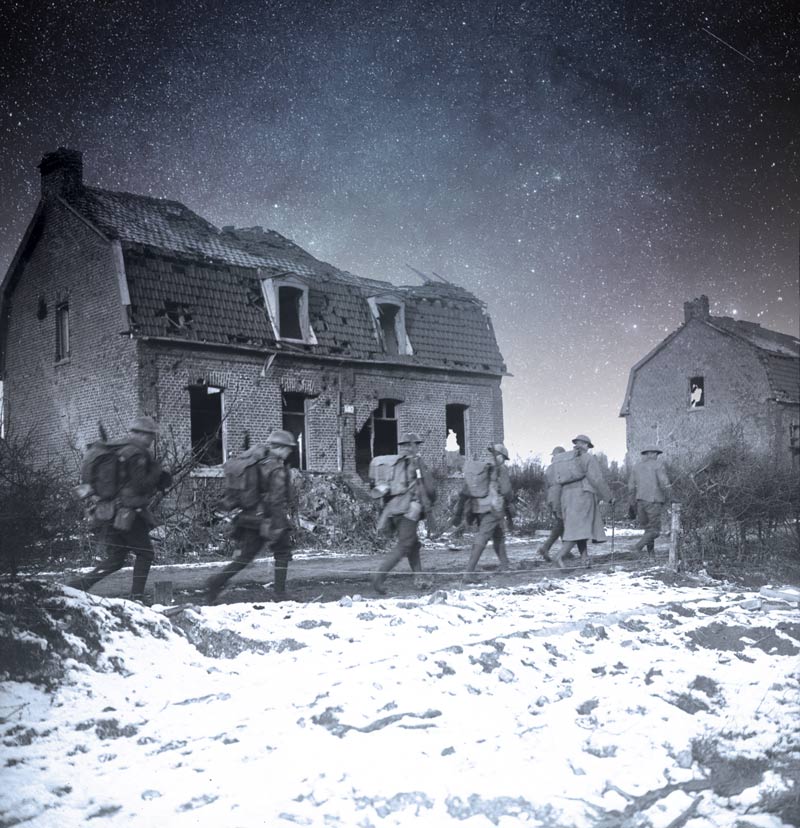
Canadian soldiers head to the front line on Christmas in 1917. [DND/LAC/PA-002324]
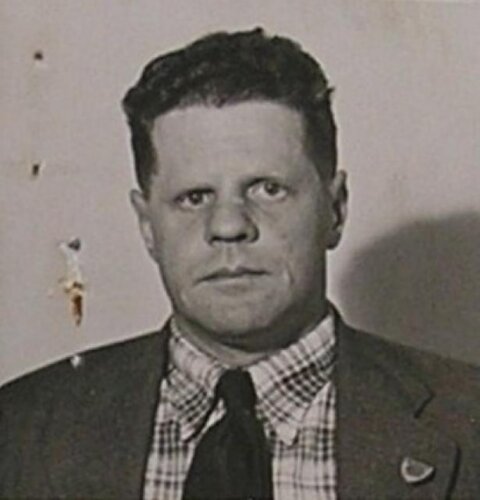
Platoon Sergeant George MacDonell of Stratford, Ont., realized that Christmas Day 1941, only his 20th holiday season, was about to become his “last day on earth.”
Hong Kong was lost. It was evident to the imminently victorious Japanese force that had begun its attack on the British colony 17 days earlier. It was evident to the battered defenders, including The Winnipeg Grenadiers and MacDonell’s own Royal Rifles of Canada—the latter now holed up on the Stanley peninsula to the south. And it was especially evident to MacDonell himself, who, along with two other platoons from ‘D’ Company, was to participate in an apparent final stand.
The recently hardened veteran mustered his troops for what he perceived to be an “idiotic” assault on the enemy-controlled Stanley village farther north. Worse, the roughly 35 men of 18 Platoon would do so by crossing open ground without artillery support. MacDonell laid out the odds, yet “not a single soldier objected.”
After wolfing down a Christmas lunch of depleted rations—of bully beef and hard tack washed down with water—the Canadians were thrust into a maelstrom of mortar and small-arms fire toward their first objective, a local graveyard.
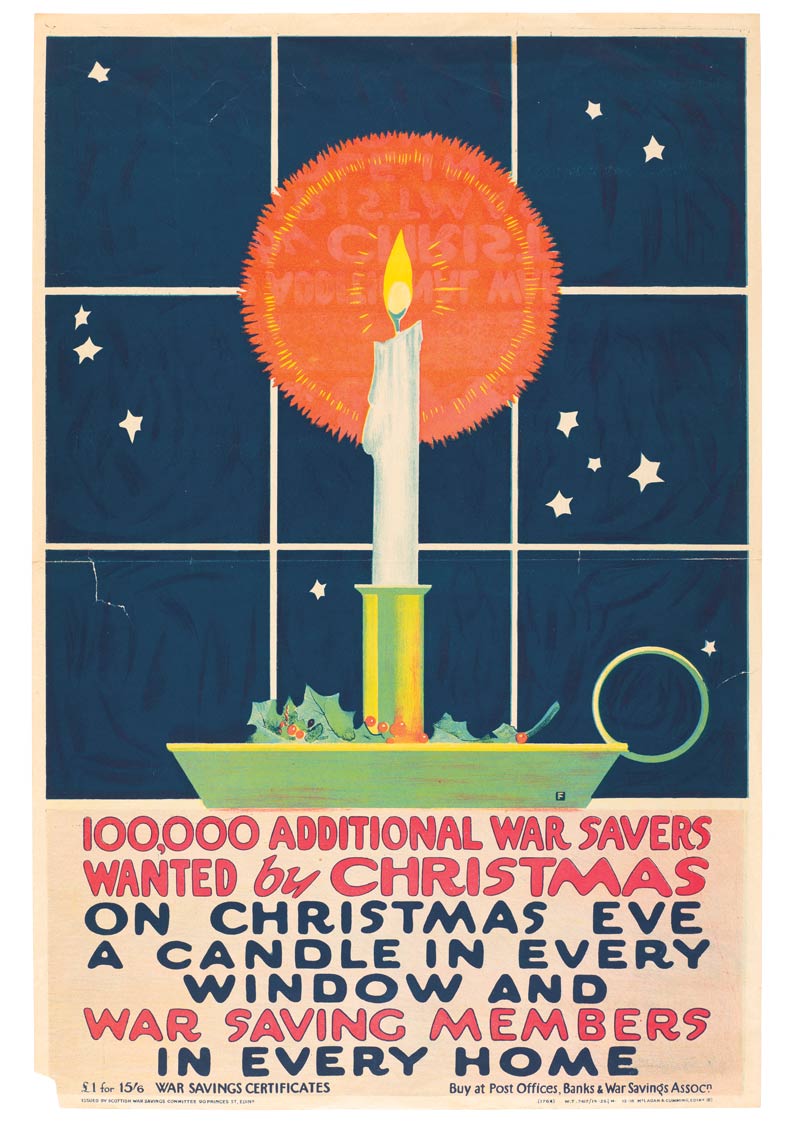
A Great War Christmas time propaganda poster. [CWM/197920121-039]
There, Japanese soldiers used tombstones for cover as MacDonell’s force charged ahead with bayonets fixed.
“For the first time,” said the platoon commander, “I saw the Japanese run in terror” toward a row of thick-walled bungalows.
It wouldn’t last.
An attempt to dislodge the enemy devolved into vicious hand-to-hand fighting. MacDonell then found himself leading not one, but two platoons as casualties mounted. While regrouping and reorganizing the survivors, he spied Japanese reinforcements, seemingly assuming their troops still controlled the cemetery, making for the position. The Canadians cut down half their number in seconds, the other half escaping before retreating toward an underground garage.
MacDonell’s men followed close behind—boys, really, from Quebec, Ontario and the Maritimes, once raised on stories of Christ’s nativity and the spirit of goodwill. There would be no goodwill here, nor peace. Not when so many, and soon so many more, had sacrificed their lives protecting a godforsaken island so far from their festive-filled homes, families and loved ones.
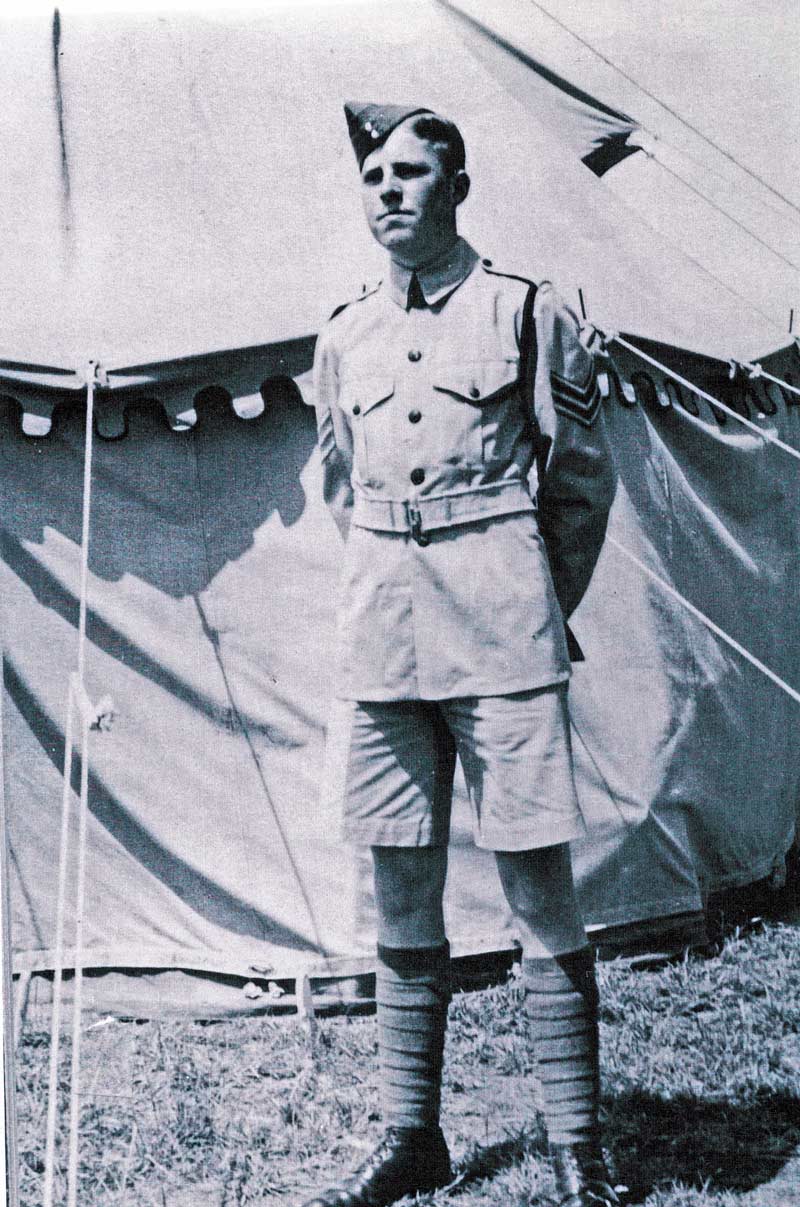
Platoon Sergeant George MacDonell [Courtesy George MacDonell/The Canadian Encyclopedia]
For the cornered Japanese, not that their Canadian pursuers likely knew, it wasn’t Christmas Day but Taisho-tenno-sai, a commemoration marking the 1926 passing of Emperor Taishō. Now, they were dutiful servants of his son and heir, Emperor Hirohito, an allegiance that sealed their fate.
“We just walked down the road and hosed them with our automatic weapons,” said MacDonell as quoted in author Nathan Greenfield’s tome The Damned: The Canadians at the Battle of Hong Kong and the POW Experience, 1941-1945. “We killed every single one of them.”
Despite a minor victory amid the carnage, the Canadian positions were becoming increasingly untenable. Newly dead and wounded littered the site when MacDonell learned of Japanese flanking efforts, prompting him to order a withdrawal of all fit and able-bodied men. Those who couldn’t walk were, regrettably, left behind. The sergeant and a comrade chose not to join and instead covered the evacuation until enemy shots rang out from the direction of their supposed escape route to the rear.
Both shot blindly and ran for a shallow drainage ditch. Crawling through the muck and water, they felt the thud of bullets hitting the bank mere inches above them. A machine-gunner added to the cacophony, the weapon’s bursts carefully monitored by the duo in order to judge when it required reloading. When the moment came, they ran again.
After wolfing down a Christmas lunch of depleted rations, the Canadians were thrust into a maelstrom of mortar and small-arms fire toward their first objective.
MacDonell and the fellow non-commissioned officer of 17 Platoon returned to what was left of the Royal Rifles. Their suicidal attack ordered by British Brigadier Cedric Wallis had achieved little other than adding 26 killed and 75 wounded on their numbers.
At around 3:15 p.m., the British garrison’s General Christopher Maltby ordered all defenders to formally capitulate. The surrender announcement took hours to reach Wallis’s East Brigade, initially met by refusal as the junior commander continued acting on previous orders to “hold to the last.” Only in the early hours of Dec. 26, Boxing Day to many defenders, did Wallis finally, and belatedly, concede defeat.
The Battle of Hong Kong cost an estimated 4,413 Allied casualties, 2,113 of whom were killed in action. Of those, the formerly 1,975-strong ‘C’ Force, including The Winnipeg Grenadiers and Royal Rifles, suffered 290 fatalities before the surrender. A further 264 Canadians would die in Japanese captivity under terrible conditions.
MacDonell laid down his arms, received permission to bury the dead, and started Day 1 of his three-and-a-half-year imprisonment. Like scores of his compatriots, the sergeant was destined to be shuffled between several filthy, primitive, disease-ridden prisoner-of-war camps—both in Hong Kong and Japan itself—where the Canadians and their allies endured beatings, torture, enslavement and borderline starvation.
“To keep from going mad, I tried to escape the misery of the present by daydreaming,” wrote MacDonell in his 2002 biography One Soldier’s Story. “I tried to relive my life with my wonderful mother and my father,” not least the memory of better Christmas mornings, warmly recalling “all the joyous experiences I had shared with my parents, grandparents, uncles and aunts, cousins and friends at home.”
MacDonell had been wrong about his impending demise on Dec. 25, 1941, but he might still have wondered if he would ever be free to enjoy such festive delights again.
Lieutenant Wilf Gildersleeve of North Vancouver sat at the church organ of Santa Maria di Costantinopoli. There, on Dec. 25, 1943, the ferocious Battle of Ortona raged beyond the nave’s scarred walls. Death and destruction against a fanatical German defence showed few signs of abating. And, as Canadians tried to celebrate their fifth Christmas at war, the 27-year-old resolved himself to play on.
Why exactly, Gildersleeve had brought a hymn book with him from B.C. to Europe, not least to an Italy in flames, he had never been entirely certain. Perhaps it had been to remind him of once accompanying the choir in his local congregation. Perhaps, somehow, in some strange, unknowable way, it was for the very moment at hand.
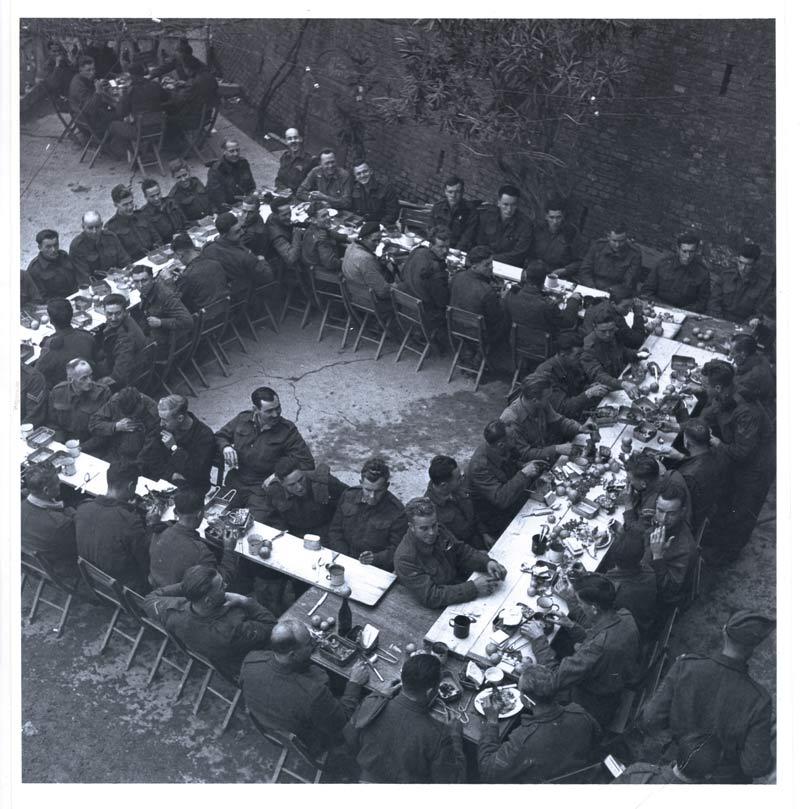
Canadian infantrymen sit down to Christmas dinner near Ortona, Italy, in 1943.[CWM/20020045-2726]
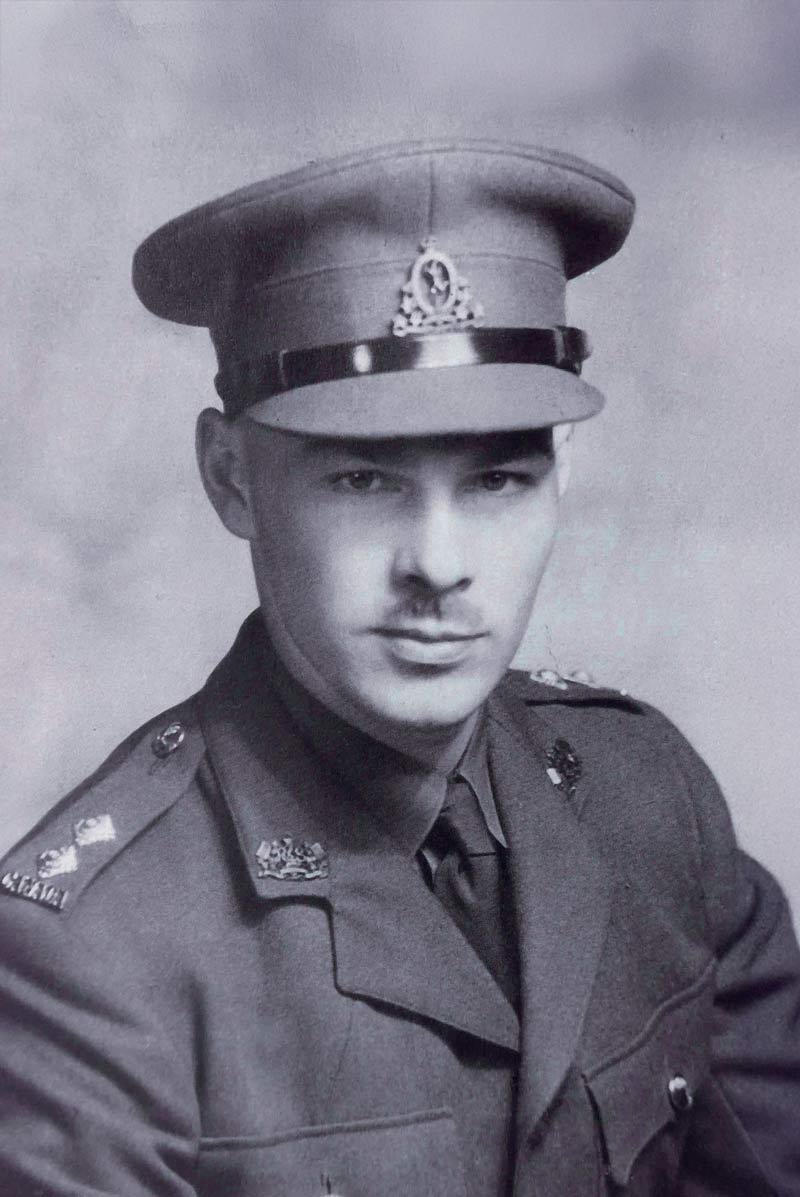
Lieutenant Wilf Gildersleeve played carols for fellow Canadians that holiday on the organ at a nearby church.[Courtesy Juliana Leahy]
The signal officer’s Christmas carols filled the air as comrades of his own Seaforth Highlanders of Canada gathered. The plan—should circumstances permit—was to have each forward rifle company rotate out of the urban fighting and into the semi-ruined church for a seasonal lunch. The melodies of “Silent Night” would play to the sounds of mortar strikes, artillery bombardments and machine-gun fire outside.
From 11 a.m., attendees from ‘C’ Company nevertheless found festive cheer among the rubble as they savoured every bite, every minute, of their first two-hour respite.
“The setting for the dinner was complete,” the regimental war diarist wrote of the scene, “long rows of tables with white table cloths, and a bottle of beer per man, [with] candies, cigarettes, nuts, oranges and apples and chocolate bars providing the extras.” Added to that was the large main course, an offering of “Soup, Pork with apple sauce, cauliflower mixed vegetables, mashed potatoes, [and] gravy.”
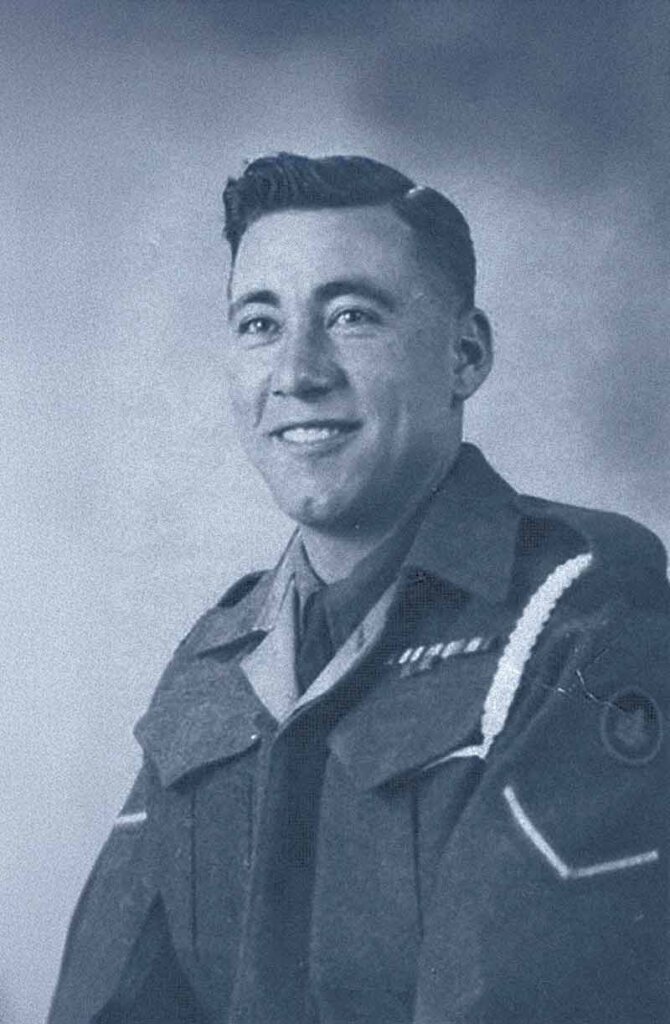
Private Maurice White was in action in Ortona, Italy, on Christmas Day 1943, inflicting casualties, which he later said “bothers me so much.”[The Canadian Encyclopedia]
Finally, to conclude the feast fit for a king—and fitter still for soldiers weary of meagre rations—a dessert of “Christmas pudding and minced pie” ensured that everyone was to be well fed as officers honoured tradition by serving the ranks.
While the Seaforth Highlanders weren’t alone in the battle, they were alone in the meal. Elsewhere in Ortona’s ruined streets, men of The Loyal Edmonton Regiment were lucky if they could wolf down cold pork chops delivered to them at the front.
Loyal Eddie Private Maurice White, observing a piazza from a hole knocked out of a house attic space, was afforded not only meat but mashed potatoes and a bottle of beer. With his weapon trained on the town square, the 18-year-old infantryman had been counting his blessings when a German appeared in his sights.
“I had to shoot him on Christmas Day,” he remembered decades later. “That bothers me so much.”
Canadians would die, too, amid the merrymaking. Seaforth Highlander Lieutenant Dave Fairweather, serving in ‘D’ Company, had previously expressed fears about there being “too much beer and liquor available” at the church. Despite limits on ale, free-flowing wine left him concerned that drunken battlefield mistakes could end “in disaster.” Leading his platoon out from the last rotation at 7 p.m., a shell landed among them. Fairweather counted one killed and two wounded.
Not every Seaforth soldier would attend for that precise reason.
When one six-man section received permission to partake in the festivities, their leader, 29-year-old Private Ernest (Smokey) Smith of New Westminster, B.C., revoked the consent.
“I don’t know what goes through the minds of those people who are in charge of this,” said the future Victoria Cross recipient, “but people are going to get killed going to that dinner and others are going to die coming back from it.”
Smith maintained that his demands prevented preventable tragedies.
Notwithstanding the evident stakes, for most Canadians, their brief stint at Santa Maria di Costantinopoli was the closest they would ever get to glad tidings in Ortona.
That sentiment was not lost on Gildersleeve, who continued playing the organ for hours, even after his fingers started to ache, acutely aware that it could be worse. Equally, he was acutely aware that many comrades had enjoyed their last supper.
The Dec. 20-28, 1943, Battle of Ortona would be dubbed Little Stalingrad. A bloody house-to-house clash endured by men with minimal experience in urban warfare, the Canadians ultimately prevailed at a horrendous cost: no fewer than 2,339 casualties, 502 of whom were killed (including in the Moro River Campaign that preceded the street fighting itself). No authoritative figure exists for German fatalities, although upward of 100 unburied bodies were identified following liberation. Ortona’s residents suffered more than 1,300 deaths in the crossfire.
But the victory also represented yet another wave in the Allies’ turning tide.
Gildersleeve would see his old congregation again—albeit via the liberation of the Netherlands, where he would meet his Dutch wife. In the meantime, with the Seaforth dinner over, he stretched his tired fingers, replaced his helmet and walked outside.
“When the last man of the Battalion reluctantly left the table to return to the grim realities of the day,” penned the Seaforth war diarist of the conviviality, “there was an atmosphere of cheer and good fellowship in the church. A true Christmas spirit.
“No one had looked for a celebration this day, December 25th was to be another day of hardship, discomfort, fear and danger, another day of war. The expression on the faces of the dirty bearded men as they entered the building was a reward that those responsible are never likely to forget.”
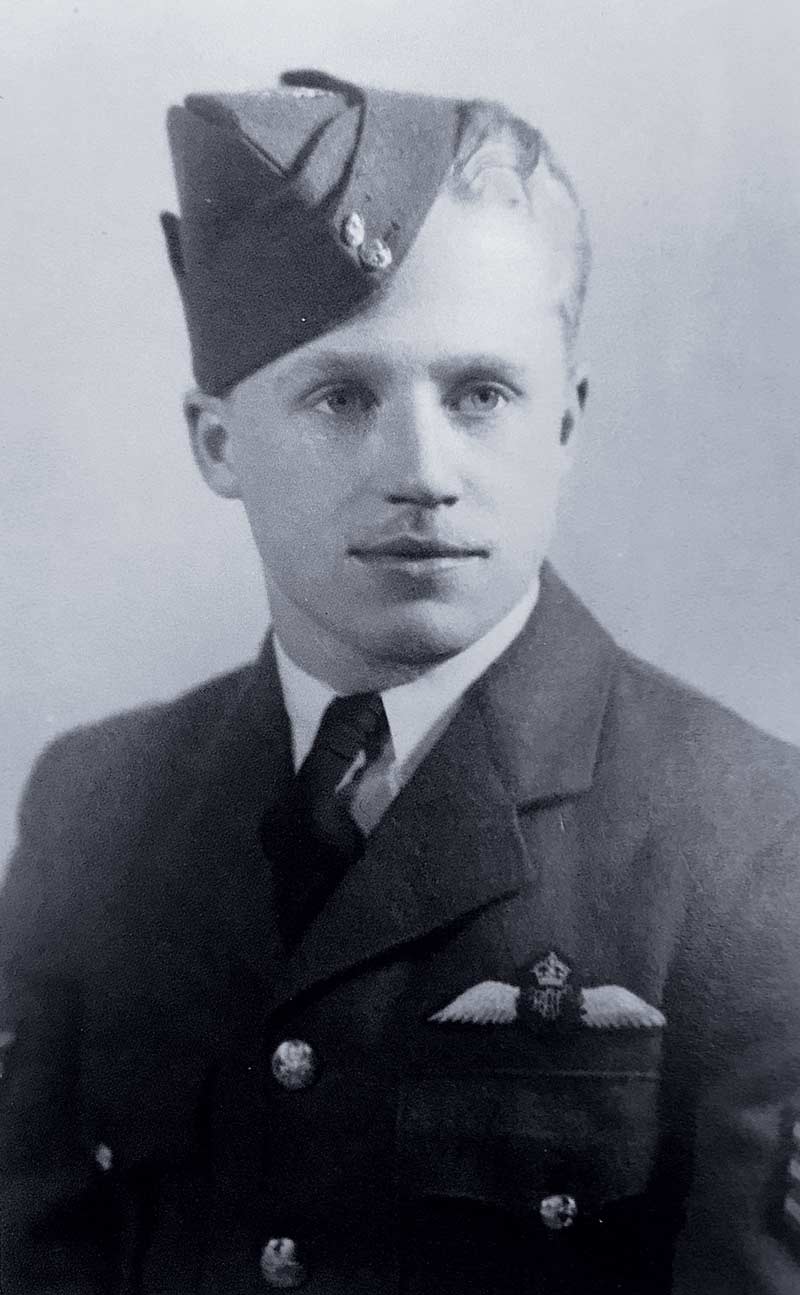
Pilot Jean Cauchy led a bombing run over Germany on Christmas Eve 1944.[Courtesy Jean Cauchy]
Cauchy savoured another ale, opened a tin of Spam for an impromptu Christmas dinner, and thanked God for the chance to revile it.
Flight Sergeant Jean Cauchy of Lévis, Que., piloting a crippled Halifax Mark III bomber above Nazi Germany on the afternoon of Dec. 24, 1944, had a Christmas concert to get back to. He was supposed to be singing in the choir. How could he let his 425 (Alouette) Squadron ensemble and its radio broadcasters down?
Having lost one engine to enemy flak, however, and with ordnance still in the aircraft’s compromised bomb bay, there was no telling if he would make it home at all.
The 20-year-old flyer kept his cool at the controls, maintaining altitude at the cost of reduced speed. Below, German anti-aircraft guns persevered in trying to knock the Halifax out of the sky, a barrage that appeared to follow it across much of wartorn Europe. Not that Cauchy could do much about it. Act too aggressively in evasive manoeuvres, and the bomb still on board might detonate; sustain the same trajectory and risk being a sitting duck.
Severe damage to the right wing effectively made the decision for him as the plane, unable to align with the other bombers in the formation, gradually fell away.
It was about then that Flying Officer Joseph J.P. L’Esperance’s voice came over the intercom. Rather than prolong their ordeal by attempting to make their distant Yorkshire base, the navigator urged Cauchy to divert to the nearer RAF Rivenhall in southeast England. There would almost certainly be no Christmas performance, alas, but what did that matter if they couldn’t escape with their freedom and lives?
It was a gift enough for Cauchy, who wasted no time in changing course.
Enemy flak became increasingly sporadic before petering out as the bomber approached the English Channel. Somewhere down there, Allied ground forces, including the men of First Canadian Army, were dismantling Hitler’s so-called thousand-year Reich piece by piece, battle by battle, amid the worst European winter in 50 years. Somewhere down there, far out in frigid waters, Canadian sailors were overcoming the greatly diminished threat of the U-boat menace.
More importantly for Cauchy and his crew, somewhere down there, not much farther now, was the British coastline and a ready and waiting airfield beyond.
The pilot had already switched off the intercom to silence his comrades’ anxieties. Cauchy needed to concentrate if he was going to land the aircraft with its volatile cargo intact. Slowly, steadily, he lined himself up with the runway, brought down the wheels, and hoped for a Christmas miracle in which rubber settled onto grass.
Cauchy breathed a sigh of relief as he touched ground. The plane’s ordnance remained secure, the three surviving engines were safe to disengage, and the semi-deserted airfield was a sight for sore eyes. All that was left was to sate dry mouths.
The Canadians visited a local pub, content to be served by a “beautiful red-headed English woman.” When a later effort to locate a midnight mass turned out to be in vain—a mystified priest had explained that blackout conditions had forbade such occasions for years—Cauchy instead savoured another ale, opened a tin of Spam for an impromptu Christmas dinner, and thanked God for the chance to revile it.
As for his missed choir performance, there was always next year.
Former prisoner George MacDonell had previously promised his men they would be “home for Christmas.” Now, in December 1945, his oath was about to be fulfilled.
The Hong Kong battle survivor, seated on a Canadian Pacific Railway train rolling eastward across the country, caught sight of his reflection in the carriage window, distracting him from familiar views of the scenery beyond. His face, still swollen from vitamin deficiency, carried the scars of his harrowing internment. Would his loved ones recognize him?
At least he would be afforded the opportunity to see them again, thought the 23-year-old veteran of the worst war in human history, a bloody conflict that had claimed some 45,000 Canadian lives. He, like Gildersleeve, like Cauchy, would be considered one of the luckier ones, whatever that meant. Certainly, in the case of post-traumatic stress disorder-inflicted MacDonell and countless others bearing the weight of their experiences, it was up for debate.
But he was alive, and his family, after some four years of uncertainty, knew that too as they gathered at Toronto’s Union Station to await his arrival. MacDonell had been in the process of bidding a final farewell to his men when his aunt and uncle—his surrogate parents since he was 13—approached him on the platform.
“My uncle walked up and suddenly there was almost silence as he put his big arms around me,” MacDonell recalled of the moment. “They had given up hope so long ago.” He then embraced his aunt, who, through tears, recognized him in an instant.
It was the week before Christmas, but there remained ample cause to celebrate the holidays early upon the family’s return to their three-storey Stratford, Ont., home. There, finally together in seasonal joy, they tucked into a “wonderful dinner” just like the ones MacDonell used to know, memories of which had sustained him through the darkest of days. There would be further difficult days ahead, of course, but those days would have to wait. Exhausted in more than one way, MacDonell excused himself following the festivities, “went to my room and collapsed into my bed.”
Advertisement