

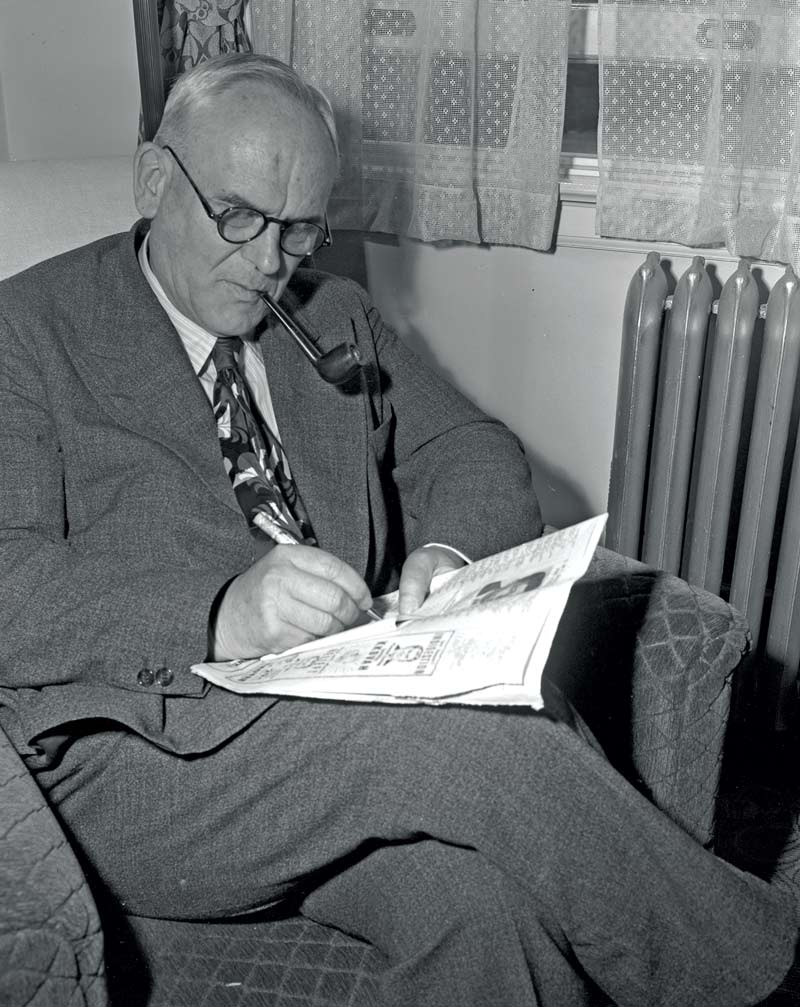
[Eric Bland/City of Edmonton Archives]
Taking his turn bailing and rowing was Clarence Decatur (C.D.) Howe, leader of a Canadian delegation heading to Britain to discuss wartime supplies for the beleaguered country.
Howe, said Lord Beaverbrook, British minister of aircraft production, was “one of a handful of men of whom it can be said, ‘But for him the war would have been lost.’” The British ensured a safer return trip, sending Howe home aboard the battleship King George V.
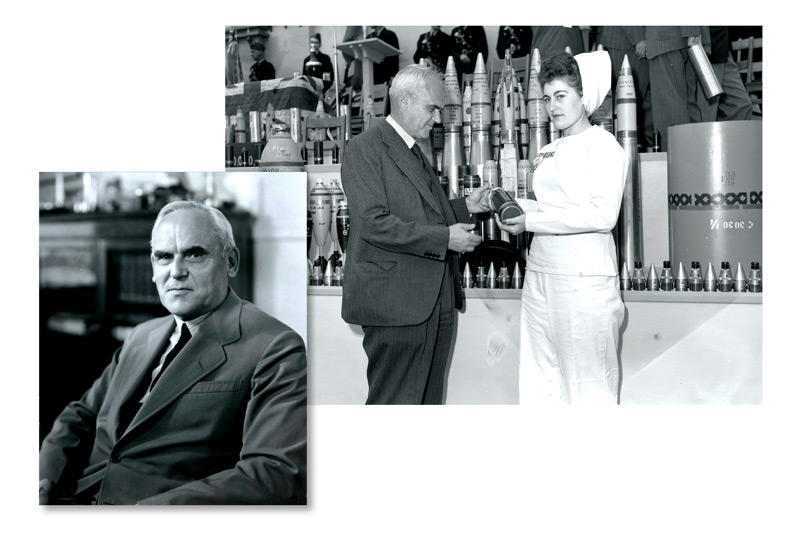
C.D. Howe at work: Edna Poirier presents him with the one-millionth projectile manufactured at Defence Industries Limited in Saint-Paul l’Ermite, Que., in September 1944 (above); in an undated photo (above); and in 1949. [ MIT Museum; LAC/PA-112908]
Howe was the man of the hour in Canada’s—and Britain’s—hour of need, relying on experience and know-how gained during a long and varied career to shepherd Canada through the war and into peace.
Along the way he transformed Canada’s economic base from agriculture to industry.
As minister of munitions and supply, Howe organized his department along business lines and ran it like a chief executive officer, hiring top talent, cutting red tape, and creating Crown corporation to fill supply and production gaps.
Born in the U.S., Howe trained as an engineer, gaining confidence in his abilities and developing the work ethic to propel him to success in academia, public service and as an entrepreneur. And that success was the foundation of a stellar two-decade political career.
Howe found job prospects limited by a recession after graduating from the Massachusetts Institute of Technology in 1907. He accepted a position teaching civil engineering at Dalhousie University in Halifax, taking out a loan to tide him over to his first paycheque.
Engineers, said Howe, “deal with concrete problems, where facts are facts and all else is error.” He had little patience for opinion and debate, and none for waffling, traits that would plague him throughout his political career.
In 1913, Howe took a job designing storage elevators for the Canadian Grain Commission. He travelled across the West learning about the grain trade, farmers and grain companies, railways and ports, prairie people and their politics. People appreciated his plain talk and orderly approach.
A First World War boom for grain farmers created a shortage of storage facilities. He seized the opportunity, forming C.D. Howe and Company in 1916 to supply grain elevators.
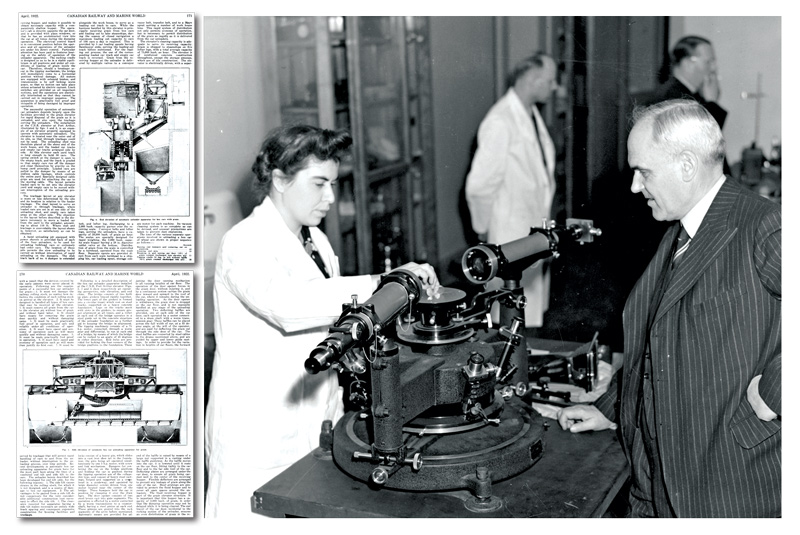
In an April 1922 edition of Canadian Railway and Marine World, Howe wrote about his innovations for grain elevators and cars, including diagrams. [Old Time Trains (2); National Film Board of Canada/LAC/3195768]
That same year, he married Alice Worcester, whom he met while at university. The newlyweds established a home in Port Arthur, Ont., near Fort William (present-day Thunder Bay), the hub for Great Lakes grain shipments, where land was cheaper—and not only for family homes.
Howe persuaded the Saskatchewan Grain Growers’ Association to also buy land in Port Arthur for its massive storage facility, which he would build. What followed, said Howe, used up his lifetime quota of worry. A fierce storm destroyed the half-completed project.
But, Howe refinanced, hired a crew of 300 to work around the clock, and the facility was ready for the season’s first grain shipment later that year.
Howe was “one of a handful of men of whom it can be said, ‘But for him the war would have been lost.’”
“I lost my shirt,” he said of the project. But he cemented his reputation and his grateful client’s bonus made up for the losses.
Howe’s company prospered, expanding across Canada, then overseas, taking him with it more often than not. He designed more efficient grain elevators and automatic grain car unloaders, devised electrical building jacks that sped construction and mastered logistics. Howe became a consulting engineer and general contractor.
According to a family tale, after one business trip, wife Alice said: “Children, I’d like you to meet your father. You may not remember him.” Despite his frequent and long absences and often brutal working hours, the Howes were married 44 years and raised five children.
The Great Depression caused wheat prices to plummet and put Howe’s company on the ropes. Believing the Conservative government bungled the crisis, Howe agreed to run for the Liberal party in the 1935 federal election—in exchange for a cabinet post if elected; he was. He sold his company and moved his family to Ottawa.
Prime Minster Mackenzie King chose Howe to head the ministries of marine, railways and canals, to be combined into a new department of transport. Howe’s first trial by fire in the House of Commons was legislation replacing the seven harbour administrations with a National Harbours Board. Run under a patronage system, harbour administration “shows the most shocking betrayal of public trust,” he said. But members of both major parties liked dispensing plum harbour appointments to supporters.
The debate was long and rancorous. At one point, Howe said if the bill was wrapped up in red tape, “I will not administer it.” It passed, but with more amendments—and debate—than he liked.
Howe had “the air of a man who wants to get ahead with his job and would be deeply obliged to everybody if they would cut the cackle and let him get down to business,” wrote journalist Leslie Roberts in C.D.: The Life and Times of Clarence Decatur Howe.
Get down to business he did, creating and strengthening Crown corporations. He established the Canadian Broadcasting Corporation (CBC) and Trans-Canada Air Lines and put Canadian National Railways on the track to profitability.
Now was the time for Canada to spread its wings, though it was a decade behind other countries in civilian air service. Howe closed that gap by picking the brains of experts in other countries. Trans-Canada Air Lines was incorporated on April 10, 1937. Less than a year later, on March 6, 1938, coast-to-coast passenger service began, not least due to Howe’s hard work and determination.
“I reach a point in the development of a project,” Howe said later, “where I begin to think…it is the most important thing in the world.”
Canada’s air industry became particularly important during the Second World War, when some 16,000 aircraft were manufactured and 130,000 aircrew trained in the country under the British Commonwealth Air Training Plan.
But the nation entered that war unprepared. Though a department of supply was created in 1939, it was unclear what supplies would be needed.
Howe had an inkling. In early 1938, the British War Office contracted 5,000 Bren guns from a Canadian manufacturer, and Canada tacked on 7,000 additional weapons for its defence department.
In September, a Maclean’s magazine article about the contract lit a media firestorm, raising questions about patronage and war profiteering. A royal commission investigated; its report sparked heated debate in the Commons. How could this facility, described in 1936 as a broken-down boiler factory, produce modern weapons? Howe reported that he visited the plant himself, finding a new addition fitted with modern equipment to produce machine guns. And on a cost-plus basis. Debate over.
Howe spoke with “stubbornness which stems from personal study,” wrote Roberts. He “repeatedly irritates opponents by telling them obliquely ‘I know what I’m talking about’ in a way which often suggests they do not….”
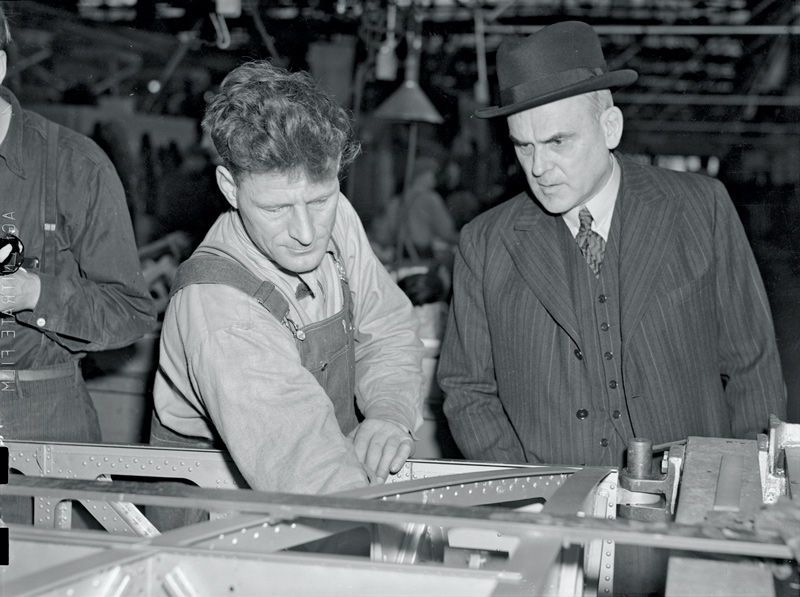
Howe visits the lines at a Fort William, Ont., aircraft factory (above) and at the Canadian Arsenals Company optical plant in Toronto (above) in 1941.[National Film Board of Canada/LAC/3195720]
Appointed minister of munitions and supply on April 9, 1940, Howe immediately built a team with experience sourcing raw materials and supplies. He persuaded businesses to send their brightest executives to serve the country—and pay their salaries for the duration. Those salaries were augmented by a paltry sum to make it clear they were government employees. They were called dollar-a-year men.
“Once he had picked a man…he expected him to go away and get on with the job,” wrote biographer John D. Harbron. “‘Keep out of here and keep out of trouble,’ he would say.”
In total, Howe established 28 Crown corporations to ensure industry had what it needed, regardless of cost.
“We have no idea of the cost,” said Howe. “If we lose the war nothing will matter…. If we win the war the cost…will have been forgotten.”
Howe used his ministerial power, augmented by the War Measures Act, to find materials and fuel for wartime production: steel and lumber to build ships, aircraft, trucks and tanks; rubber for wheels; minerals for rifles and ammunition; kapok for lifebuoys and sleeping bags; silk for parachutes; and hundreds of other items for hundreds of other products.
Aside from parliamentary business, Howe “turned from one crisis to another,” in a parade of daily half-hour appointments, often working late into the night, wrote Robert Bothwell and William Kilbourn in their 1979 Howe biography. It seemed Howe was everywhere, earning him the nickname Minister of Everything.
When victory was imminent, Howe was given a new post: minister of reconstruction. His job now was to help industry shift from pumping out military supplies to producing consumer and trade goods. It wasn’t an easy transition. Howe enjoyed wartime powers unsuited to peacetime democracy—and he did not want to give them up.
“His contemptuous attitude toward criticism and his determination to write his own rules brought the Opposition down on him in virtually every debate,” wrote Roberts.
In 1948, Howe, then minister of trade and commerce, sought power to grant export permits at his own discretion, resulting in an explosion “among the most violent of Howe’s parliamentary career,” observed Roberts. What was to prevent him from favouring friends and ruling against people he didn’t like? asked one opponent.
“The honourable Member has spoken from the sewer of his own mind!” thundered Howe. But he withdrew the request.
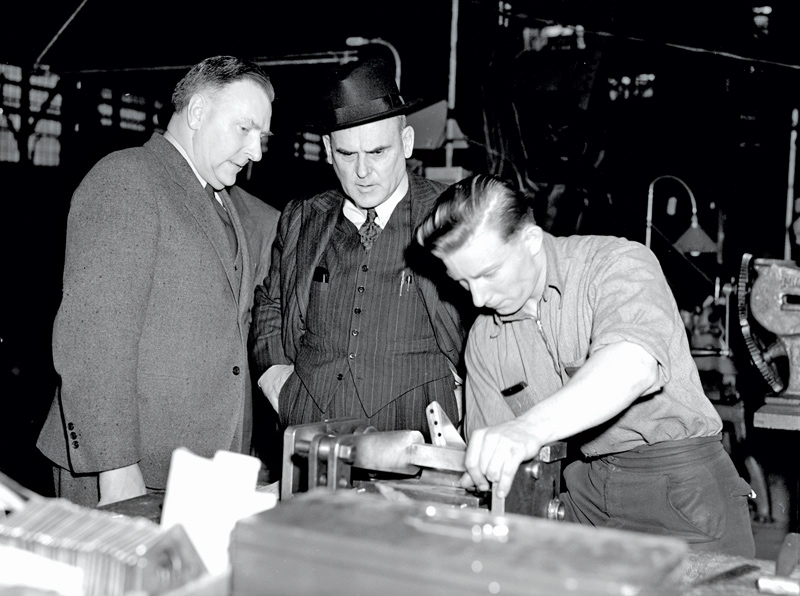
Howe speaks with workers at an aircraft plant in Fort William, Ont., in March 1941. [National Film Board of Canada/LAC/3195721]
Howe’s star continued to climb. In 1951, he added the defence production ministry to his existing trade portfolio. A 1952 profile in Fortune magazine said Howe was the most powerful man in Canada, the prime minister’s right hand and a guru to private industry.
“Howe looks and acts like exactly what he is—a stocky, candid, unpretentious ‘engineering type’” so accustomed to making the right decisions he never had to put on airs or curb his tongue.
Howe had little patience for opinion and debate, and none for waffling, traits that would plague him throughout his political career.
Canadian industry was now producing consumer and industrial goods, and the postwar economy was booming. Howe was enchanted by the idea of building a natural gas pipeline across the country, a massive project that would provide jobs for years, long-term economic benefit and reliable supply for Canada. But politics and economics threatened to turn it into a pipe dream.
Trans-Canada Pipe Lines, incorporated in 1951, was initially a syndicate of Canadian and U.S. businessmen, raising worries it would primarily serve American interests. The Canadian government was also leery of financing a for-profit enterprise.
Investors didn’t want to put up money until there were customers, and they worried it would be too expensive to build a pipeline across rugged northern Ontario. Customers didn’t want to sign contracts to buy gas until the line was built.
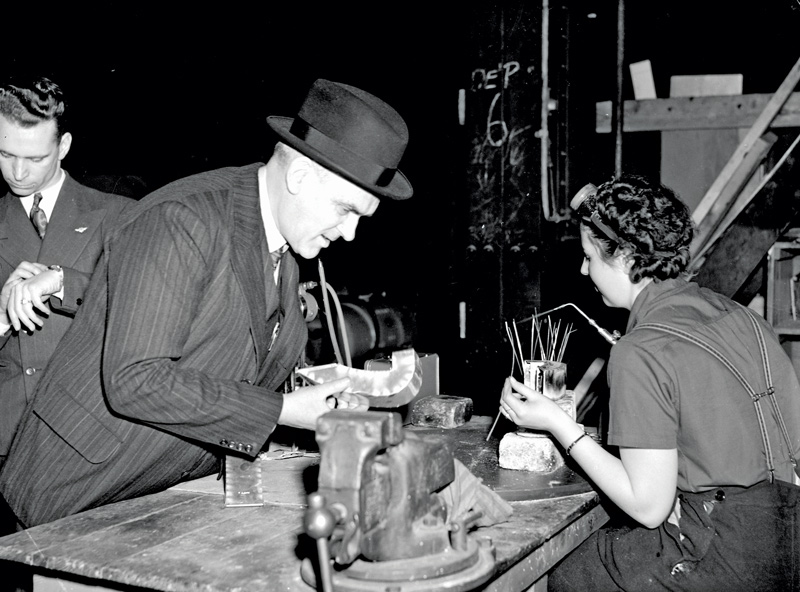
[National Film Board of Canada/LAC/3195719]
Howe’s hard work behind the scenes paid off. The federal and Ontario governments would build the Ontario line, recouping their costs by selling it to the company when the line was making money.
Howe had one last hurdle, a chill on investment caused by the U.S. dragging its heels on approving natural gas imports from Canada. With workers and material on hand to start construction, Howe persuaded the federal government to advance start-up costs.
The bill authorizing financing and construction was introduced on May 8, 1956, and needed to be passed by June 6 or the construction season would be lost. A furious debate ensued: public versus private ownership; public money backing profit-making enterprise; concerns over American control; backroom deals. The Liberal government invoked closure, limiting debate four times.
“Parliament was turned into a madhouse—a scene of angry, confused and shouting members,” wrote Howe biographer Harbron. The government was criticized as arrogant. Future prime minister John Diefenbaker called the once minister of everything a dictator.
Nevertheless, the bill passed on June 6. Work began the next day. Trans-Canada Pipe Lines repaid Canada for building the line in February 1957. By October 1958, the pipeline stretched from Alberta to Montreal. But by then, Howe was minister of nothing; he lost his seat along with 63 of his Liberal colleagues in the 1957 election.
Howe died of a heart attack on New Year’s Eve 1960, aged 74.
Advertisement