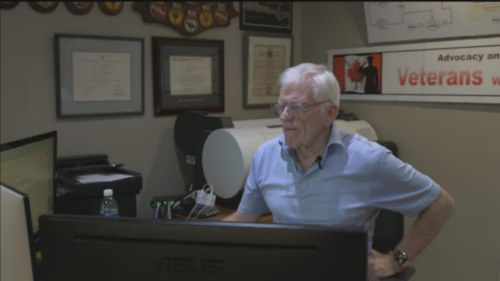


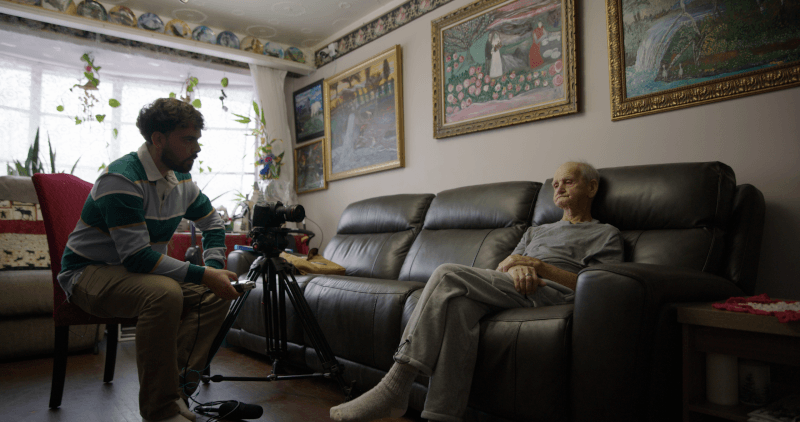
Documentarian Eric Brunt interviews Second World War veteran Eugene McKinnon. [Courtesy Eric Brunt]
Documentarian Eric Brunt isn’t in the business of irrefutable historical record. He has long understood that memories fade, that dates get lost to time and that details can be misremembered in recalling events from more than 80 years ago.
Such is the nature of interviewing the last Canadian veterans of the Second World War, a task that Brunt has undertaken for nearly a decade. Still, the 33-year-old Montreal resident affirms that his work goes deeper than facts and figures.
“For me,” he told Legion Magazine, “it’s about capturing the way these people tell their stories. Where is their emotion? Where is their lack of emotion? Where do they skim over parts? Where do they spend over an hour talking about their best friends? This is the aspect I find most fascinating.”
Brunt found his answers when he travelled across Canada to record first-hand accounts of a community often considered the greatest generation. Now, a large body of his interviews, produced by Melki Films, has been preserved by the Canadian War Museum.
With hopes high of creating his own film in the not-too-distant future, Brunt remains dedicated to the tales he can tell through his platform. Nevertheless, the documentarian himself has, in some ways, become part of the story.
On the project’s origins
I was born in Victoria and later attended the University of British Columbia in Vancouver where I majored in film production. It was while I was there that my grandfather, a Second World War veteran who had served in the Royal Canadian Air Force, passed away at 95.
When he died, I realized that my family didn’t really know his story, and that made me wonder what other untold stories were out there—about whether other veterans had never been interviewed. Many years later, I’ve now interviewed 519 Canadian Second World War veterans.
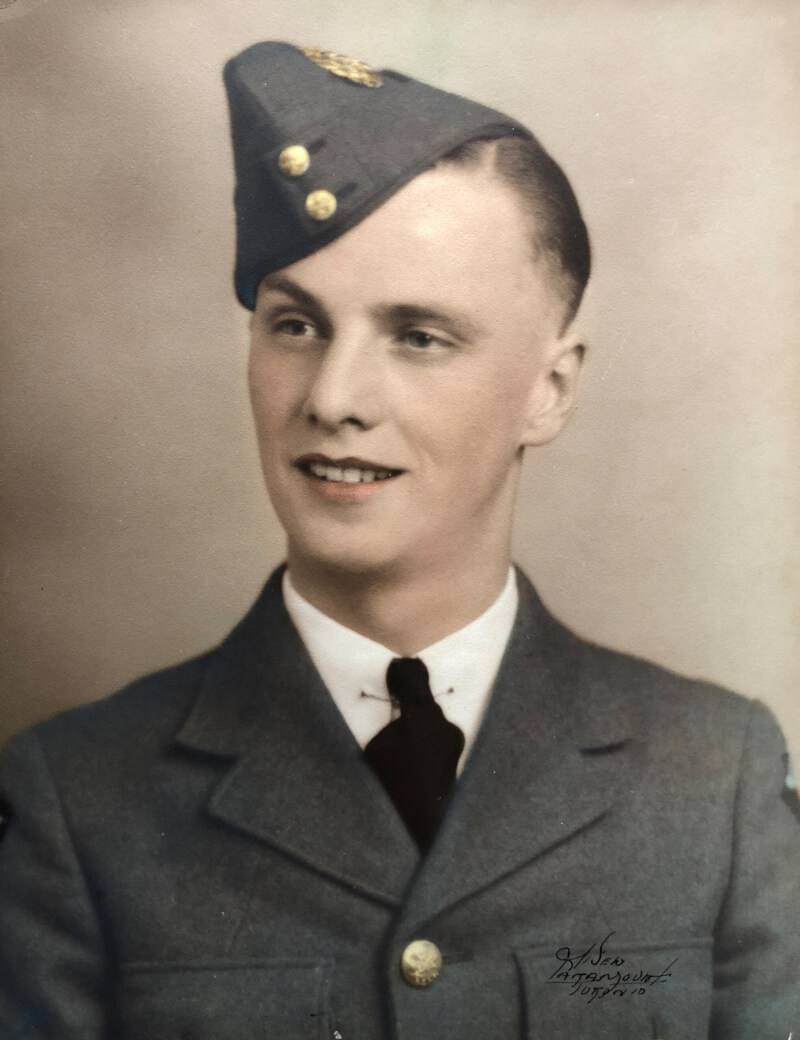
Clifford Brunt, Eric’s grandfather, circa WW II. [Courtesy Eric Brunt]
On cross-country interviewing
I started this project in 2018, when I was 25. The first veteran I interviewed was a Victoria resident named Walter Wickson. He had served in the air force in Africa. I hadn’t known that Canadians had served there at the time. Had I not come and sat with him, perhaps his story would never have been told.
I then started to get phone calls, and the ball began rolling in the best way possible. I lived out of my van to make the project work. All of my money went into what became a labour of love, basically living on the road for 13 months.
At that time, the average age of these veterans was about 95. That has increased significantly and it has become harder to find these men and women.
On how veterans feel about sharing their stories
A lot of them were hesitant—maybe even reluctant on occasions—to talk to me. But, for almost all of them, I think there was a sense of relief, maybe even a sense of closure, after the interview was over.
There are definitely underlying themes when you speak to these veterans. In some cases, there’s the silence of having never talked about any of this. There’s also the downplaying of what they did, and guilt for having not done enough in their own eyes. And there’s always the message that war is terrible.
Once you sit with someone and hear their story, maybe for the first time, a strong connection is forged. I like to say that I lost my grandfather, but I gained hundreds of grandparents along the way.
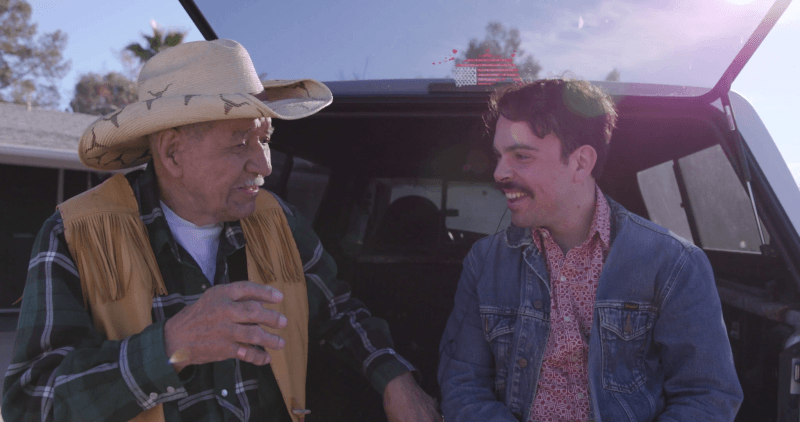
Brunt interviews Canadian WW II veteran Justin Roy. [Francois Pesant/Melki Films]
On a particularly noteworthy story
Justin Roy was an Indigenous veteran from Manitoulin Island, Ont. I went down to Arizona to film him. He had fought on D-Day and was later wounded. He never had any children. It was hard for him to talk. After spending four days together, I had as good an idea as I ever could have about what he had experienced.
This is what I mean when I say closure. He had shared his story, I had filmed that story, and he knew from that moment onward that others could learn from it. It was now up to me to get it out to as many Canadians as possible.
On sharing WW II stories with younger generations
I’m trying to put together a feature-length film so people my age and younger can connect with these stories. I want it to show the power of talking to each other—especially as men—and the importance of opening up. The real focus will be on the veterans, but there will be themes of men’s mental health.
I understand why these individuals often didn’t talk about the war, but I think it’s important to understand those reasons. There’s a lot you can learn from that in itself.
It can sometimes be a challenge for young people today to see ourselves in these men and women because they’re much older than us and have experienced such different things. But when you strip it down, when you get to the emotional core, we’re all human.
This interview has been edited for brevity and clarity.
Advertisement