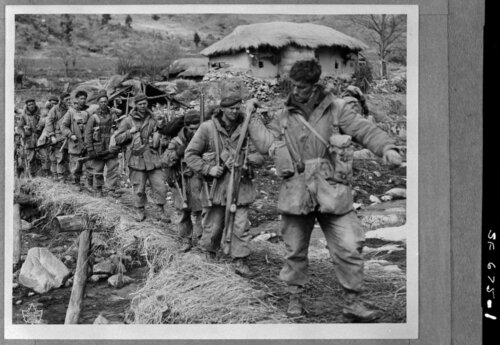



2nd Battalion, Princess Patricia’s Canadian Light Infantry, cross a bridge in a combat area of Korea in February 1951. [Bill Olson/DNDLAC/PA-170750]
On April 23-25 that year, Adye helped defend Hill 677 in Korea as a private with 2nd Battalion, Princess Patricia’s Canadian Light Infantry (PPCLI) during the Battle of Kapyong.
A runner with the battalion’s ‘A’ Company, he delivered secret messages during the fighting—sprinting “on foot, out in the open”—from his company’s headquarters to the rifle platoons dug into the hillside guarding the Kapyong Valley.
“There were bullets and shrapnel flying around everywhere,” he told Legion Magazine. “We were young men, but even at 22 you still feel fear, especially when the bullets start flying and they come awful close to you.”
“There were bullets and shrapnel flying around everywhere.”
Kapyong is Canada’s most famous engagement of the Korean War, and one of its greatest feats of arms. Roughly 700 Canadians held on to their position against an assaulting force of about 5,000 Chinese soldiers. For three days, the Canadians repelled wave after wave of night attacks, even calling for an artillery strike on part of their own position to avoid being overrun. Surrounded by the enemy and short on food and ammunition, they were resupplied by a critical airdrop before they could be relieved.
The Canadian defence of the Kapyong Valley—along with the efforts of Australian, New Zealand, British and U.S. forces—was a critical factor in defending Seoul and defeating the Chinese offensive in South Korea that year. The battle cost Canadians 10 soldiers killed and 23 wounded, compared to approximately 2,000 enemy casualties.
Adye is one of a rapidly dwindling number of surviving Canadian veterans of the Korean War. A resident of Victoria, he’s the last veteran of the Battle of Kapyong still living on Vancouver Island.

This Thursday, Nov. 19, the Korean community in Victoria will express its gratitude to Adye—and all Canadians who fought in Korea—with a new monument unveiled at Veterans Memorial Park in Langford, B.C., part of Victoria’s western suburbs.

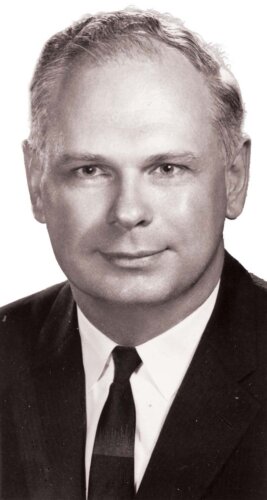
Ted Adye, a private with 2 PPCLI, photographed in 1950, before arriving in Korea. [Veterans Affairs Canada]
The monument is the result of a years-long campaign by Claire Yoo, a local realtor and former president of the Victoria Korean Community Association, to honour Canada’s Korean War veterans on Vancouver Island.
Yoo, who was born in South Korea and immigrated to Canada in 1994, told Legion Magazine that the Korean community on the Island has long enjoyed close ties with Legion branches and veterans in the area.
She said there’s a strong awareness among Koreans—including those in South Korea and Canada—about the sacrifices made by Canadians and others during the war.
“We appreciate what the Canadians have done for us,” she said.
“When I go to South Korea and I see how well developed it is and how well people are doing, I think: ‘Without the soldiers who fought for us, our people wouldn’t have had the chance to reach their potential. South Korea wouldn’t be what it is today.’ That’s how most Koreans think of the war.”
“We appreciate what the Canadians have done for us,” she said.
In recent years, as Korean War veterans became older and fewer, Yoo decided to spearhead a local memorial in their honour. She was especially eager to have one finished while Adye was still alive, “so that Ted could see that his service and the sacrifices of his fellow soldiers had not been forgotten.”
The memorial in Langford will be the seventh such monument built in Canada out of Gapyeong stone. The others—in Langley, B.C., Banff and Airdrie, Alta., Winnipeg, and Brampton and Niagara Falls, Ont.—are among a series of memorials across various Commonwealth countries made from Gapyeong granite in memory of the battle that helped save South Korea from Communist rule.
“Chances are Canada won’t see another stone from Gapyeong for a very long time,” said Terri Orser, a volunteer with the Legion’s B.C./Yukon Command and a PPCLI veteran who helped Yoo organize the Langford memorial.
“The cost of everything has gone up,” said Orser. “Other countries like Australia, New Zealand and Britain that were also at the battle, they want more of the stones, too. And they all have to be cut and shipped from Gapyeong.”
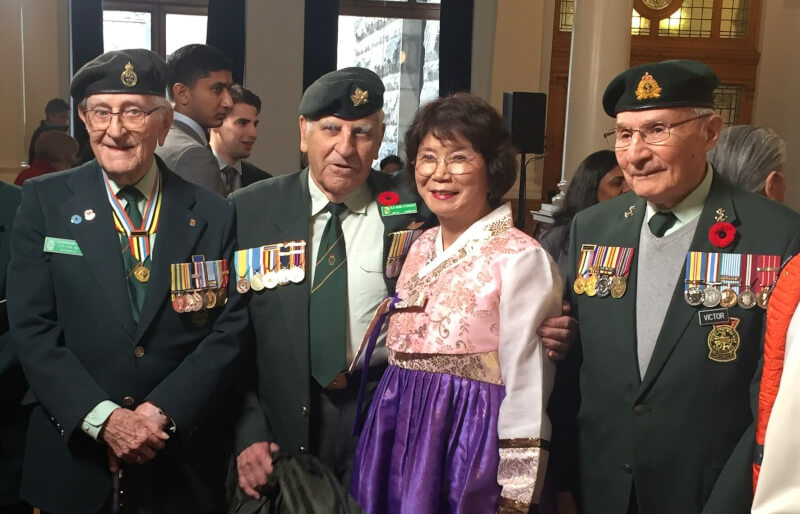
Claire Yoo with Korean War veterans (left to right) Ted Adye, Bob Right and Victor Flett. [Courtesy Claire Yoo]
Adye himself will be there as a guest of honour, along with fellow Victoria resident Victor Flett, also 98, who served in Korea with the Royal Canadian Navy.
Adye said he’s gratified that the Korean War—once known as the “Forgotten War”—is now remembered with the gravity once reserved only for earlier 20th century conflicts.
Adye’s father was a veteran of both the First and Second world wars. And while Adye himself served and nearly lost his life in Korea—shot through the lung in another firefight six months after the Battle of Kapyong—it took decades before he and other surviving Korean War veterans received the kind of public recognition and respect bestowed on veterans of the world wars.
“It took a while after we got home before not just Kapyong, but the whole Canadian effort in Korea, was taken seriously,” he said. “There’s a lot more public knowledge now, and younger people know that all this occurred and how important it was.”
Advertisement