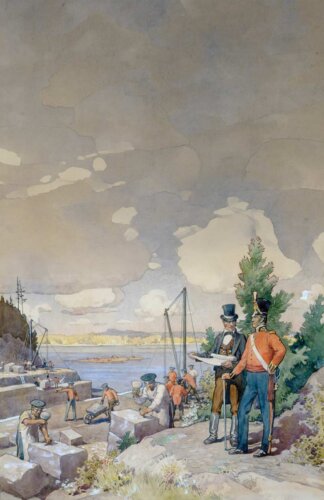


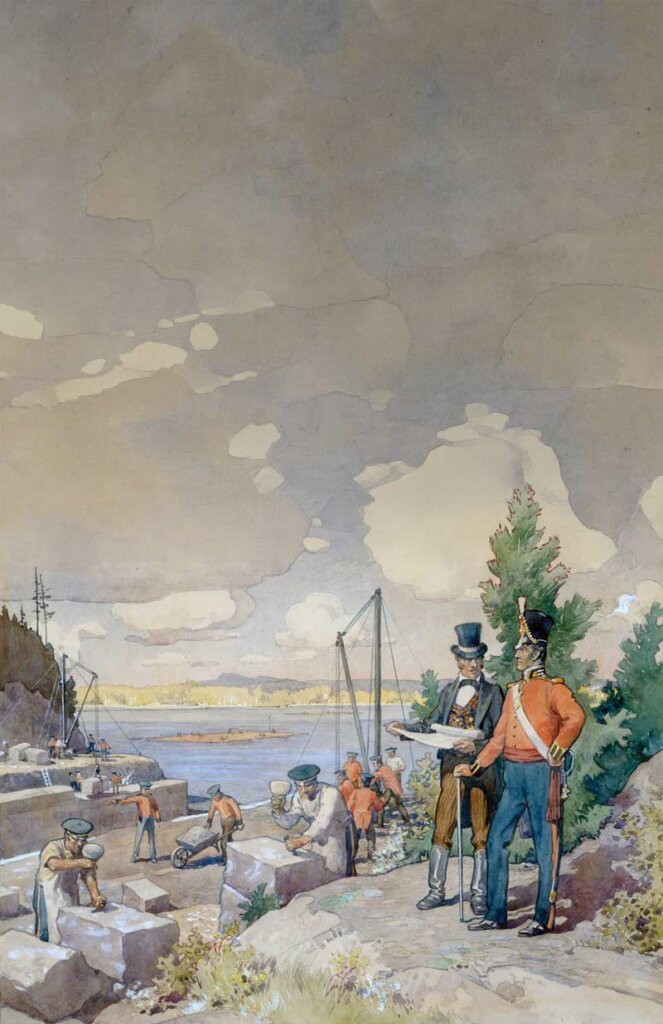
Artist Charles William Jefferys depicts Colonel John By supervising construction of a portion of the Rideau Canal. [Charles William Jefferys/LAC]
Not long after taking office, President Donald Trump floated the idea of Canada becoming the 51st state. He has repeated the idea several times since, saying it “does make a lot of sense.” Understandably, his blithe talk of annexation has made a lot of Canadians nervous. It’s a recurring theme in the country’s history, part of its national DNA. The Americans first invaded in 1775. It was the newly formed Continental Army’s first military excursion and ultimately ended in their defeat at the Battle of Quebec.
They invaded again in 1812, with former president Thomas Jefferson writing that “the acquisition of Canada…will be a mere matter of marching.” This turned out not to be true, another military miscalculation in what would become a substantial list (Vietnam, Iraq, Iran et al.). In 1837, there was more talk of annexation and another failed invasion out of the U.S. In the 1860s, Fenian raiders attempted to “liberate” Canada, and while not an official American army, they were at least tolerated by the White House.
John A. Macdonald’s rush to bring the West into Confederation was largely to prevent the Americans from annexing the territory. During the presidency of Benjamin Harrison (1889-1893), the McKinley Tariff Act was introduced with tariffs of up to 50 per cent on Canadian goods. The end-game was the annexation of Canada after it was economically decimated. Trump, in many ways a 19th-century figure, has been working from McKinley’s playbook, though he might note that the tariffs backfired spectacularly.
In 1930, the U.S. War Department conceived of War Plan Red, yet another strategy to invade Canada, using chemical weapons this time, and destroying infrastructure. And now Trump has revived the country’s historical uneasiness.
Much of Canada has been built on its joint economic and defence alliances with the U.S., and the ongoing, paradoxical threat of American invasion, whether military or economic (or both).
The threat of invasion usually does two things: it increases Canadians’ sense of national unity, and it increases the need for autonomous defence. There is evidence of this now with increased demand for Canadian products (and increased shunning of U.S. goods), and the expansion of the defence budget. Canada experienced similar responses after other invasions.
So, perhaps it should come as no surprise that the Rideau Canal, today that placid home to skaters in winter and kayakers in summer, was born of the need to defend against American invasion.
After the War of 1812, there was a greater sense of national identity as well as a push to make Canada less vulnerable to any further American attacks. One of the country’s vulnerabilities was the St. Lawrence River.
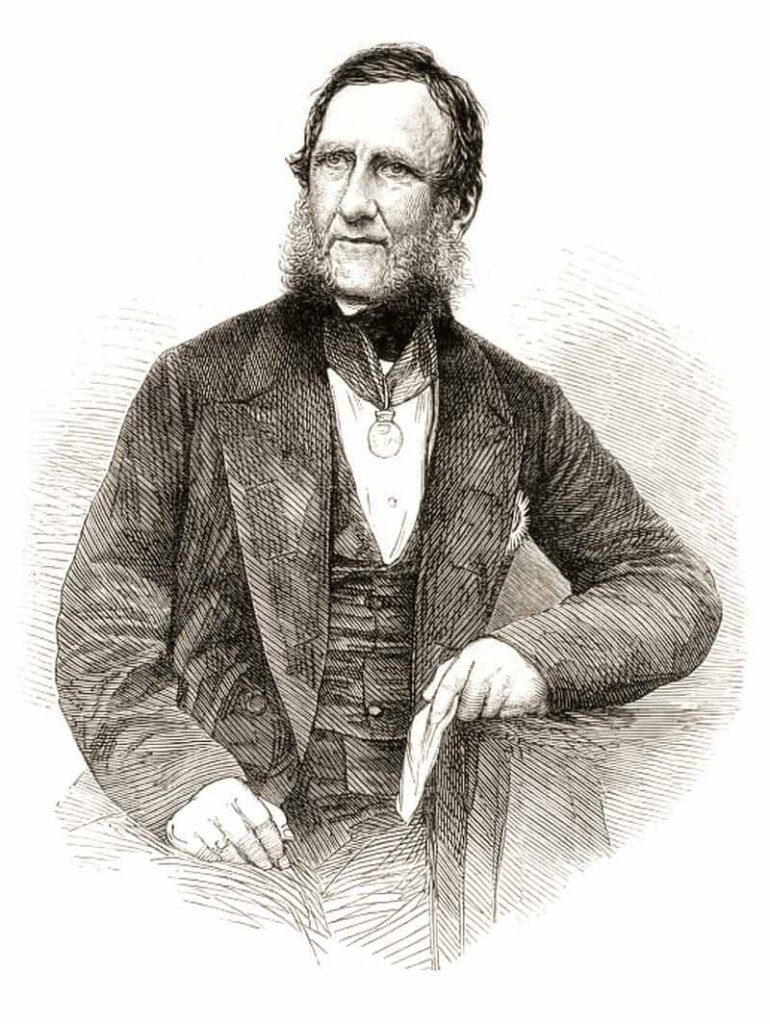
Lieutenant Joshua Jebb of the Royal Engineers mapped the region of the canal route more than once (including in 1816) with an eye to its military use. [Thomas Dewell Scott/The Illustrated News London/Wikimedia]
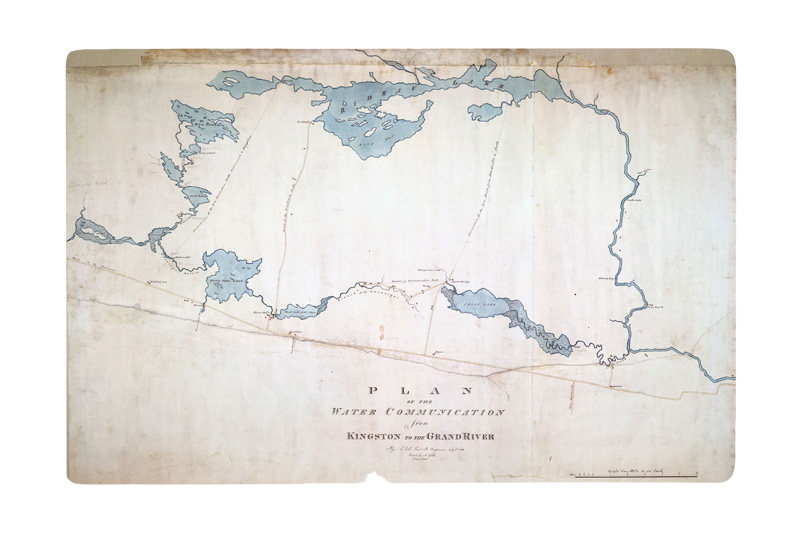
The mapped the region of the canal route in 1816 by Lieutenant Joshua Jebb of the Royal Engineers. [LAC/NMC 21941 2/3]
There was a naval base at Kingston, a strategic military asset that was exposed to attack. The only way to get men and supplies there was along a crude, torturous land route, which was slow, or along the St. Lawrence, which had proved treacherous.
A canal connecting the site of present-day Ottawa to Kingston would provide a safe alternative. The Rideau Route, as it was called, had been surveyed in 1783 as a possible settlement site for United Empire Loyalists who were leaving the U.S., but in 1816, it was mapped once more by Lieutenant Joshua Jebb of the Royal Engineers, with an eye to military use.
In the early 1820s, Upper Canada did what would become a familiar federal pastime—it appointed a commission. The Macaulay Commission was established to look at navigation routes and, in 1824, it began surveying a route for the Rideau Canal.
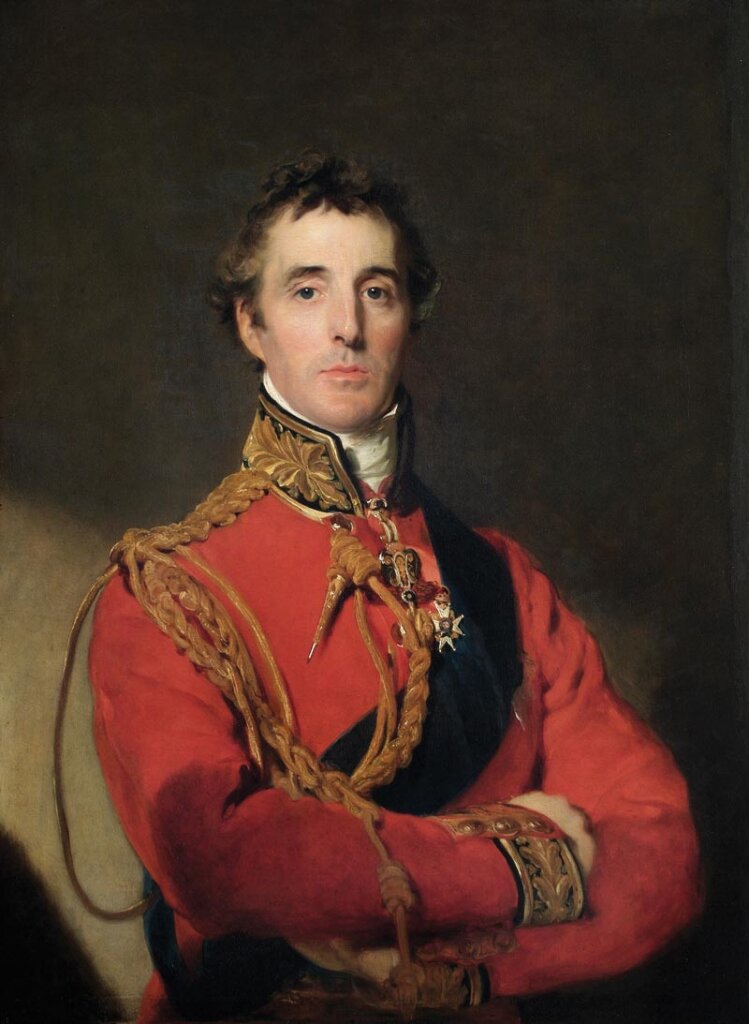
The Duke of Wellington was a champion of the canal. [Thomas Lawrence/Apsley House/Wikimedia]
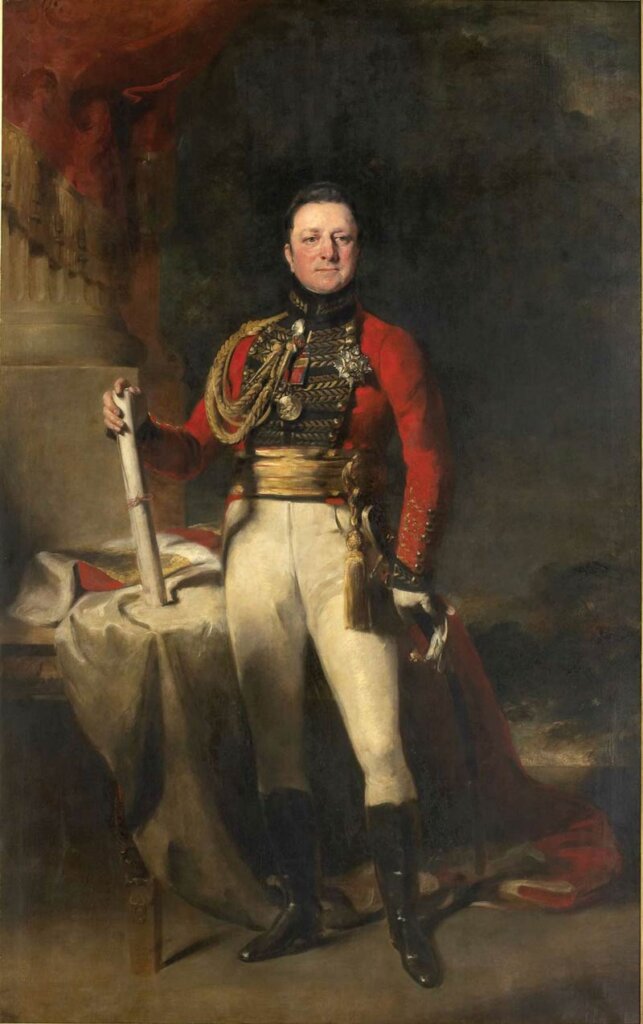
The Earl of Dalhousie, governor of Canada, turned the first ceremonial shovelful of earth to start its construction. [Wikimedia]
Building a canal through the wilderness would be a very expensive proposition and Upper Canada made it clear it wasn’t interested in paying for it. Britain was essentially broke after the onerous expense of the Napoleonic Wars, so the project stalled.
The canal found an unlikely champion in Arthur Wellesley, the Duke of Wellington. In June 1815, he had defeated Napoleon at Waterloo, an iconic victory that echoes more than 200 years later. Wellington’s victory made him the most renowned military man in Europe, though he was tired of war.
“I hope to God that I have fought my last battle,” he said. His wish was granted. In 1818, he was appointed Britain’s master-general of ordnance, in charge of fortifications, transport routes, supplies and engineering. As a military strategist, he understood the importance of the Rideau Canal and successfully lobbied to have it built. It would become one of the greatest engineering feats of the 19th century. It has been said that the Rideau was never used for its intended military purpose, though this isn’t entirely true.
Construction began on Sept. 29, 1826, with the Earl of Dalhousie, the governor of Canada, turning the first ceremonial shovelful of earth. That evening, the governor and other dignitaries met at Philemon Wright’s tavern in Hull (now Gatineau) for dinner and toasted the success of their ambitious project.
It’s one thing to propose (numerous) toasts to the canal, another to actually build it. That job fell to Lieutenant-Colonel John By of the Royal Engineers, who had served with the Duke of Wellington during the Peninsular War (1808-1814).
As a military strategist, Wellington understood the importance of the Rideau Canal and successfully lobbied to have it built.
Colonel By wisely decided on building a slack water canal, which uses dams and locks to manipulate water levels, rather than a conventional canal, which involves far more excavation. The terrain was challenging enough already. Recognizing that steamships were the future, By insisted that the locks be large enough to accommodate military gunboats. This was a source of contention, as it added extra expense, but By got most of what he requested.
He divided the route into 23 sections, each separately put to tender. It was ironic that advertisements to submit tenders appeared in U.S. newspapers, soliciting bids to build the canal from the very people it was to defend against. Many Americans tried to find work on the project. John Burrows, overseer of works, wrote, “Through the whole route, the Yankees followed after us like Vultures after an Army, or Sharks after a sick ship, seeking for jobs.”
The canal boasted 47 masonry locks, mostly built by Scottish, Cornish and French-Canadian stone masons. They quarried whatever rock was closest to the route so most of the locks are limestone, with sandstone at the southern end. At the base, the walls were 2.4 metres (eight feet) thick, tapering to 1.5 metres (five feet) at the top, and buffered by 60 centimetres (two feet) of a clay, sand and gravel mixture that ensured they were watertight. Very little machinery was used; most of the heavy stones were set by hand.
There weren’t enough labourers in Canada for the job so By brought in 2,000 men from Ireland, many of whom likely wished they hadn’t come. They joined the mostly French-Canadian labourers who had already been hired. The highest paid labourers were given seven shillings a day (roughly equivalent to seven cents), the lowest paid a little more than two shillings. There’s no definitive record of the number of workers on the project, but estimates range up to 4,000, an impressive count, especially given that Kingston had a population of about 3,000 at the time.
John MacTaggart was a clerk of works who outlined the construction challenges in his book Three Years in Canada. The chapter titles give some idea of those challenges (Carrion Crows, Disputes and Crimes, Cranberry Marsh and Sickness, Suicidal Manners).
MacTaggart described the dangers of using gunpowder to remove the rock. “I once saw a poor man blow a red stick, and hold it deliberately to the priming of a large shot he had just charged. I cried out, but it was no use. He seemed to turn round his face, as if to avoid the smoke; off went the blast, and…he was killed in a moment.”
The dangers of blasting largely fell to the Corps of Royal Sappers and Miners. Of the 162 who left England in 1827, 35 deserted, five were invalided home, and 22 died (one drowned, five were killed in blasts and 16 succumbed to diseases).
The entire canal system is 202-kilometres long, but 90 per cent of that distance is in existing lakes and rivers, with canals joining them. There are 52 dams, many of which posed unique challenges.
At Jones Falls, for example, there are three locks, a turning station and a fourth lock, with a total lift of 18 metres (60 feet). The arched dam there was one of the first of its kind, and the largest—107 metres (350 feet) wide and 18 metres (60 feet) high.
Hog’s Back dam posed an even graver challenge. It was 14 metres (45 feet) high and during the spring flooding of 1829, a third of it collapsed. Colonel By was at the site at the time, working with the men, trying to fix a leak, when he felt “a motion like an earthquake.” He yelled to the men: “Throw down your tools and run for your lives!”
They were able to rebuild, and remarkably, did so without any casualties.
The nature of the area’s terrain, meanwhile, made it difficult to use draught horses to haul away earth and stone, so digging the canal was done almost entirely by hand. Earth was dug out with picks and shovels then loaded into wheelbarrows, which were rolled away over the uneven terrain. To remove rock, holes were chiselled by hand then packed with gunpowder and detonated by the British sappers. The work was dirty, dangerous and arduous—but that wasn’t the biggest problem.
The swampy topography also produced mosquitoes in millions, some infected with malaria. Often viewed as a tropical disease, it reached epidemic proportions among the workers. Even Colonel By endured it, barely surviving. The men called it “swamp fever” and in summer 1828, work had to be shut down for weeks because so many of the men were stricken with malaria, many of them dying. The death toll for the entire project has been estimated at an alarming 1,000 workers, the vast majority dying of disease. The malaria outbreak alone is believed to have set the project back six months.
Beyond that, the working conditions were brutal. The men toiled 14-hour days, six days a week.
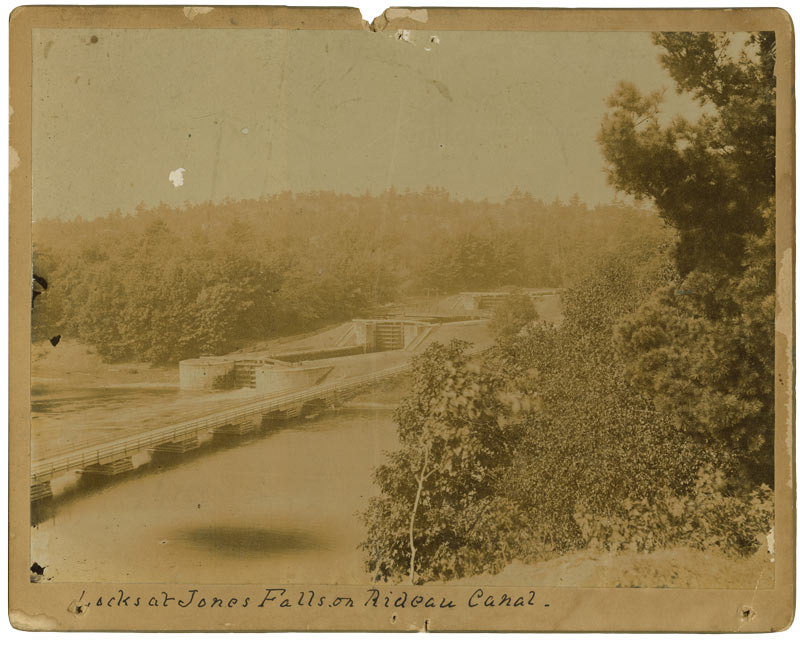
A photo of the Jones Falls portion of the canal circa 1898. [Bytown Musuem/1990.026.02]
They worked in mud up to their knees and lived in makeshift shanties. “My hands are raw from the pick and shovel,” one labourer said. “We move earth in wheelbarrows along narrow, slippery ‘barrow runs’ from dawn until dark.”
And the work was dangerous. “The rock blasting is the worst,” one of the men said. “We use ‘merchant powder’—highly unstable stuff. Many a man I knew was blown to pieces or crushed by falling rock when the explosives went off too soon.”
By spring 1829, the workers had had enough. On March 2, hundreds rioted in the streets of Bytown (now Ottawa), the town named for their employer. This was the fourth time they had protested the difficult working conditions and low pay (the first three all occurring in 1827). Conditions didn’t improve much afterward, however. By the time the canal was completed, there were hundreds of graves marked with wooden crosses. The wood rotted within a decade or so, leaving unmarked plots.
The construction of the Rideau Canal posed extraordinary engineering challenges, and it also saw litigation, drunkenness, brawling, disease (there was also a smallpox outbreak), infighting, desertion and, of course, the weather, which was more severe than the British or Irish workers had ever experienced.
The canal’s final section was completed at Kingston Mills, north of the city proper in spring 1832. The hope was that the simple fact of its existence might deter the Americans from any further thoughts of invasion. That it had been such an expensive and ambitious undertaking underscored the British resolve to defend Canada.
Henry Grey, the British under-secretary of state for the colonies, described the Rideau as “one of the greatest securities by which we hold the Canadas and the protection of every other great work which either has been, or may be undertaken there.”
Colonel By and his family boarded the first steamship (renamed Rideau) to travel the canal in May 1832. In Canada, he was praised for presiding over one of the most remarkable engineering feats of the 19th century. His patron, the Duke of Wellington, emphasized that despite the project’s considerable cost (822,000 pounds—equivalent to about $220 million today), that no one could doubt “the wisdom of the plan, its efficiency and above all its Economy.”
He was wrong about that last point. When By returned to England in 1832, members of Parliament did doubt its economy, and he was accused of going over budget and publicly ridiculed.
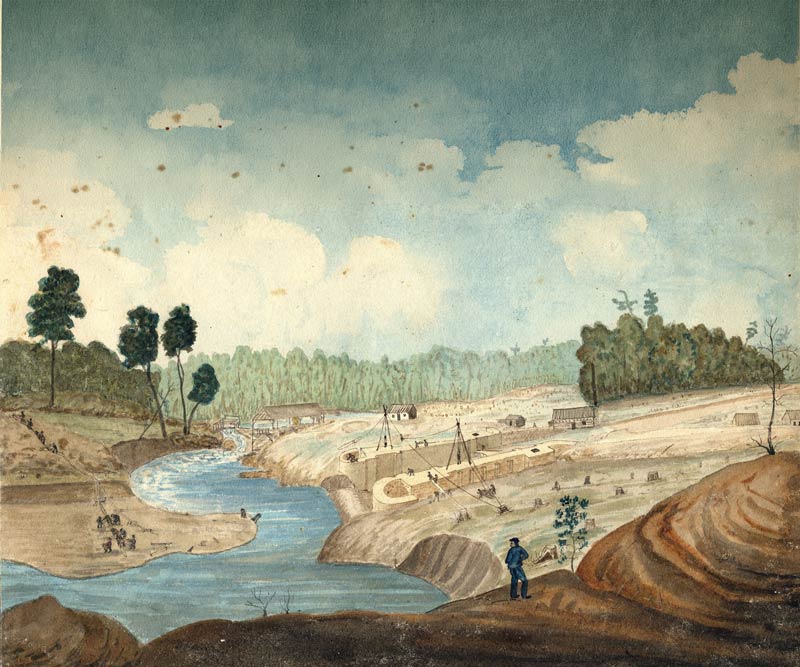
Artist Thomas Burrowes depicts excavation for the canal nearing completion at Brewer’s Lower Mills. [Thomas Burrowes/Canadian Canal Society/Wikimedia]
The initial budget had been an unrealistic 169,000 pounds, an estimate delivered by civil engineer Samuel Clowes. Colonel By had amended it to 474,000 pounds, but the final cost was double even that. The colonel had expected a knighthood at his homecoming but was met instead with a parliamentary inquiry where he was accused of massive overspending and mismanagement. It was also suggested he had spent money without the authorization of his superiors, though he had been instructed to forge ahead without their approval, given that it could take six weeks to get it.
Perhaps even worse was the impugning of By’s good character. The inquiry accused him of “conduct unbecoming to an officer.” He had two private residences that were built on government land in Bytown, and the parliamentarians implicated him in land speculation and expropriated the houses. In their view, wrote historian George Raudzens, By was guilty of having “repeatedly and wilfully exceeded his orders for the gratification of his own ambitious designs.”
Colonel By was caught in the often-vicious fighting between the Whigs and Tories and used as a political scapegoat. He was already in poor health, partly the result of his work on the canal, and was now a broken man in every sense. He suffered a stroke on Oct. 13, 1834, then another in December. He died in February 1836 at 56.
The Duke of Wellington, meanwhile, emerged unscathed. He had been U.K. prime minister from 1828-1830 and served again briefly in that role in late 1834. He went on to become foreign secretary, then leader of the House of Lords (1841-1846) before his death in 1852.
Bytown was renamed Ottawa in 1855, another indignity. But in 1971, a statue of Colonel By was erected on the site of his home in Ottawa’s Major’s Hill Park, in recognition of his remarkable achievement.
The military use of the canal didn’t have to wait long. The Upper Canada Rebellion of 1837 gave the U.S. yet another opportunity to attempt to annex the territory. This time, though, it wasn’t the government, but a group called the Patriot Hunters, who wanted to “liberate” Canada from the tyranny of British rule. The rebels weren’t sanctioned by President Martin Van Buren, who was maintaining a neutral stance in his relationship with Britain.
The Patriot Hunters had upward of tens of thousands of members, though their numbers dwindled during a short-lived war. Between December 1837 and December 1838, they made 14 recorded invasions into Canada. In one of their last attempts, a group of some 300 men tried to capture the village of Prescott across the St. Lawrence River from Ogdensburg, N.Y.
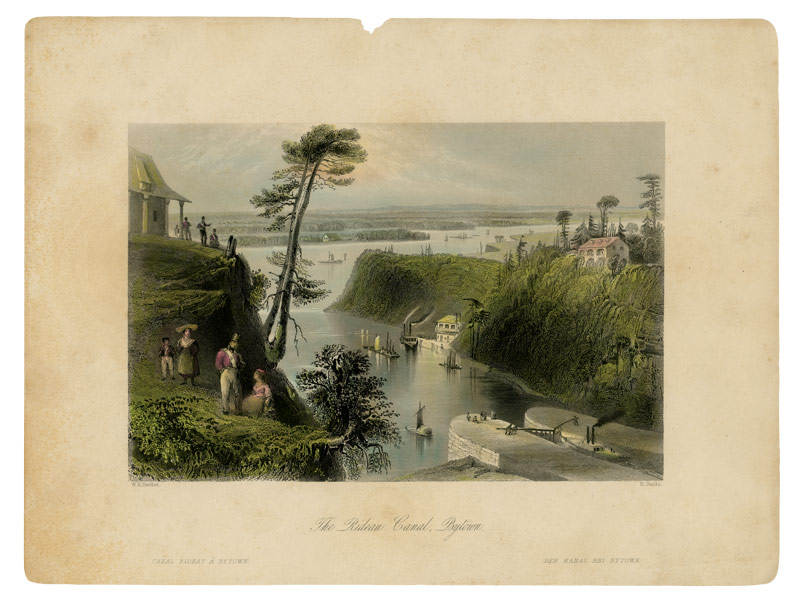
An artist’s 1841 depiction of the Rideau Canal at Bytown (present-day Ottawa). [William Henry Bartlett/Bytown Musuem/P1410]
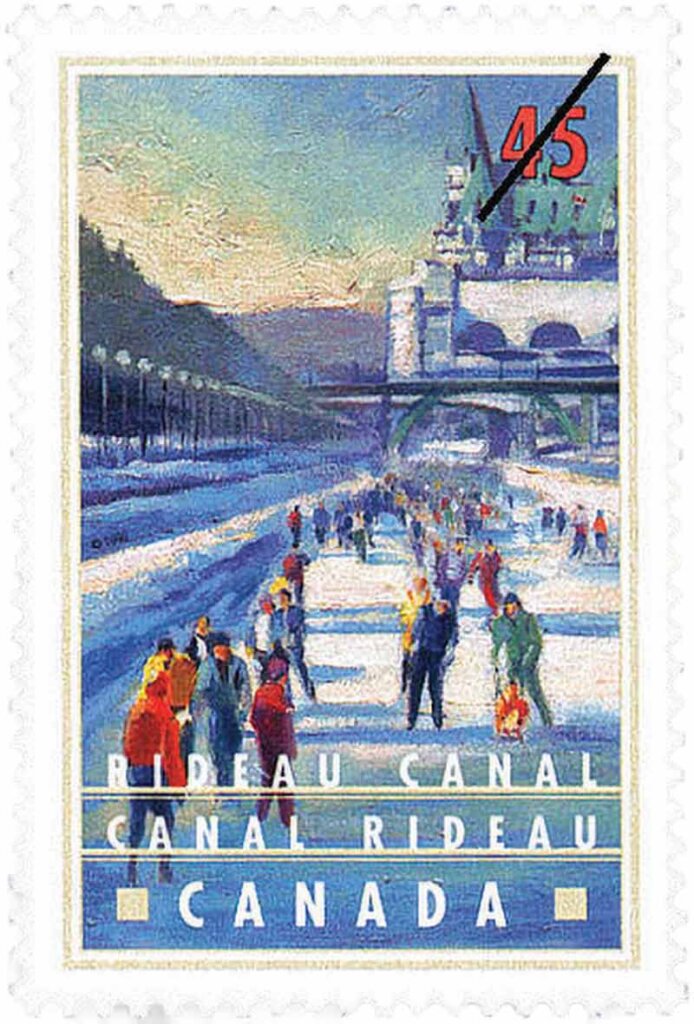
A modern-times stamp celebrating the waterway. [LAC/Canada Post]
A UNESCO world heritage site, the canal was “linked to a significant stage in human history—that of the fight to control the north of the American continent.”
They were repelled by a British gunboat but found refuge in a stone windmill just north of Prescott. Canada sent a company of Royal Marines and supplies to the area using the Rideau Canal. It was the first and only use of the canal for military purposes. The Battle of the Windmill, which ended on Nov. 16, 1838, with the Patriots limping back to the U.S., was one of the last of the Patriots’ War.
Still, concerns of a U.S. invasion lingered. A significant proportion of residents of Upper Canada were American-born and there was fear of the enemy within. What were the loyalties of Americans living in Canada? Local newspapers warned of saboteurs disabling the locks along the canal. The threat from the south waned, but never entirely disappeared.
In the mid-1840s, a new American threat emerged: the Oregon Crisis. In 1844, James K. Polk was elected president on an expansionist platform. He was looking to annex both the Republic of Texas to the south and what’s now British Columbia up to Alaska (the latter still Russian territory at that point). His campaign slogan was “54-40 or fight!” referring to the latitude of the southern border of Alaska. The annexation of Texas created the threat of war with Mexico, and Polk couldn’t afford a simultaneous war with Britain, so an agreement was negotiated. The Oregon Treaty established the northern border at the 49th parallel.
Through it all, the Rideau Canal stood at the ready. It served as a commercial route in the early years but has since mostly operated as a recreational waterway. It boasts one of the world’s longest skating rinks—7.8 kilometres—and is a popular spot for pleasure boaters. It’s the best-preserved example of a slack water canal in North America, and the only one that’s still operational.
In 1925, the Rideau Canal was designated a national historic site and, in 2007, it was designated a UNESCO world heritage site. One of the criteria the UN officials cited was that the canal was “linked to a significant stage in human history—that of the fight to control the north of the American continent.”
That stage of history still lingers. Once more an expansionist U.S. president is invoking manifest destiny. While it’s now home to pleasure craft rather than gunboats, the Rideau Canal remains a vivid and enduring symbol of Canada’s resolve when under threat.
Advertisement