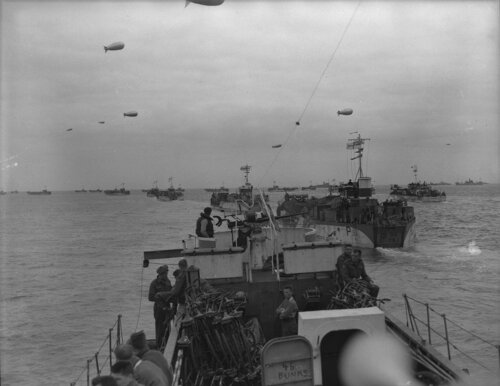







Landing Craft, Infantry, of 2nd Canadian Flotilla en route to France on D-Day. [Gilbert Alexander Milne/DND/LAC/3203933]
Last week, the day after Ottawa brazenly walked away from U.S. trade talks, a popular podcast declared that Prime Minister Mark Carney “has taught the West how to stand up to Trump.”
The podcast, “The Rest is Politics: US,” is co-hosted by Anthony Scaramucci, a New York financier and former White House director of communications during President Donald Trump’s first term, and Katty Kay, U.S. special correspondent for BBC. Scaramucci warned their millions of listeners that the U.S. would come to regret its tariff war on Canada.
“You don’t fight with people that live in cold weather, okay? Napoleon learned that about the Russians, and the Americans are gonna learn that about the Canadians,” he said. “These people will eat snow! They don’t care!”
Also last week, U.S. economist Paul Krugman published an essay on Substack titled, “The Moose That Roared: Why Trump will lose his war with Canada.”
The editors at the Globe and Mail also weighed in: “Mr. Trump should not mistake Canadian politeness for passivity. A country that fought and died in the charnel houses of the world wars, in Korea and in Afghanistan knows the value of standing up for its ideals.”
Anyone familiar with Canada’s military history understands these sentiments well. Canadians are tough people.
Consider, for example, Lieutenant-Colonel Charles-Michel d’Irumberry de Salaberry, the French-Canadian army officer who raised the venerated colonial infantry known as the Voltigeurs.
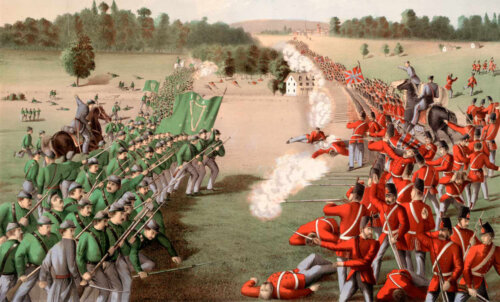
De Salaberry and his Quebec soldiers—along with their Kahnawake warrior allies—combined cunning tactics with fearless fighting ability to turn back a much larger American invasion force during the Battle of Châteauguay in the War of 1812, thereby helping to save Canada from American conquest.
Or consider Lieutenant Bruce Carruthers of Kingston, Ont., who in 1902 rallied a small band of troops with 2nd Canadian Mounted Rifles to defend its position against an overwhelming onslaught of mounted Boer riflemen in South Africa.
Rather than flee or submit, Carruthers raised his revolver and shouted, “No surrender!” Over the next several hours, about 17 of his 21 troops were either killed or wounded during their defiant stand at the Battle of Hart’s River—the deadliest and most heroic Canadian action of the Boer War.
Rather than flee or submit, Carruthers raised his revolver and shouted, “No surrender!”
How about Private William Milne of Moose Jaw, Sask., the 24-year-old farmhand who took part in the assault on Vimy Ridge in 1916 as a member of the 16th Battalion (Canadian Scottish)? Taking cover from German machine-gun fire along with other platoon mates in a shell crater on the ridge, Milne crawled over open ground on his hands and knees, with bullets snapping into the mud all around him, until he was 20 metres from the enemy gun. He lobbed grenades with deadly accuracy, silencing it.
He then captured a second enemy machine-gun nest, and was killed shortly after. Milne’s remains were never found. He was posthumously awarded the Victoria Cross and is remembered today on the Canadian National Vimy Memorial in France.

Canadian soldiers returning from Vimy Ridge. [W.I. Castle/DND/LAC/PA-001332]
Pike fought for nearly two years in the trenches of France and Belgium, often serving as a stretcher-bearer, one of the most dangerous front-line tasks. He was sent home after the 1918 Battle of Cambrai, where burning shards of shrapnel tore off two of the fingers on his right hand. Pike died in 1999—at age 99, Newfoundland’s last surviving Great War veteran.
Don’t forget Flying Officer Lloyd Berryman of Hamilton, a 21-year-old Royal Canadian Air Force fighter pilot who, in 1944, managed to bring his damaged, burning Spitfire safely back to England after a raid on German airfields in France. Berryman landed with both himself and his aircraft on fire.
Months later, recovering from his burns, Berryman ignored his doctor’s pleas to return to Canada for further treatment, insisting he would participate in the D-Day landings.
“I had some dandy scars,” Berryman said, “but there was no way I was going home. There’d be time for that later.”
Berryman provided air cover for the invasion forces on D-Day, and a few weeks later shot down his first German airplane over France. During the dogfight, another German pilot blasted a hole in the wing of Berryman’s Spitfire, sending the aircraft plunging toward the ground. Berryman regained control and managed to fly the plane with its shredded wing back to England once again. He received the Distinguished Flying Cross for his extraordinary service in the war.
“I had some dandy scars,” Berryman said, “but there was no way I was going home. There’d be time for that later.”
Finally, consider Lieutenant Bill Turner, a Canada Post letter carrier and army reservist with The Royal Regiment of Canadian Artillery in Edmonton, who in 2006 volunteered to serve in Afghanistan with 1st Battalion, Princess Patricia’s Canadian Light Infantry. Turner was a civilian-military co-operation officer with the Canadian mission in Kandahar. He carried weapons and took part in the same dangerous patrols as his companions in the infantry, but his main job was working with ordinary Afghans to help deliver aid to rural communities beleaguered by years of war.
“Over here,” Turner said, “if I can make a small difference in one person’s life—in a child’s life especially—my time in Afghanistan will have been worth it.”
Kites, previously banned by the Taliban, were what children most wanted from Turner.
While finding them, as well as clean water and other supplies, for the communities around Kandahar, Turner was killed, age 45, along with three other soldiers, by a roadside bomb explosion in April 2006.
From de Salaberry to Turner, Canadians across the centuries have always risen to meet the challenges of war or crisis. Each time danger confronted them, they responded with courage, humanity and resilience.
Advertisement