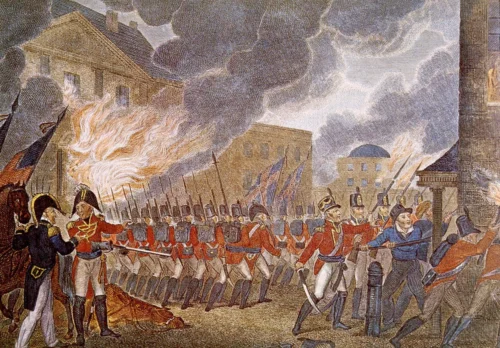



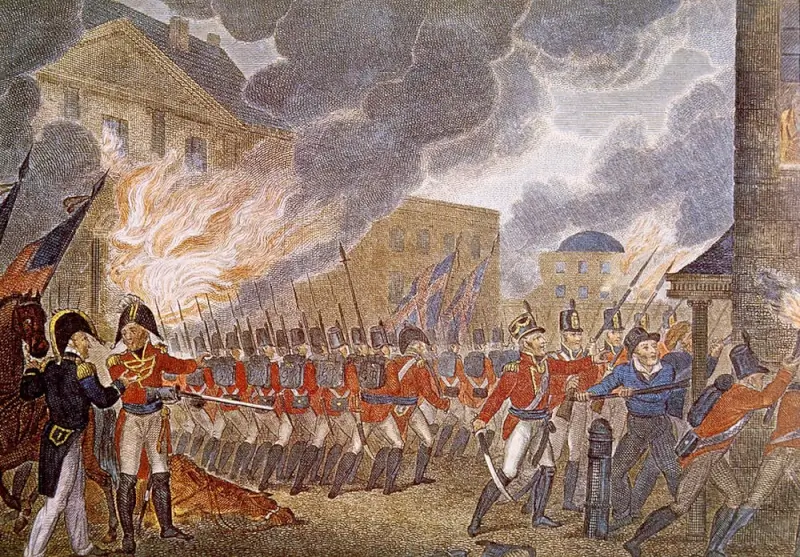
An 1815 British illustration depicts the “Capture of the City of Washington.” [Smithsonian]
Legion Magazine: General Ross, why are you wandering among the gravestones? Shouldn’t you be inside your tomb?
Ross: I’ve been cooped up in there more than 200 years. Even a spectre needs to stretch his legs once in a while. Plus, these are disturbing times. Walking around calms my nerves.
LM: Disturbing? How so?
Ross: Aren’t you reading the news? Ever since the latest American president—who, let me tell you, is no James Madison—started bullying Canada and threatening to make the country the 51st state, everyone seems to be talking about me!
LM: You mean the fact that you set fire to the White House in 1814? Hey, isn’t next week the anniversary of that event—August 24?
Ross: You see? That’s all anybody knows about me. It’s embarrassing, not to mention infuriating!
LM: Canada’s recent troubles with the U.S. have indeed brought your story to the fore. There have been lots of media reports about you, and our former prime minister, Jean Chrétien, even invoked your memory when he joked about burning down the White House during a fiery March 2025 speech to the Liberal Party faithful.
Ross: Yes, that address had me turning over in my grave!
LM: I guess your story could be a useful counterpoint in times like these, a reminder that Canada—well Britain actually, because Canada wasn’t yet a country in 1814—once captured and set fire to Washington.
But what’s the problem? Don’t you like all the attention you’re getting?
Ross: They’re tarnishing my good name! I was a man of honour: a successful son of Ireland, an upstanding commander in the British army, a wounded veteran of the Napoleonic Wars. And today all I’m remembered for is a single, regrettable night of arson. Such slander!
LM: Why was setting fire to Washington regrettable?
Ross: Civilized British officers don’t burn down fine buildings and other spoils of war unless absolutely necessary. This was an unfortunate outcome of our occupation of the American capital. Of course, that damned agitator Cockburn wouldn’t have it any other way.
LM: Rear-Admiral George Cockburn was the British naval commander who supported you in capturing Washington.
Ross: Supported is one way of looking at it.
I had only a small contingent of 3,500 troops under my command, with orders from my superiors not to operate far from the Atlantic coast. But Washington, despite its inland location, appeared weakly defended and there for the taking. It was Cockburn who pushed me to attack the city, even though that exceeded my official orders.
LM: So, you made a dash for Washington with your small army. And you were met on the outskirts of the city at Bladensburg, Md., by an American force comprised mostly of militia. Your redcoats routed the Americans, and Washington then lay open to you.
Ross: That’s right. And before we marched into the city, I issued strict orders to my men that non-military property and private citizens were to be respected. I wanted no pillaging and no atrocities—and with any luck, no burning.
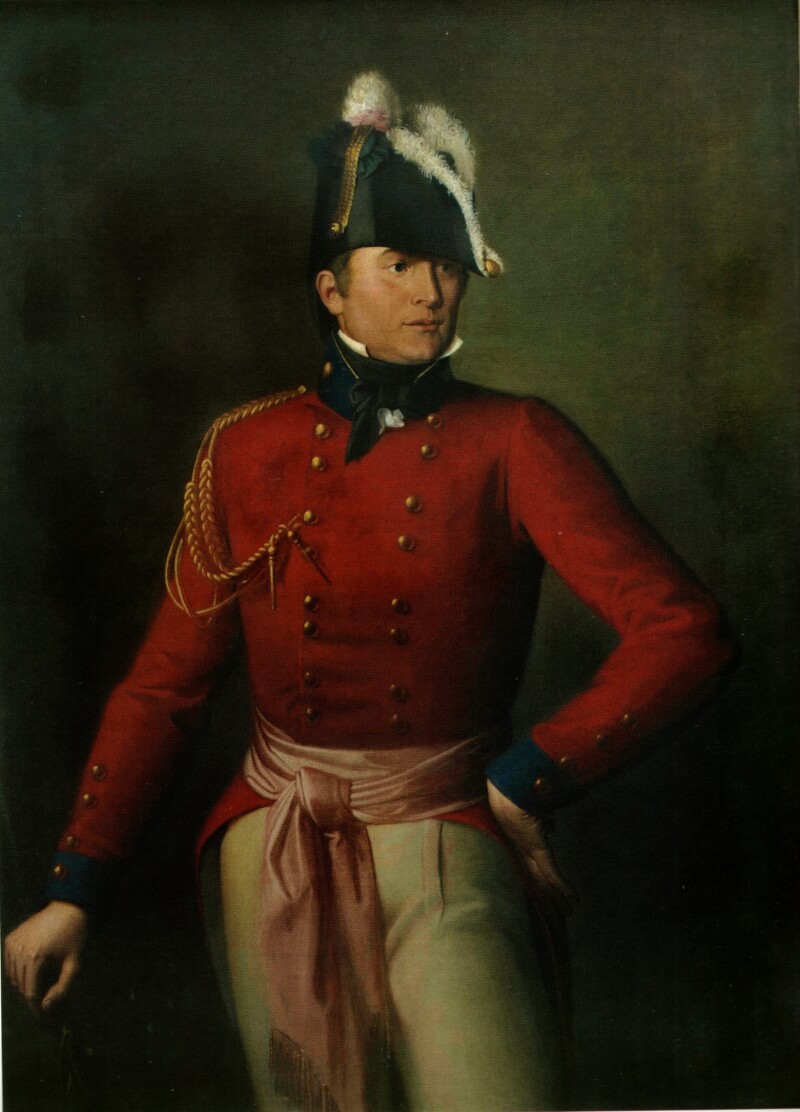
A portrait of Major-General Robert Ross. [Wikimedia]
Ross: Indeed, there were, but that’s my point: I did not personally advocate such tactics. There are rules of conduct in war that need to be respected. And yet here we are, more than two centuries later, and my name is synonymous with this behaviour.
LM: I understand that you rode into Washington with your troops, and with Admiral Cockburn beside you?
Ross: We rode straight up to Capitol Hill, carrying a flag of truce, hoping for a parley to discuss terms of surrender. As we approached the Capitol, the enemy fired upon us. Two of my soldiers were killed, as well as my horse! It was unclear where the enemy was shooting from, but I ordered my troops to fire a volley in response at the Capitol building, in case the enemy was hiding there.
LM: You were idolized by your troops. I imagine that the sight of you being fired at and knocked off your horse while carrying a truce flag, must have shocked and angered them?
Ross: It was an affront against the codes of warfare. And if I had been killed at that moment, I think it would have been impossible to restrain my men from committing the worst outrages upon the city and its people.
Cockburn himself was keen for retribution. Don’t take my word for it. John McCavitt, an Irish historian who wrote my biography—God bless him—has said this, based on his research:
“It was only after being ‘warmly pressed,’ implicitly by Rear Admiral Cockburn, that Ross agreed to burn the public buildings of Washington…. It is also clear that Cockburn pressured the army commander to burn the entire city, private dwellings and all.”
It seemed unchivalrous to me to destroy the whole city, so I conceded to the burning of government buildings, but ordered private property off limits. We set fire to the navy yard and the Capitol building, which destroyed the Library of Congress and its thousands of books. We also burned the presidential mansion, not long after President Madison had fled the building with his wife.
LM: I understand that before setting fire to the mansion, British troops enjoyed a feast that had been abandoned by the Madisons at the White House . I suppose if the same thing happened today, the only food anyone might find there is cheeseburgers.
Ross: I am not familiar with that term, cheeseburger.
LM: Never mind. What happened after you captured Washington?
Ross: Our success there tempted us to march on Baltimore. But the city withstood our attacks from both the sea and land, and it was there, leading the army’s assault, that I was shot and killed on Sept. 12.
LM: I believe your body was embalmed in a cask of rum and shipped to Halifax, the closest British naval port, for burial. Which explains why you’re here today in the Old Burying Ground.
Ross: Where I have lain, in merciful peace, for centuries, until I recently became an object of renewed attention and curiosity—unfairly labelled as the conflagrator of Washington!
LM: I can see that description pains you.
Ross: I’m not denying that under my command, British troops burned the Capitol and the White House. But there’s more to the story.
Consider this—in Admiral Cockburn’s commissioned portrait, he’s standing proudly in his uniform while behind him Washington is on fire. My portrait shows only me, an officer and a gentleman, no city burning in the background. That is how I wish to be remembered.
It’s Cockburn who should be known to history as the man most eager to burn down Washington. I’m counting on you to spread the word.
LM: We’ll do our best general, thanks for the chat.
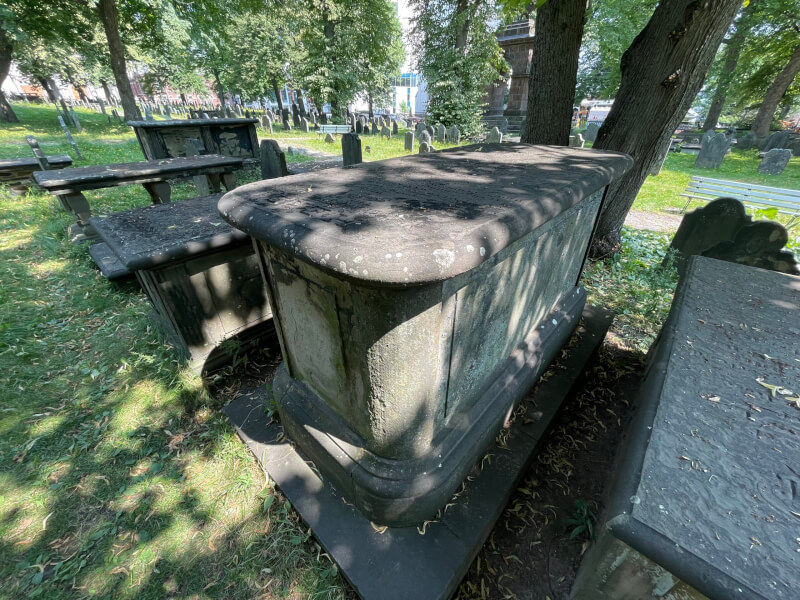
Major-General Robert Ross’ tomb in Halifax’s Old Burying Ground. [Richard Foot/LM]
Advertisement