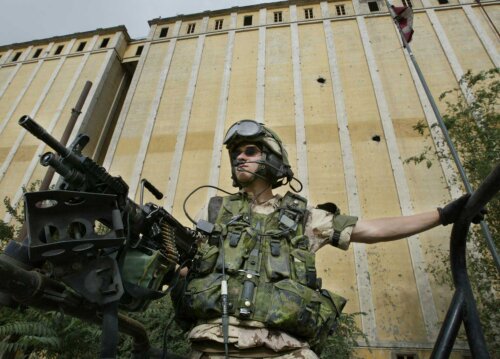



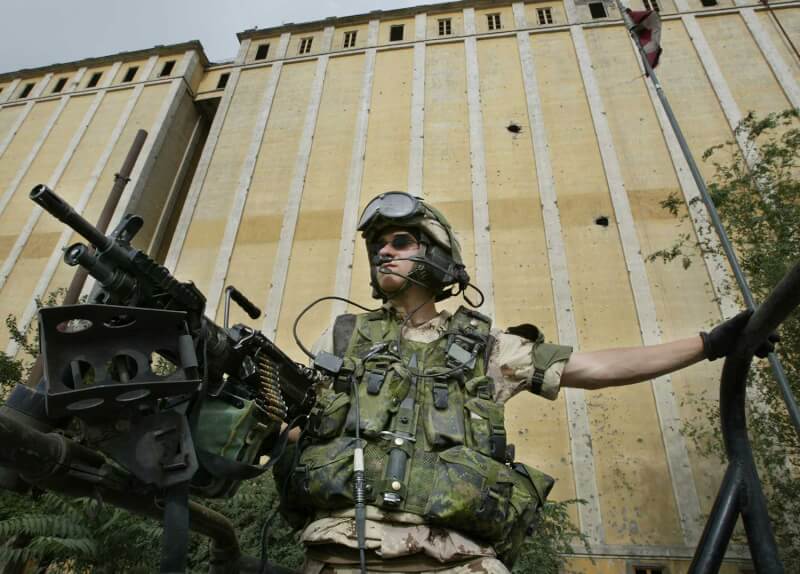
A Canadian soldier on NATO operations in Kabul, Afghanistan, around 2006. [Stephen J. Thorne]
A new article published last month in the academic journal Canadian Military History answers “no” to both those questions.
In an essay titled “The Canadian Army in Afghanistan and the Decline of Official Military History in Canada,” Peter Kasurak argued that the Department of National Defence and its history branch need to rediscover the culture of excellence that was once a hallmark of Canadian official military history dating back to the Second World War.
“It is perhaps time for senior levels of the Canadian Armed Forces to reappraise the place of official history and resource it accordingly,” wrote Kasurak, a fellow at the Centre for International and Defence Policy at Queen’s University in Kingston, Ont.
Official military history emerged in Canada at the end of the First World War, when Colonel Archer F. Duguid was assigned the enormous task of producing an official record of Canada’s activities in the conflict. Two decades later, the project went dormant after the publication of only the first of an intended multi-volume work.
Despite the disappearance of documents, backroom infighting and inadequate funding, a revised and compressed single-volume work, Canadian Expeditionary Force, 1914-1919, was finally completed in 1962 by Colonel Gerald W.L. Nicholson. Whatever it compromised, the book remains an invaluable official record of the Canadian Army in the First World War, a key source for generations of historians and ordinary readers.
In the Second World War, a more serious approach was established—what Kasurak called the “gold standard” for military history—when a team of professional historians, directed by Charles P. Stacey, was employed as part of an official historical section. They collected war diaries, conducted interviews and gathered high-level government records during the war.
Stacey’s team published a multi-volume official history of the Canadian Army’s activities, the first of which was released in 1956, only 11 years after the end of the fighting. Official war histories of the Royal Canadian Air Force and the Royal Canadian Navy were also published during or promptly after the war. Meanwhile, an official history of the Canadian Army in Korea was released in 1966, 13 years after the end of that conflict.

Colonel Gerald W. L. Nicholson wrote Canadian Expeditionary Force, 1914-1919, the official history of the Canadians in the First World War. [Wikimedia]
Jean-Michel Turcotte, who became chief historian at DHH about a year ago, told Legion Magazine that his current team of 10 historians is working on the histories of various Canadian peacekeeping missions—he said manuscripts on the missions to Southeast Asia, Cyprus and Congo are nearing completion and should be published during the next few years.
Other projects underway include a history of Canada’s missions to the Balkans in the 1990s, and a four-volume history of Canada’s activities in southwest Asia, including Afghanistan.
It has been 22 years since the last Canadian Armed Forces contingent left the Balkans (almost 35 years since the first troops arrived in the former Yugoslavia), and 12 years since Canada withdrew from Afghanistan. For Kasurak, that kind of delay in releasing official histories points to a lack of commitment and inadequate resourcing by the government.
“There’s quite a gap,” said Kasurak in an interview with Legion Magazine. “It’s a poor state of affairs that the department has de-emphasized official history to such an extent that it’s taking decades to produce things of which the first cut should have been produced a long time ago.”
For his part, Turcotte said official history has always taken many years to produce, and the existing time frames between the end of various missions and publication “are mostly within the norms.”
He does acknowledge that the war in Afghanistan, starting in 2001, delayed existing projects, such as the peacekeeping histories, as staff were diverted to work with military officials to ensure that war diaries and other records would be prepared and available to DHH staff throughout the conflict.
“It’s a poor state of affairs that the department has de-emphasized official history to such an extent that it’s taking decades to produce things of which the first cut should have been produced a long time ago.”
Notably, Turcotte also said there were disagreements in the mid-2000s between the history directorate and General Rick Hillier, then defence chief, about how DHH should tackle the history of the Afghanistan mission.
Turcotte said Hillier and other senior commanders wanted work to begin immediately on an army-focused history, while DHH insisted on pursuing a broader history encompassing the entire Canadian Armed Forces, including the navy, air force and other government agencies, which would require more time and patience.
“My understanding of General Hillier is that he wanted something very quick, focusing more on the army. And my predecessor tried to mitigate his expectations,” said Turcotte. “Some senior commanders have a misunderstanding of how writing official history works.”
The dramatic increase in combat operations by Canadian soldiers in Kandahar, Afghanistan, starting in 2006 meant that—with the eyes of NATO suddenly focused on Canada’s high-profile fighting campaign—Hillier and other senior officers wanted a Canadian perspective of that effort to avoid being defined by historians from the U.S. or Britain.
Hillier “misunderstood the resources required for that work to be done,” said Turcotte. “To get the whole story, it was going to be a titanic task.
“And for many reasons, [Hillier] preferred to choose another man, and the army hired historian Sean Maloney to write a book on his own. And we respect that—‘ok, fine, if you prefer to go in that way.’”

Standing atop the Camp Normandy main entrance in Tomislavgrad, Bosnia and Herzegovina, Private Anthony Gruppuso of the Toronto Scottish Regiment takes the sunset watch. [Department of National Defence]
Maloney spent the next several years immersed with Canadian Forces in Afghanistan, making 11 trips there, including one where he was nearly killed. By the end of Canada’s combat operations in 2011, Maloney had written a three-volume history titled The Canadian Army in Afghanistan—a vivid, highly detailed account of the army’s dozen years fighting the Taliban.
Maloney made it clear in the book that his account is only one of many different “types of history” and “not intended to be the final word” on the subject. He also said one purpose of his narrative is to offer an “unapologetic Canadian outlook” on the war, in contrast to other allied histories of the period.
“The existing literature in the United States and the United Kingdom has, thus far, virtually written Canada out of history,” Maloney explains in an author’s note in The Canadian Army in Afghanistan. “Where Canada or the Canadian Army is mentioned it is cursory in nature, derisive in tone, or both.
“As a mature nation, however, we must take responsibility for our own history. We need to stop relying on what others think, feel or believe as the basis of what we, as Canadians, should think, feel or believe.”
Mike Bechthold, a military historian who works in the air force historical office and teaches at Wilfrid Laurier University in Waterloo, Ont., said in an interview that Maloney’s volumes, while not an all-encompassing official history, are still an “outstanding achievement,” the only detailed narrative currently available of Canada’s military experiences in Afghanistan from start to finish.
And yet, Maloney’s volumes almost never became available to the public.
By the time Maloney delivered his work, Hillier, Leslie and other backers of the project had retired from the military. Maloney, despite having received guarantees of editorial independence, then spent roughly 10 years fighting with Defence Department officials and others over the series’ content and its interpretation of players and events.
In 2022, the three volumes—with Maloney’s interpretations intact—were finally published by the government in limited electronic form, with only a handful of hard copies made available to a restricted audience.
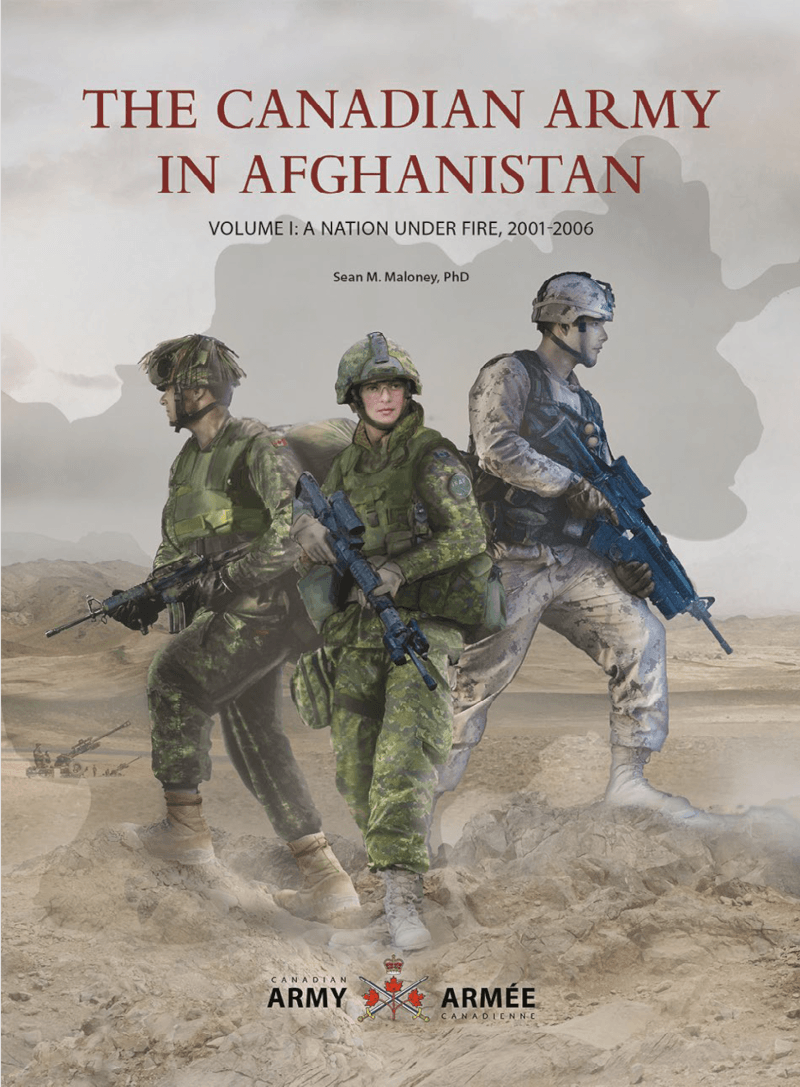
Sean Maloney’s The Canadian Army in Afghanistan was finally released to the public in 2022. [Department of National Defence]
“Yes, it was well-intentioned,” Kasurak said, “but it didn’t turn out well.”
Kasurak said its most serious shortcoming is that it only represents the thinking and activities of the field army in Afghanistan, omitting a wider view of the mission from the perspective of Defence Department headquarters, other branches of the military and other government agencies involved in Afghanistan, such as the Privy Council Office and Foreign Affairs, not to mention the thinking of NATO allies that fought alongside Canada.
“There is also the question of the preservation of the massive research that underpins [the work],” Kasurak said. “Dr. Maloney interviewed hundreds of individuals and had privileged access to documents and files. If this were an official history, all these would be preserved…. Unfortunately, National Defence may choose not to archive records from field units, and the references cited in this book may never be seen again.”
A better option in the future, he said, is for official military history to be restored to a central role within the culture of the Armed Forces, and resourced accordingly, so that senior commanders never again feel compelled to look outside the Defence Department to ensure that Canada’s war history is collected and presented in a timely fashion.
One benefit of timely publication is that still-living participants have an opportunity to see an official account—to read a narrative or point to a map showing where they served—and feel a sense of recognition from their country. The official histories of the First and Second world wars provided that validation to Canadian veterans. Meanwhile, those who served in the Balkans, for example, are still waiting.
Turcotte said one reason his office hasn’t yet finished its own Afghanistan history is the sheer volume of electronic documents produced by modern militaries, making official history a more complex and time-consuming undertaking than ever before.
“The military produces hundreds of gigabytes of documents, with no index, no organization,” Turcotte said. “We need more archivists and more time just to go through all the documents.”
Bechthold believes there’s room for both: traditional official history—which might take more than a decade of painstaking archival and historical effort—and the more immediate, on-the-ground reporting approach by Maloney, whose narrative does not, in his view, detract from what DHH may itself one day publish.
“Official history isn’t dying in Canada,” Bechthold countered. “Would I like to see DHH getting stuff published quicker? Absolutely. But at the same time, when you publish official history it comes with that official moniker, and it’s absolutely essential you get it right, and that takes time.”
Advertisement