




This is the second of a two-part series examining the impact that drones and autonomous weapons are having on modern warfare. Read Part 1.
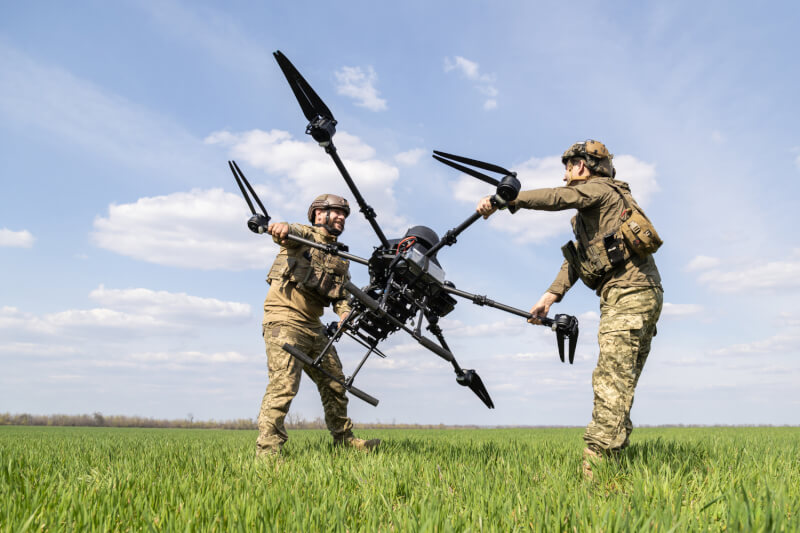
Ukranian forces calibrate a “Baba Yaga” heavy lift drone in 2024. [АрміяІнформ/Wikipedia]
On the front lines of Ukraine’s war with Russia, death is delivered not by artillery, tanks or machine guns, but via the spinning rotors of hobbyist-style, explosive-laden drones, lethal enough to kill a section of infantry or destroy an armoured vehicle.
Welcome to the battlefield of the 21st century, where, according to Francis Farrell, a reporter with The Kyiv Independent, “drones fly further and further with every month, and closer to the front line, reality breaks down into a deadly kill zone unlike anything warfare has ever seen.”
Last month, Farrell and videographer Olena Zashko posted a remarkable report on YouTube in which they joined Ukrainian troops along a critical highway linking four beleaguered “fortress” cities in eastern Ukraine, considered key to holding back the Russian assault in that part of the country.
The freeway offers a haunting glimpse of the new reality of modern warfare. The road resembles an eerie tunnel covered by kilometre after kilometre of overhead netting, an attempt at stopping small first-person view (FPV) drones from reaching people and vehicles on the ground. Occasionally an armoured vehicle races by at high speed, itself cocooned in an anti-drone wire cage. But even these vehicles aren’t immune to drone attacks, as the burned-out hulks littering the road attest.
The safest way for Ukrainian forces to ferry supplies or troops to the front are for soldiers to simply walk the highway pulling wheeled carts by hand. And when a Russian reconnaissance or attack drone appears overhead, the soldiers duck into the adjacent forest for protection, firing at the drones with their automatic rifles and, more effectively, shotguns.
The early years of the war in Ukraine were fought with traditional tactics: motorized columns of troops, tanks, mortars and heavy artillery. About two years ago, swarms of buzzing, high-speed, aerial vehicles changed everything.
“You can hide from artillery,” a brigade commander of the Ukrainian national police told The New York Times last year. But drones, he said, “are a different kind of nightmare.”
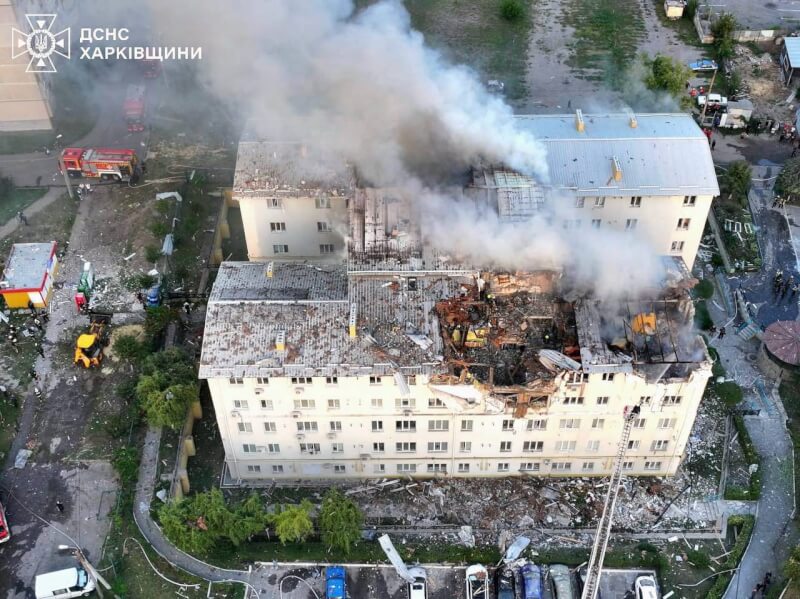
The aftermath of a Russian drone strike on an apartment block in Kharkiv, Ukraine, in 2025. [State Emergency Service of Ukraine/Wikipedia]
According to the Times, most of the 31 sophisticated M1 Abrams tanks sent by the U. S. to Ukraine in 2023 had either been disabled by drones or taken off the front line. Now, 70-80 per cent of all Ukrainian and Russian casualties are inflicted by drone attacks.
The transformation of modern warfare from expensive, complex weapons systems toward cheap, mass-produced drones was driven in part by necessity. When U.S. funding and weapons shipments dwindled following the 2024 election of President Donald Trump, Ukraine was forced to adapt and find homegrown means of arming itself. Local drone production—using off-the-shelf products and technology—began scaling up in 2024, with Ukraine producing about two million FPV drones that year alone.
Russia followed suit, while also importing (and now manufacturing domestically) tens of thousands of fixed-wing Shahed drones from its ally Iran. Shaheds—a simple, propeller-driven cruise missile often launched off the back of a truck—can fly at low altitude for up to 2,400 kilometres, using GPS to deliver a 40-kilogram (90-pound) warhead.
Iran itself fired thousands of Shaheds at cites and U.S. bases across the Persian Gulf during the recent Iran war. The U.S. military quickly ran down its stockpile of multi-million-dollar Patriot missiles in efforts to intercept the inexpensive Shaheds. Even so, some drones made it through, killing seven U.S. service members, wounding hundreds more and causing serious damage to airfields, warehouses and barracks at American bases across the region, according to a recent analysis by the Washington Post.
The U.S. military quickly ran down its stockpile of multi-million-dollar Patriot missiles in efforts to intercept the inexpensive Shaheds.
Meanwhile, despite the U.S.-Israeli bombing campaign aimed at destroying Iran’s military capability, the country continues to churn out enough Shaheds and other drones to exert its grip over the Strait of Hormuz, limiting the movement of world oil supplies with little more than a supply of drones.
Ironically, Persian Gulf states rattled by Iranian attacks sought help in countering this threat not from the U.S., but from a country with indispensable expertise in drone warfare—Ukraine.
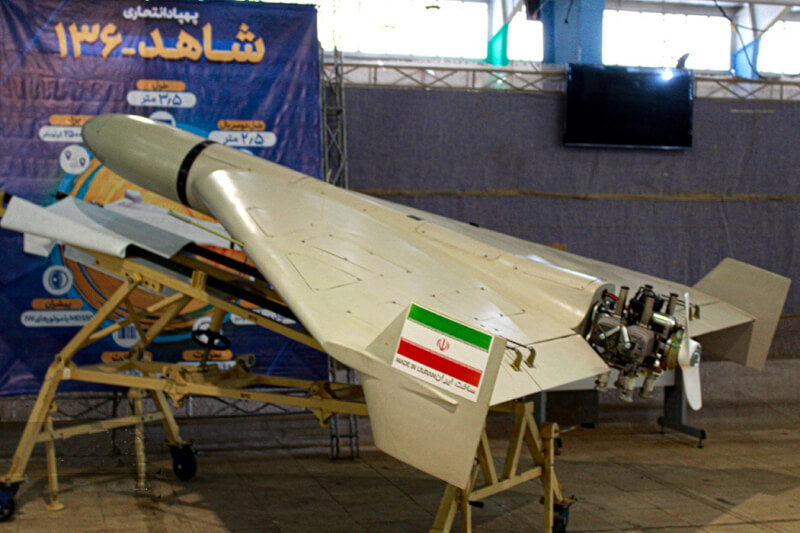
Iran’s low-cost, high-performance Shahed 136 one-way attack drone. [Behrouz Ahmadi/Wikipedia]
Drones haven’t made traditional, sophisticated weapons systems obsolete. Ukraine still needs U.S.-made Patriots for intercepting fast, ballistic missiles fired at its cities from Russia, which are beyond the defensive abilities of drones. But offensively, locally made drones are allowing Ukraine, for the first time this year, to attack oil depots and other logistics infrastructure inside the Russian heartland.
In recent weeks, Ukraine has used fixed-wing, long-range drones to target major Russian oil facilities and military factories in large cities, such as St. Petersburg, and as far away as Siberia. It has also been launching medium-range drones to attack supply routes—Russian roads and railways that feed troops and materiel into the war—making it harder for Russia to press its summer offensive.
Meanwhile, sea-going Ukrainian drones packed with explosives pose such a threat to traditional warships that Russia has pulled its most valuable naval assets from most ports around Crimea, and now rarely sends its vessels into the northwestern Black Sea.
Not only are Ukrainians helping Arab Gulf states with drone expertise, they’re now teaching NATO forces (who once guided the Ukrainian military) how to survive in the drone age. At a NATO war games exercise in Latvia in May, former officers in the Ukrainian army instructed Canadian and other NATO troops on how to deploy and defend against land-based and airborne drones.
“They are the experts [and] we need to learn from them,” Latvian Major Andris Bruveris told the Globe and Mail. “There is a jump in the tactics every three to four months. We cannot adapt in peacetime at such a pace.”
“There is a jump in the tactics every three to four months. We cannot adapt in peacetime at such a pace.”
As drones upend the nature of war, they also raise hard moral questions about the wisdom of augmenting such weapons with artificial intelligence—giving drones the ability to autonomously attack targets without direct human decision making. This heralds an age where choices about when not to pull the trigger or when to stop shooting are being handed to machines reliant on algorithms rather than human judgment.
Experts also worry about the impact of drones on U.S. military power, which has traditionally been built around sophisticated, expensive and hard-to-produce weapons systems on land, sea and air.
“We have assumed that if America is ever going to have to fight a war, we are going to enter the battlefield with technological superiority against any rival,” Chris Brose, the president of Anduril, a U.S. defence company building autonomous weapons, recently told The New York Times. “I don’t think that we have the kind of military dominance that many of us in the 1990s and early 2000s just took for granted.
“We have peer competitors and rivals in the world who are adapting to and really disrupting the American way of war…that is not a future that we’re really ready for.”
Advertisement