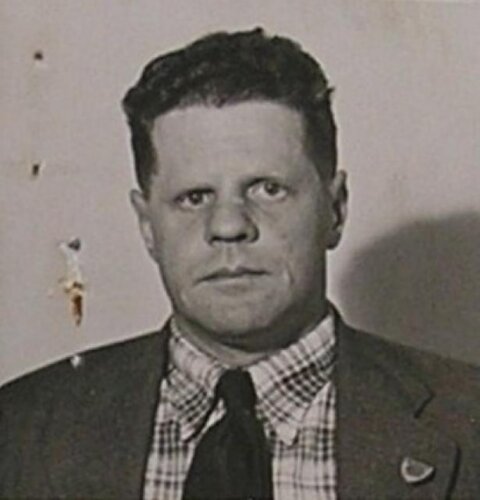


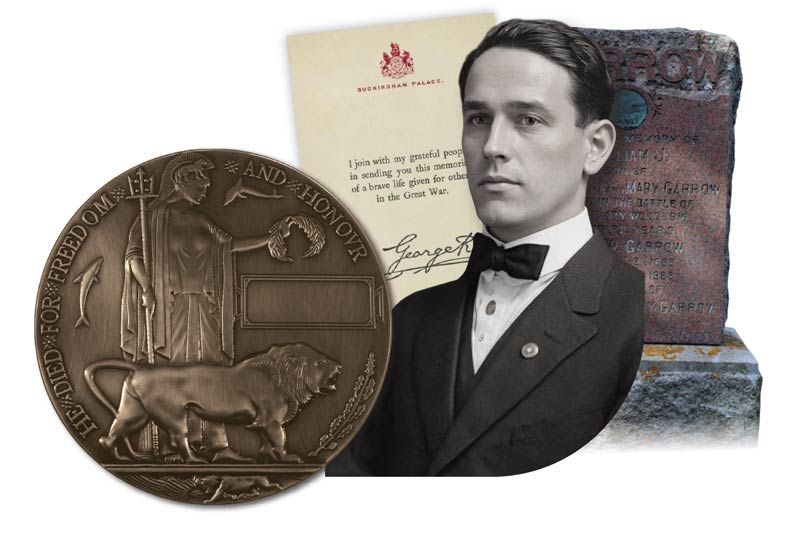
A bronze next of kin Memorial Plaque (left), nicknamed the Dead Man’s Penny, and a memorial scroll signed by the King (above left), were given to the families of soldiers, like private William Garrow Jr. (above right), who was killed during the Great War. The plaque is displayed on Garrow’s tombstone (top) at Oshawa Union Cemetery. [The Commemorative Coin Company/ebay.ca; Oshawa Museum Blog; Whitby Archives; Oshawa Museum Archival Collection]
“The life in the trenches isn’t too bad, from my experience,” penned private William (Willie) Garrow Jr. of Oshawa, Ont., in a Jan. 28, 1916, letter to his sister, Leah. What the Princess Patricia’s Canadian Light Infantry (PPCLI) soldier didn’t know was that such realities would be short-lived.
Four months later, between June 2-4, Garrow was killed during the savage Battle of Mount Sorrel (also see “The take back” on page 26). He was 22 years old.
To recognize Garrow’s sacrifice, his family, like those of 1.3 million others in the British Empire, received a bronze next of kin Memorial Plaque, along with a memorial scroll signed by the King. The plaque was a 12-centimetre (4.7-inch) disc cast in gunmetal. It was designed by Edward Preston, who beat 800 other entries in a public competition, and boasted a traditional figure of Britannia clutching a laurel wreath. The imperial imagery continued with the portrayal of lions, one of which bites into an eagle, symbolizing Germany. Finally, two dolphins, representing British sea power, glide beneath a simple yet profound inscription: “He died for freedom and honour.” Space was also left to inscribe the recipient’s name.
Dubbed the “Dead Man’s Penny” or “Widow’s Penny” for its resemblance to a coin, there was “no formalized etiquette for displaying the plaques,” noted an Oshawa Museum article. Occasionally, they were “hidden away in drawers or chests so as not to be reminders of their loved ones.” In the case of Garrow’s family, like others, it was affixed to his tombstone at Oshawa Union Cemetery.
Two dolphins, representing British sea power, glide beneath a simple yet profound inscription: “He died for freedom and honour.”
Advertisement