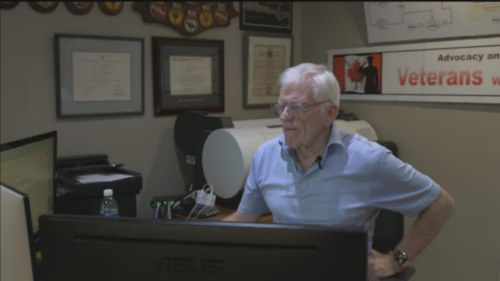


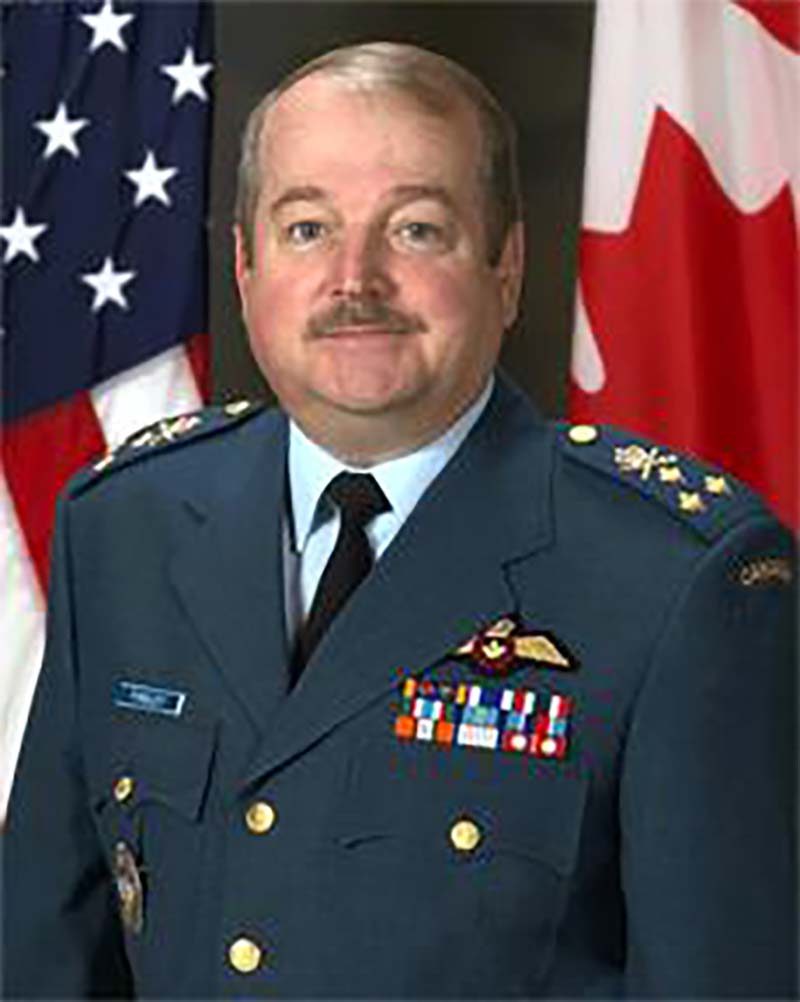
“I have to admit,” said retired Canadian lieutenant-general Eric (Rick) Findley, a former director of operations at the North American Aerospace Defense Command, “that when I first got to Norad, it was relatively quiet. 9/11 changed everything.”
A major-general in September 2001, the helicopter pilot-turned-overseer of continental air defence found himself at the centre of an unprecedented tragedy, one that left the U.S. reeling from a terrorist attack that claimed 2,977 lives.
“It didn’t matter what flag you had on your shoulder,” Findley continued. “It really didn’t matter.” Far more pressing to the Maple Leaf-uniformed senior officer was defending against the surprise threat and rapidly shifting events.
Discourse surrounding 9/11 is replete with distinctly Canadian stories within the country’s confines—of Halifax runways and Gander, N.L., hospitality when U.S. commercial aircraft passengers were grounded north of the border. Here, however, in a Legion Magazine exclusive, the Canadian at the helm of Norad that day explains his role.
On the prelude to the 9/11 attacks
When I ended up in Norad as the director of operations in 2001, I was promoted to major-general and tried to learn as fast as I could. I had been involved with Norad before, but it was still a new environment, and we were still in the process of getting to understand what some of the issues were when September rolled around.
It was an interesting time because we were into Exercise Vigilant Guardian, which was a global strategic exercise that was usually held in November. But that year, it was held in September, a move dictated by several circumstances. The other interesting aspect was Russia indicating that they were going to fly some provocative routes with their bombers. They gave us a heads-up, so we started an operation called Northern Denial, which was basically just demonstrating that we had the capability of responding to that.
By the evening of Sept. 10, I was on shift with all the Norad battle staff in Cheyenne Mountain, Colo., because we were running both the exercise and the operation overnight. Nearly 12 hours later, I was having breakfast when someone came in and said, “Hey, there’s a possible hijacking taking place.”
On Norad’s initial response
There hadn’t really been a significant hijacking in Canada or the U.S. since the early 1970s, though there were procedures in place. The idea was to ask Ottawa or Washington whether we could use Norad resources to assist, which, 99.99 per cent of the time, meant using an unarmed fighter jet to shadow the hijacked aircraft.
We were in that process when we saw the first aircraft crash into the World Trade Center. We would soon realize that we didn’t have good situational awareness, as I had asked if that had been the hijacked aircraft, and the initial answer was no; that was apparently just a commuter plane that had gone off course. I was thinking, it’s a beautiful sunny day—pretty hard for a pilot not to be able to steer around the building. It didn’t make any sense.
As we were asking all these questions, the phone rang. I looked down to pick it up, and when I looked up again, I saw bits and pieces coming off the other tower. That said to me that there was some kind of co-ordinated activity unfolding. There’s a bomb that’s just gone off in the other tower, I thought.
“Boss,” somebody close by said, “you had your head down. That was another aircraft.”
We went to battle stations, and Otis Air National Guard Base [in Cape Cod, Mass.] launched two F-15s. But at the beginning, we were just trying to understand what was taking place, because there really wasn’t a lot of information.
On the unfolding challenges
There’s no question that if there’s an attack on North America coming from the outside, usually military aircraft from another country, it’s within Norad’s purview to take counter-air measures. I could even, at that moment in time, in a situation that was extremely urgent, decide to shoot a military aircraft down.
But by virtue of the aircraft originating inside of North America, we didn’t have that luxury. It’s always deemed to be a friendly aircraft if it’s taken off inside the U.S. or Canada. That had changed the way we were looking at things.
Also, hijacked aircraft usually don’t become their own projectile. There’s something that the hijackers want in return. It’s usually transactional. But that wasn’t the case here. They were using the aircraft as a weapon.
As the morning progressed, we decided to put more air patrols out. We started emergency security control of air traffic at the same time the U.S. Federal Aviation Administration was grounding aircraft.
At that moment, probably about 3,300 commercial planes were in the air in the northeastern U.S. alone. What do you do? Always, the lead agency for that in the U.S. was the Federal Bureau of Investigation, and in Canada, it was the RCMP. The only reason we would ever get involved would be to shadow an aircraft, but in this case, we were forced to consider whether we would have to shoot an aircraft down.
We never got involved with shooting an aircraft down. We were never there in time to do anything about the crashes themselves.
On reconciling emotion with discipline
You have to suppress the emotion. You can see or feel the tension within the staff, but I had an amazing group of people who really showcased what initiative and discipline are all about. They knew their levels of accountability, responsibility and authority, and they came forward with ideas.
People told me later that I was standing, and that it had a calming influence while answering questions. The only reason I was standing was because my butt was sore from sitting there for 10 hours, but I’m glad it had a calming effect.
For me, seeing the towers collapse was the hardest thing to watch. But then, to drive home from Cheyenne Mountain that evening, listening to what people were discussing on the radio, that was also quite impactful—how it had affected the psyche and resolve of the people of the United States.
I got home and had people from the neighbourhood coming over to thank me for what I did for a living. I said, “I’m a Canadian,” and they said, “It doesn’t matter. Thank you.” I’ll always remember that.
This interview has been edited for brevity and clarity.
Advertisement