




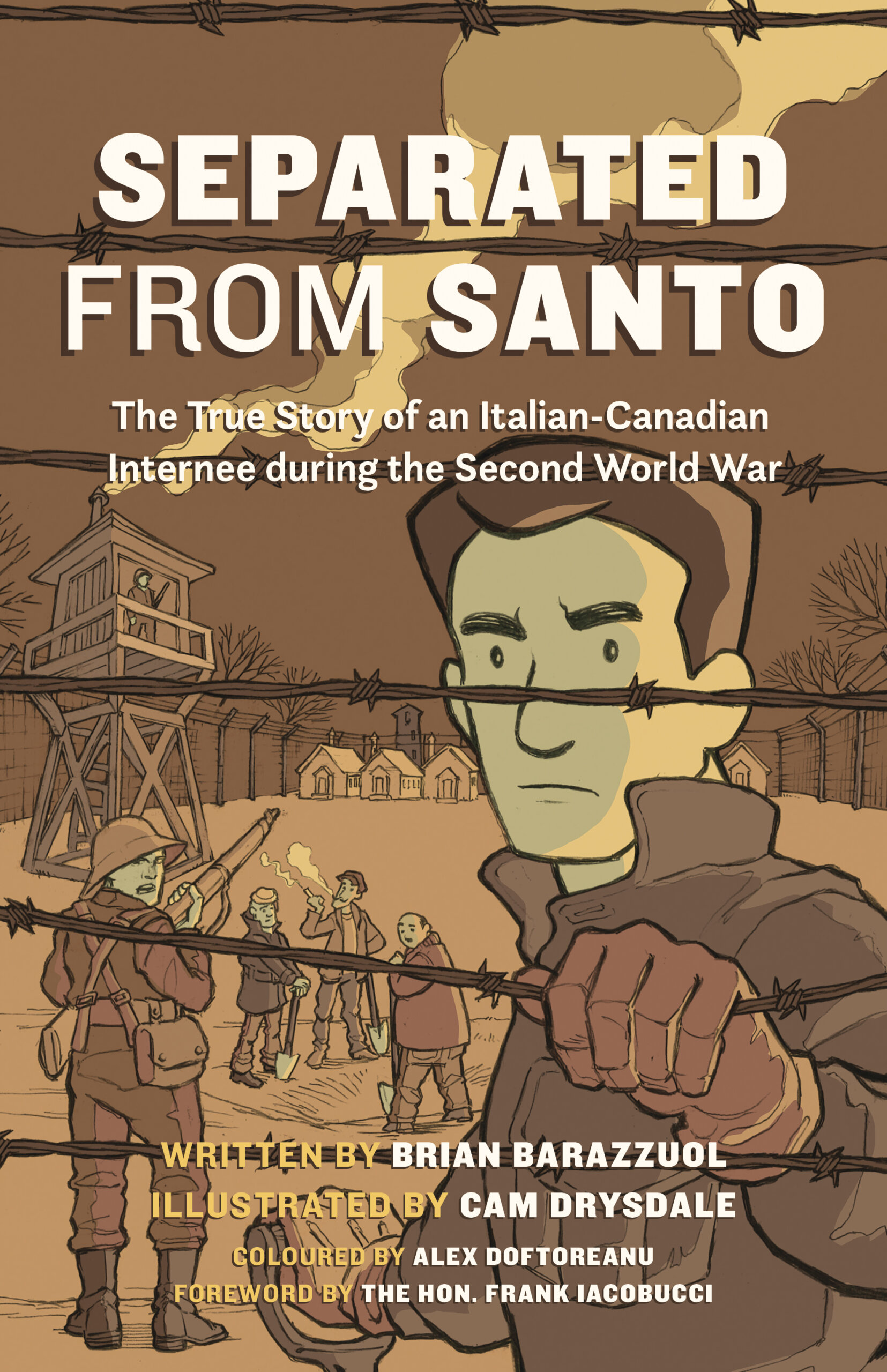
The new graphic novel Separated from Santo. [Courtesy Heritage House Publishing]
Teacher Brian Barazzuol was around eight years old when he first heard the wartime story of his great-grandfather, Santo Pasqualini. It was a tale not of fortitude in battle, nor even of bearing arms for King and country at all.
The resiliency was there, unquestionably, but the familial fight in the Second World War had taken on a far more personal guise, a then-adolescent Barazzuol had discovered. His ancestor was one of 31,000 Italian Canadians declared so-called enemy aliens, some 600 of whom—Pasqualini among them—were interned.
Most of those incarcerated were male; all were perceived as a threat to Canada. Despite having fled Benito Mussolini’s Fascist Italy in 1933, and despite having made a life for himself as a business owner in Vancouver, Pasqualini spent two years behind wire. Only in 1990 did Prime Minister Brian Mulroney deliver an unofficial apology for the wartime treatment of Italian Canadians, and only in 2021 did PM Justin Trudeau formalize that statement of regret.
Now, Barazzuol of Port Moody, B.C., has brought that overlooked story to light in Separated from Santo, a debut graphic novel for both him and his publisher Heritage House.
Barazzuol and the book’s illustrator Cam Drysdale spoke to Legion Magazine about the long-yet-gratifying creative process, the real-life story of Pasqualini and his family, and what they hope readers will take away from it.
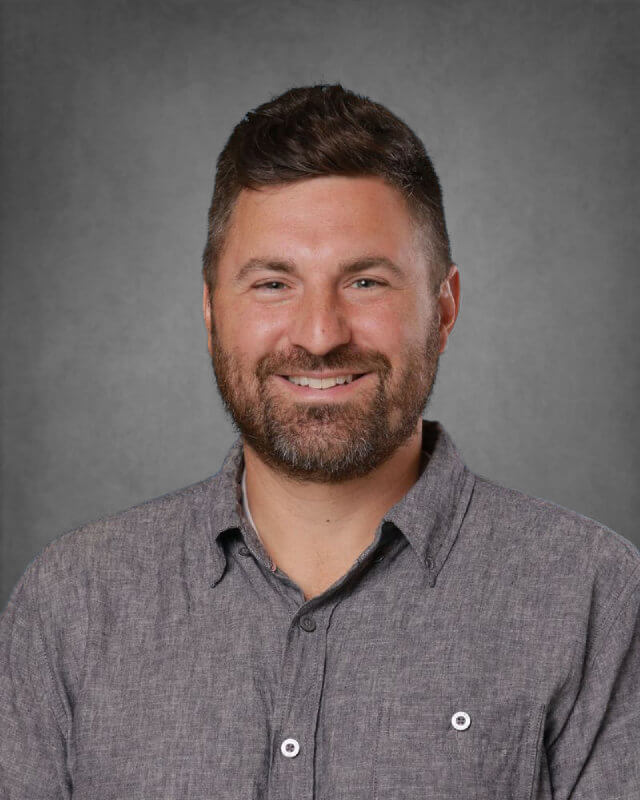
Author Brian Barazzuol recounts his family’s traumatic WW II separation in Separated from Santo. [Mike Schoenhals]
On the story behind the storyboard
Barazzuol: I never met Santo, who died in the 1960s, but I did know my great-grandmother, Alice [Santo Pasqualini’s wife], who lived to 106 years old. She was one of the main characters in the story, having experienced a mental breakdown [during Santo’s internment]. Her children—my grandmother and great uncle—were raised by a different family for roughly a two-year period.
Anyway, as I grew older and started to understand the story, it gripped me.
Fast forward to 2018, and I discovered that I was able to contact [Library and Archives Canada], which was releasing documents from World War Two that were no longer classified. Within a few months, I received around 100 letters from the time Santo was interned. Reading them in chronological order painted a better picture of Santo’s internment. They told a story of how he’d become separated from his loved ones, lost his [bakery] business, and more.
On imagining what his great-grandfather endured
Barazzuol: It was heartbreaking to see what my great-grandfather went through. Talking to my uncle Lino, who’s the little boy in the story [one of Santo’s two children], I realized that he never really spoke about his experiences after finally returning to Alice and the kids. It was something he was almost ashamed of—even if he was never charged with anything. But I knew it was a story that had to be told.
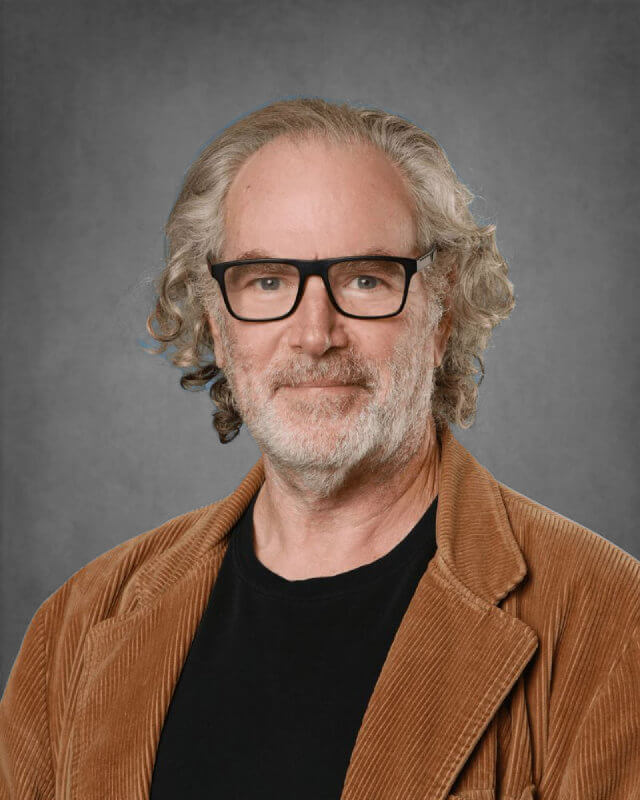
Artist Cam Drysdale depicted the story of a WW II Italian-Canadian internee. [Mike Schoenhals]
On turning the story into a graphic novel
Drysdale: Some years ago, Brian came to me and told me the story of his great-grandfather. I quickly thought it would make a really fascinating graphic novel.
Before I was a teacher, I worked in animation [including on TV productions ranging from “X-Men” to “Inspector Gadget”], so the concept of illustrating a graphic novel was something I thought I could do because of my prior 25 years of experience. The more I got into the story, the more I felt like I began to know the characters.
Barazzuol: We had started with mostly the facts, but then we really fleshed out that personal connection to ensure that all of the various characters came to life.
Honestly, for me, it consumed my life for four and a half years, trying to tell the story from a neutral perspective so that people didn’t necessarily feel like Santo was a hero, because he wasn’t. That’s not what the book was written for. It was really about trying to tell the story as it was—about what and why it happened.
Cam and I would meet every week for coffee. He would then show me his latest pencil sketches, I’d bring them home, digitize them all whilst cleaning them up, and we finally started putting them out in the layout we’d previously discussed.
To see these actual drawings weekly over that time, to see my family story told through such beautiful art right in front of me, was beyond a surreal experience.
Drysdale: It was such a thrill for me, too, as I grew to like these characters, not to mention the real people behind them. I’d love our readership to feel the same.
On a hurdle in the creative process
Barazzuol: Perhaps one of the biggest challenges was that we decided to do the whole thing in colour six months prior to finishing it. One of our students, Alex [Doftoreanu], who was in my English class and Cam’s art class, then agreed to [colourize] the whole story, which I’d say gave it a real sense of completion afterward.
Drysdale: It worked out so well. Alex was the perfect choice.
On their hopes for readers
Barazzuol: I hope that our audience will better understand a part of Canadian history that’s often overlooked and has rarely been discussed. I also hope that they’ll see someone who, all things considered, just wanted to be a Canadian.
Drysdale: I also hope they want more—because we have other books in us.
This abridged interview has been edited for brevity and clarity.
Advertisement