


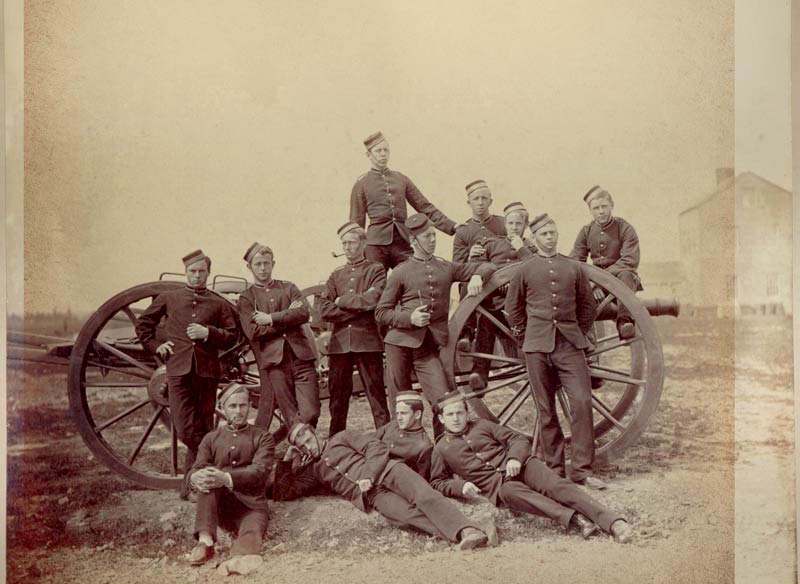
Cadets of the Royal Military College of Canada’s first year pose for a photo after artillery training. [Royal Military College of Canada]
The story is that cadets at the Royal Military College of Canada in Kingston, Ont., pass through the Memorial Arch to the school only twice in their careers: when they march through it for the first time to begin their studies; then after their commissioning ceremony held in May of their final year, striding away as freshly minted second lieutenants or acting sub-lieutenants.
The gathering is quite the sight: beaming scarlet-clad cadets, holding their pith helmets or distinctive pillbox hats aloft on their swords, walk—not march—through the gate, to the applause of parents, friends, past graduates and others. Looking at those Victorian-era uniforms, the monument with its long list of battles where past graduates served and fell and the quote from poet Rupert Brooke (“Blow out, you bugles, over the rich Dead!”) chiselled into the stone, one imagines the time-honoured ceremony stretching back a century plus.
But the story doesn’t hold up. Until the late 1970s, the arch was the main entrance to the school. If a student picked up a pizza downtown they would pass through it on the way back to their dorm. Indeed, there was no way around it. But the old road running through the gate connected to Highway 2, where the sightlines were bad and the traffic had grown heavier over the years. The danger of a collision was palpable. So, the main entrance to RMC, as it’s known, was shifted east. At some point after that, the “tradition” came into existence.
That tradition serves as a metaphor for the college itself: it’s tempting to see it as unchanging but, since its founding more than 150 years ago this year, it has changed regularly as the needs of the military and country have shifted.
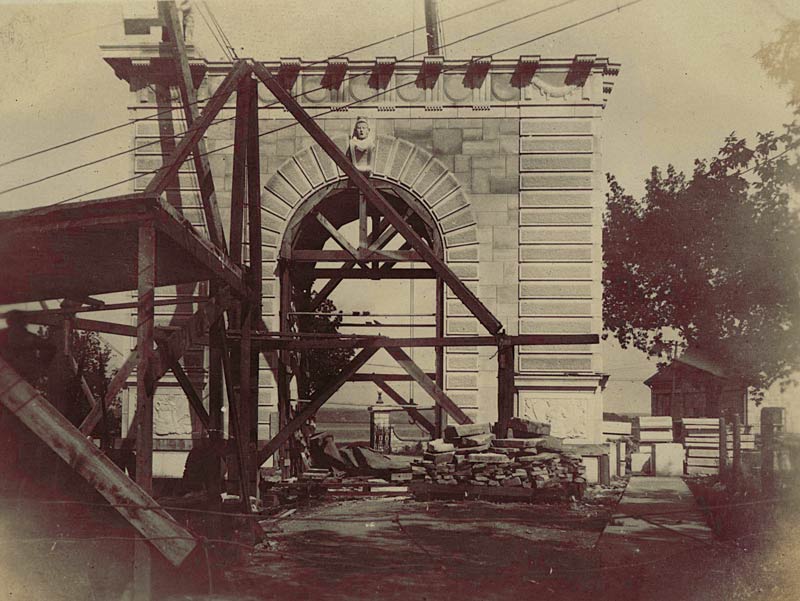
The Memorial Arch under construction in the early 1920s.[Royal Military College of Canada]
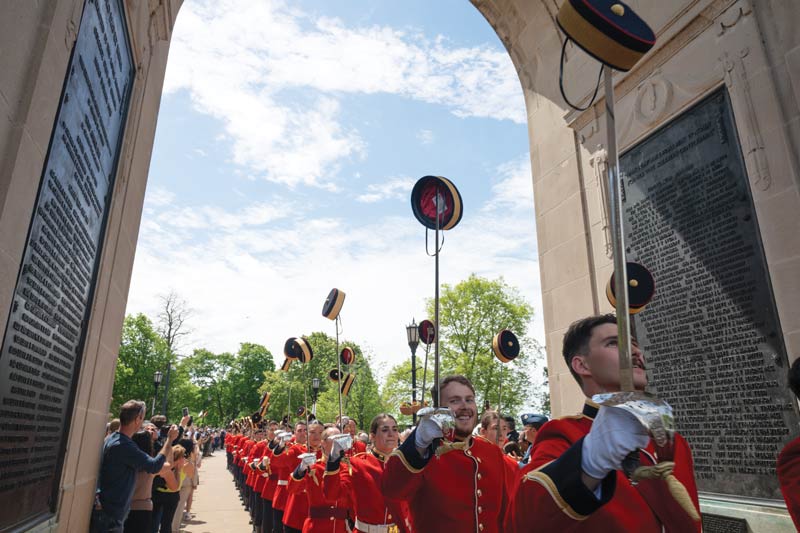
RMC grads march through the arch during the commissioning ceremony in May 2024.[Lisa Sheppard/Royal Military College of Canada /flickr/RMC Canada CMR]
RMC opened its doors to the first cadets (the “Old Eighteen” as they are known today) in 1876. Those originals were lodged in a Georgian building known as the Stone Frigate that still occupies one side of the drill square today. Standing kitty-corner is the Mackenzie Building, the impressive Victorian edifice where they took their first classes, completed in 1878. Now, it’s home to the college’s administrative offices and an extensive collection of objects and art connected to the school’s history. Modest beginnings, but they were in their way among the first tentative steps on Canada’s road to true nationhood.
The country had gained dominion status in 1867. Just three years later, the Imperial government in London withdrew most of the troops it had stationed in Canada (some remained at Halifax until 1905).
It was a who’s who of Canadian society that sent their sons here.” Montreal’s Molsons, for example, and similar such families across Canada.
“They needed a military,” said Lena Beliveau, curator of the college’s museum and a keeper of the institution’s lore. There was a part-time militia scattered across the country that had depended for training and administration on British officers. The fledgling government “needed specifically officers to look after the militia.”
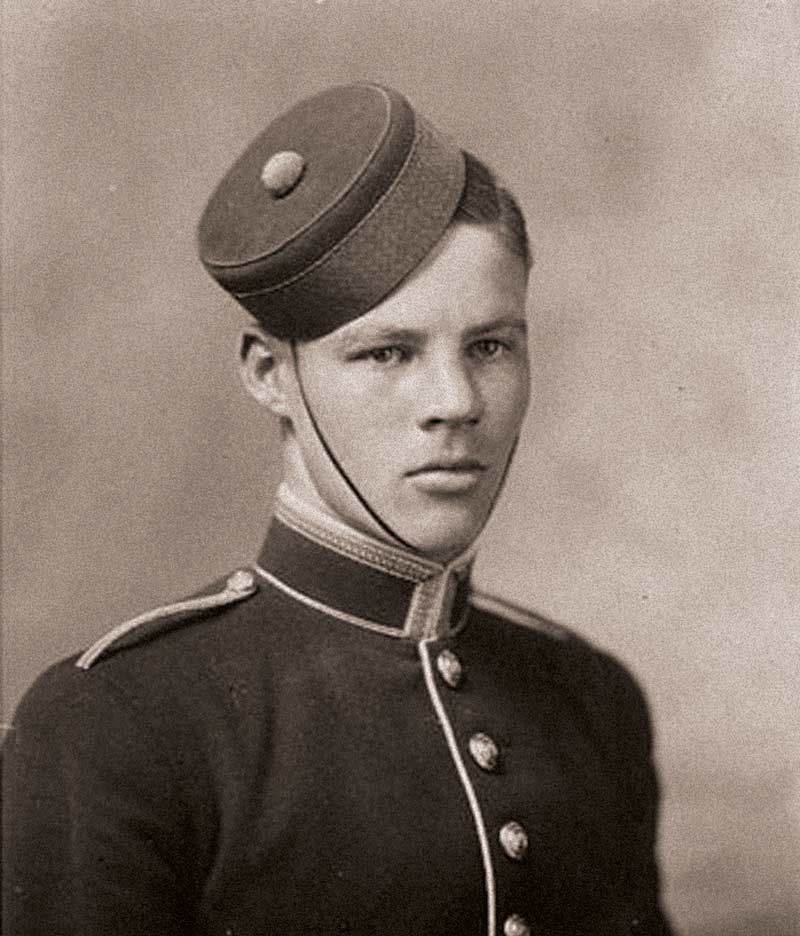
RMC grad Charles Cecil Merritt (top) would go on to earn the Victoria Cross during the Dieppe Raid. [Royal Military College of Canada]
However, added Beliveau, “Canadians weren’t super thrilled with having to provide a military,” so the school was positioned to the public as an engineering academy. “Western expansion was happening,” she said, “so they needed roads, they needed railways, and they could kind of sneak in the military aspect.”
With time and changing priorities, said Beliveau, governments came to emphasize the military side. But the school still has strong engineering ties—about 40 per cent of its current 1,200-some cadets are majoring in the discipline.
“It was a who’s who of Canadian society that sent their sons here,” said Beliveau. Montreal’s Molsons, for example, and similar such families across Canada—well, English Canada, as instruction was originally offered in primarily that language.
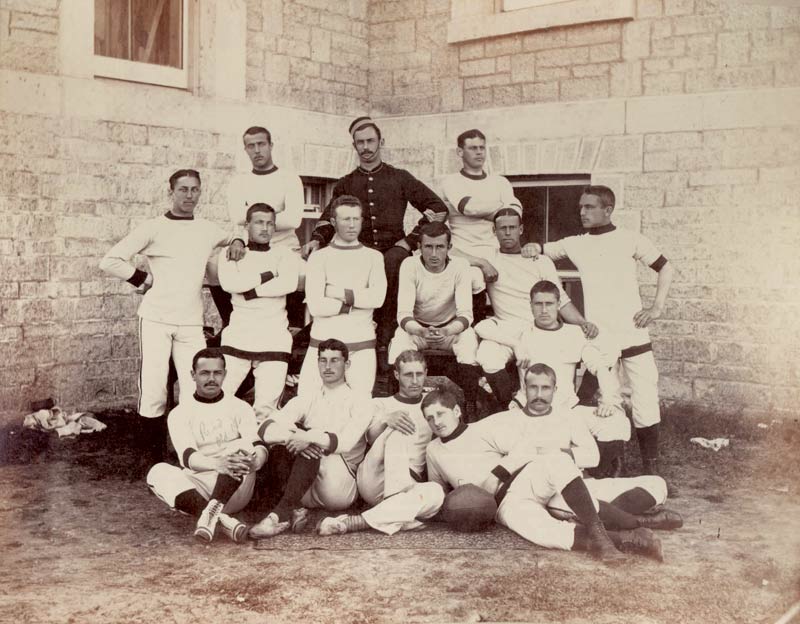
The school’s first-year sports team.[Royal Military College of Canada]
Unlike today, when one of the college’s selling points is a fully subsidized education, cadets paid to attend. Typically after three years (some took a fourth at nearby Queen’s University to get their professional engineering qualification), most graduated to a part-time military career. A few gained commissions in Canada’s miniscule regular force and every year five distinguished cadets were offered commissions in the Imperial forces.
Having a large pool of trained officers, larger than the army could hope to employ in peacetime, had benefits in war. Eighty-six per cent of the school’s eligible graduates served in the First World War, and a similar number did likewise in WW II. Graduate Charles Cecil Merritt earned the Victoria Cross during the ill-fated Dieppe Raid in August 1942.
Accounts of cadet life in those days make RMC sound like a 19th-century British boarding school—perhaps unsurprising, as many cadets were graduates of their Canadian equivalents. Sports were everything, said Beliveau. “There were no women available and the cadets weren’t allowed off campus.”
Instead, cadets participated in gymnastics, vaulting, football and hockey. Boxing was popular, too. Students also spent time shooting and horseback riding, though as Beliveau points out, the latter “was less of a sport and more of a military skill.”
Hazing and general mistreatment of fellow cadets wasn’t officially tolerated but was widespread. “In the period between the wars,” said Beliveau, “it was common for senior cadets to use recruits as personal servants. If an upper-year cadet needed something when he was in his dorm room, he would just yell ‘Recruit!’ and whoever heard him had to come running and then do whatever it was that he wanted. And if it wasn’t done to that [senior] cadet’s satisfaction, they could hit them with their swagger stick.”
The Royal Military College of today began to emerge after the Second World War. In 1942, the school had essentially shut down. The military still needed officers, but it needed them faster than RMC could provide. The college didn’t reopen until 1948. By then, at the highest levels of the military, specifically the army, there was a belief that, “The world of warfare had changed,” said Howard G. Coombs, a professor of history at RMC and a retired infantry officer.
The development of the atomic bomb meant that “officers were going to need degrees to understand this environment,” continued Coombs.
The school began offering courses in the humanities and social sciences resembling those at civilian universities. In 1952, the chiefs of the staff committee proposed that future cadets would receive a subsidized education in exchange for agreeing to serve for several years (initially three) after graduation. By 1954, this became virtually standard for all cadets.
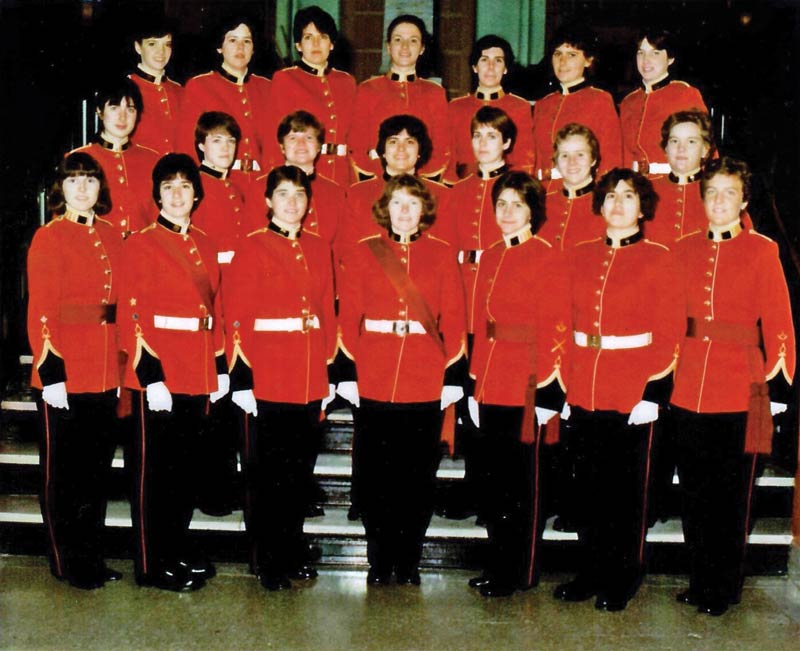
RMC’s first women grads, 1984, pose for a group photo. [Royal Military College of Canada/Wikimedia]
The result, according to Richard Arthur Preston’s seminal history of the school, Canada’s RMC, was that the college and its sibling institutions (Royal Roads Military College, founded in 1940, and Royal Military College Saint-Jean, founded in 1952) “now became more than ever a cross-section of the youth of the nation, drawing from all classes from coast to coast, including ‘new Canadians’ and boys of various ethnic origins.”
RMC granted it first degrees in the arts and science in 1959 and engineering in 1962.
It wasn’t until 1980 that the first women were officially admitted, though not without some resistance. Then, in 1995 after the end of the Cold War, both Royal Roads and Saint-Jean were closed as cost-saving measures. That left RMC as the country’s only military college (though Saint-Jean reopened in 2007).
During the years, RMC also introduced several innovations and confronted scrutiny about its operations and aims. As Coombs put it, within the college, and the Canadian Armed Forces and country generally, “There’s a desire always to do better.”
One of the most far-reaching changes in RMC’s history occurred in the late 1990s. In the aftermath of Canada’s 1993 military scandal known as the Somalia Affair, there was, said Coombs, a recognition that, in a new and baffling environment, one that did not resemble a traditional battlefield, “officers weren’t equipped with the cognitive tools to deal with realities of the conflict.” As a result, “intense reform was imposed on the Canadian military, including increased accountability and a renewed professionalism,” as Richard Foot put it in an article for The Canadian Encyclopedia.
At RMC, this led to the so-called Withers Report, a review of the school’s programs to ensure that they responded effectively to the new environment in the Canadian Armed Forces. Conducted by retired general Ramsay Withers, a former defence chief, the study led to a major rejigging of RMC’s curriculum to focus on four pillars: academics, military leadership, physical fitness and bilingualism.
Whatever implementing the four pillars means in theory, in practice it comes down to an epic example of the challenges of time management.
“Time management becomes an asset you need,” Officer Cadet Zachary Bowerman, a fourth-year chemical engineering student at RMC, told Legion Magazine. “It becomes an essential asset.”
The school arranged for Bowerman and fellow cadet Gina Ge, also studying chemical engineering, to provide a perspective on what it’s like to attend RMC today.
In December 2025, Bowerman and Ge were in the midst of a project to develop strategies to grow vegetables in the Arctic— something “really applicable in today’s geopolitical climate,” said Ge. In addition to such academic work, Ge is also the commander of the cadet wing, the most senior post held by a student at the school. She also plays rugby and, in previous years, was a member of the RMC’s multi-sport club.
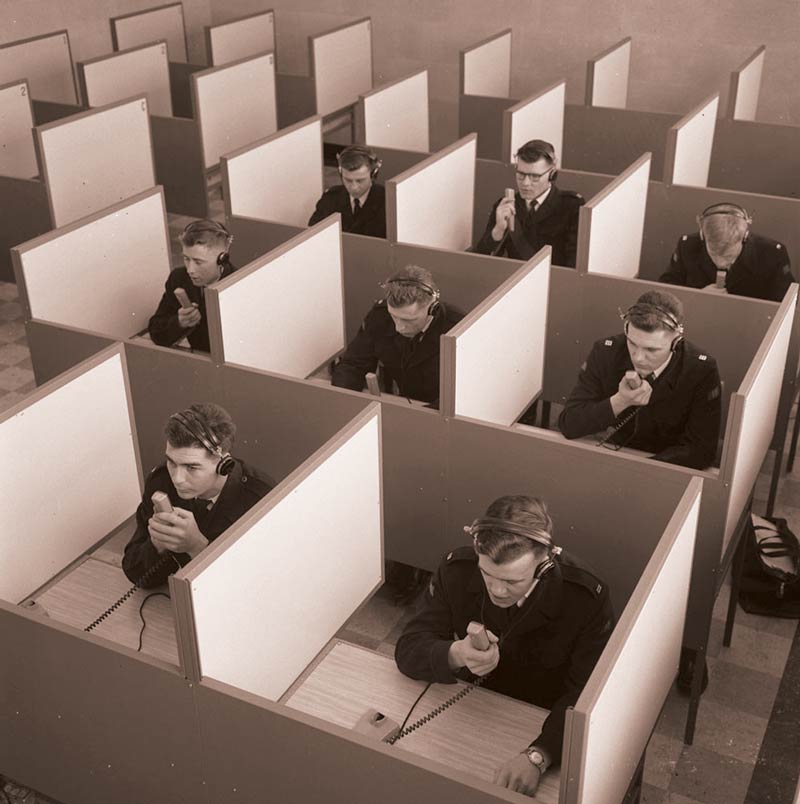
In 1959, cadets at Royal Military College Saint-Jean near Montreal listen to bilingual recordings in preparation for further studies at RMC. [LAC/NFB/e011177011]
Bowerman, meanwhile, is a cadet squadron leader (students are broken into divisions, squadrons, flights and sections, led by more senior comrades) and captain of the running team.
Ge arrived largely bilingual, but Bowerman spoke no French. In addition to the aforementioned pursuits, like all students, they are also expected to study exclusively military subjects. This can range from classroom time to sports days to inspections.
Nominally, the school day runs from 8 a.m. to 4:30 p.m., but cadets often start before that (Bowerman and Ge get up at 6 a.m.) and continue long afterward. But they all pull together.
Bowerman, who spent time at Ontario’s University of Waterloo, compared the attitude there to RMC: “It’s like an eat or be eaten world at a civilian university, especially Waterloo. It’s very competitive there, and nobody would help you, because you’re the competition for a job.”
By contrast, at RMC, “We already all have our jobs,” said Bowerman. “We already know what our contracts are. So, nobody’s here to stab somebody in the back. We’re here to push each other forward.”
“A lot of people form study groups,” said Ge. “And there’s a lot of support here at the college.” She did note, however, “Sometimes I feel like our work-life balance isn’t necessarily there because we live, work and study in the same place. We don’t have a reprieve from that.”
“I don’t think it’s something that people are meant to do forever,” said Bowerman. “Four years is definitely the limit.”
Both students plan to join the Royal Canadian Air Force after graduating, Bowerman as a pilot and Ge as an aerospace engineering officer.
Bowerman hails from Brantford, Ont., and his family didn’t previously have a direct military connection, although his father was a military contractor. Bowerman was in a youth cadets program growing up and has long wanted to join the air force (he got a commercial pilot’s licence prior to attending RMC). When he was accepted to the school, “My whole family was ecstatic,” he said. Bowerman’s looking forward to a long career in the RCAF.
Ge’s path to military college was a little less straightforward. The daughter of Chinese immigrants with no military connection at all, she grew up in Calgary. Speaking of attending RMC, she said, “I didn’t really know about it until I was in Grade 12.” She had been applying to civilian schools, with a long-term goal of becoming a doctor, but realized she wanted something different.
“I wanted to go have a challenge, go on an adventure, do really cool things, and just make a big impact,” said Ge. “So, RMC just sounded really cool.
“I had a big military movie stint during COVID,” Ge also admitted. Now, she’s applying for graduate engineering programs, though, she noted, “I still want to become a doctor.”
She hopes to achieve that goal through the CAF’s Military Medical Training Plan, and “stay in as long as possible because I enjoy the environment.”
What will they remember about their time at RMC? “I’m going to really miss the people and the bonds I’ve built here,” said Ge. Bowerman responded similarly. “I’m confident I could name 75 per cent of the people at this college and probably almost 100 per cent of our year, and there’s 200 of us at least.”
Both students also highlighted being tested and challenged more than they had ever been before and about becoming the best version of themselves.
“If you want to look for a challenge and like, really push yourself,” said Ge, “this is the place you want to be.”
Given relatively recent events, Ge’s enthusiasm for RMC, in particular, is heartening, as the school has once again had to confront its policies, procedures and practices from the past decade. In light of several widely reported cases of sexual harassment in the early 2020s by senior members of the Canadian Armed Forces, including by a serving defence chief, the government appointed retired Supreme Court justice Louise Arbour to conduct an Independent External Comprehensive Review of culture in the Canadian military.
In her 2022 report, Arbour was critical of the environment Canadian military colleges fostered for women and said the CAF should consider if the schools “should continue as undergraduate degree-granting institutions.” Arbour recommended a detailed review of the schools.
In response, the Defence Department created the Canadian Military Colleges Review Board in 2023. Its report, released in January 2025, maintained that the schools should continue to exist, that they were essential, but that they also needed to continue to change.
“The Board believes that the Military Colleges must conceive of themselves as, and be understood to be, military units,” said the report. “Although they grant university degrees, they are not the same as civilian universities.”
One key challenge the board identified related to RMC’s four pillars. The report indicated that their emphasis should be altered, to try to offset the time pressure that cadets operate under that sometimes leads to military skills being downplayed.
“I can’t say there were any major surprises in the report,” said Brigadier-General Pascal Godbout, RMC’s commandant since 2023.
The four pillars were intended to ensure the multifaceted education of cadets. “So, how do we achieve the aim of the interdisciplinary degree and the concept of the four pillars moving forward?” asked Godbout. Currently, RMC is considering integrating some of the non-academic-related pillar activities into academic ones. “To look at how much of the fitness and wellness strand can be accredited to count as university credits,” said Godbout, “to look at the bilingualism strand, and to see what portion of it could be accredited, and to look at what portions of the military strand could also be accredited.”
The college “became more than ever a cross-section of the youth of the nation, drawing from all classes from coast to coast, including ‘new Canadians.’”
The effect, Godbout argued, would reduce the time pressure on cadets. It would also increase emphasis on the other three pillars, particularly the military one. (Godbout is an example of what the military colleges can turn out. A graduate of Royal Military College Saint-Jean, he said that, for a kid from the Gaspé, “to be offered subsidized education, to be paid to go to school, when I came from a hometown where we had a 25 per cent unemployment rate, to me, this was a gift falling from the sky.”)
However it changes in the future, RMC’s core mission will remain the same, said Godbout: “to deliver character-based leaders for the Canadian Forces to meet the needs of today and tomorrow, in service to Canada.
“This is a responsibility that the entire team here takes very, very seriously.”
Tucked in behind the charming limestone house where Godbout lives on campus is RMC’s Wall of Honour. Built by the class of 1963, the long stone wall features bronze plaques honouring notable graduates, listing their names, cadet numbers and a brief descriptions of their accomplishments.
What’s surprising about the tribute are the individuals included who achieved successes outside of the military. People such as Larry Stevenson, the founder of Chapters, and Walter Gordon, the business executive, cabinet minister and founder of the Committee for an Independent Canada. They’re a reminder of the college’s enduring influence on the country.
“What we produce is Canadians who have the spirit of service,” said Godbout. “No matter which path they choose.”
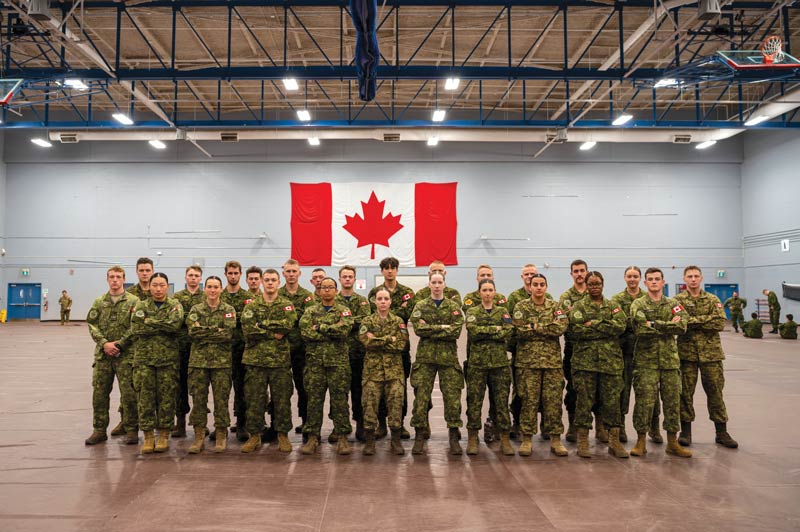
Students of the class of 2029 pose for a photo in August 2025. [flickr/RMC Canada CMR]
Advertisement