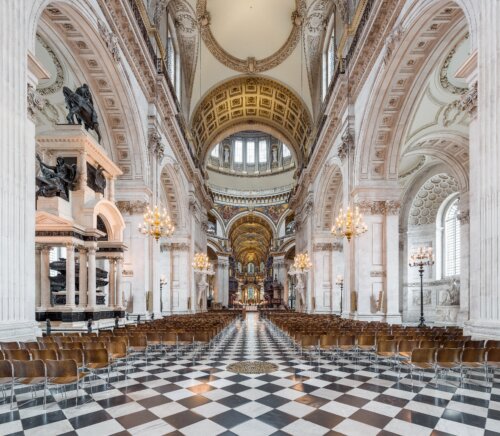






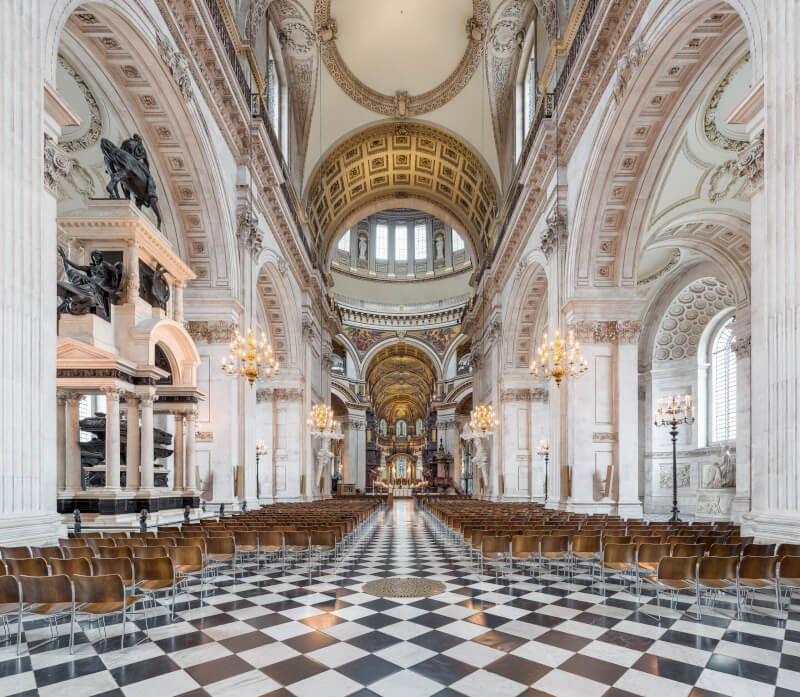
Among the British war heroes honoured at St. Paul’s Cathedral in London, England, is Captain Alexander Macnab of Upper Canada. A plaque dedicated to his memory is located near the tomb of Arthur Wellesley, 1st Duke of Wellington (pictured at left). [Diliff/Wikimedia]
Within the crypt of St. Paul’s Cathedral in London, England, rest two of the country’s most revered war heroes. To innumerable Britons, both the tomb of Admiral Horatio Nelson—the seafaring legend of Trafalgar—and that of Arthur Wellesley, 1st Duke of Wellington—whose cunning carried the day at Waterloo—are sacred. Together, they embody Britain’s victory over France during the Napoleonic Wars (1803-1815), epitomizing the martial prowess and imperial confidence that defined an era.
Nearby, however, the chamber holds a far humbler memorial—indeed an ode to an all-but-forgotten chapter in Canadian history and heritage.
“If you stand in the right spot,” said military historian Tanya Grodzinski, “you’ll see near Wellington’s tomb, a bust of [Canadian prime minister] John A. Macdonald, then a little rectangular wall stone dedicated to the memory of Captain Alexander Macnab.”
The unassuming tribute honours a largely unknown officer, yet in those same chiselled letters, a larger story is revealed. While the War of 1812 dominates popular Canadian memory of the period, it has obscured the fact that an untold number of men from British North America fought in Europe against Napoleon. Macnab was one of them.
Grodzinski has spent years researching such individuals, shedding light on their lives, legacies and broader contributions to the conflict. Here, in a Legion Magazine exclusive—the second of two parts—she explores their service and why they deserve a more prominent place in Canada’s collective consciousness.
On Canadians who served in Napoleonic-era Europe
I don’t know exactly how many [British North Americans fought in the Napoleonic Wars] because it’s difficult to trace them. I have, however, been able to track a number of individuals, including a couple from Lower Canada and another from Upper Canada. They have different stories, all different backgrounds. Two of them were in the infantry and one was an engineer.

William Johnston Hughes. [William Berczy/Musée national des beaux-arts du Québec]
On William Johnston Hughes
William Johnston Hughes joined the 39th Foot. He was from Lower Canada, achieved a captaincy, wound up in Spain [during the Napoleonic-era Peninsular War] and fought one action at [the July 25, 1813, Battle of] Maya, which happened in a valley area, and the British lost that battle.
In 1814, Hughes came back to North America, where he was among the reinforcements that arrived for the unsuccessful British campaign against Plattsburgh.

Alexander Macnab. [The Queen’s York Rangers Regimental Council]
The next one that is quite interesting is Alexander Macnab, who was of an Upper Canadian family that had originally come from the United States and was involved in the local economy, hierarchy and so forth. He joined the local militia but later transferred to the 30th Foot and ends up in the second battalion.
Macnab is briefly in Spain and is pulled in by Wellington to be on the staff. He is basically the town major of a couple of communities [including Gibraltar], but he doesn’t really get into the thick of things until [the June 18, 1815, Battle of] Waterloo.
A lot of the literature says that he was an aide-de-camp to Lieutenant-General Thomas Picton, who commanded one of the divisions. In reality, Macnab commanded a company, but was mortally wounded in the process. As he lay dying on the field, one of his colleagues came up to him. Macnab gave him his watch, sword, some letters to his family and other materials. When he died, he was buried at the site of Waterloo.
On Édouard de Salaberry
The third one I think is the most interesting of all because it has implications in North America. It also deals specifically with a major battle in the Iberian Peninsula.
Édouard de Salaberry belonged to a fascinating family who were linked with imperial hierarchy. The de Salaberry family had four sons, all of whom went into British service. The most famous was Charles de Salaberry, one of the early proponents of light infantry and rifle regiments and commanded the British, Canadian and Indigenous forces at the Battle of Châteauguay in 1813.
Édouard, on the other hand, joined the Royal Engineers.
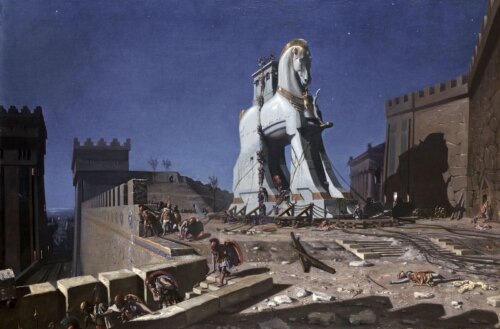
In 1812, Wellington planned to move from Portugal into Spain, and there were two forts he needed to take. There was one to the north—Ciudad Rodrigo—and Badajoz further south.
Édouard was briefly at Ciudad Rodrigo, but it’s at Badajoz that he played a primary role. This is a walled city, so the way to attack it in that period was to first isolate it before establishing artillery batteries. One would then try to bash down a portion of the wall to squeeze a company-sized unit through. These volunteers were known as the “Forlorn Hope,” to give you an idea of what was expected of them. They would carry ladders and assault equipment to get in, then follow-on forces would break through and carry on taking the city.
Because the assaulting forces moved at night, they had to be guided to their jumping-off point—and that was the job of the Royal Engineers. Young Lieutenant de Salaberry was in charge of one of these groups, and as he was leading them forward, French artillery was coming down. He was wounded and died.
On preserving the period’s Canadian stories
Of course, every person has a story, and you can often divine what they might have gone through. I used to like going to the War of 1812 battlefield in Chippawa on a hot day, closing my eyes and standing in the tall grass. I would hear the sound of battle and sense the spirits of those who had fallen there.
You begin wondering what the soldiers’ aspirations were, how they died. They had been marching and countermarching, so they were probably thirsty and hungry and scared. Some of them had even probably been drinking before the battle to loosen their nerves.
Some of their experiences are recounted in art. Some people wrote poetry at the time, while others wrote memoirs. But what I would say of all conflicts, not least the Napoleonic Wars, is that more stories are lost than are saved.
This interview has been edited for brevity and clarity.
Advertisement