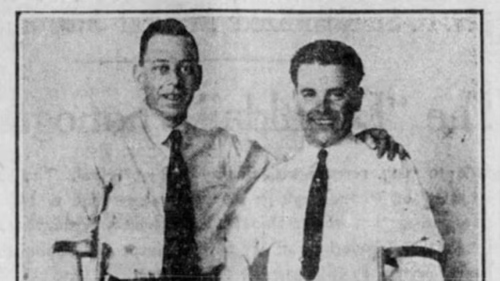




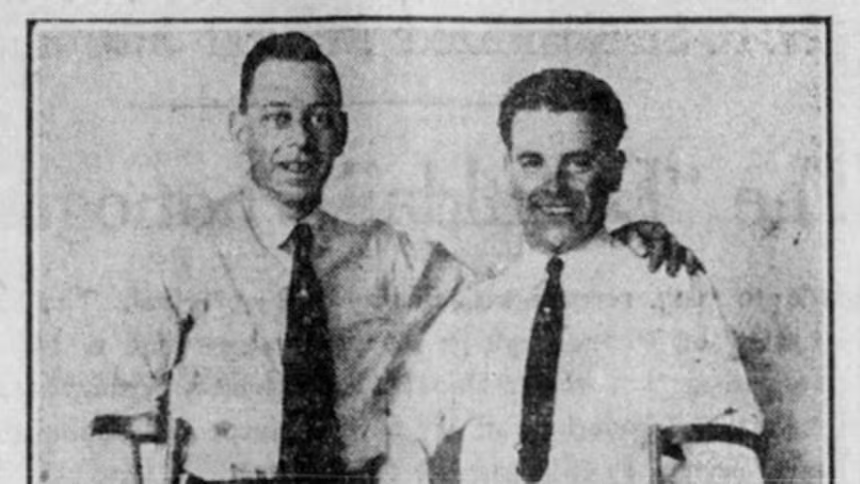
Wounded Great War veterans George Hincks and Marshall McDougall pictured in the Calgary Daily Herald on April 21, 1923. [Calgary Daily Herald]
When the guns of the Western Front fell silent on Nov. 11, 1918, the smoke of battle gradually faded. The violence of the previous four years, however, had left countless scars—not only on the shattered landscape, but on those who survived it.
In time, sites of such bloodshed could largely heal—mud replaced with fertile fields, ruins rebuilt into thriving communities. The same could not always be said for tens of thousands of Canadian veterans with disabilities—men who had lost limbs, developed chronic illnesses or otherwise endured life-altering wounds. For many of these individuals, the Great War was carried home with them.
Medical and military historian Eric Story, an assistant professor at Wilfrid Laurier University in Waterloo, Ont., has studied the legacies of the conflict for more than 10 years. Rather than the quagmires of Belgium and France, his research has charted the very different—yet no less complex—landscape of postwar disability and advocacy in Canada.
Here, in a Legion Magazine exclusive, Story discusses the struggles that some veterans continued to face long after the Armistice.

Medical and military historian Eric Story. [University of Wilfrid Laurier]
On postwar veterans with disabilities
In the official history of the First World War by Gerald Nicholson, it’s written that 172,000 soldiers were wounded on the battlefield. A large majority of those returned home, but that figure of 172,000 doesn’t account for the many hundreds of thousands of soldiers who were diagnosed with illnesses on the battlefield as well. Even in the official history, shell shock wasn’t included in that number, so the short answer is we don’t really know the real figure. It’s certainly more than 200,000, probably north of 250,000, but the bottom line is that it’s complicated.
Veterans were seen as heroes who were to help carry Canada into a more prosperous and better future. When we’re looking specifically at veterans with disabilities, however, two archetypes emerged. Yes, on the one hand, they’re battlefield heroes—with the scars of war to prove it. But on the other hand, those same wounds were framed as a hindrance to transitioning into the workforce in a postwar world. They were caught between two competing ideals.
On early advocacy efforts
A few groups began advocating for these veterans, began challenging those ideals. Two particular groups, the Tuberculous Veterans Association of Canada [since subsumed into The Royal Canadian Legion] and the Amputations Association of the Great War [today known as the War Amps], were very much at the forefront.
The Amputations Association became a national group by 1920, representing between 4,000 to 5,000 veterans who had had various forms of amputations. The lesser-known group, the Tuberculosis Veterans Association, advocated for those diagnosed with the infectious and chronic disease. By 1921, over 10,000 Canadian Great War veterans had received treatment for tuberculosis stemming from their wartime service.

Members of the Tuberculous Veterans’ Section of the Canadian Legion meet at the 1946 national convention in Quebec City. [TB Vets]
On the forgotten story of George Hincks and Marshall McDougall
Hincks and McDougall, two wartime leg amputees, embarked on a long-forgotten trek across Canada in 1923. It’s the kind of story that has obvious parallels to Terry Fox’s 1980 Marathon of Hope.
These two veterans decided that they would walk from Calgary to Ottawa—about 3,000 kilometres—and would do so unassisted and on crutches. They trekked across Alberta, Saskatchewan and Manitoba. They financed it by McDougall playing piano and Hincks giving speeches to raise awareness of the issues facing veterans with disabilities.
When they reached Winnipeg, Hincks gave his most provocative address. I find [that speech] such an interesting point of comparison to Terry Fox, who very much championed the idea of overcoming one’s adversity, of overcoming one’s limitations. Hincks, meanwhile, flipped the script entirely. He said that it wasn’t just his issue of needing to overcome the limitations that had been placed on his body, but that the wider public needed to think about the discriminatory attitudes holding him back in the postwar world.
Those words were uttered more than 100 years ago, but they’re still so resonant. He shifted the focus onto ableist attitudes that kept him and his fellow amputees from re-entering the workforce.
Hincks and McDougall continued on after Winnipeg, crossing into Ontario, but they started to encounter considerable pain. They made it to Kenora, Ont., before McDougall decided to return to Winnipeg. Hincks kept going until Fort William, but there he, too, decided that he couldn’t go any further. In a fascinating coincidence, Fort William today is Thunder Bay, where Terry Fox’s journey ended.
It’s such a wonderful story of fortitude and endurance, but it’s also such a relevant story when we’re talking about today’s disability rights.

Hincks and McDougall as pictured in the Winnipeg Evening Tribune on June 12, 1923. [Winnipeg Evening Tribune]
On drawing parallels with the modern world
We often associate the 1970s, and especially the 1980s, with the [beginning of the] modern disability movement—at least in North America. But the story of McDougall and Hincks, as well as the larger advocacy work of the Amputation Association and the Tuberculosis Veterans’ Association, started as early as 1918.
It’s hard to draw a direct parallel between then and now because the research hasn’t been done, whether in a Canadian context or otherwise. But I would be surprised if there wasn’t some throughline.
On reframing our understanding of wartime disabilities
We often think about wars having firm start and end points. The First World War, for example, was 1914 to 1918; the Second World War was 1939 to 1945. We attach these dates to mark the beginning and end of war, but veterans tell us that wars don’t necessarily end with peace deals and armistices. They can linger long after.
This interview has been edited for brevity and clarity.
Advertisement