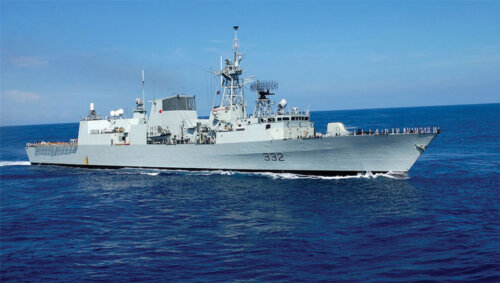


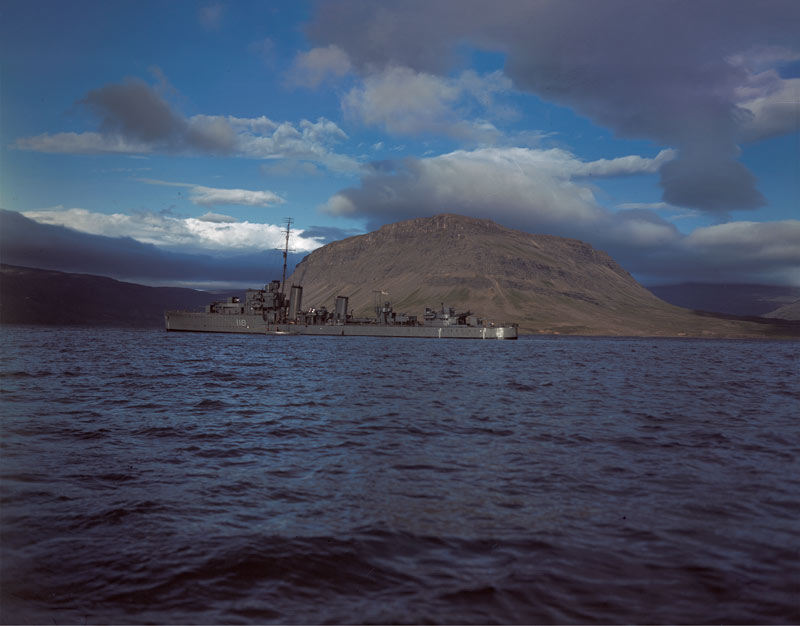
HMCS Assiniboine passes the island in May 1942. [DND/LAC/CT279]
The trees—or lack thereof—were among the first things that private Claude Arthur Hill observed of the mountainous, fog-shrouded realm that lay ahead of him on July 7, 1940, as HMT Empress of Australia cruised closer to port.
The Smiths Falls, Ont., native jostled for space beside the crowded ship railings, where his comrades in The Cameron Highlanders of Ottawa (Machine Gun) shared in the curious scenery, their heads tilted as if gazing on another world.
They had all laughed in disbelief when the news broke during the voyage that they were bound for Iceland. Soldierly gossip, they had thought; likely a mere joke.
But here they now were, staring at the isle of the midnight sun.
“Reykjavík presented a city unlike any Canadian city,” wrote the regimental war diarist. “The view from the boat reminded one of many coloured shoe boxes set around and on a hill.” That may have been so for some, but for 27-year-old Hill, it was the perceived absence of conifers and evergreens, that
oh-so familiar sight back home, that left him pining for the forests he had taken for granted.
He and every Allied occupier on board were in for a cold reception.
A 103,000-square-kilometre island forged in molten rock and cast-iron resolve, Iceland was a sovereign state under the Danish monarchy, a sparsely populated yet fiercely proud country of some 120,000. It was a semi-autonomous nation of anglers and farmers, where sheep outnumbered people by approximately six to one. It wasn’t a land of soldiers, nor a kingdom of conflict.
War found it eventually, however, following the German invasion of Denmark on April 9, 1940, prompting its swift surrender against overwhelming odds. Iceland was alone, with a borderline non-existent military, in an increasingly strategic arena—itself surrounded by increasingly contested waters. That the secluded Nordic nation had maintained neutrality, despite having assumed legislative control over its foreign affairs, was seemingly of little consequence as London and Berlin eyed the prize. “Whoever has Iceland,” suggested one unidentified German sailor, “controls the entrances into and exits from the Atlantic.”
Winston Churchill, then British First Lord of the Admiralty, not only agreed but intended to go further. Two days after Denmark fell to the Nazis, the prime minister-in-waiting announced that steps were being taken to occupy the Faroe Islands, a Danish-administered archipelago located southeast of Iceland. Royal Marines landed there on April 13. It was a stepping stone toward a far greater precautionary measure, based on the assumption that enemy forces could use Iceland as a forward naval and air base to attack the British Isles.
Thus, on May 10, 1940, the U.K. struck first.
Several occupations began that day, not least Hitler’s blitzkrieg into France and the Low Countries. Meanwhile, Churchill walked through the door of 10 Downing Street as Britain’s new wartime leader. Elsewhere, indeed far away from the upper echelons of power, two British Royal Navy cruisers and two destroyers arrived in Reykjavík harbour transporting 42 officers and 775 other ranks from the Royal Marines, their task to implement Operation Fork.
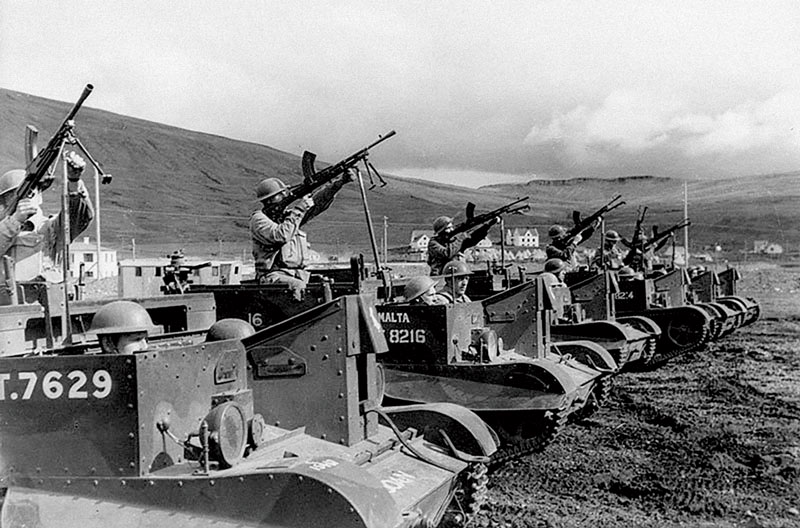
Soldiers of The Royal Regiment of Canada aim their guns to the sky near Reykjavík, Iceland, in August 1940. [Wikimedia]
It was obviously a stepping stone based on the assumption that enemy forces could utilize Iceland as a forward naval and air base to attack the British Isles.
The invasion of Iceland was bloodless, if peculiar. Disembarking from the dockside at 6:20 a.m., the first troops were met by a crowd of onlookers, most of whom had been alerted to events after spying a Walrus aircraft patrolling overhead. Rather than openly resist the unwelcome guests, Reykjavík residents instead thronged the quay, passively surveying the scene, until their presence impeded progress.
“Would you mind…getting the crowd to stand back a bit so that the soldiers can get off the destroyer?” the British consul politely asked a local police officer.
“Certainly,” the uniformed man replied.
As the German consul in Reykjavík burned records in a bathtub, British authorities dealt with the immediate fallout of having violated Iceland’s sovereignty, insisting that the occupying force wouldn’t intervene in domestic affairs, that citizens would be compensated for any damages, and that every soldier would leave at war’s end. Beyond lodging a formal protest, the Icelandic government agreed to the terms with much reluctance, instructing its people to display civility to the invaders.
Nordic courteousness had its limits under the circumstances, of course, but the British had more pressing concerns after dispersing troops across Iceland to guard against enemy assaults: they needed more men.
A new, 4,000-strong contingent from 147th Infantry Brigade arrived a week later to relieve the Royal Marines, but even that wasn’t enough to satisfy the demand.
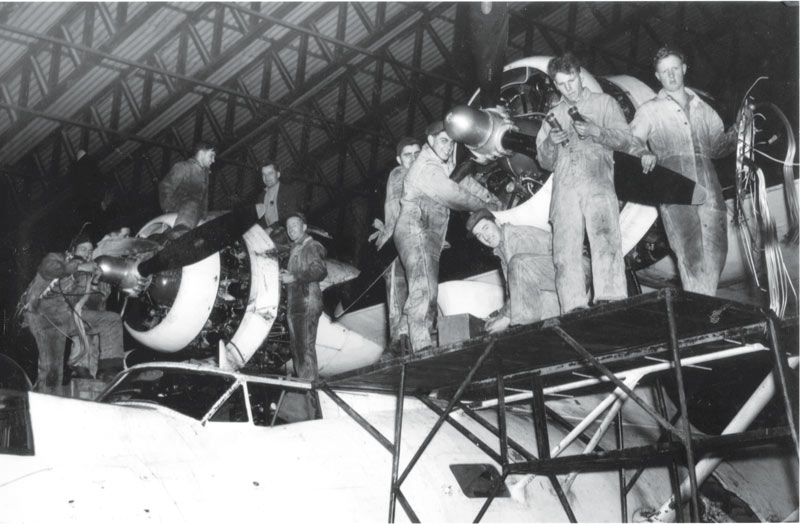
Royal Canadian Air Force ground crew service aircraft in Reykjavík in September 1944. [DND/LAC/e005176199]
Churchill was in no position to send additional forces for some faraway garrison duty as the infamous Dunkirk evacuations loomed. And so, he turned to Canada for reinforcements, requesting a large formation to help fill the void.
Prime Minister Mackenzie King’s own war cabinet approved the plans on May 22. In doing so, argued Steven J. Bright in a 2022 article for the Journal of Canadian Military History, the Dominion had committed to its “first substantial and sustained deployment beyond the British Commonwealth up to that time in the expanding war,” even if King himself considered it as an afterthought.
Three battalions from 2nd Canadian Infantry Division formed the bulk of what became designated ‘Z’ Force, commanded by Vimy Ridge veteran, Brigadier Lionel F. Page. On June 10, 1940, Page departed with his staff and a vanguard outfit comprising the Toronto-based Royal Regiment of Canada (RRC), arriving just six days later “without incident”—barring bouts of “seasickness in rough seas.”
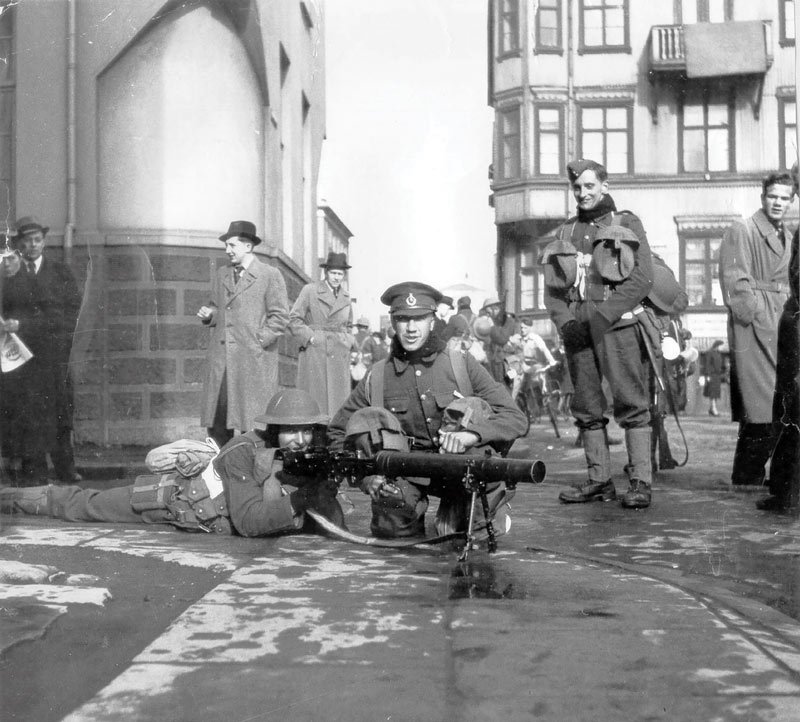
British soldiers pose for a photo on a street in Reykjavík. [icelandmonitor.mbl.is]
Joining them from July 7 was Les Fusiliers Mont-Royal (FMR), consisting of mostly francophone recruits, and Hill’s Cameron Highlanders of Ottawa.
The machine-gunner marched through cheerless Reykjavík streets to the sound of bagpipes, their shrill notes a novelty to the Icelanders gathered on either side.
He and his fellow highlanders, as recounted in Hill’s posthumously published memoir Wind, Gravel and Ice, were destined to endure an arduous 10 months.
‘Z’ Force’s problems had begun almost immediately when it took about 16 days to fully unload one ship, due mostly to Reykjavík harbour proving ill-equipped to handle the tremendous influx of materiel. Worse, having departed from Canada hastily, a large proportion of those supplies had been left behind. The men had little choice but to suffice with an acute lack of rain jackets and boots that wore out easily on Iceland’s unforgiving hard-rock surface, compounded by the reality that the Canadians, like their British counterparts, were eventually spread out across huge swaths of the country for its defence.
Another monumental challenge was that Iceland’s infrastructure was considered rudimentary at best. Without an airport and boasting only a few rugged roads, it inevitably fell to the occupiers, including ‘Z’ Force, to transform the entire island into a self-sufficient military asset. Hill and a Cameron Highlanders detachment were sent to help the FMR and British personnel build a Royal Air Force aerodrome and defensive networks at Kaldadarnes, roughly 60 kilometres southeast of Reykjavík. There, toiling away in the “sea of gravel” and sodden soil amid rain showers, the troops erected hangars and machine-gun emplacements on a flood plain. The base was washed out in spring 1943.
The RRC likewise encountered hurdles, both literally and figuratively, in their efforts to fashion water pipes into tank obstacles, having evidently resorted to improvisation to execute their garrison duties. The experiment failed to meet expectations, but slowly, surely and with great perseverance, the Canadians and willing locals safeguarded Iceland against an enemy invasion.
All the while, the men contended with spartan sleeping arrangements, as Hill and his work crew realized from day one.
“The lava gravel bends our tent stakes into strange formations,” penned author Christina Chowaniec, granddaughter of the Canadian private who fleshed out his tome by recreating his voice, “and the wind tears at the canvas with such force that…it is torn from our hands.”
Gusts capable of hauling vehicles off roads—let alone campsites from rain-saturated grass—were an all-too-common cause of soldiers’ insomnia as canopies were shaken from the inside out. Adding to the misery, Chowaniec, or possibly Hill himself, wrote that “two weeks after the summer solstice…just below the Arctic Circle, the sun will not set tonight.”
Damp nights devoid of darkness would ultimately be replaced by plummeting temperatures through fall and winter.
By September 1940, only half of ‘Z’ Force had a roof over its head. The rest had to cope with the canvas lifestyle until the availability of Nissen huts increased. According to Cameron Highlander Fred Hicks, a combination of dismal weather conditions and sheer boredom drove myriad soldiers to go “stark raving mad.”
Dealing with the monotony of their bleak existence, many Canadians turned to the bottle, numbing their senses with a potent local spirit nicknamed “Black Death.” In Chowaniec or Hill’s view, the “horrific” beverage resembled “something between paint thinner and diesel fuel.”
Regardless, its high prevalence among all ranks led military officials to warn against its consumption and severely punish non-compliance. Shipments of cigarettes, chocolate, coffee and trusted brands of alcohol—not to mention mail from back home—helped alleviate the tedium.
At the same time, Canadians rarely sought comfort in Icelandic food—almost always mutton or fish—resulting in one anonymous poet putting pen to paper:
Oh Lord, we would thank thee, for what we are about to eat,
If you could change this mutton, into some other kind of meat.
We would thank thee for the potatoes, the peas and carrots, too,
If the mud was only washed off, before they went into the stew.
Don’t think that we’re not grateful, we surely are, but now,
We just entreat a little meat, that came off a cow.
Please listen to our pleading, we hope ’tis not in vain,
For ev’ry time we look at sheep, we get an awful pain.
The occupiers weren’t alone in having choice words for being immersed in an unfamiliar culture. Icelanders, too, remained wary, especially those who feared that foreign soldiers may court local women. The scenario, and reality, became known as Ástandið, or “the situation.” One subsequent investigation suggested that more than 500 such liaisons occurred. The 255 babies—perhaps more—born of these undesirable relations, mainly of British and, later, U.S. soldiers after they joined the occupation starting in the summer of 1941 (despite main-taining neutrality at that time) were dubbed
ástandsbörn—meaning “children of the situation.”
Accusations of fraternizing forces, drunken confrontations, and even sheep theft persisted throughout the Anglo-Canadian inhabitancy of Iceland. But there were also, arguably, upsides to the invasion. Locals quietly benefited from new roads, amenities and, indeed, luxuries afforded to them by Allied occupiers as prosperity surged across the country. In gratitude, a proportion of Icelanders called it the “lovely war.” The majority, however, resented their guests for the duration.
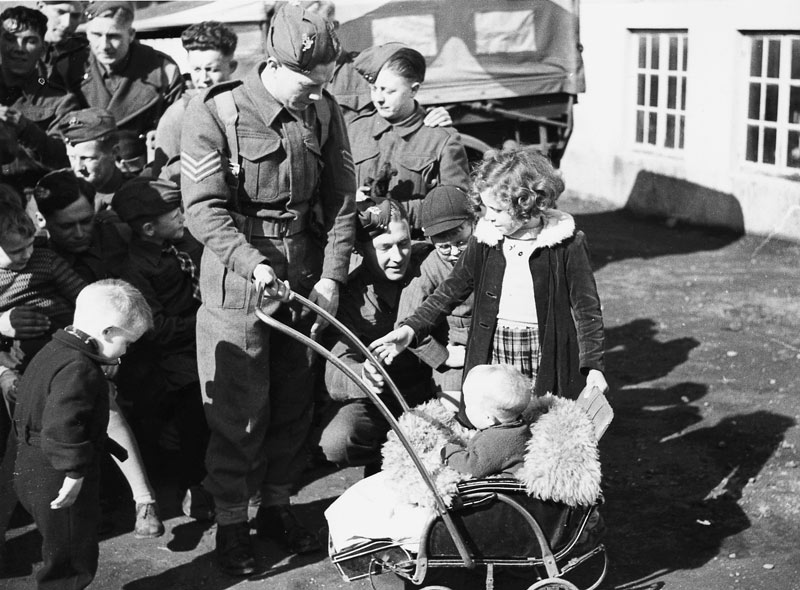
British soldiers chat with Icelandic children (above).[North East War Memorials Project: 70th Infantry Brigade 1939-1944]
As for the soldiers themselves, some managed to make the most of what would be, unbeknownst to most of the ranks, a short interlude before experiencing the harshest realities of war. Hiking or horseback riding through the unceasingly vast wilderness, staring in awe of “open grass plains, smoothed low volcanic hills, [and] rock gardens of green moss,” humbled in ways that the likes of Toronto and Montreal city boys had seldom fathomed. Bathing in hot springs was one novelty that never wore off. Leaves spent in Reykjavík were a chance to grab a drink or catch a movie. And while soccer games against the British rarely resulted in victory, the Canadians enjoyed schooling their friendly yet “foul-mouthed” allies in the basics of baseball.
Hill learned to love Iceland on the roads his comrades helped build. Borrowing a motorcycle, he toured across the country, savouring its landscape in solitude.
Brigadier Page and the majority of ‘Z’ Force departed Iceland in October 1940, although the last elements, namely Hill’s Cameron Highlanders, remained until April 28, 1941. It had been an unmistakably bizarre start to their war, and not a wholly welcome one for either occupier or the occupied, but it was a beginning, nonetheless. Both the RRC and FMR had a date with destiny on the beaches of Dieppe, where 916 Canadians perished amid nine hours of hell. Less than two years later—on June 6, 1944—the Cameron Highlanders found themselves attached to 3rd Canadian Infantry Division for Operation Overlord. Beyond D-Day, Hill served in France and Holland, surviving the conflict. He never saw the midnight sun again—but it would stay with him.
“Whoever possesses Iceland,” penned Churchill after the war, “holds a pistol firmly at England, America and Canada.” But there would be no smoking gun.
On balance, there was only the slightest threat of the trigger ever being pulled.
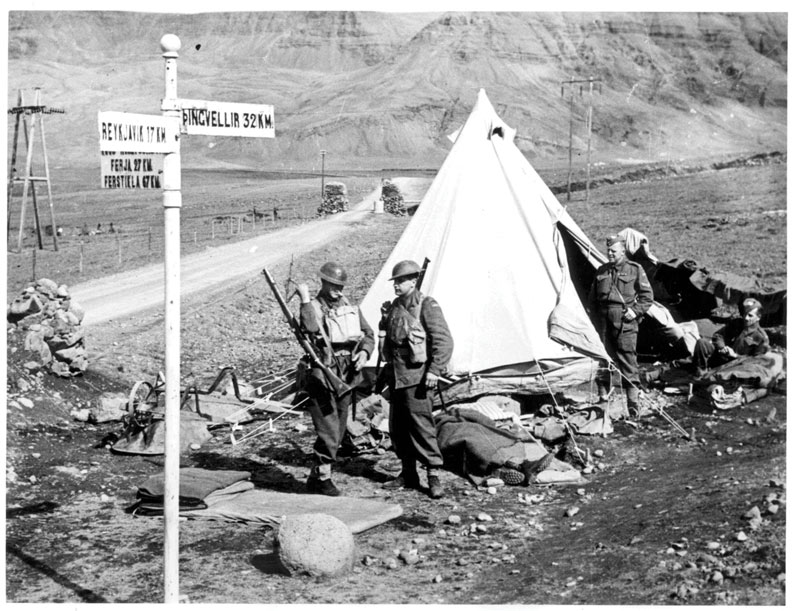
Allied soldiers at a roadside post near Þingvellir, Iceland.[icelandmonitor.mbl.is]
German Kriegsmarine commander Erich Raeder had learned on June 12, 1940, that Operation Ikarus—the allocated code name for a planned Axis invasion of Iceland—was under genuine consideration. It appears highly likely that Hitler himself advocated for the scheme—for the very reasons that the Allies feared.
“Whoever possesses Iceland holds a pistol firmly at England, America and Canada.”
Raeder was unconvinced. “The risks involved in conveying troops across a sea area dominated by the enemy,” read the Kriegsmarine diary, “are incompatible with any results to be expected from the occupation.”
Meeting Hitler one week later, Raeder argued that beyond the more apparent logistical complications, it would require the entire navy over a sustained period to ensure success.
The Führer continued to entertain the illogical plan for months; however, faced with ever-mounting impossibilities, he belatedly relented. Ikarus was scrapped.
Low stakes though it was, the Canadian garrison duty wasn’t entirely bereft of drama. On Feb. 9, 1941, for a “few lively moments,” the Cameron Highlanders did battle with a lone enemy Heinkel HE 111 that had, according to Chowaniec, “traded its bombs for extra fuel” in order to reach the secluded island. Hill was there, manning a machine gun with a comrade when the aircraft assaulted the aerodrome, strafing the site once before disappearing.
“The whole incident lasted less than thirty seconds,” he or his ghostwriter granddaughter remarked.
There would be no great struggle for Iceland, no clash of powers for the isle in the middle of the North Atlantic, but in its positioning lay the most significant victory of all. In the direst years of the U-boat menace, the Allied presence in the country helped turn the proverbial tide, emerging as an essential base for long-range patrol aircraft that provided aerial coverage for friendly warships and merchant vessels braving the gauntlet. The Iceland port of Hvalfjördhur, meanwhile, desolate though it was, became a sanctuary, as well as a critical relay point for anti-submarine escorts and war materiel destined for Russia.
From early 1944, the Royal Canadian Air Force’s 162 Squadron—attached to RAF Coastal Command—bolstered the Allied air support available between Iceland and Scotland. The formation sank numerous U-boats from these bases. Equally, the Canadian-built military facilities themselves proved invaluable to the transatlantic flights that Ferry Command pilots carried out until war’s end.
Fundamentally, the gruelling efforts of 2,653 Dominion troops—76 officers and 2,577 men—from June 1940 to April 1941 weren’t in vain. Of those serving in ‘Z’ Force, six paid the ultimate sacrifice, victims of accidents, disease and, in the case of one, a potential suicide. Others perished in the cruel Atlantic waters surrounding Iceland, among them 15 Canadian souls aboard HMCS Skeena after it foundered and sank off the Reykjavík coast during a freak Oct. 25, 1944, storm.
Come VE-Day, the fallen of ‘Z’ Force shared the windswept isle with a further 42 Dominion soldiers, sailors and airmen who lost their lives in or around Iceland.
They remain there today, far from the forests of home.
Advertisement