

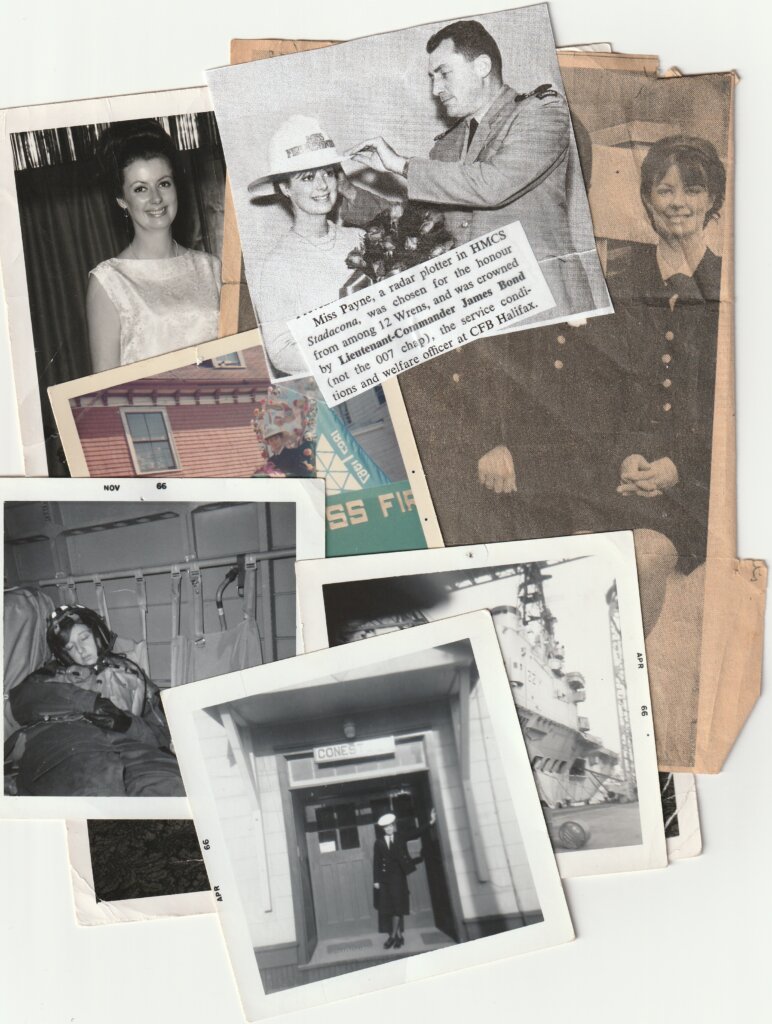
A collage of veteran Ann Burke’s time as a radar plotter in the Royal Canadian Navy in the 1960s. [Courtesy Ann Burke]
I have harboured a deep love of the sea and ships for most of my life. My enlistment into the Royal Canadian Navy in the 1960s was fuelled by this interest and fresh memories of living aboard a yacht on the south coast of England before immigrating to Canada. I recalled being tethered to the mast in a sudden English Channel gale and, earlier in my life, a reckless excursion of rowing beyond the limits of an Isle of Wight harbour with another girl to get a close-up look at HMS Queen Elizabeth. Fortunately, the latter adventure ended happily after a little help from the Royal National Lifeboat Institution.
As a youngster, I would sit for hours listening to stories shared by a Royal Navy chaplain who secretly delivered mail to ships off the coast of the Isle of Wight as they covertly awaited their orders for the D-Day invasion. I also spent hours looking at the wonderful ships he made from matchsticks, and I treasure the paintings he gave me as a child.
My earliest reading was focused on the sea and reflected my love of all things maritime. By 12, I had devoured Rachel Carson’s The Sea Around Us and Francis Chichester’s Gipsy Moth Circles the World. I sensed early that I was destined to live on or near the sea.
That notion seemingly came to an end when my parents announced that we were moving to Canada and would be settling inland. For a few years I plotted every means to a return to my great love, but I was stymied at every turn. Eventually, however, as a teenager, I joined the RCN, as it was still permissible to enlist as a British subject at that time.
Some 50-plus years later, I found myself browsing the Canadian War Museum’s website when I stumbled across a photo of myself (below) in a collection of objects and photographs on Canada’s navy history. Among the selection was also an image of the country’s last aircraft carrier, HMCS Bonaventure. I recalled it had been half a century since it was scrapped. The ship has a special place in my heart.
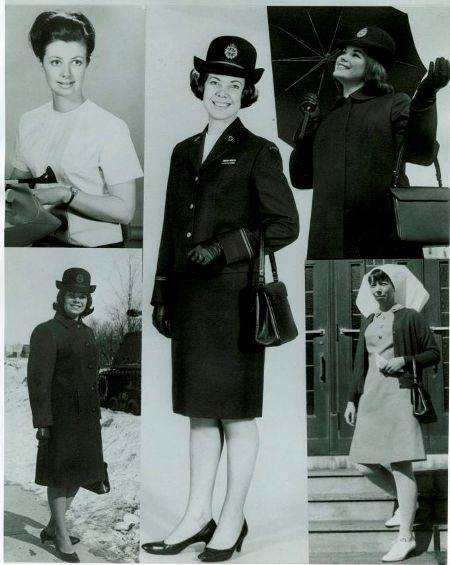
This collage featuring Burke (top left) shows the women’s uniform introduced in 1968 for the three elements of the unified Canadian Forces. [George Metcalf Archival Collection/CWM 19800278-011]
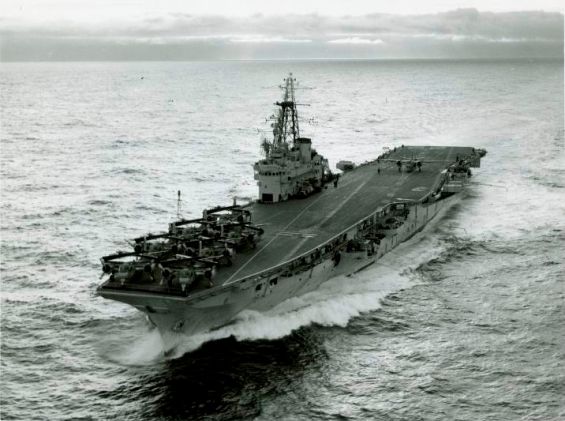
An aerial view of HMCS Bonaventure, Canada’s third and last postwar aircraft carrier.
[George Metcalf Archival Collection/CWM 19900076-998]
I joined the RCN in the latter part of the 1960s as a radar plotter and was stationed at HMCS Stadacona in Halifax. Bonnie, as the ship was affectionately known by those who served in the RCN at the time, is inextricably linked to my memories of my time in the navy. I would regularly go to the dockyard to check it out.
It was originally designed for the Royal Navy to provide air support for Second World War convoys, but it wasn’t completed in time and construction was halted. Canada had used two previous Royal Navy carriers, but in 1952, it purchased the Majestic-class light aircraft carrier and completed its construction. HMCS Bonaventure was commissioned on Jan. 17, 1957. I felt its motto, “Not for us alone,” clearly defined Canada’s peacekeeping role.
It might be difficult today to rationalize Canada’s purchase of a carrier in the 1950s, but this was during the Cold War when Russian submarines along the country’s eastern seaboard were a cause for concern.
Bonnie was involved primarily in naval flight training, firstly to monitor the North Atlantic and adjacent areas and, secondly, to track Russian submarines operating in considerable numbers in the North Atlantic. Ultimately, HMCS Bonaventure would assist in NATO commitments.
By 12, I had devoured Rachel Carson’s The Sea Around Us and Francis Chichester’s Gipsy Moth Circles the World. I sensed early that I was destined to live on or near the sea.
The ship’s Banshee fighter jets were to provide protection in the event of an enemy attack (and stayed on standby until 1962), while the twin-engine Trackers and helicopters assisted attendant destroyers and frigates in anti-submarine work and attack roles. By 1963-64, Bonnie also had new Sea King all-weather, anti-submarine helicopters.
The carrier was 215 metres (704 feet) long and 34 metres (112.5 feet) wide. It carried a complement of 1,370 men: 810 of whom were ship’s company, and 560 of whom were air branch. The latter bunked immediately below the catapult deck. It was commonly referred to as “under the cat” and was a noisy spot due to the proximity of the steam-operated launchers.
Bonnie had two particularly noteworthy missions: the first in October 1962 during the Cuban Missile Crisis as part of the fleet-at-sea patrol in the western Atlantic; the second in March 1964 transporting Canadian Army peacekeeping elements to Cyprus.
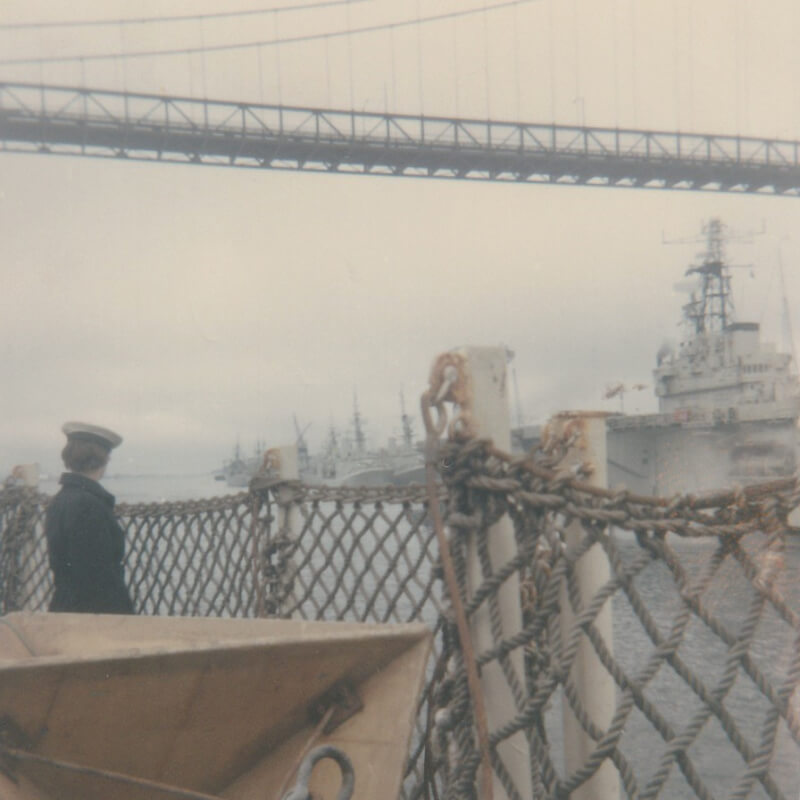
Burke looks out at the Bonaventure with several Canadian destroyers astern of the ship from the HMC Dockyard in June 1966. [Courtesy Ann Burke]
At HMCS Stadacona, I worked with operations training, which was spread over many rooms filled with banks of computers in large cabinets. It was incredibly impressive and daunting for the time. I helped to train operations teams from various ships in warfare tactics. The banks of computers projected images on screens in an ops room, which looked like a “Star Trek” set.
Trainers operated simulated carriers, ships, aircraft, and even civilian vessels conducting various anti-submarine manoeuvres, all of which were displayed on a screen. One of my roles was to operate a simulated civilian sailing vessel, randomly moving in and out of convoys, causing havoc. My call sign was Tinkerbell and it stuck with me as a nickname for quite a time. As incredibly cutting edge as all of this seemed then, we were probably operating somewhere at the level of the early video game Pong.
I always happily anticipated the opportunity to go to operational headquarters for NATO exercises. Again, this was simulated warfare, but with real ships, aircraft and submarines. We communicated and plotted their actions. While Wrens, as women enlistees of the RCN were known, didn’t serve at sea then, female navigational/radar operators were often out for day-long exercises. I still chuckle when I recall how we were constantly encouraged to enjoy some of the readily available fruit aboard ship. It was as if during a day’s outing we might contact scurvy if we didn’t regularly avail ourselves of an apple or a banana.
In addition to opportunities to go to sea, there were also chances to fly in aircraft and helicopters. As thrilled as I was to take a ride in a huge Sikorsky out over the Atlantic, I hadn’t prepared for the 15-20 aborted landings that would be involved for the pilot in training. The motion is intense, and another poor young Wren spent the entire trip clutching a sickness bag.
One of my roles was to operate a simulated civilian sailing vessel, randomly moving in and out of convoys, causing havoc. My call sign was Tinkerbell and it stuck with me as a nickname for quite a time.
I also sometimes took advantage of “flips” home on naval aircraft. We would head out from Shearwater, N.S., to Downsview, Ont., on a Friday and return on Sunday. These weren’t huge aircraft, so someone would end up sitting on the steps. I loved sitting in the radio seat, boxed lunch in my lap, listening for the different towers checking in as we flew.
During ops training, extra security was required for visitors during downtimes. Another Wren and I took on an early morning watch one time, during which we encountered a man in civilian clothing accompanied by a young navy lieutenant. The officer provided us with his ID and introduced the civilian, who, unfortunately, was unable to produce acceptable identification. The civilian wasn’t very happy when we politely, but firmly, refused him entry.
Sometime later, my colleague and I were hauled before our commanding officer. Didn’t we know that civilian was Paul Hellyer, the defence minister? After a stern reproach, she followed up with: “Good work and get out of here.” Hellyer, a principal advocate for unifying the forces, wasn’t the most popular man with the navy at the time.
Around this time, I was understandably startled when informed that I had been chosen by the Bonaventure’s complement to represent the ship in the Miss Maritime Command Pageant. (This was the only pageant that the navy held, and thankfully so, as I don’t feel it really had or has any place in the Armed Forces.)
We didn’t have to tie knots, or climb any masts, but we did have to provide a talent. I put together a trio of old English music hall songs, accompanied by a quickly composed skiffle group from the crew.
It wasn’t long after that there was no more Royal Canadian Navy. We became part of the unified forces in 1968.
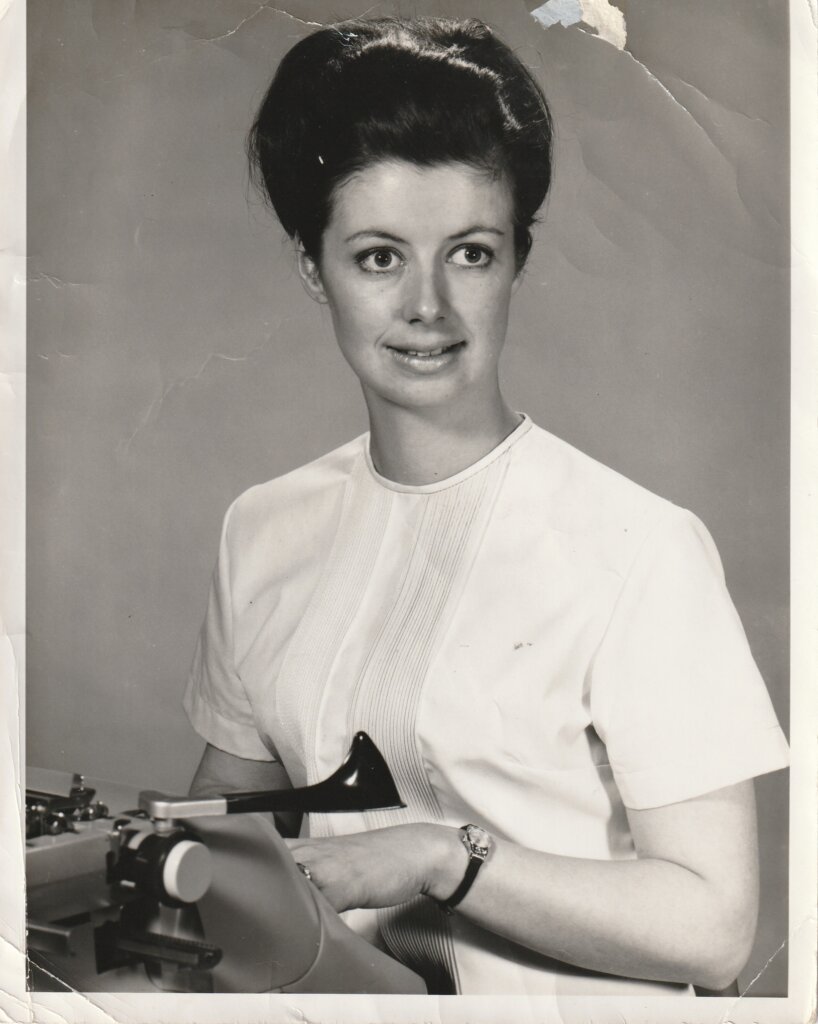
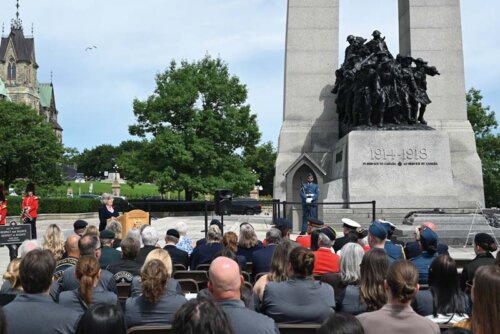
Burke modelling the new women’s uniform in 1968. [Photo: Courtesy Ann Burke]
Back to the beginning of my story and why I thank my relationship with HMCS Bonaventure for my appearance on the Canadian War Museum website.
With the unification of the three Canadian services underway, many naval personnel were upset that our new uniform wouldn’t reflect the centuries of naval history we had inherited. I had always felt particularly proud of our tradition, knowing what the three stripes on our middies represented and why sailors sported bell-bottom trousers. But we would be donning green uniforms henceforth.
I was sent to Ottawa—along with representatives from the other services—to model the new women’s uniform for public relations purposes. After sitting atop tanks, gazing skyward at imaginary aircraft at the museum, I was eventually cast smiling into the distance as I sat behind a typewriter, with a decidedly Princess Anne hairstyle, boasting a pleated mint green blouse that held as much history as a stick of celery.
A year later, in 1969, Canada phased in a reduction of its NATO commitments—a harbinger of the end of naval air on carriers, and a swing to the cheaper operation of helicopters and destroyers. In September 1969, while on a NATO exercise in the mid-Atlantic, word reached the Bonnie (via CBC Radio) that it was to be scrapped, and its Tracker squad disbanded. The carrier was decommissioned in Halifax on July 3, 1970, and sold for scrap to a Taiwanese steel company.
A crazy rumour circulated for a while that HMCS Bonaventure hadn’t actually been sold for scrap but had made its way to some foreign country to serve out a few more years—perhaps fulfilling its motto, “Not for us alone.” I secretly hoped it was true for Bonnie and I had forged a special bond.
Advertisement