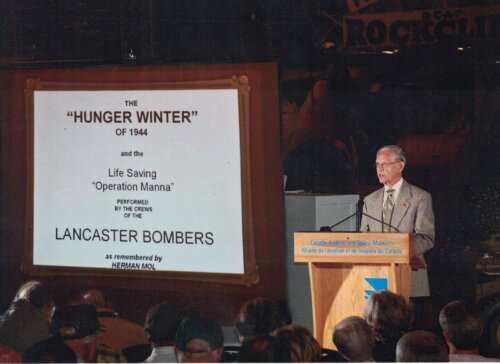



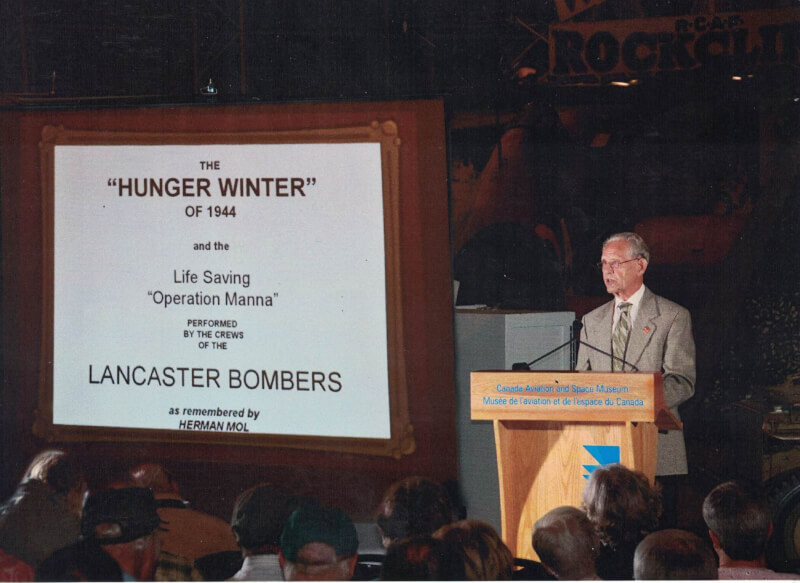
Herman Mol shares his experiences as a Dutch teenager during the Second World War at the Canadian Aviation and Space Museum in 2010. [Courtesy Herman Mol]
It was May 1958 when Dutch-born immigrant Herman Mol began his Canadian dream. Though the war had been over for 13 long years, and while Mol himself had managed well over that time, the Netherlands was still a country in healing.
Career opportunities had brought him across the Atlantic to the shores of Halifax. From there, he was bound for Ontario and, in due course, a promising future as a newspaper linotype operator and typesetter.
The new Canadian thus settled into life among many of those who, more than a decade earlier, had played a significant role in Holland’s liberation.
Now 97, Mol still vividly remembers his personal war—not least the Nazi-orchestrated famine dubbed the Hongerwinter, or Hunger Winter, that devastated the western Netherlands during 1944-1945, killing an estimated 20,000 civilians.
He recalls, too, his salvation from the sky, when Allied aircraft—including Canadian crews—dropped thousands of tons of food in the final days of the war.
Mol documented numerous such scenes on camera. He has also since written about the Allied liberation in his memoirs. Here, reflecting anew from his Windsor, Ont., home, Mol revealed what adolescence was like under the German occupation.
On the start of the war
I was born in Amsterdam on Nov. 21, 1928, so I was about 11 when the war started; I was 16 when it finished. Initially, life after the Germans came didn’t change too much so long as we kept to the rules. Of course, that wasn’t the case for the Jewish people, but at the beginning, the Germans wanted to be looked at as saviors more than occupiers.
There was no real trouble at that time, but there was burning of books, as well as handing over radios and copper. Otherwise, the Germans would leave you alone. That was the first year, but it gradually got worse after that.
On life in Nazi-occupied Netherlands
Before the Hunger Winter, I went to the farmers quite often to pick up potatoes. I went on my mother’s bicycle about five kilometres outside of Amsterdam. You would dig up your own potatoes, put them in burlap bags and carry them home.
Further into the war, when it got worse, people sold their silver, clothes and other valuables—you name it—to get food from the farmers. We also had all these food coupons, but there was nothing to buy with them in the stores.
At some point in ’43 or ’44, I went to live with my aunt on a family farm in the small village where my mother was born. I lived there for half a year or so. I was there because I had two brothers and that meant one less mouth for [my mother] to feed.
I ended up in the farm attic. The first night I was there, the mosquitoes were after me—they [went after] city boys. But I got used to it, and eventually I had a great time. I learned a lot. I think I was back home by the end of ’44.

Mol and his mother during the Second World War. [Courtesy Herman Mol]
On surviving the Hunger Winter
What you got to eat—when you did get to eat—was terrible. My mother couldn’t eat the potato soup because it was made from rotten potatoes, the leftovers from the Germans. My friend’s mother made cake out of grinding tulips, which was actually pretty good.
When you’re hungry, you don’t realize you’re losing weight. You’re getting used to the situation. Of course, you know you’re hungry, but you’re trying to keep morale high while waiting for some good news.
Unfortunately, the bad news was that the Allied forces bypassed the western part of Holland. For several months, there was nothing available anymore. That was hard because the morale suddenly goes. What do you do if somebody knocks on your door and asks for food? You might have some, but you can’t give it away. There’s nothing to share.
In the end, there were people starving in Amsterdam daily, just lying on the streets. I remember one fellow who you could see was going to drop at any minute.
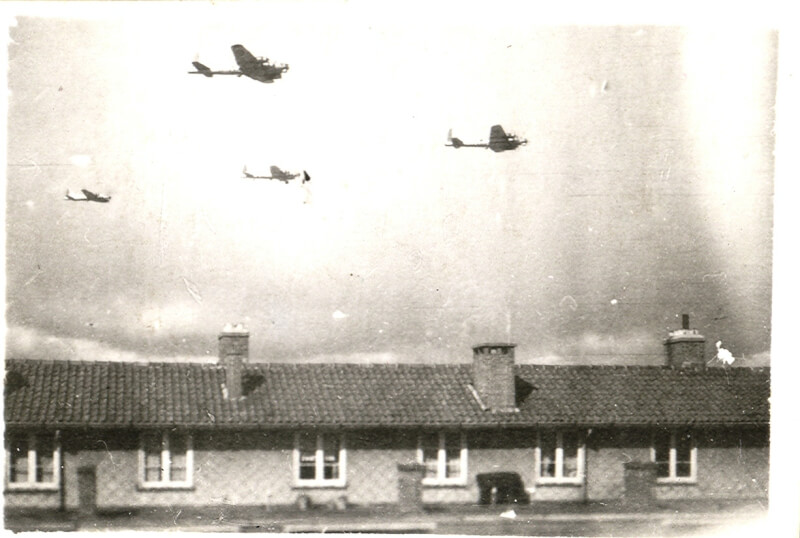
Allied planes drop supplies near Amsterdam in the spring of 1945. [Herman Mol]
On receiving airdropped Allied supplies
I was on my way to school when I saw a plane flying at low altitude. They started to drop off the parcels and people picked them up, which created a situation, too, because you don’t want any fighting.
It went on for about two weeks and everybody was on the rooftops waving their hands. I remember going with a pillow cover and filling it up with these dry biscuits. I also remember the corned beef that came in a little can. Other people had cigarettes, but that wasn’t for me. But, oh boy, you couldn’t believe it. You realized that the war was over.
On a May 7, 1945, tragedy in Amsterdam
Everybody was heading to the main square in Amsterdam to celebrate because, hey, this is it. The trouble was the Germans had signed the surrender papers, but there weren’t any Allied soldiers in the western part of Holland yet. So, the Germans were still there, even if there was no war anymore.
Thousands of people were there, dancing and hopping about. And that’s when the Germans started shooting. We headed for the palace nearby and hid behind the big pillars. After that, the Dutch resistance came in and they went after the Germans in a building. We snuck away and went home. All in all, 32 people died there.

An Allied tank rolls through Amsterdam in the spring of 1945. [Herman Mol]
On the Canadian liberators, now and then
After the Allies arrived, we had dances every Saturday night—dances we had never seen before. I did ballroom dancing, the foxtrot and the waltz, but those Canadians had something new, and everybody started doing the same thing.
Nowadays, however, I’ve found that interest in what happened more than 80 years ago is almost completely gone. They have enough troubles of their own right now, of course, but the past is beyond them.
This interview has been edited for brevity and clarity.
Advertisement