




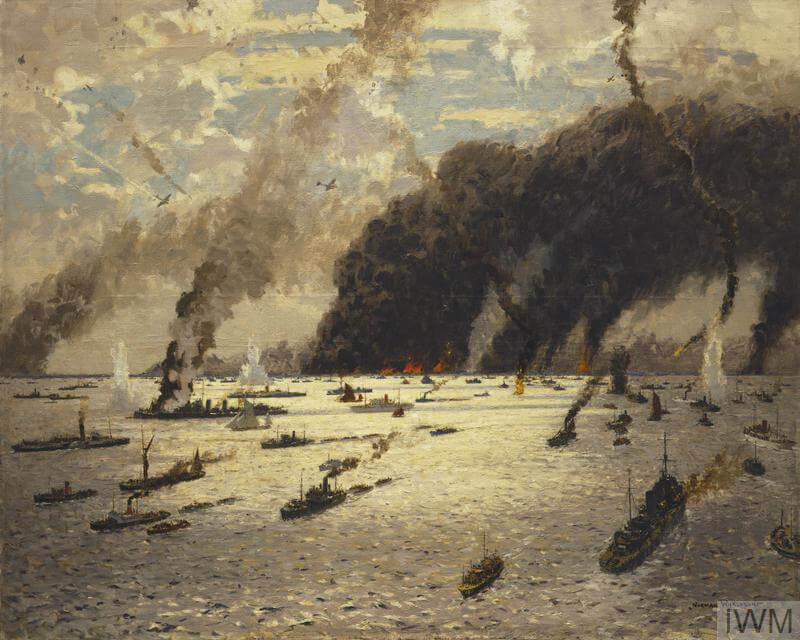
Artist Norman Wilkinson depicts the horrific scene at Dunkirk, France, during the 1940 evacuation. [Norman Wilkinson/Imperial War Museums]
Dunkirk was ablaze when Canadian Royal Navy Commander James Campbell Clouston arrived on the scene, having travelled from England with a large relief party to mitigate the disaster unfolding before them.
It was May 27, 1940, and the British Expeditionary Force was trapped, along with its allies, at the French port as German ground troops closed in. Meanwhile, in the skies above, Luftwaffe aircraft rained hell on huddled masses with few places to hide—and nowhere to run.
There was only one route out: the sea. And Clouston would be among those to facilitate an exit when the evacuation began. With Dunkirk harbour rendered unusable due to severe damage, the British settled on the only viable alternative: one of two protective breakwaters called the East Mole. There, inbound vessels could be secured and loaded with men bound for Blighty—free to fight another day, as well as to shape Operation Dynamo into the “Miracle of Dunkirk.” As pier master, Montrealer Clouston earned his place in that legend.
Last week’s Briefing detailed Clouston’s life and military career prior to the evacuation. Here, the tale of the Canadian’s wartime heroism concludes, told by biographer Brian Jeffrey Street in a Legion Magazine exclusive.

On Clouston’s Dunkirk exploits
Over six days and nights, Clouston was on the East Mole carrying out various roles. He appeared to be everywhere at once, at times cajoling ship captains into taking far more troops than they wanted. It wasn’t too long until they were getting men out at a rate of 1,000-2,000 an hour, which is incredible.
One veteran described Clouston as if he were a policeman in the middle of an intersection, directing traffic while keeping everybody calm and organized.
Initially, the Mole was a difficult target—even with ships alongside it—but the Stuka dive bombers got better over time. During these air attacks, Clouston would tell the men to stop, lie down, run for it, or do whatever the moment called for, because he was standing there watching the aircraft.
There was one incident on May 29 when the weather suddenly cleared, and the Luftwaffe, which had been grounded for most of the day, came out in force, coinciding with when there was a dozen or so ships secured alongside the Mole. They wreaked havoc on them, and the breakwater itself took a lot of damage. At one point, Clouston was standing about midway on the Mole, and a whole bunch of soldiers came running from the seaward end because of the bombing.
Seeing this, Clouston drew his service revolver and instructed a young naval lieutenant to do the same. When the soldiers approached, he stopped them, gave a clear warning and ordered them to get back into the bloody ships. And they did.
Under his guidance, probably about 200,000 troops were rescued. That’s significant. I spoke to veterans who said, despite not knowing his name, they vividly remembered Clouston. The Mole was like a big ship in a way, and he was its captain.
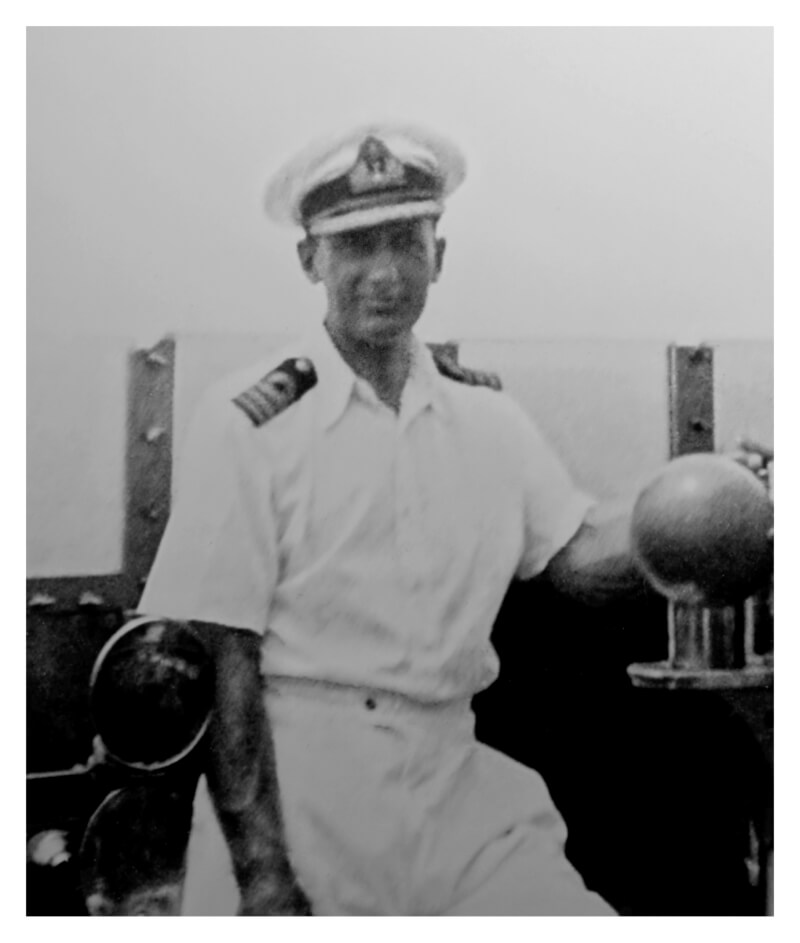
James Campbell Clouston aboard HMC Isis earlier in the war. [Courtesy Clouston family via Brian Jeffrey Street]
On Clouston’s final action
Clouston left Dunkirk in the early hours of June 2, getting to Ramsgate, England, by late morning. He immediately travelled to Dover Castle for a meeting with Vice-Admiral Bertram Ramsay, where they planned what was thought might be the last night of the evacuation, focused on getting larger numbers of French troops out. They finally assembled two parties that were to return to Dunkirk on Royal Air Force Seaplane Tenders that afternoon.
They were nearly across, about 13 kilometres off the French coast, when they were suddenly attacked by Stuka dive bombers. Clouston’s boat suffered a near miss but everyone aboard was flung into the sea. The aircraft came back for another attack and started strafing them in the water.
The other boat closed in on the survivors, but Clouston waved it off. He ordered it to proceed to Dunkirk because it was needed there. His concern was that if it didn’t carry on, it would jeopardize the mission. Only two men from Clouston’s boat survived—and he wasn’t one of them. It was an incredible sacrifice.
One survivor recalled that even at the end, Clouston was cracking jokes, trying to keep everybody’s spirits up. Their loss was reported the next day, so his official date of death is June 3, but it likely happened the night before.
On initial recognition efforts
He was one of several officers recommended for the Distinguished Service Order, but somebody then cottoned onto the fact that he was deceased. At that time, the only posthumous awards you could get were the Victoria Cross or a Mention in Dispatches. Clouston received the latter.
Some have said that he should have received the VC—Clouston’s widow, who was pregnant with their second child when he died, claimed that Lord Mountbatten apparently thought as much. Every once in a while, you hear about people who have considered campaigning to award him the VC posthumously, but I don’t think that’s going to happen.
On the other hand, Clouston received no end of praise from Captain William Tennant [senior naval officer for the evacuation in Dunkirk]. In his report, he listed several factors that accounted for the operation’s success—one of the most important of which was Clouston’s role. He also wrote privately to Clouston’s widow to say that he had never met such a courageous man.
On Clouston’s largely forgotten status
The fact that Clouston didn’t survive is probably one of the leading reasons why he isn’t widely known. Had he survived, he would have had the opportunity to tell his story, to be interviewed by historians, and certainly, to have written his own report.
I also think that people who have written about Dunkirk have missed opportunities to ask questions about what really happened there. Some researchers have shown a lack of interest in the Mole, specifically, because it’s just one part of a bigger canvas, and details have occasionally been neglected.
And then you watch Christopher Nolan’s 2017 movie, Dunkirk. When that film was released, it sparked a huge outcry about his fictional pier master character. The uproar started in Britain, but it crossed the Atlantic in a hurry, and Canadians got wind of it. Eventually, Parks Canada held a commemorative ceremony in Lachine, Que., to unveil a plaque about Clouston.
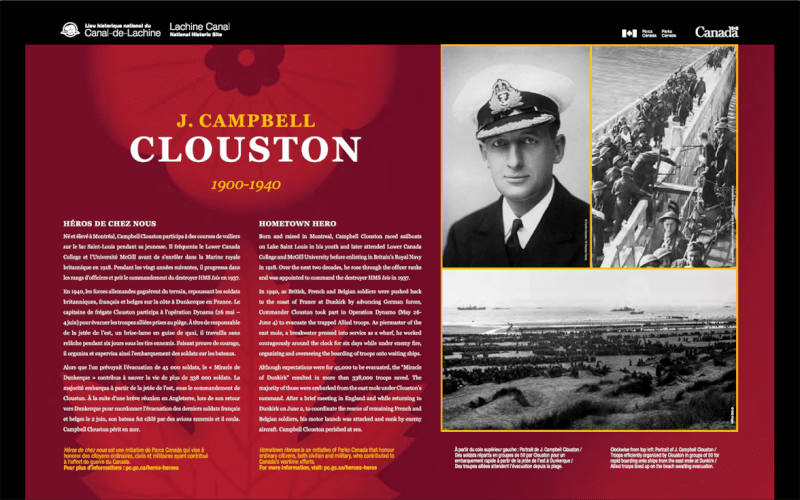
The plaque in honour of James Campbell Clouston unveiled in 2017 at the Canal-de-Lachine National Historic Site in Montreal. [Veterans Affairs Canada]
On how Clouston should be remembered
I’ve talked to some people who think that Dunkirk was just a giant fiasco, who ask why we should celebrate any of it. My response is that it may have been a military disaster, but it wasn’t a naval one. The Royal Navy performed brilliantly to save more than 338,000 Allied troops. Clouston was at the centre of all that. In a sense, he epitomized that success.
This interview has been edited for brevity and clarity.
Advertisement