

Illustrations by Joel Kimmel
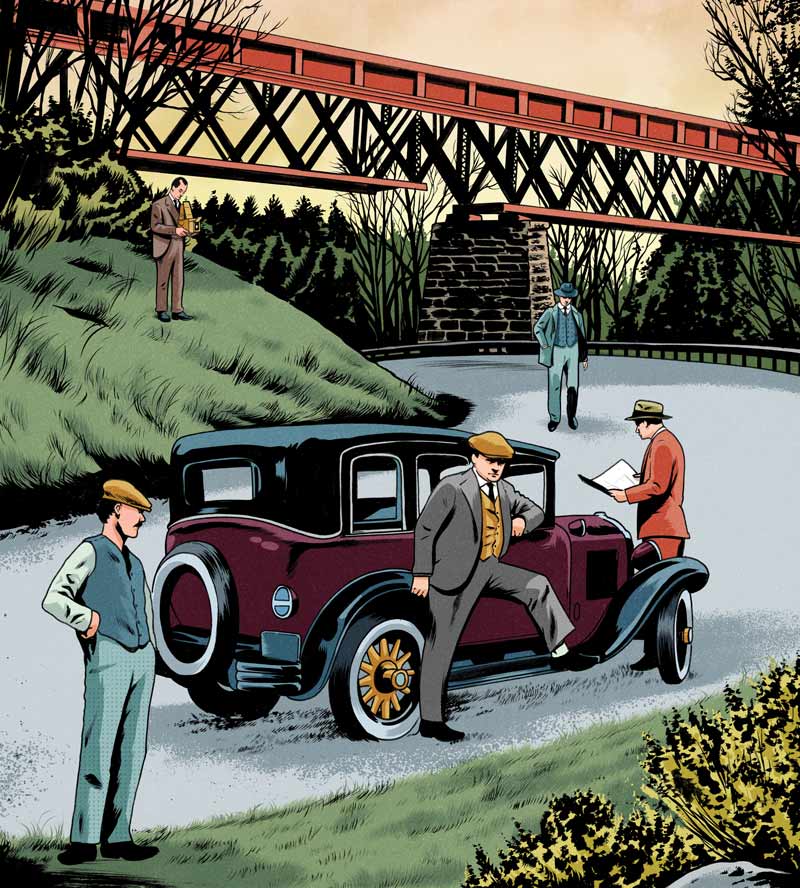
To the Americans of Upstate New York, the five men dressed in business attire likely looked like any other well-to-do visitors.
They were touring the state in a McLaughlin Special, a luxury vehicle with a powerful engine that would later become a favourite of alcohol smugglers during Prohibition because it could easily outrun police cars. The men snapped photos of bridges, roadways, canals and highway overpasses. They purchased local maps from gas stations and talked to residents about interesting geographic features in the area.
But these men weren’t tourists. They were all senior officers in the Canadian Army, and they were on a reconnaissance mission led by Lieutenant-Colonel James Sutherland (Buster) Brown.
Brown was a decorated veteran of the First World War who had fought in most of the significant Canadian battles during that conflict. As the army’s director of military operations and intelligence, Brown’s foray into New York in spring 1921 was for a very specific purpose—he was going to draw up plans for a Canadian invasion of the U.S.
Brown, later promoted to brigadier-general, had the task of devising a variety of strategies under a series of numbered Defence Schemes. One outlined a plan for neutrality in case the U.S. went to war with Japan. Another involved an enlarged Canadian expeditionary force in the event of a deployment in an overseas or domestic emergency.
“Brown’s plan was to take the initiative and throw the Americans into disarray by launching this strike with the intention of buying time for the Brits to come in.”
But it’s Defence Scheme No. 1—a bold blueprint for a pre-emptive Canadian military strike against U.S. border states—that Brown is best known for. Major-General George Pearkes, one of Canada’s most famous soldiers, would describe the initiative as “a fantastic desperate plan (which) just might have worked.”
Pierre Berton, writing in his 2001 book Marching As to War, dismissed Scheme 1 as “madcap” and Brown as “a bit of a nut.” Berton claimed that the idea of a major threat to Canada coming from the U.S. was “fanciful” as both countries enjoyed the best of relations.
But Andrew Burtch, a historian at the Canadian War Museum, told Legion Magazine that Defence Scheme No. 1 should be viewed in the context and political atmosphere of the times.
The U.S. had grown in economic power and influence. Canada was still closely tied to Great Britain, whose diplomats viewed the Americans with suspicion and distrust. In addition, there was growing tension between the U.S. and Britain over the American insistence that England pay back billions of dollars in loans from the First World War, Burtch explained.
Brown’s plan also took into consideration the potential U.S. desire for Canada’s natural resources, particularly the grain-growing provinces of Manitoba, Saskatchewan and Alberta.
“There are a lot of these pressures that factored into the thinking about security in that time,” Burtch explained.
In spring 1921, Brown received permission for the first of several clandestine trips into the U.S. His initial foray was the reconnaissance of the northern portions of New York state. Brown’s report from that journey was 60 pages long and contained 56 photos of key infrastructure.
In 1922, he set out on another surveillance, this one covering 1,750 kilometres through Vermont. Again, his summary was 60 pages and accompanied by photographs.
Brown’s missions were a combination of identifying strategic locations and taking measure of the potential American enemy. For instance, he noted that Wells River in Vermont was geographically important since it was a convergence point of both rail lines and roadways.
While in Burlington, Vt., Brown described that “the tradespeople and others we came in contact with seemed to be very affable.” Meanwhile, he observed that one man he met in North Duxbury, Vt., “was characteristic of a large number of men of the state—fat and lazy but pleasant and congenial.”
Brown took particular note of the individuals in the various rural areas he toured. He concluded the men appeared to be divided into two types: either lean and lanky or chubby, round-faced and congenial. “If they are not actually lazy they have a very deliberate way of working and apparently believe in frequent rests and gossip,” Brown wrote in his report. “The women throughout the rural districts appear to be a heavy and not very comely lot.”
Still, he thought the men of Vermont would make good troops if they had a cause they could fight for.
In 1926, Brown sent another Canadian Army lieutenant-colonel on reconnaissance of the upper Michigan peninsula, covering more than 4,000 kilometres in 13 days. All of the material they gathered went into the plans for Defence Scheme No. 1.
It called for a pre-emptive attack by Canadian troops if it became apparent the U.S. was planning its own invasion of Canada. The Canadian initiative would involve quick-moving columns to temporarily seize U.S. centres near the border. Canadian troops in the West would capture Seattle and Spokane, Wash., and Portland, Ore. Great Falls, Mont., would be overrun and Canadian forces would continue their march through North Dakota before eventually seizing Minneapolis.
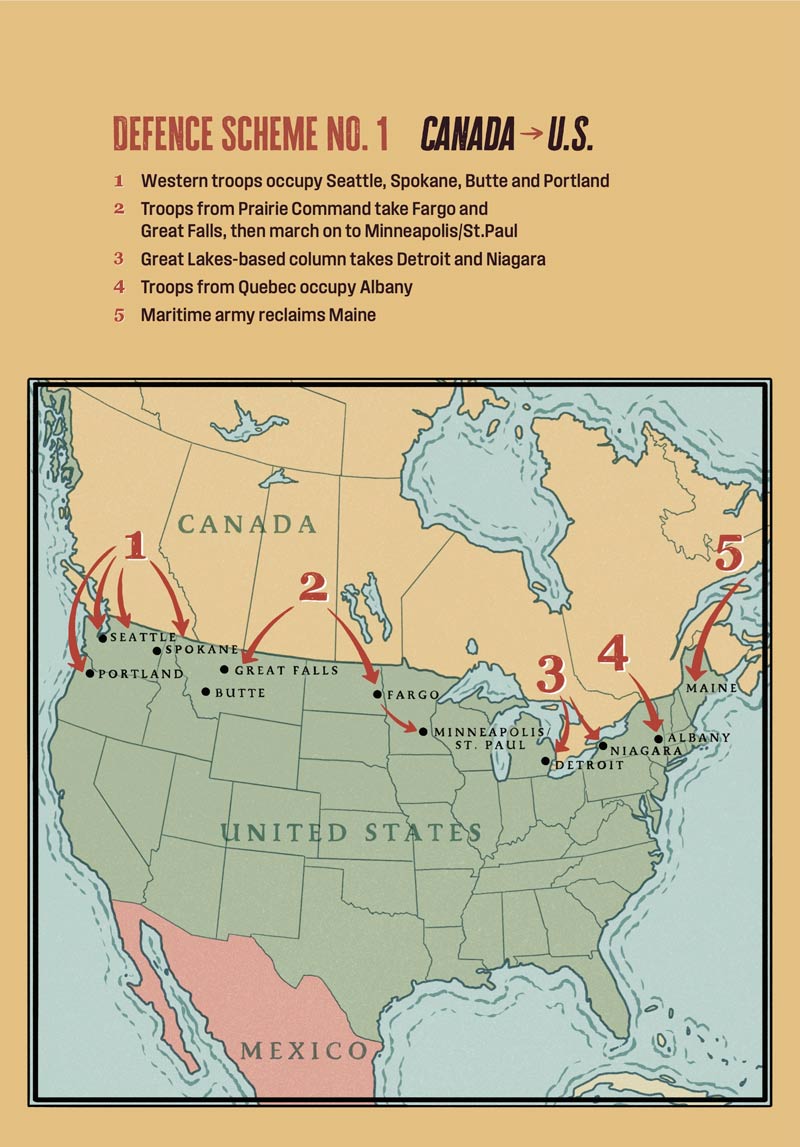
In the east, Albany, N.Y., would be captured. Canadian forces would also launch attacks along the Niagara River in New York state while other troops crossed into Maine to strike key points.
Brown’s strategy—based on the principle that the best defence is offence—wasn’t geared to hold territory for long. Bridges, rail lines and crucial transport hubs would be destroyed by the Canadians before they retreated. The idea was to hinder a U.S. invasion until Canada could receive reinforcements from Great Britian.
“Brown’s plan was to take the initiative and throw the Americans into disarray by launching this strike with the intention of buying time for the Brits to come in,” explained Burtch.
Defence Scheme No. 1 was circulated among senior Canadian Army staff for discussion and was updated throughout the 1920s.
“You’re really talking about one branch of the Canadian Army whose goal is to study and think about security threats,” said Burtch. But, he added, “it was more than just a thought experiment.”
Like Brown and his entourage, American military officers conducted their own reconnaissance of the potential battlefields and strategic targets in Canada.
While Brown was working on Defence Scheme No. 1, the Americans were developing their own plans to seize Canada. The 94-page document, titled “Joint Army and Navy Basic War Plan – Red,” was more aggressive in nature and called for the U.S. to ultimately take full control of Canada.
The strategy was among a series of colour-coded plans the Americans had prepared to deal with conflict with several countries. Those included Orange for Japan, Black for Germany and Green for Mexico.
Red wasn’t specifically aimed at a direct conflict with Canada but rather focused on a war between the U.S. and Britain. Discussions about such a conflict were underway in American military circles throughout the 1920s, but War Plan Red wasn’t written until 1930. It was issued in February 1931 and revised several times.
Red had its origins in the economic rivalry between the U.S. and England. The strategy called for the “definite elimination of Red (England) as a strong competitor in foreign trade” and called for military action against “Crimson” (Canada) because of its close ties to the British.
Burtch says there was an obvious distinction between War Plan Red and Defence Scheme No. 1. “The main difference between the two is that the Americans had the presence and industrial base to actually effect the plan,” he said. “The Canadians never did.”
Like Brown and his entourage, American military officers conducted their own reconnaissance of the potential battlefields and strategic targets in Canada.
War Plan Red called on the U.S. army to launch an invasion at several points along the border. Troops would move from Vermont to capture Montreal and Quebec City. U.S. army units, marshalled in Grand Forks, N.D., would cross the border to seize Winnipeg, targeted as a central point for Canada’s rail system. American forces would also drive into northern Ontario to capture nickel mines in Sudbury. Toronto would be seized along with key hydro plants in Ontario.
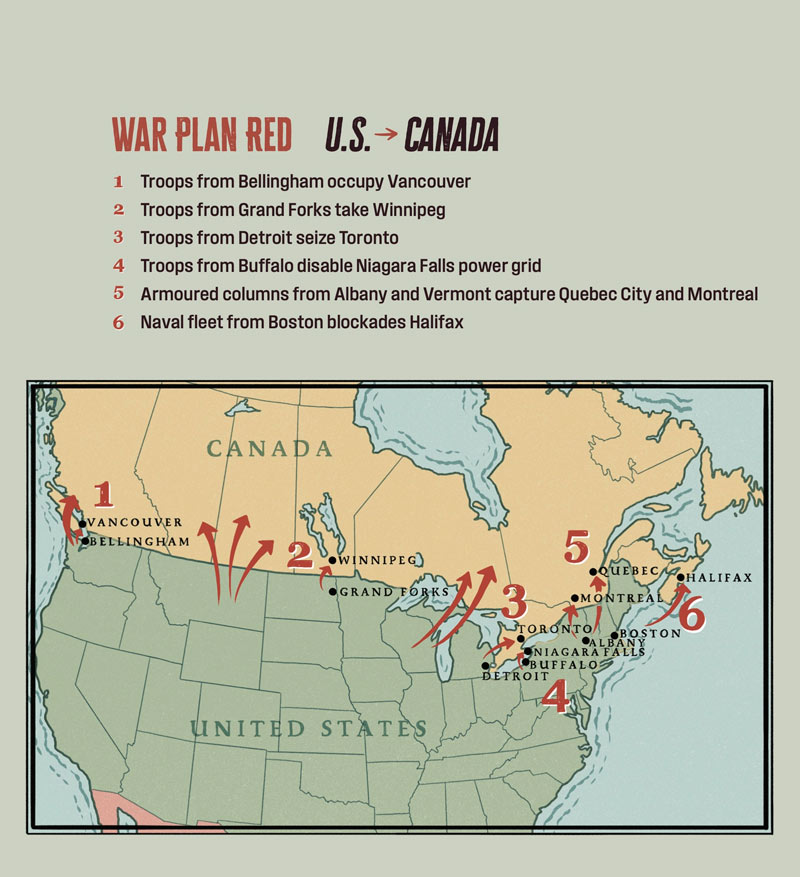
The U.S. navy would conduct operations on the Great Lakes and establish a blockade of Canada’s Pacific and Atlantic ports. Particular focus centred on Halifax, as the U.S. aimed to prevent Britain from using the port for reinforcements. The city would be subjected to both a strategic bombing campaign and chemical warfare. And troops would eventually seize the city.
The Americans had no plans, however, to return any captured territory. Canada’s provinces were to become U.S. states.
If the invasion of Canada was successful, U.S. planners envisioned further strikes to seize other North American British colonies, including Jamaica, The Bahamas, Bermuda, and Trinidad and Tobago. But, if military operations didn’t go as planned and Britain emerged victorious, the American strategists concluded that Alaska would have to be ceded to Canada.
Both plans reflect the global uncertainty of the period in which they were developed.
Work on War Plan Red continued into 1935. That same year, though, U.S. lawmakers were dealing with a scandal involving American plans against Canada becoming public. The U.S. War Department had secretly built three military airfields, disguised as civilian airports, near the border. The project had been discussed at the House military affairs committee by two generals in a closed-door session, but their testimony was mistakenly published. That, in turn, prompted the Canadian government to lodge a protest.
The news made the front page of the May 1, 1935, New York Times as U.S. President Franklin D. Roosevelt sought to reassure Canada he wasn’t planning a war and that “the United States expected to live up to the letter and spirit of [its] treaties relating to the permanent disarmament of [the nations’] three thousand miles of common boundary.”
By 1939, the invasion plans of both countries had fallen by the wayside.
Defence Scheme No. 1 was the first to go. By 1929, it was shelved and in 1933, Canada’s defence chief, General Andrew McNaughton, ordered most of the documents related to it burned. McNaughton concluded that: “Politically Canada’s position vis-à-vis the United States has been immensely stabilized.”
Historian John Major of the University of Hull in the U.K. has noted that by May 1936, War Plan Red was considered a low priority by U.S. military leadership. By then, the American focus had shifted to the threat posed by the Japanese and War Plan Orange took precedence. Plus, U.S. and British interests in the Far East were coming together as both countries faced an increasingly aggressive Japan.
War Plan Red was declassified in 1974 and resides in the U.S. National Archives at College Park, Md. Records related to Defence Scheme No. 1 are scarcer, but historians have found enough documents to put together the details of the invasion plans.
The notion of a war between Canada and the U.S. has surfaced several times in recent memory. In the early 1990s, War Plan Red was highlighted by Queen’s University professor Floyd W. Rudmin when he raised questions about why the Pentagon had launched a significant expansion of Fort Drum near the Canadian border in the vicinity of Kingston, Ont. Rudmin maintained that the 10,000-strong U.S. army unit located at the base was more suited for fighting its way into Ottawa than for the overseas battles it was supposed to take part in.
In his 1993 book Bordering on Aggression: Evidence of US Military Preparations Against Canada, Rudmin argued that several factors could prompt an American invasion. Those included the possibility of Quebec separation, or the U.S. need to maintain access to Canadian raw materials, energy and water resources.
In September 2012, a U.S. State Department official had to deny that a closed-door meeting between American and Mexican government officials had anything to do with a secret plan to invade Canada. Although the remarks were taken as a joke, the statement sparked another round of interest in War Plan Red and Defence Scheme No. 1. So, too, has current U.S. President Donald Trump’s talk about annexing Canada.
These days, the initiatives tend to be dismissed as the designs of paranoid or overzealous military leaders. Brown’s strategy has, in particular, faced open ridicule. But historian Burtch says that isn’t fair. Both plans reflect the global uncertainty of the period in which they were developed. It’s the job of professional military staff to protect their respective countries and draft strategies to deal with various scenarios, however unlikely they may seem in hindsight, he added.
Does Burtch think the current tensions between the U.S. and Canada have prompted defence planners to go back to their drawing boards and develop new sets of invasion blueprints?
“It’s doubtful,” he said. “But you never know.”
Advertisement