

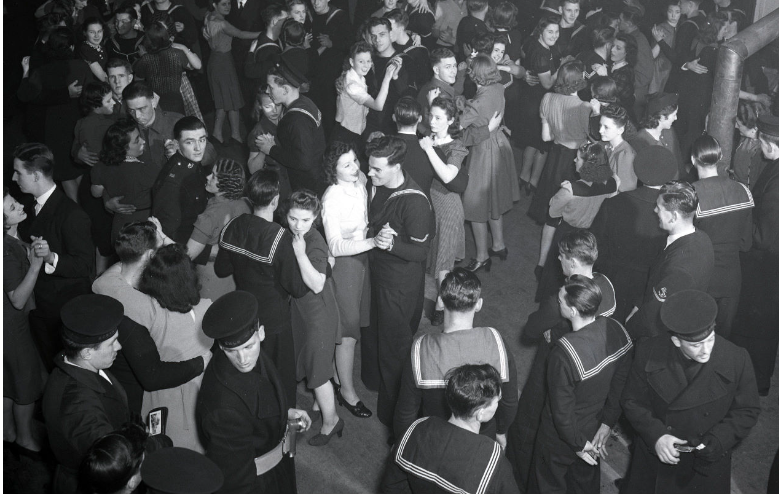
Navy personnel and local women at a dance in Halifax in 1941. [E.A. Bollinger/1975-305 1941 no. 269/Nova Scotia Archives]
Ruth and her parents arrived in the city in 1940 from Prince Edward Island, where the family had eked out a living during the Great Depression. Life in Halifax was different. From their home at 42 North Street, Ruth could see convoys forming up in Bedford Basin to the north. She was shocked one morning to discover that all the ships had vanished, off to do their war work. Meanwhile, her new school was larger and busier than she had been used to. Outsiders seemed to be shunned. Ruth’s Halifax experience wasn’t starting well. Eventually, she attended the new Queen Elizabeth High School. That helped. By then, she felt more equal to her classmates.
Halifax had few social activities for the hordes of newly arrived military personnel. And legal alcohol wasn’t easily available. Young trainee sailors wandered the streets, sometimes getting into trouble. This further tarnished the navy’s reputation and solidified civic leaders’ determination to tighten restrictions. To their credit, navy brass responded. They organized events such as dances in the gym of HMCS Stadacona. And the Navy League of Canada was enlisted to help support the initiative.
It was responsible for selecting, supervising and safeguarding young volunteer Haligonian women who would act as hostesses and dance partners for the events. Ruth’s parents felt the role was an important way their daughter could contribute to the war effort and she became a junior hostess. Ruth’s social life blossomed. Suddenly, Halifax became a whole lot more tolerable for her.
Ruth’s parents felt the role was an important way their daughter could contribute to the war effort and she became a junior hostess.
Ruth’s father worked as a crane operator at the dockyard. There, he would often see young sailors who appeared homesick. His own experience in the Merchant Marine encouraged him to occasionally approach some of them and extend an invitation to his home. The Pigotts’ front parlor was often full of sailors. Many were fed home-cooked meals, too. Louis and Olive were hosting their own little private, free social club.
Late one night, Ruth and her family were awakened by the sound of a truck rumbling its way down North Street. Then they heard something heavy hitting the front steps. They rushed to the door as the truck pulled away and found a large ham resting on the porch. They interpreted it as some sailor’s way of saying thanks for the hospitality.
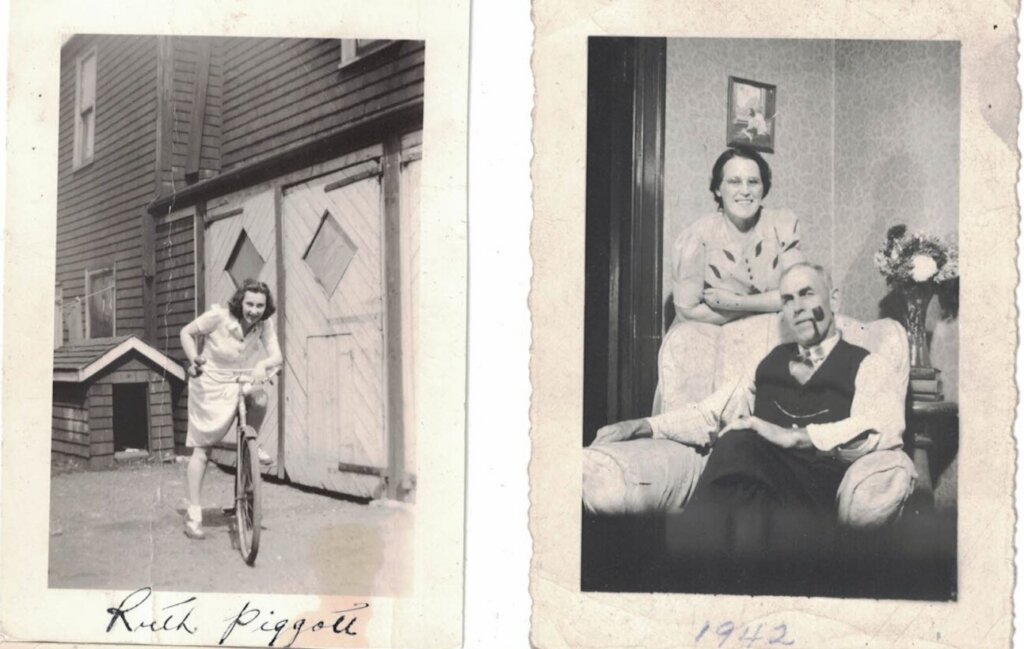
Ruth Pigott as a girl in Halifax (left) and her parents, Olive and Louis. [courtesy Stephen A. Harper]
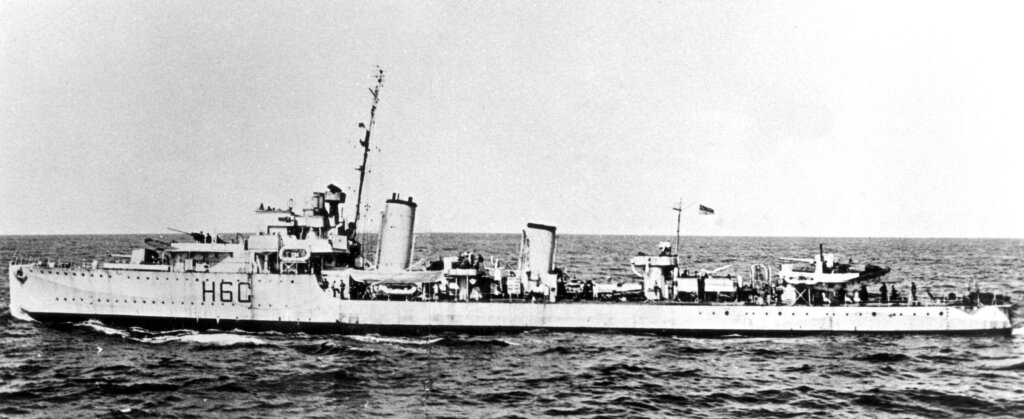
HMCS Ottawa, pictured here in 1941, was sunk by a U-boat in September 1942. [Ken Macpherson/Naval Museum of Alberta]
HMCS Ottawa had had a busy summer in 1942. It made four successful Atlantic convoy crossings, but after leaving Londonderry, Northern Ireland, on Sept. 5, during its fifth, Ottawa was attacked by several U-boats. On the night of Sept. 13-14, Ottawa was hit by two torpedoes and sunk. A total of 114 crew died, including Ruth’s friend. She carried his loss with her for the rest of her life. Even 50 years later, you could still hear the sadness when Ruth retold the story.
Indeed, life at home wasn’t always smooth. Ruth’s aunt, Marion, arrived from Brooklyn, N.Y., to stay with the family. Marion was only five years older than Ruth, but Louis and Olive’s rules didn’t apply to her. Ruth chaffed at the appearance of inequality.
A total of 114 crew died, including Ruth’s friend. She carried his loss with her for the rest of her life. Even 50 years later, you could still hear the sadness when Ruth retold the story.
To help relieve the pressure, Louis and Olive sent Ruth to a boarding school in Windsor, N.S., for her final year of high school. The population of Edgehill School had swelled with the arrival of English students from the noted girls-only Roedean School near Brighton on Britain’s south shore. Roedean had been evacuated over fears of a German seaborne invasion. The students were sent to independent boarding schools in Canada and Edgehill welcomed as many as it could. These additions made life interesting for the Canadian girls. The effects of war were brought into sharp focus for Ruth when one of her English classmates was awakened in the middle of the night and told her parents had been killed in an air raid.
Ruth returned to Halifax in 1944 and resumed her life there, including her Navy League volunteer hostess duties. Aunt Marion was still around, but she had a beau and the atmosphere was much more tranquil at home. Ruth also began the process of applying for the registered nurse’s training program at a Halifax hospital. Meanwhile, she filled her days with a job as a teller at the Royal Bank. She loved being able to eat lunch in the richly appointed dining room above the branch.
Early that autumn, Ruth’s mother, usually a bundle of energy, began complaining of tiredness and discomfort and swelling in her leg. As the condition persisted and symptoms intensified, Ruth postponed her nursing training. By October, Olive’s condition had worsened alarmingly. She died at age 48. Ruth had just turned 18.
Ruth’s family faltered in their grief. Marion had left to marry. Her father dealt with his grief with anger. He would disappear for days on end, without telling his daughter where he was going or when he would return. When he was at home, he would often erupt in angry tirades at Ruth for not having prepared a meal for him or for not properly maintaining the house.
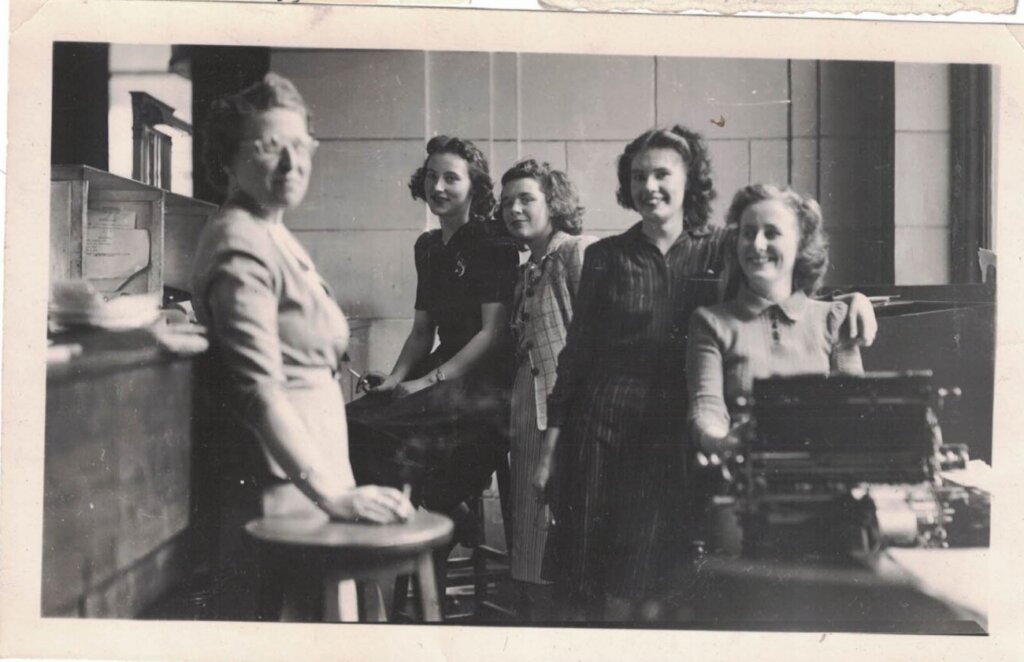
Ruth Pigott (second from left) working at the Royal Bank in Halifax around 1944. [courtesy Stephen A. Harper]
As it turned out, Jack wasn’t making it up. He had been a late volunteer for service, previously working as a machinist doing protected war work at Rogers Radio Tubes in Toronto. In 1944, he secured his release from Rogers and entered basic training at HMCS York in Toronto. Afterward, he was sent east to do shore work, primarily refitting and later decommissioning ships in North Sydney, Halifax and Shelburne, N.S. He had been a celebrated singer in the prominent Toronto choir of the Cathedral Church of St. James since 1935. And he didn’t drink.
A navy guy who didn’t drink? And sang in a choir? Ruth figured she had now heard it all.
Ruth and Jack started dating in 1945. The romance helped Ruth deal with the difficulties at home. But Jack was posted to Shelburne again, then assigned to a frigate for coastal patrols. The couple carried on a correspondence during this time. Eventually, Jack returned to Halifax and they were able to see each other frequently.
By 1946, Canada was transitioning to the postwar world. Military activities were winding down. Ships were returning and being decommissioned. Sailors were being demobilized. Jack was busy getting corvettes and frigates ready for disposal after their wartime service. Rogers Radio Tubes had held his job in Toronto since 1944, but now they needed him back. Philips, the electronics giant from the Netherlands, had purchased the factory and were eager to start non-war-related manufacturing again. So, they urged Jack to demobilize, return to Toronto and resume his job as a machinist. He did just that. Ruth joined him in Toronto and they married on Oct. 12, 1946.
They had been married 52 years when Ruth died on Dec. 30, 1988. On her death bed, Ruth apologized to Jack for having to leave him. He was determined to do one more thing for her. After Ruth’s passing, Jack took the train to Halifax with an urn containing her remains to reunite Ruth with her parents in the family plot at Fairview Lawn Cemetery.
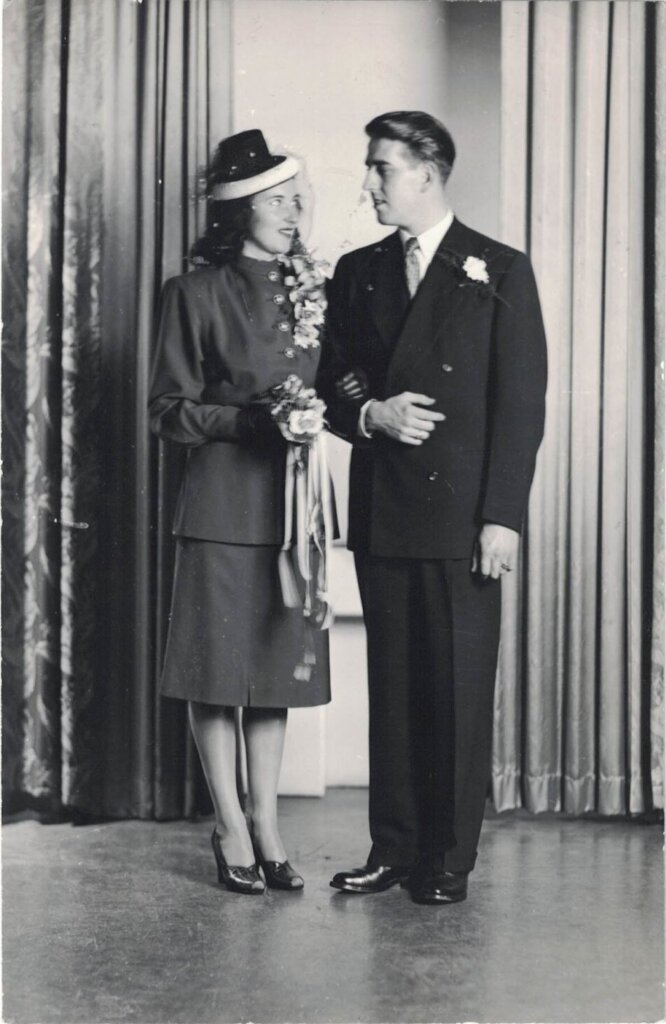
Ruth and Jack on their wedding day on Oct. 12, 1946. [courtesy Stephen A. Harper]
Advertisement