

 |
Throughout the history of modern warfare and international peacekeeping, the primary focus for military leaders has been the operational mission. The task—in very simple terms—is to get in, get the job done and then move on to the next objective with as little baggage as possible. The fact that men and women get killed or injured during operational missions is sad, but it’s all part of the deal military personnel sign on to when they join up. In return for their service and personal sacrifices, most of these men and women expect very little.
They do, however, hope to be treated fairly by the country they serve.
To this day the Canadian Forces has had trouble dealing with the inevitable array of “baggage” that accompanies military service. In particular, it has viewed disability situations as unwanted occurrences that in some cases impede the operational mission. This mindset and the failure to deal with these types of situations has caused many problems for the military as a whole, its leaders and especially its personnel. It has also caused significant hardships for the families of those who serve.
However, the establishment in 1999 of a support centre for Canadian Forces members and their families is viewed as a positive development towards correcting this neglect.
Based in Ottawa, The Centre for the Support of Injured and Retired Members and Their Families, exists to address the long-standing need, a need identified by members of the Canadian Forces and one that resulted in a lot of adverse publicity for the forces through individual stories by members and former members showing how badly they had been treated by their employer. Two recent reports—the Stow report and the McLellan report—were commissioned by the Canadian Forces to survey and report on the needs of those who had been injured in the service of their country. The latter report was authored by Rick McLellan who initially headed the centre as a military officer with the rank of lieutenant-colonel and now, after his retirement, as a civilian.
McLellan’s report was a collaborative effort—a culmination of a six-month review—that included input from a number of individuals who had dealt with the disability pension system and related issues. It found feelings of abandonment rampant among injured service personnel and a lack of support in their quests for pensions.
The people who contributed to the report were able to air their grievances, but they also made suggestions
on how the system might be fixed. In addition, Veterans Affairs Canada and The Royal Canadian Legion sat as advisers to McLellan and had input in his report. Of the numerous recommendations, perhaps the most significant was the establishment of the support centre.
Jointly staffed by the Department of National Defence, the Canadian Forces and Veterans Affairs Canada, the centre acts as a single point of inquiries for members of the regular force and reserve that arise from problems associated with military service. These include a claim for pension under the Pension Act, dealing with medical and administrative release proceedings and with the Servicemen’s Income Security Insurance Plan, SISIP.
The pressure to change the system had been mounting throughout the 1990s. In March 1997 Lieutenant-General Roméo Dallaire articulated an extended family concept to the Standing Committee on National Defence and Veterans Affairs. Dallaire’s concept drew on the strengths of the members of the extended family, namely the Canadian Forces, Veterans Affairs Canada and the Legion.
While speaking to delegates at the Legion’s 1998 dominion convention in Winnipeg, Dallaire emphasized the need to reach out and help members of the Canadian Forces and their families. “In this modern era of transparency and media, there is no such thing as only the soldier, sailor, airman, living through the mission. My mother-in-law, upon my return from Africa, said she would have never been able to survive the four months of war and slaughter that my wife and children lived through, watching it over the media…. When I was in the war zone in Rwanda and in the middle of that genocide, my wife spent every waking moment of the day flicking channels on TVs and radios to find out which radio or TV station picked up me being killed, injured or taken prisoner…. Our families are living our missions with us…. And they live the hell like we live it. We have got to bring them into the fold. We have got to take care of them….”
Dominion Command Service Bureau Director Jim Rycroft says the “operational mission” for Veterans Affairs Canada and the Legion is dealing with that part of the baggage known as disability situations arising from military service. “When the support centre refers an individual to the Legion or to VAC for assistance with a disability pension, the primary objective at that point is to represent the individual and his or her rights to achieve a fair disposition for the case. The Legion and other veterans organizations sit as representatives on the centre’s advisory committee, and committee members are able to raise any apparent shortcomings directly with the centre so that they can be fixed. In this way, the system will be made to serve individual members that much better.”
Rycroft says that by having centre staffer Warrant Officer Reg Eddy attend Legion service officers training, the Legion has clearly signalled the need for members of the extended family to understand each other very well. “Since Eddy had attended service officer training in the spring of last year he was in a good position to understand and relate to service officer Marc Gauthier from Nova Scotia Command when he toured the centre to gain insight on how it could help those he was assisting in the disability pension process.”
Rycroft says the initiative announced by the chief of defence staff, General Maurice Baril, in March of 1999 to amend the Pension Act to allow still serving members of the forces to receive their pension prior to release—even if they did not serve in a special duty area—is one initiative for which the centre and its partners can take credit.
Last fall—shortly before Jean Chrétien called the federal election—Bill C-41 was put into effect. Prior to that the Legion had proposed two amendments to the legislation. One would have made the legislation retroactive to March 1999 when Baril announced the expanded right to receive a pension while still serving. The second amendment was aimed at applying the same set of rules that apply to Canadian Forces members to members of the RCMP. That proposal was accepted, but the government declined to make the legislation retroactive to 1999. It is felt that the amendment pertaining to the RCMP would not have happened without the Legion’s input.
McLellan says the centre, which has a staff of 15, has made a lot of progress since its April 1999 grand opening. A budget of $1.1 million a year is provided by the Department of National Defence. The department also allocates $150,000 a year for contingencies. McLellan is proud of the contingency fund. “It’s a small but important part of our work. As of August 2000, “we have already used $140,000…responding to injured service members where there was no funding available.”
Veterans Affairs Canada contributes a pension officer, a counsellor and equipment. The centre helps with the transition from injury to healing and from service life to civilian life and channels claims through the Legion’s Dominion Command Service Bureau or by way of VAC pension officers.
Among case histories McLellan mentions is that of the difficulties an injured soldier out West had with DND and VAC. Using contingency fund money, the centre purchased him a $20,000 artificial leg. Then there was the case of the husband who died of post-traumatic stress disorder due to his work in the military. His wife had received no assistance and had no idea of her entitlements. “We took the case to VAC and she got $26,000 in back benefits and $1,300 a month tax free for life.”
Another case deals with a female reservist and her two-year-old daughter. The child was dreadfully sick and needed to be taken to hospital once a week. The mother could not afford the money to take her because it was quite a distance to travel. “We paid her through the contingency fund to take her dying daughter to hospital,” says McLellan. “From the perspective of reducing anxiety in the mother’s mind the fund was doing its job.”
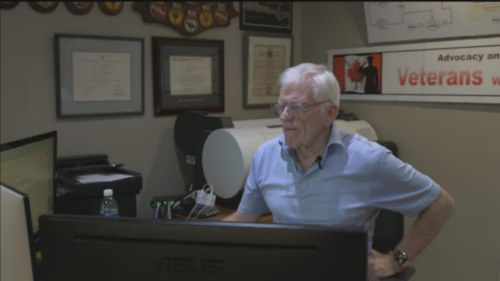
McLellan has used his computer and other resources to smash through a maze of separate departments, agencies, regulations and what his report considered were systemic attitudes from authority—attitudes that stood in the way of helping people in need. The conclusion of his report states that the most commonly expressed feeling among the service personnel interviewed for the review was that of abandonment. “Generally, military members injured in the line of duty felt strongly that the military forgot about them post their injury and that VAC wasn’t responsive to their situation as veterans. What can be concluded from this review is that the Canadian Forces/Department of National Defence, and certainly VAC, need to make improvements.”
McLellan’s report goes on to state that it is not the rules, regulations and policies, in and of themselves, that produce this situation. “It would appear to be the basic attitudes of those who must interpret and work within them, the leaders, the gatekeepers, the providers of service. Once set, attitudes are extremely difficult to change. These attitudes are often buried in customs and approaches long passed.”
The government says the centre is tangible evidence of its determination to make sure that former and current members of the Canadian Forces are treated fairly. During the centre’s grand opening, federal politicians went on record to say that the continued care of Canadian Forces members during and after their service to Canada is essential to maintaining morale in Canada’s combat- capable, multi-purpose force. It was noted that the centre’s staff will provide answers, referrals and assistance, and will also be responsible for all casualty information in the Canadian Forces.
During an interview last fall, Harold Leduc of the Canadian Peacekeeping Veterans Association said the centre is providing good service. “In my opinion, it is providing a small portion of the re- establishment needs of veterans of the Canadian Forces. While our injured have special needs, all Canadian Forces veterans have transition needs to effect a successful re-establishment from military to civilian life.”
Leduc says the evidence of that need is the 1946 Veterans Charter that was a compilation of various legislation, regulations and orders dealing with the re-establishment needs of Canadian Forces members. “The centre is definitely a start,” he adds. “But we should keep in mind that the re-establishment of Canadian Forces veterans is a Government of Canada responsibility that should be led by Veterans Affairs Canada as it was in the post World War II era.”
Leduc says the centre has been able to provide a referral service for injured veterans. Service personnel have been referred to VAC and to potential employers. He says the centre has also helped prepare veterans for the compensation process. It does this primarily by working through the paperwork and obtaining medical documentation. “It has also started branching out into the areas of job search and job placement for injured veterans.”
Advertisement