







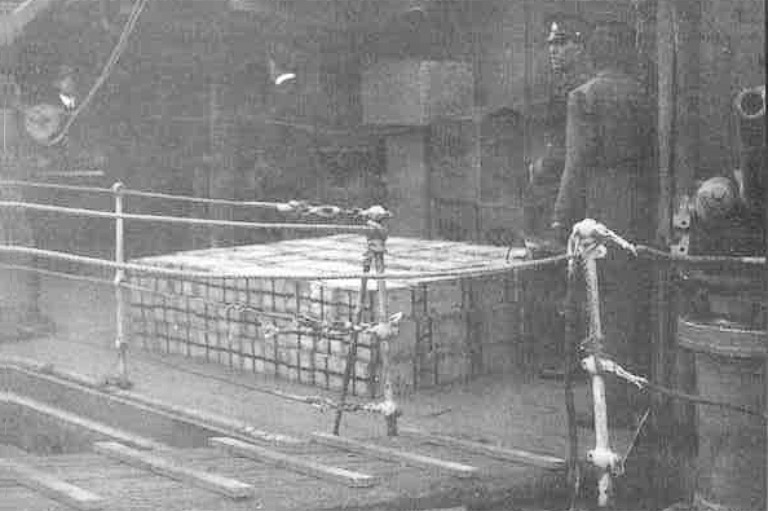
On June 24, 1940, HMS Emerald set sail for Canada with British gold and securities worth millions of pounds. [Imperial War Museums]
“It’s a stunning story that has sort of been lost to time,” said Canadian author and journalist Ted Barris on WW II’s stranger-than-fiction Operation Fish.
That tale, recounted in the bestselling author’s 2023 book Battle of the Atlantic: Gauntlet to Victory, involved a bold yet desperate gamble to safeguard Britain’s gold in the event of a Nazi invasion—by shipping the country’s entire reserves to Canada.
Despite remaining little-known today, Barris believes that the mission’s importance, with all its immense perils, can’t be overstated. “We often think of the Second World War as being a six-year-long siege,” he said. “Well, there were pivot points along the way where had they gone differently, the war would have been much longer and might not have ended up the way it did. One of those pivot points was Operation Fish.”
Here, in a Legion Magazine exclusive, Barris details the largest movement of physical wealth in history.

Author and journalist Ted Barris. [Courtesy Ted Barris]
On the prelude to Operation Fish
I think it’s fair to say that Operation Fish, which was an enormous clandestine operation to literally transfer the wealth of Britain from the British Isles across the Atlantic Ocean to Canada in the summer of 1940, was an interesting indicator of the times.
It was in some ways an admission of the peril that Britain faced in that first year of the war, a time when the Battle of the Atlantic was beginning to consume tremendous amounts of Royal Navy manpower and ship-power. And it would be the same summer that the nation faced the Battle of Britain.
Both of those battles—out in the middle of the Atlantic against U-boats and, eventually, in the skies above Britain against the Luftwaffe—could have gone either way, and so, Churchill concocted a plan to move most of the country’s wealth, its gold and securities, to Canada. That was the birth of Operation Fish.
On the initial transatlantic transfer
The first [major] shipment began on June 24, 1940, when [Royal Navy cruiser] HMS Emerald was loaded with 2,229 bullion boxes, each containing four bars of gold. Collectively [with 488 boxes of securities], it was all worth 130 million pounds.
I understand that as they loaded the ship with gold, her angle bars began to bend beneath the decks—the weight was that severe.
It was transferred from Britain across the North Atlantic, not just evading the U-boats, but Captain Francis Cyril Flynn, who was the skipper aboard HMS Emerald, had to face some of the stiffest and toughest weather. We’re talking cross currents and gale storms. In fact, he sent the destroyers that had been escorting HMS Emerald home because he figured it would be better just to put the ship at 22 knots, outrunning the U-boats and the gale, to get the gold to Canada.
Imagine the darkness of that moment, not just environmentally, but in terms of the psychological burden of facing the sea, the gales, and the uncertainty of the U-boats alone. But Flynn succeeded, landing in Halifax on July 1, 1940—Dominion Day in Canada.
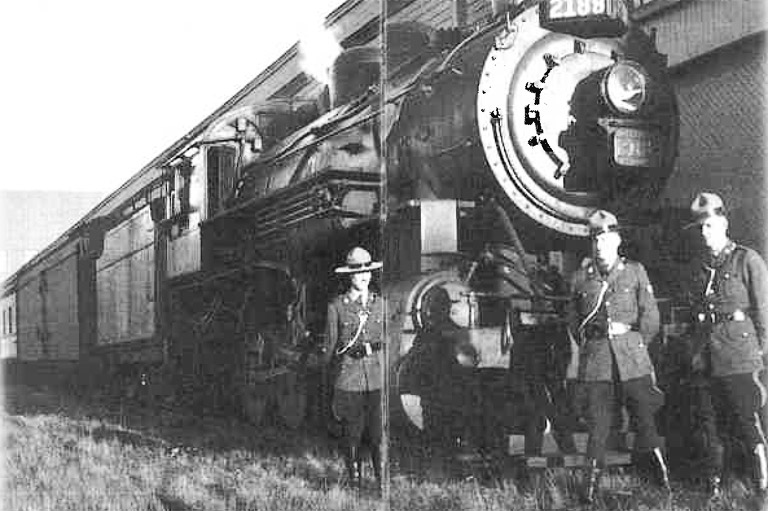
After the gold and securities arrived in Halifax, they were transferred to Montreal and Ottawa aboard a sealed train guarded by members of the RCMP. [Imperial War Museums]
On subsequent journeys
There were several [Operation Fish voyages]. The most notable followed the first shipment about a week after Emerald left.
A [Polish] liner called Batory departed [with other vessels] from the same [Greenock, Scotland] port bound for Canada with 442 million pounds worth of securities and gold bullion—and managed to again pull it off safely.
By the end of summer, the British had managed to transfer 637 million pounds worth of gold into the Bank of Canada in Ottawa. The securities were stored [at the Sun Life Assurance Company building] in Montreal.
It was a phenomenal undertaking, done so secretly that the Kriegsmarine, the German navy, had no idea what had happened.
On Operation Fish’s continuing importance
[The shipments] were the bankroll that Churchill and Britain depended on through the war to pay for its munitions, for building ships, aircraft and for arming its forces, sending them to sea and around the world. In many ways, the gold bullion and securities were the lifeblood of Britain’s survival in the war. Had it not had that resource, wherever it was, the nation would have been in even more peril and certainly would not have been supplied with as much as it needed.
I’m always absolutely stunned whenever I write about Churchill. He wasn’t a perfect man. He had all kinds of strange views on society, warfare, and so on. However, if there was ever a man who considered every option, who recognized all possible alternatives—good and bad—it was him. Just imagine sending your entire wealth from the British Isles to Canada just in case you might have to lead the war from Ottawa or Montreal rather than London. That was Churchill.
On the other end, [Operation Fish] was one of many moments in which Canada, while maybe not having as powerful a military as the United States, was certainly punching above its weight to deliver whatever Britain needed, whenever it needed it.
This interview has been edited for brevity and clarity.
Advertisement