

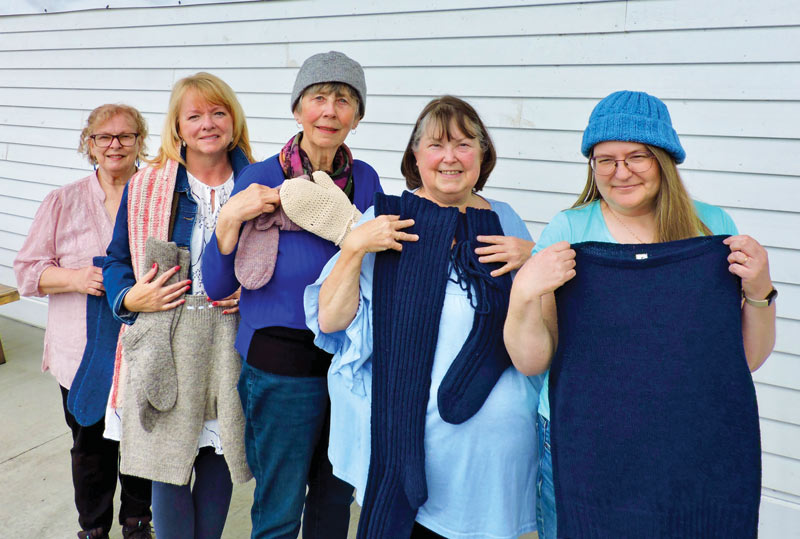
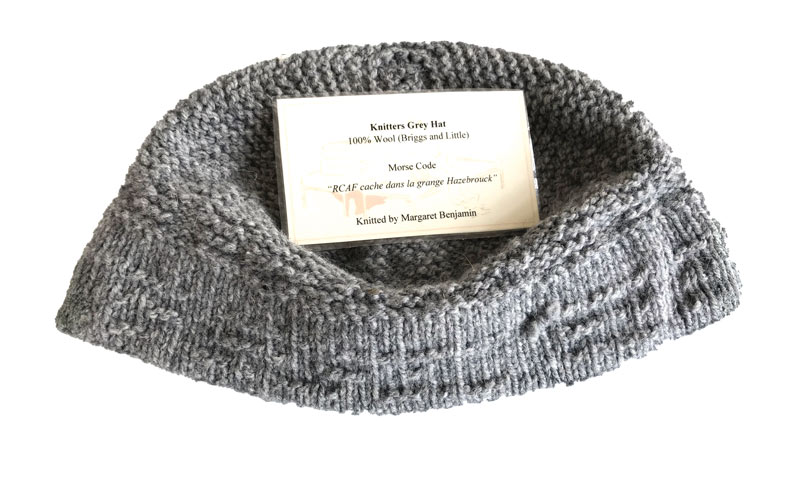
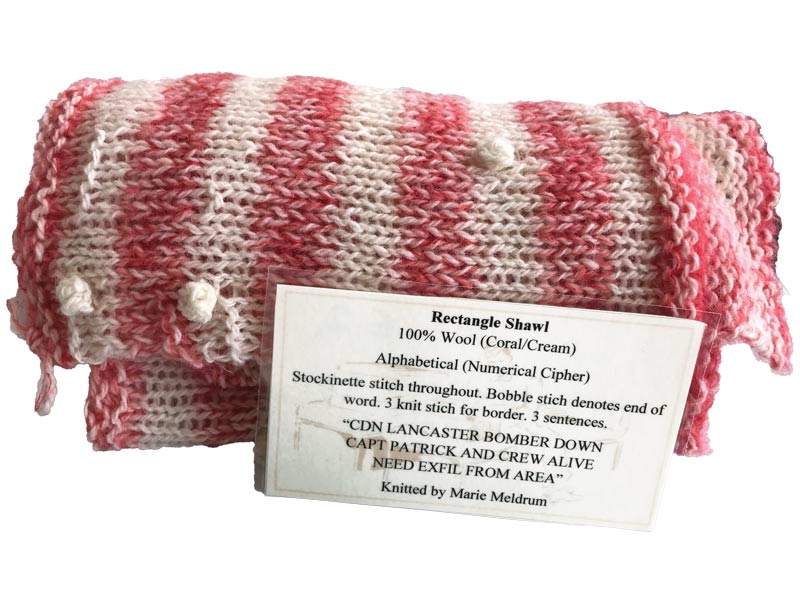
Members of the Four Seasons Fibre Group display knitted items they made for a special wartime exhibit on the craft. The display includes items such as this knit hat and shawl, which each include hidden messages.[Allan Lynch]
“When the ladies from Kentville came to me with a knitting display I was rather skeptical,” says Ian Patrick, board chair of the Greenwood Military Aviation Museum at 14 Wing Greenwood in Nova Scotia.
“But when I saw it and photographs of some of their relatives who were in the war and how the soldiers really needed the extra clothing to keep warm in the winter,” Patrick got behind the idea.
The idea turned into an exhibition called Wartime Knitting: Remembrance and Recognition. It was created by the Four Seasons Fibre Group, 16 women from Nova Scotia’s Kings County. They gathered weekly at the Kentville, N.S., branch of Annapolis Valley Regional Library until the pandemic forced them to knit in local parks, on a beach and at the Kings County Museum.
[Allan Lynch]
“In January 2022, I was knitting and thinking about my great grandmother Emily Robart DeWinter,” said group member Marie Meldrum. “Her four sons served in the Second World War. The youngest, Private Robert DeWinter, served in the Princess Louise Dragoon Guards. He was killed on the 13th of December, 1944, at Villanova in Italy. He was 20.
“My great grandmother never got over the loss. She was adamant we keep his memory alive. So, I wanted to commemorate him and the memory of my great-grandmother. I did some research, talked to [fellow knitter] Margaret Benjamin and presented the idea to the Four Seasons Fibre Group and they agreed to do the project.”
[Allan Lynch]
The knitters started to look into their family histories and wartime knitting. They got their hands on a pattern book that was based on the Imperial Order Daughters of the Empire’s Knitting Instructions for Field Comforts guide from 1942 and got stitching to create a 48-piece collection. Meldrum’s research showed that more than two million pieces were sent overseas during the First World War and as many as 50 million pieces in WW II.
The group also found that New Brunswick’s Briggs & Little Woolen Mill still produced the finer, tighter wool used during the war and in the approved wartime colours.
“I knit for my dad, Captain Kenneth McLay,” said Benjamin. “He was in the navy, on minesweepers. When the war broke out, he joined the Black Watch and switched to the navy because he had his naval ticket since he had worked on the lake boats in Ontario. I made minesweeper mitts. They were crocheted knit cotton with a wool lining.”
[Allan Lynch]
Minesweeper mitts were designed to prevent a shock or arc from static electricity, which could set off an explosion.
Group member Marie Gallant knit a sweater to represent her father, one of three brothers who served overseas. A fourth brother stayed home to run the farm. She also made a shawl, which was part of her mother’s air force nursing uniform. Brenda Thompson-Woodworth knit socks in the navy pattern in memory of her great uncle Ernest Thompson, a captain on a fuel supply ship. Thompson was torpedoed three times off the Grand Banks and Nova Scotia and, said his niece, “lived to tell about it.”
“I didn’t have any family members in the war, but my parents were children living in Friesland in Holland during the war,” said Connie Parker. “I knit in memory of the Canadian soldiers because the Dutch are really appreciative of what they did for them. It was a nice learning experience seeing what Canadian women did for the war effort.”
Sherri Farmer knit various socks. There were six official socks styles, including a pair of convalescent socks, which was “a wool sock that came up your leg [to the hip] for people in hospital,” noted Farmer. “They were warm and didn’t have anything tight on them.
“It was a nice learning experience seeing what Canadian women did for the war effort.”
“The old patterns do not have a lot of details,” she continued. “They are written for people who knew how to knit because people had skills passed down for generations. People today expect more detail in patterns.”
People were also smaller. Large wartime sweaters don’t fit medium-sized men today.
Megan McHugh, meanwhile, knit bandages, a scarf and a balaclava in honour of two great uncles, Colonel Leonard Symroski of the U.S. Air Force, and Brigadier-General Charles Symroski, and “a couple of relatives who were imprisoned in Bergen-Belsen. I remember they always wore long sleeves to cover up the numbers tattooed on their forearms.”
Jocelyn Kydd Schnare was inspired by her brother, currently serving in an anti-submarine task force in Halifax, four other relatives in the Royal Canadian Navy, and her great uncle, Charles Hewson Kydd, who spent his life known as Captain Kydd.
“He was a tank commander,” said Schnare of Kydd. “His tank was blown up in Normandy. He survived and received a medal of bravery for single-handedly taking a German position.”
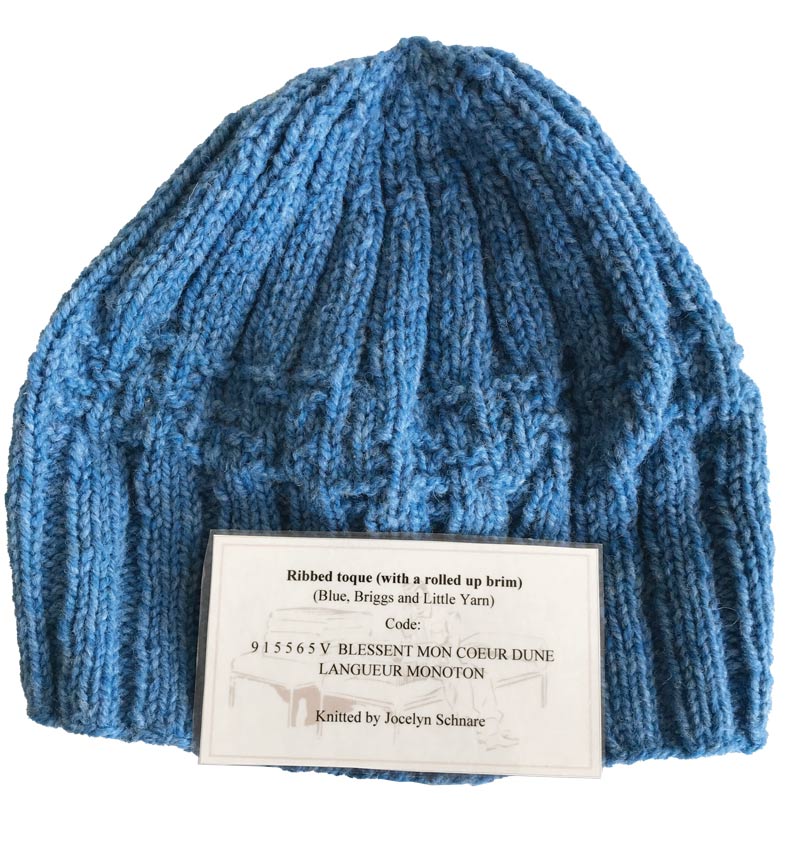
Schnare also participated in an espionage element of the collection. “There’s a Morse code message knit underneath the brim,” she said of a cap she made. “I did quite a bit of research on wartime knitting and learned Morse code. The message has to do with D-Day preparations London would radio to the French Resistance. It was a line from a poem used as a code saying how many days until D-Day.”
The message begins with a sequence of numbers representing the time and date of broadcast, then lets the decoder know Operation Overlord was close and the Resistance should begin its sabotage plans.
Meldrum said the idea for including reproduction espionage knitting came when Patrick took her “on a tour of a fuselage in the Greenwood museum. He captained a Lancaster and as he talked about his navigator doing code while the plane was flying, my mind went ‘ding, ding, yes there is espionage knitting.’”
“Espionage knitting typically happened in Europe for the Resistance,” said Meldrum. “A woman who lived near a train station would count the German troop movements, how many cars of ammunition, tanks and other things passed by, and would knit the information in hats, scarves, mittens, shawls. It would be a certain knit purl, knit purl,” continued Meldrum of the fundamental building-block stitches of knitting.
“You can knit Morse code because it’s binary.” Other wartime knitters also used phonetic code. “You could use the alphabet,” explained Meldrum. “‘A’ would be two stitches, ‘D’ would be four purls. The knitter would pass the encoded piece to the Resistance. It was a very discreet, creative way of passing on information.”
Simply drop a scarf or hat on the street or leave it on a bench.
In Wolfville, N.S., not far from where the group does its work, is a statue of local Mona Parsons (see “Moed en vertrouwen” in Legion Magazine March/April), who was imprisoned by the Gestapo for aiding downed Allied airmen. In prison, Parsons taught fellow inmates forced to knit socks for the Germans how to include a small knot that would cause wearers blistering and pain.
Farmer said her family’s silence on the war meant she had no stories of uncles, grandfathers or fathers to share, but found it “amazing to hear what people contributed, whether it was the women at home, women working in factories who still had time in the evening, or the grandfathers and children sitting around listening to the radio with their knitting needles doing work to contribute to the war. It didn’t matter how old you were, how young you were, everybody had something to do.”
The knitting exhibit has toured eight Maritime-area museums and is set to open at the Shearwater Aviation Museum this fall. The group hopes the display will eventually be hosted across Canada and in Europe.
Melynda Jarratt, curator of the New Brunswick Military History Museum in Gagetown, said the knitting exhibition was so popular, it inspired the facility and the local military family resource centre to revive the tradition for modern-day troops. In six weeks, knitters made more then 200 items in the colours of The Royal Canadian Regiment, which were hand-delivered to members of its 2nd Battalion serving in Latvia.
“Our oldest volunteer was 92 and said when she was a little girl she knit for the troops,” relayed Jarratt. “We also had young children knitting. It was such a success we’re doing it again.”
Joanne Barrett, the executive director of Connell House Museum in Woodstock, N.B., likewise found the exhibit resonated with people, including some who are knitting for troops in Ukraine.
“It spoke to the heart,” said Barrett. “It was volunteerism at its finest. I had people coming from the local nursing homes who had some memory of knitting for troops. I think it’s an important record of history and shows how the smallest contribution can turn out to be quite large. It speaks to Canadian generosity.”
Memories continue
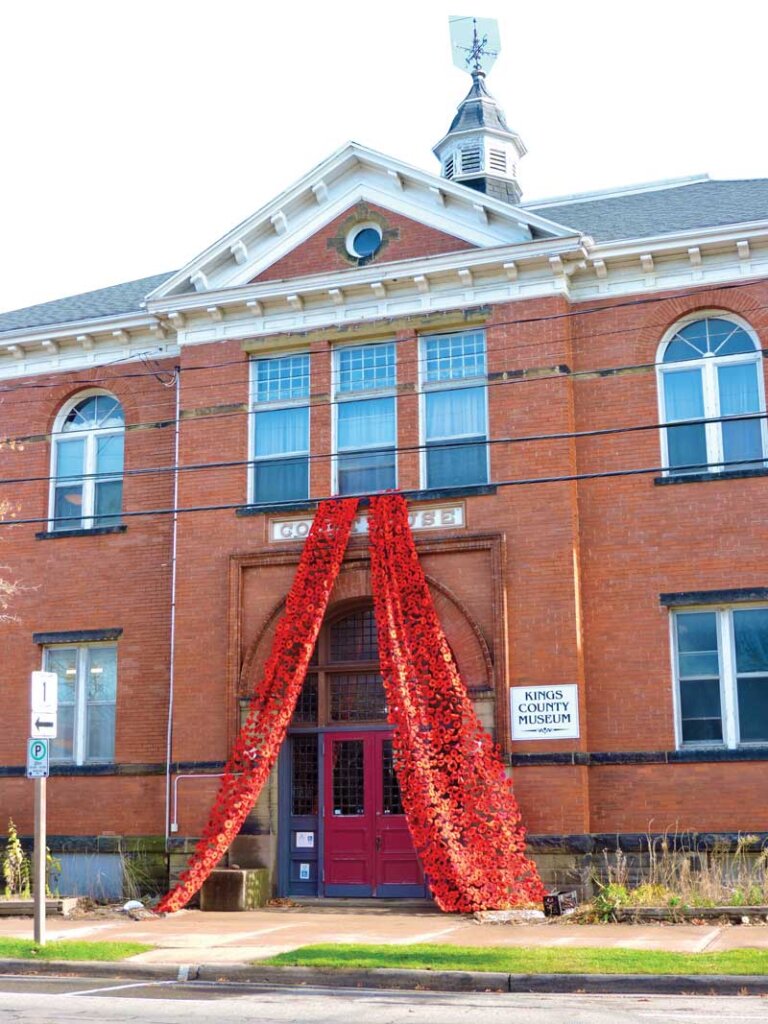
The Wartime Knitting exhibition inspired the Four Seasons Fibre Group to start a new remembrance project—one that’s expanding throughout Nova Scotia. Along with other locals, they knit and crocheted 2,200 poppies to decorate the entrance of Kings County Museum, and 1,600 for the entrance of The Royal Canadian Legion’s Dr. C.B. Lumsden Branch in Wolfville. Inspired by the idea, teachers and students at Kings County Academy in Kentville made several hundred foam poppies that they fastened to the fence around their playing fields. Meanwhile, the Macdonald Museum in Middleton created a display of 2,024 poppies to celebrate the Royal Canadian Air Force’s centennial in 2024. And a group in Bridgetown decorated power poles in hundreds of knit and crocheted poppies. The goal of it all? Creating a regional poppy trail.
[Allan Lynch]
Advertisement