

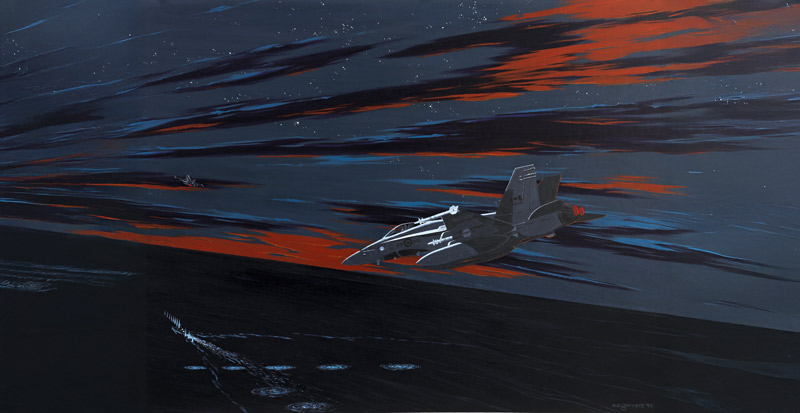
Artist Alan E. Garrett depicts an RCAF CF-18 fighter-bomber on attack during the Persian Gulf War. [Alan E. Garrett/CWM/19920201-001]
DAVID W. KENDALL and STEPHEN P. HILL
At approximately 2 a.m. on Jan. 30, 1991, two Royal Canadian Air Force CF-18 Hornet fighter-bombers were on a combat air patrol mission during the Persian Gulf War. For the past two weeks Canada’s 40 pilots flying 24 CF-18s out of “Canada Dry” air bases in Qatar had seen no action. Pilots and supporting armourers of the Desert Cats, as the squadron was known, were becoming increasingly frustrated.
Now, 1.5 hours into a two-hour mission, Hornet 13’s flight was preparing to head home when its controller aboard USS Mobile Bay asked, “Would you like to strafe a boat?” Captain Stephen P. (Hillbilly) Hill responded: “Are they defending themselves? Is there any AAA [anti-aircraft fire]?”
Racing down, Hill and Kendall emptied their 20mm Vulcan cannons at the ship—scoring numerous hits.
The controller explained that a U.S. A-6 bomber had encountered several Iraqi Navy vessels fleeing for Iran during what would become a 13-hour operation in which the Iraqi navy suffered complete destruction. The bomber had struck an Osa-class guided-missile attack craft with two laser-guided bombs and another vessel with a non-guided “dumb” bomb. Both were burning and disabled. A third fast-patrol boat, however, had broken clear. If the Canadians delayed its escape, an incoming A-6 would finish it off. Hill and his winger, Major David W. (D.W.) Kendall, accepted the mission.
At a range of 30 kilometres, the two pilots were instructed to visually identify the vessel before attacking. Despite bright moonlight and dropped flares illuminating the vessel, the Canadians were unable to confirm it as Iraqi. Suddenly, an E-2C Hawkeye controller reported no allied ships were in the area and they were “cleared to fire.”
Racing down, Hill and Kendall emptied their 20mm Vulcan cannons at the ship—scoring numerous hits. During another pass, they attempted to engage with an AIM-9 Sidewinder missile but were unable to acquire a heat signature. They then tried to lock on with AIM-7 Sparrows. Hill attained a lock on the vessel and fired. The missile struck 15 metres behind the ship.
A U.S. bomber arrived shortly after and was reported to have sunk the vessel—even being awarded with a kill. Hill and Kendall were awarded an assist and were Mentioned in Dispatches. Soon after landing, they were introduced to correspondents as having fired “the first shot” by Canadians in the Persian Gulf War. Theirs were also the only CF-18s credited with an official victory.
IRAQI FAST-PATROL BOAT
The Iraqi fast-patrol boat that Canadian CF-18 pilots Captain Stephen P. (Hillbilly) Hill and Major David W. (D.W.) Kendall attacked on Jan. 30, 1991, was initially identified as a TNC-45 fast-attack craft (missile). Iraq had captured five such vessels when it invaded Kuwait on Aug. 2, 1990. The invasion prompted a NATO-American-led intervention that resulted in the Persian Gulf War.
The 45-metre-long TNC-45 was a French design, but these ships were manufactured by the German Lürssen dockyards between 1982 and 1984. Armed with four Exocet MM40 surface-launched missiles, it also had one 76mm auto cannon and two 40mm/70 Breda-Bofors for defence against aircraft and anti-ship missile attack. It was crewed by 40 sailors.
The action the Canadians joined had started with an American A-6E reconnaissance plane locating four unlit and suspicious vessels bound for Iranian waters. USS Mobile Bay turned tactical control of the A-6E over to the E-2C Hawkeye, which soon identified them as Iraqi. A nearby A-6 was directed to attack. The A-6 scored a direct hit on the lead vessel with a 500-pound laser-guided bomb. As the surviving three vessels scattered, a second bomb destroyed the superstructure of one and it went dead in the water. It went dead in the water. The E-2C then summoned a U.S. F-18 that scored a direct hit on a third boat with a 500-pound “dumb” bomb. As the fourth Iraqi boat continued toward Iran, the call went out for the Canadians to interdict it.
Although the Canadians believed—and this was corroborated by earlier reports—they had attacked a TNC-45, this was not the case.
Although the Canadians believed—and this was corroborated by earlier reports—they had attacked a TNC-45, this was not the case. The one such boat in the four-vessel convoy had been sunk by the Americans. Instead, the Canadians attacked and damaged an Osa patrol boat, one of the Iraqi navy’s major combat vessels. Classed as guided-missile fast-attack craft, each was capable of speeds up to 40 knots and was highly manoeuv-rable. In the 1970s and 1980s, Iraq had purchased eight such patrol boats from the Soviet Union. Each was equipped with four Styx anti-ship missiles and two radar-controlled 30mm anti-aircraft autocannons. It had a crew of 29 sailors.
While initial reports concluded that the boat attacked by the Canadians had been subsequently sunk by a second A-6 with a kill award being granted, later intelligence discovered the Osa still afloat in an Iranian port. Its superstructure was noted to have suffered substantial strafing damage inflicted by pilots Hill and Kendall.
Advertisement