






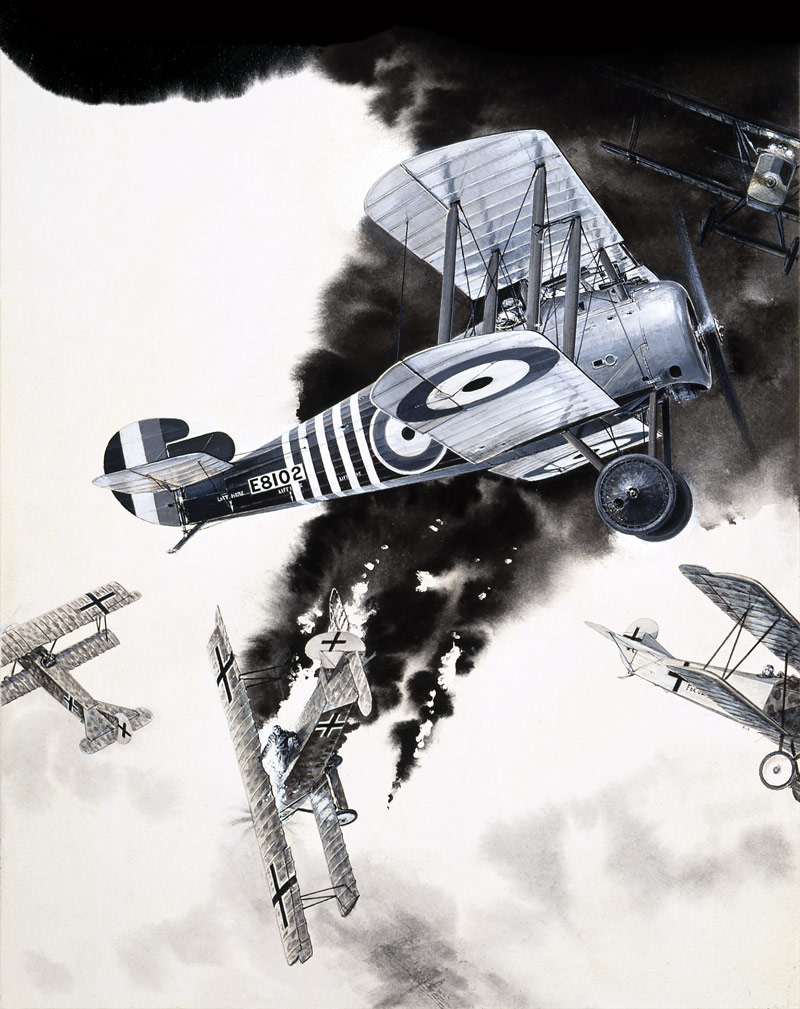
Robert Bradford’s ink drawing depicts William Barker in his Sopwith Snipe earning a Victoria Cross on Oct. 27, 1918, over the Forêt de Mormal in France.[Robert William Bradford/CWM/19710197-001]
Mention parasol and one might think of Mary Poppins floating among the chimneys of London or Impressionistic images of dainty Victorian-era ladies at refined picnics and garden parties hiding their coiffed heads from the English sun.
A “light umbrella,” the Oxford English Dictionary calls it. Delicate. Fringed with lace.
In First World War Europe, however, the Morane-Saulnier Type L Parasol was a French-built, two-seat monoplane—originally a scout aircraft that, once fitted with a single machine gun, became the one of world’s first successful fighter aircraft.
And, unlike the parasol of Mary Poppins fame, it was a rough- and rickety-looking one, at that.
This garden party was anything but highbrow, and its attendees were certainly not dainty. But for the clouds in the skies over the Western Front, there was nowhere to hide from the sun or any other threat to life and limb. And there were many.
On Dec. 19, 1915, Captain Malcolm McBean Bell-Irving of the Royal Flying Corps—one of six Vancouver brothers enlisted in Empire forces (two others also flyers)—and his observer, a Brit named Scott, encountered three of the more fearsome kind in the form of Deutsche Luftstreitkräfte aircraft, their type unknown.
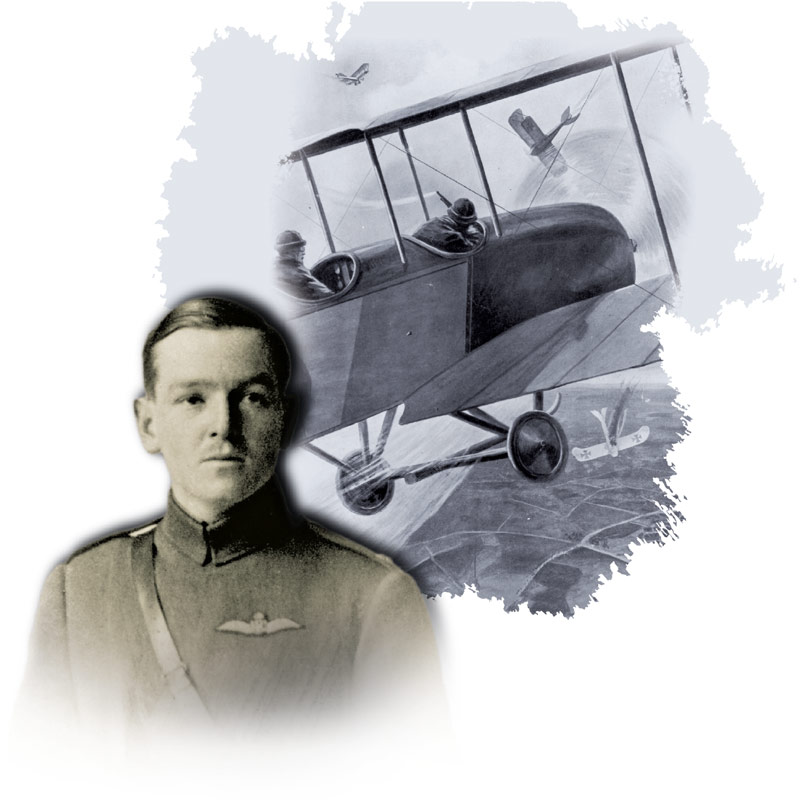
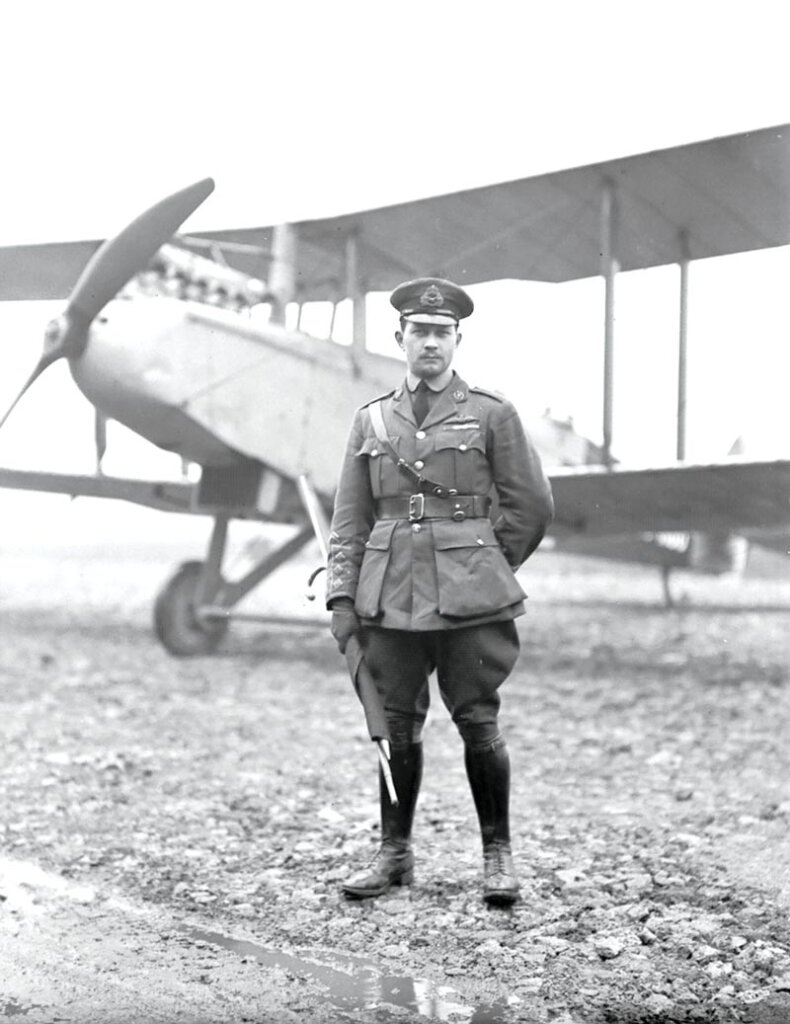
Captain Malcolm McBean Bell-Irving is credited with Canada’s first aerial victory of the Great War. [LAC/4732062; W. Avis/Vancouver Archives]
Aged 23 at the time, he was somewhere between Lille, in northern France, and Ypres, in the south of Belgium, where the German advance to the sea had ground to a halt in fall 1914. A salient had formed around the medieval trading centre that the Allies would keep pretty much in check until the war’s end.
For a pilot of his time, Bell-Irving was seasoned and, the evidence suggests, unflappable. He had joined 1 Squadron at Netheravon, England, in October 1914—the first Canadian to join the RFC—and had flown his first reconnaissance mission over France the following March.
He was wounded for the first time within a month, over Hill 60. He had survived at least one accident and several dogfights.
On this day, Bell-Irving shot down one of his foes and drove off the other two. He was wounded again, but continued to fly, and would be awarded the Distinguished Service Order, the first Canadian-earned decoration in the Royal Flying Corps.
“For conspicuous and consistent gallantry and skill during a period of nine months in France, notably on 19th December, 1915, between Lille and Ypres, when he successfully engaged three hostile machines,” reads his citation. “The first he drove off, the second he sent to the ground in flames and the third nose-dived and disappeared.
“He was then attacked by three other hostile machines from above, but he flew off towards Ypres, and chased a machine he saw in that direction.”
More than 22,000 Canadians would go on to serve in the RFC, Royal Naval Air Service and, after April 1, 1918, the Royal Air Force. More than 13,000 were aviators—pilots, gunners or observers—while the rest served as ground crew. (A fledgling Canadian Air Force was assembled, but never got off the ground before the war ended.)
In those early days, wartime flight consisted of simple planes and balloons, used primarily in scouting and photographic mapping of enemy positions. The first crews of rival reconnaissance aircraft exchanged nothing more belligerent than smiles and waves. Soon, however, they began tossing grenades and even grappling hooks at each other.
The first recorded incident in which an aircraft was brought down by another involved an Austrian reconnaissance plane rammed on Sept. 8, 1914, by Russian Pyotr Nesterov on the Eastern Front. Both aircrews were killed in the dual crash.
Battling freezing cold, buffeted by unpredictable winds and weather in flimsy, relatively unreliable airframes, and increasingly threatened by their rivals’ incursions, pilots began firing handheld weapons—pistols and shotguns, mainly—at enemy aircraft, although they were rarely an effective means of attack.
Once, when Bell-Irving’s revolver misfired, he is said to have thrown the weapon at a German pilot, hitting him in the head.
The First World War—the first industrialized war—would prove the catalyst that propelled Canada’s fledgling aviation industry to new heights.
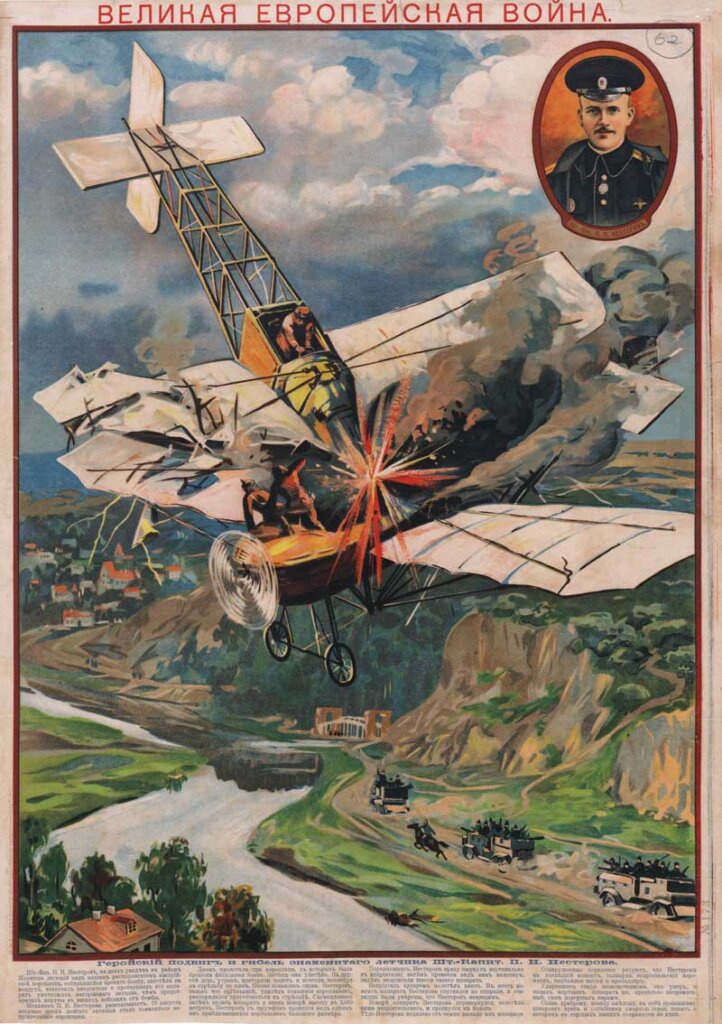
A 1914 woodcut print depicts action between Russian and Austrian aircraft. [Library of Congress/2021669153]
On Oct. 5, 1914, French airman Louis Quenault became the first aviator to unleash machine-gun fire on an enemy plane, propelling aviation into a new era. The dogfights escalated into desperate struggles over the wastelands of strife-torn Europe, the daily stakes as high as any could be.
With a homeland so vast and wild, it was only natural that Canadians took to the skies early and often. The First World War—the first industrialized war—would prove the catalyst that sent Canada’s fledgling aviation industry to new heights.
Like no other war before it, the Great War fostered unparallelled advances—in medicine, technology, weaponry, machinery and, perhaps more than any other field, aviation.
Just a decade after the Wright brothers achieved history’s first powered flight, the airplane had become a weapon of war and the focus of an arms race.
Warplanes started out as rudimentary aircraft with open cockpits and limited instrumentation. Pilots, quite literally, flew by the seat of their pants, without parachutes.
The aviation industry, however, was in rapid growth, in constant evolution, designs and performance improved with each new aircraft.
By early 1915, the British army reckoned it would need some 50 squadrons—700 planes. The British secretary of state for war, Horatio Herbert Kitchener, ordered it to double its request.
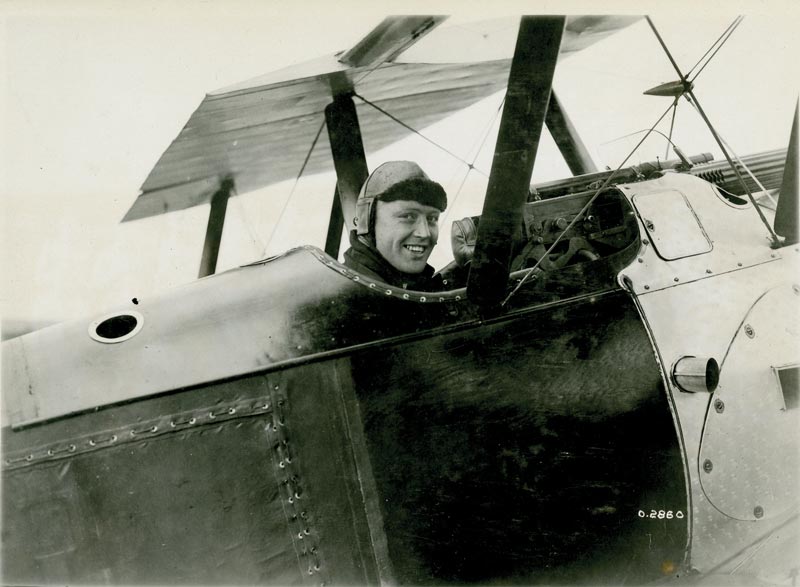
American historian Richard P. Hallion says there were more than 50 different aircraft designs during WW I, with five distinct technological generations. The combatants produced over 200,000 aircraft and even more engines. French industry alone accounted for a third of them.
By war’s end, Allied nations were outproducing the Germans by nearly 5:1 in aircraft and better than 7:1 in engines. Britain was coming out with 31 times more planes a month than it had owned when the war started. The RAF was the first independent air service, and the largest.
“Pilots were needed in ever-increasing numbers to fly the new machines and replace casualties,” the BBC reported in 2014. “Although the [Royal Flying Corps] was relatively small, their ratio of losses was at least as high as in the infantry.
“But there was never a shortage of volunteers either to fly as a pilot or as an observer. The romance of flying was an attractive proposition, it avoided the tedium of life in the trenches and offered a novel way of going to war.”
Flying with British units, Canuck aviators acquitted themselves exceptionally well in history’s first aerial confrontation between countries.
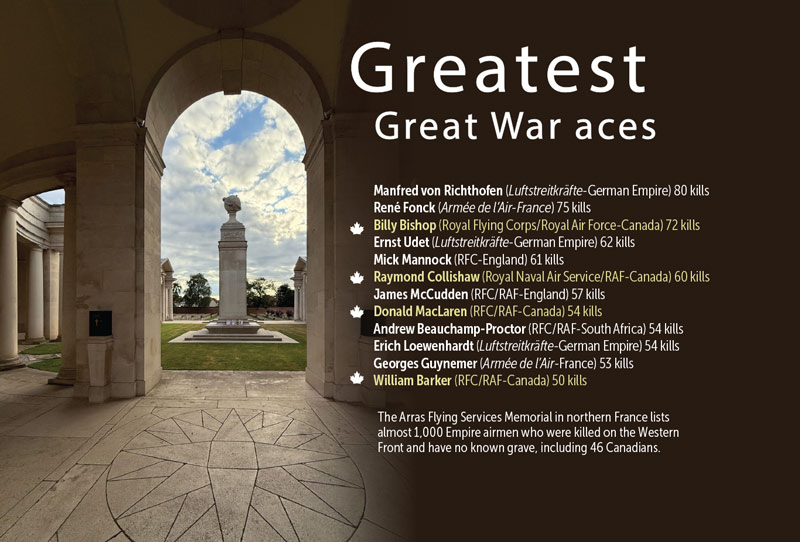
There were 171 Canadian flying aces between 1914 and 1918—airmen with five-plus aerial victories, or kills. Four of the Top 12 were Canadian, three Top 10: Billy Bishop with 72 kills; Raymond Collishaw (60); Donald McLaren (54); and, at No. 12, William Barker (50). Twenty-four Canadians scored 20 or more.
Canadian flyers were awarded at least 495 British decorations for gallantry, including three Victoria Crosses—Bishop and Barker among them—and 193 Distinguished Flying Crosses, plus nine bars.
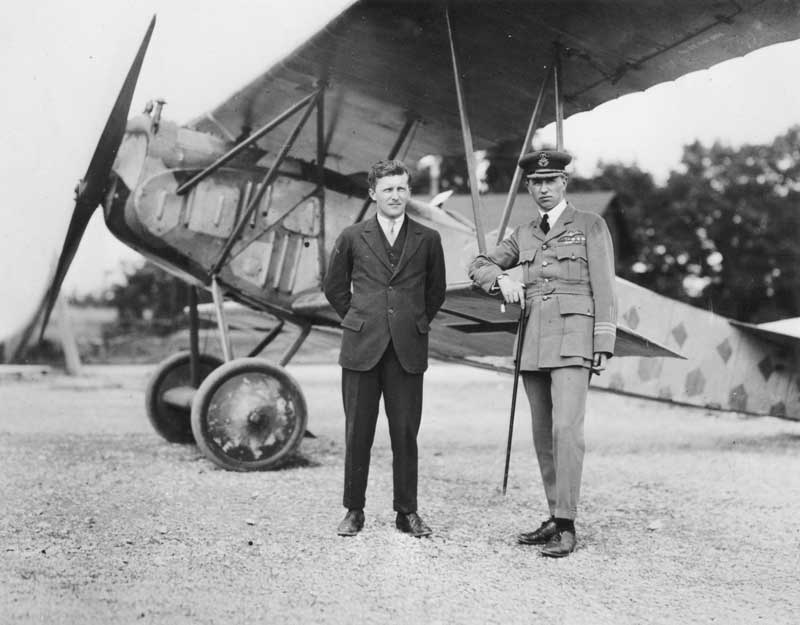
Canadian aces William Barker and Billy Bishop pose by a captured Fokker D.VII [Pringle & Booth/LAC/3364746]
They were trailblazers and warriors who shared a mutual regard and respect, even camaraderie, with their mates and enemies alike. They were privileged to fight above and beyond the mud and misery of the trenches, and they knew it, albeit with the underlying acceptance that fiery death could come at any time.
Theirs was a singular experience, the scale and intimacy of which were unique in the annals of conflict. With it, a new chivalric tradition, vestiges of which persist to this day, was born.
Masters of the air in bare-bones, canvas-and-wood airplanes, they fought mano-a-mano, skill to skill, often just metres apart. And mostly chute-less.
As fighter squadrons were formed and aerial conflict escalated, aces emerged. Personalities emerged with them, recognizable by their distinct aircraft and markings: German Richthofen in his red Fokker triplane; Canadian Bishop in his Nieuport 17; American Rickenbacker with his “Hat-in-
the-Ring” Nieuport 28.
They battled in freezing cold, buffeted by unpredictable winds and weather in flimsy, even delicate, airframes.
“Now a dogfight is rather an exciting game actually,” pilot Thomas Isbell of 41 Squadron, RFC, told the Imperial War Museums. “You’d dive onto the first Hun you come across, you open out your guns…and no sooner you’ve got your guns on him, someone else has got their guns on you.”
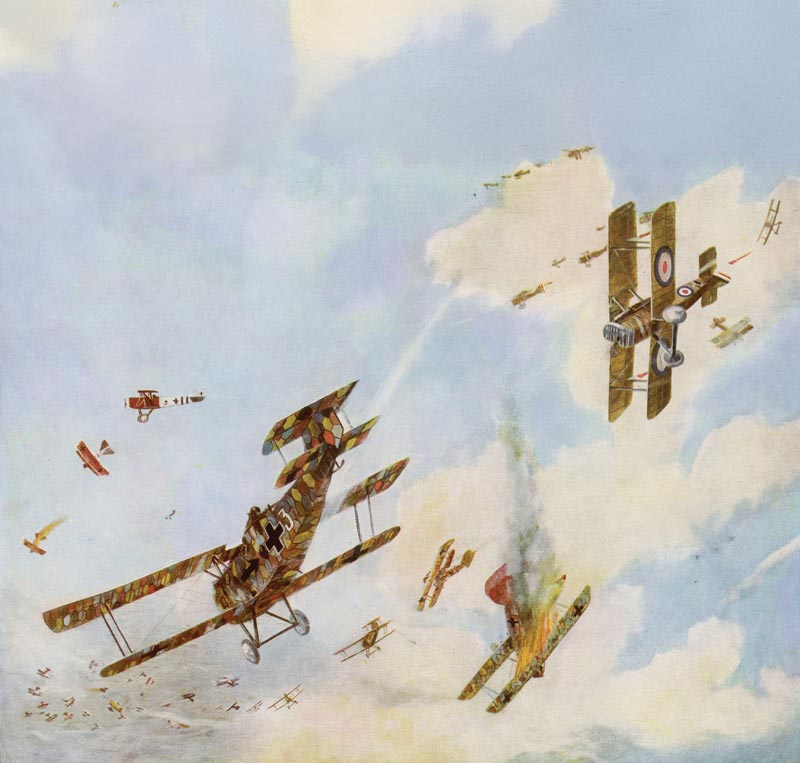
Dogfights over the Western Front were furious affairs, conducted at close quarters, usually with decisive outcomes. [Chronicle/Alamy/2M3KA0J]
“You’d dive onto the first Hun you come across, you open out your guns…and no sooner you’ve got your guns on him, someone else has got their guns on you.”
While lice-ridden soldiers wallowed in the rat-infested filth, cringing under artillery bombardments and awaiting the next dreaded order to go over the top, pilots at least had days flying the wild blue—and good food and a warm bed to go back to.
At night, they would engage in the drunken, bittersweet celebrations and tributes to their fallen brethren, the prospect of death or disfigurement lingering somewhere in the recesses of their collective consciousness, the price of a slight miscalculation, a moment’s loss of focus, or circumstances unforeseen. Over time, the latent stress would do its work, chipping away at their psyches.
In April 1917, the RFC’s worst month, the average life expectancy of an Allied pilot on the Western Front was 69 flying hours. Denied parachutes, many ensured they had enough ammunition to hasten the inevitable.
Those who flew belonged to an exclusive club whose members quickly came to understand the special place they occupied. The rare air above 10,000 feet brought on hypoxia, a potentially fatal high, but there were no borders, or dictums, up there among the clouds. They forged their own, unwritten, terms of engagement.
In the Roberto de Haro novel A Twist of Fate: Love and The Great War, the protagonist, a Louisiana Cajun named Quentin Norvell, describes the experience of flying in combat with the French Air Service during the First World War.
“There’s a bond between fighter pilots, even if we’re adversaries,” he says. “You see, we share the same things, the deafening noise of the engine which blots out our hearing, the speed and maneuverability of our planes, the sensation of flight, and the single purpose of defeating your opponent.
“It all comes down to one man pitted against another, high above the ground, making instant decisions that determine success or failure, and often death. There’s not enough time to think about hate.
“The enemy pilot knows my purpose is the same as his. If I hate anything…it’s the need for us to fight and kill each other.”
Indeed, opposing airmen went to astonishing lengths to help each other in the First World War, even warning the other side of where they were about to drop bombs and sending photographs of graves when they buried enemy dead.
Diaries kept by a young pilot from Pembrokeshire, Wales, reveal how the camaraderie sometimes took precedence over hostilities, particularly between British and German flyers.
The notes taken by the 22-year-old Royal Naval Air Service pilot William David Sambrook suggest German adversaries warned their British enemies of where they planned to drop bombs.
Posted to Coudekerque airfield near Dunkirk, France, in 1916, Sambrook’s diaries tell of almost daily bombing raids on German-held aerodromes, docks and Zeppelin sheds at Bruges and Zeebrugge in Belgium.
One day in May 1916, a colleague failed to return from a raid on the aerodrome at Ostend, Belgium. There were rumours that the missing airman had been recovered from the sea by a Belgian trawler.
A few days later, with still no confirmation of his fate, another airman flew over the German airfield and dropped a message asking if they had information about the missing pilot. His British colleagues received a prompt reply, also dropped from the air, confirming that the aircraft had been shot down over the sea.
“They said attempts had been made at rescue, but when the machine was brought in, the pilot was already dead,” Sambrook wrote. “He was buried with full military honours alongside two comrades at Marrakerke cemetery, Ostend. The message was accompanied by two photos of the funeral and the grave.
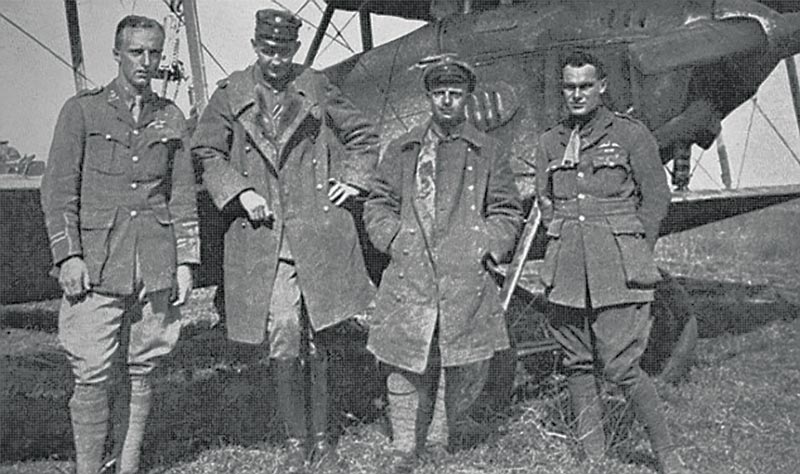
Captain Gerald Gibbs (opposite, left) and his observer pose with the German aircrew (centre) Gibbs shot down. [BNPS]
“There was also a message in German stating the name and place in German territory where our machines could land if they had engine trouble.”
Alan Wakefield, head of photographs at the Imperial War Museums, told London’s Daily Mail in 2014 that such co-operation was far more common among pilots than among those fighting the war on the ground.
“I know of cases where German pilots dropped notes and photographs of a crashed aircraft and its occupant, saying they’d buried him and asking for his name so they could make a headstone,” he said.
“In one instance, a German pilot dropped a note saying he was about to bomb an airfield and suggesting that those on the ground should get out of the way.”
Captain Gerald Gibbs, a British pilot who was awarded three Military Crosses in six months, received adulatory fan mail from two German airmen whom he captured, then took to lunch. It was signed “with chummy German airman greetings.”
Gibbs earned the Military Cross after capturing the plane and its two-man crew by disabling its engine and forcing them to land behind British lines in Macedonia.
“I came quite close, watching the observer in case he aimed his gun in my direction, and was amazed to see he was fluttering a white handkerchief,” Gibbs wrote later.
“He landed in a pretty good field as I circled round. I then landed alongside, jumped out with my revolver. The observer threw up but the tough little egg of a pilot looked surly.
“You can imagine how excited we were to get a German aircraft down intact with two live prisoners. We gave them lunch in our mess and then handed them over rather sadly to their escort.”
In a letter penned shortly afterward in March 1918, the German observer, Lieutenant Robert Walther, said: “Dear Captain! My pilot and I ask you quite warmly, if you might have the kindness to send us a few autographed pictures. They shall be a reminder of the brave and quixotic adversary in aerial combat, as well as of the comradely picture of your battalion.”
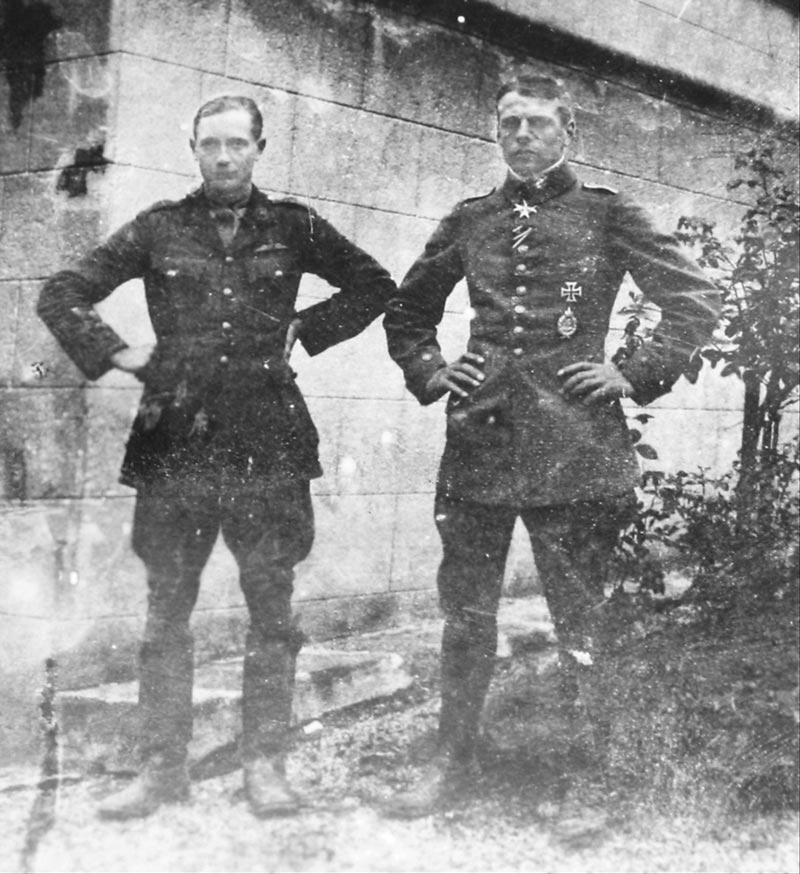
German ace Oswald Boelcke (right) shot down British Captain Robert Wilson, then took his rival for coffee and a tour of his aerodrome.[BNPS]
“I fetched the Englishman I had forced to land from the prisoners clearing depot, took him to coffee in the mess and showed him our aerodrome.”
Gibbs described the note, which sold at auction in 2014 for more than $30,000, as “very nice.” It’s not known whether he honoured the request, but he dropped a letter over German lines to inform the enemy their two airmen were safe.
Shot down twice, Gibbs was credited with 10 aerial victories during the Mesopotamia Campaign in the Middle East. He once bombed a German aerodrome from 30 metres and strafed the hangars from six.
Gibbs also served in the Second World War. He died in October 1992 at 96.
In another WW I incident, Oswald Boelcke, a legendary air ace regarded as the father of the German air force and the aviator who trained the famed Red Baron, formed an instant friendship with a British pilot he shot down near the Somme front in September 1916.
The Brit was Robert Wilson, a captain of 32 Squadron, RFC, forced to crash-land his aircraft behind enemy lines.
Boelcke followed him down but, rather than hold him at gunpoint and send him away for interrogation, he shook Wilson’s hand, took him for coffee in the mess, and gave him a tour of his aerodrome. It was Boelcke’s 20th aerial victory.
“When he went down, his machine was wobbling badly,” the German wrote later. “But that, as he told me afterwards, was not his fault, because I had shot his elevator to pieces.
“It landed near Thiepval—it was burning when the pilot jumped out, and he beat his arms and legs about because he was on fire too.
“I fetched the Englishman I had forced to land—a certain Captain Wilson—from the prisoners clearing depot, took him to coffee in the mess and showed him our aerodrome, whereby I had a very interesting conversation with him.”
It wasn’t Boelke’s first act of chivalry. Seven months earlier, he had flown over British lines and dropped a letter informing Allied troops that he had visited one of their missing airmen, who was alive and safe in hospital.
After the war, Wilson described his encounter with Boelcke as “the greatest memory of my life, even though it turned out badly for me.”
A photograph of their encounter emerged in a German pilot’s photo album a century later—one of the last taken of Boelcke before he was killed in a mid-air collision with another German aircraft a month later.
“Flying in the First World War was almost like a gentleman’s club no matter which side you were on,” said Matthew Tredwin, an auctioneer who sold the album in 2016. “An unspoken camaraderie existed between Allied and German pilots.
“A lot of these men were celebrities of their time because what they did had a certain romance about it, even though it was deadly.”
Seven months after his first aerial victory, on June 20, 1916, Bell-Irving was wounded by anti-aircraft fire yet again, hit by shrapnel in the head. Half-blinded by blood, he steered for the nearest airfield and, feeling he couldn’t last, landed his Morane scout plane in a small field behind Allied lines. After giving orders for the safe delivery of his photos, he collapsed. His “pluck and skill saved his observer,” said the citation for the Military Cross he earned that day.
He was transferred to Lady Ridley’s Hospital in London where he lay in and out of consciousness for three months. Bell-Irving’s wound, a piece of shrapnel in the brain that had temporarily affected both his sight and memory, kept him out of action for 18 months.
Once reactivated, he went to the School of Special Flying at Gosport, England, commanded by his brother, Alan Duncan Bell-Irving, for a refresher course. Impatient to get back to France, he talked his way into soloing on a Sopwith Camel and spun it into the ground from a left-hand turn. It was a typical mishap attributable largely to the plane’s stubby fuselage and the torque of its powerful rotary engine.
But Bell-Irving suffered further head injuries and lost his left leg above the knee after the accident. The American brain surgeon who had advised on his earlier head wound saw him in a London hospital on May 23, 1918.
The doctor reported that Bell-Irving “only vaguely recalled me—suffering the tortures of hell from neuromats in the stump of his amputated leg…. Still the same charming person, however, despite his thoroughly drugged condition.”
Bell-Irving eventually returned to Canada where he served as liaison officer with the RFC, responsible for all matters affecting Canadians who had been seconded from the army.
All six Bell-Irving brothers were decorated for valour. All but one, Major Roderick Ogle Bell-Irving, survived the war. Arthur, a captain, achieved ace status with seven aerial victories and served in WW II with the Royal Canadian Air Force. But not Malcolm.
He ended the war at the rank of major. He doesn’t appear in the list of Canadian aces and his total victories are unrecorded. He died June 11, 1942, in Oak Bay, B.C.
By the time the aircrew who survived the Great War came home, many had caught the flying bug, or at least saw opportunity in an emerging industry that, in a country such as Canada, offered tantalizing new opportunities.
Between the wars, aircraft design continued to evolve, records were set and broken, early bush and float planes hit production lines, and the airplane began to open Canada’s vast hinterlands to easier exploration, exploitation and settlement.
Versions of a new Canadian military flying force came and went until, in 1924, a reconstituted CAF was granted royal sanction by King George V.
The RCAF was forged on a growing aviation culture of hinterland stick jockeys, airmail pilots, transport captains and high-flying adventurers. At its WW II peak, the RCAF was the world’s fourth largest air force, and had asserted itself as a respected, if not feared, hunter and protector.
[Stephen J. Thorne/LM]
Advertisement