




Margaret MacMillan on the war in Ukraine, Putin, Canada’s Arctic sovereignty and more!

Margaret MacMillan on the war in Ukraine, Putin, Canada’s Arctic sovereignty and more!
“We should not be impressed when our leaders say firmly, ‘History teaches us’ or ‘History will show that we were right.’ They can oversimplify and force inexact comparisons just as much as any of us can,” wrote Margaret MacMillan in her 2008 book The Uses and Abuses of History.
MacMillan, a history professor at the University of Toronto, emeritus professor of international history at the University of Oxford and the author of seven books, won the 2021 Pritzker Military Museum & Library Literature Award for Lifetime Achievement in Military Writing. Her latest work is War: How Conflict Shaped Us.
She spoke with Legion Magazine in advance of “An evening with Margaret MacMillan,” a free virtual event to be held on Sept. 12, 2022, in collaboration with the Legion National Foundation and Toronto’s Bill Graham Centre, where she will read from one of her books and share time with attendees. For more info on “An evening with Margaret MacMillan, click here.
I would very much describe it as Putin’s war. He wanted to bring it about and he started it. There were tensions between the two countries, but a lot of them were created by him earlier. Those could have been negotiated, but he wasn’t interested in negotiations. When he went into Ukraine, he thought it would be easy. He thought the Ukrainians would fold. The Russians were clearly planning an easy move toward Kiev. Putin, and whoever was advising him, thought the Ukrainians wouldn’t fight back. He had also come to think that the West wouldn’t do anything about the invasion because they hadn’t done anything when he went into Georgia or Chechnya or Syria and when he took over Crimea and the Donetsk and Luhansk areas of Ukraine. It was just a series of miscalculations. And we’re now finding out that the Russian army, which look really good on paper, is badly organized. Its logistics are pretty awful. It has command problems. It is not as impressive as it looked.
Wars are often started by people who miscalculate. They miscalculate their own strength and they underestimate the strength of the enemy. We’re also seeing that materiel factors in war—how many tanks and battleships and equipment you have—are important. But so is organization, training, logistics and morale.
Putin’s showing what happens when people get into positions of great power and they have very few checks on them. He has re-established the old Soviet system with himself at the apex. He is re-establishing as much of the Stalinist system as he can. And the longer you live in that position of great power, surrounded by people who tell you are a genius, the less sensible you get, the more likely you are to get things very badly wrong.
Nationalism is a very new phenomenon in the world. Before the 18th century, with a few exceptions, people did not identify themselves as being part of this thing called the nation. It seems to have really come to flower in the 19th century with the spread of modern communications, urbanization, more education, and people began defining themselves with this curious term of the nation. Benedict Anderson wrote a very good book on this called Imagined Communities. You know, you may never meet everyone in your nation, but you sort of feel very strongly that it exists. It existed before you, you’re just part of it and it will exist after you. And people became deeply attached to this notion. Many people were prepared to do things in its name, prepared to kill other people, prepared to risk their own lives. It’s a very powerful organizing force. People create histories that help create this impression of this eternal nation. Putin has done it. Other nations have done it. They go back into the past and they claim we were always here.
Nationalism has become one of the motivating factors for war. War is motivated by a number of things. It’s motivated by notions of honour, pride, fear and religion. Sometimes people went to war because their rulers told them to or because they felt they ought to. Nationalism is another type of motivating force that makes people want to go to war to protect the nation or to spread the power of the nation. The types of motivating forces change over time.
It depends on what you mean by great. If you mean great in terms of the greatest impact for good or bad, there are leaders like that. I would say Putin is having a great and dreadful impact on history, his own people and his neighbours. Do I see someone like a Churchill or Napoleon? I don’t think so. In some ways, it may turn out that Ukrainian President Volodymyr Zelensky will be seen in the future as a great leader who’s done what Churchill did in some ways. He has spoken to and for the Ukrainian people and inspired them and made them feel that they have a chance.
Sometimes you get good people, sometimes you get bad people. I think the nature of democratic politics probably puts a lot of people off because in some countries, democratic politics has become very vicious. Look at what’s happened in the United States, Italy or some other countries. Democratic politics can be pretty rough. I think that sometimes deters good people from getting involved.
Canadians have been able to live very comfortably for the last 50 years. We were very much a major player in the Second World War. We were one of the founders of NATO. Canada contributed a great deal, certainly in the early stages, to the Cold War. But as peace was maintained, then as the Soviet Union disappeared, I think a lot of Canadians came to feel that we never have to worry about war. We had the United States to the south of us. They’ll probably defend us. We didn’t seem to have any enemies. We became perhaps a little bit too reassured.
Canada hasn’t treated its military that well. We’ve systematically underfunded it. We haven’t taken the needs of the military as seriously as we might have done. We’re now having to face that the world is not necessarily a peaceful place and that Canada can’t just assume that everyone’s going to be nice to us. We’re having to think about how we contribute to the defence of the West and in what ways.
If you lived in Canada, the U.S. or Latin America or most of Europe, large parts of Asia, Australia, New Zealand, you probably felt war was something that was not ever going to happen to you. And when we were involved in wars, they were far away and fought by small professional armies. We should have remembered, lots of people in the world did know what war was. There was a war pretty much everywhere in the world every year since 1945. Westerners got too easily reassured that war wasn’t going to happen again. I don’t want war to happen. Nobody does. We are seeing the horrible costs of war in Ukraine at the moment. We’re seeing what it does to civilians and we’re seeing what horrors it leaves in its wake. And Ukraine is going to take years to recover from this. But how do we stop it? Can you imagine a world without war? I can’t.
Canadians should be concerned about the Arctic for a number of reasons. And it’s not just Russia. The Chinese have made it very clear that they think of themselves as having an interest in the Arctic, too. With global warming, there are more possibilities to explore and sail through the Arctic and more potential to find and exploit minerals in the Arctic. How will Canada manage that? Canada occupies a very large part of the Earth with a very small population. Canada should probably be doing more to establish a presence in the North, but that’s expensive. We may not be willing to pay for it. Canada should also be working with like-minded nations. There are international agreements about the Arctic and Canada should be doing what it can to enhance those. But it’s going to be a real challenge. It’s not a frontier we have thought about very much, but it’s increasingly becoming something we need to think more about.
A free virtual event hosted by the Bill Graham Centre and the Legion National Foundation, Margaret MacMillan will share about her books including War: How Conflict Shaped Us. This is a hybrid event with a 50-person live capacity and unlimited attendance online.
Bill Graham Centre for Contemporary International History
6 Hoskin Avenue
Toronto, ON
M5S 1H8
| Cookie | Duration | Description |
|---|---|---|
| cookielawinfo-checkbox-analytics | 11 months | This cookie is set by GDPR Cookie Consent plugin. The cookie is used to store the user consent for the cookies in the category "Analytics". |
| cookielawinfo-checkbox-functional | 11 months | The cookie is set by GDPR cookie consent to record the user consent for the cookies in the category "Functional". |
| cookielawinfo-checkbox-necessary | 11 months | This cookie is set by GDPR Cookie Consent plugin. The cookies is used to store the user consent for the cookies in the category "Necessary". |
| cookielawinfo-checkbox-others | 11 months | This cookie is set by GDPR Cookie Consent plugin. The cookie is used to store the user consent for the cookies in the category "Other. |
| cookielawinfo-checkbox-performance | 11 months | This cookie is set by GDPR Cookie Consent plugin. The cookie is used to store the user consent for the cookies in the category "Performance". |
| viewed_cookie_policy | 11 months | The cookie is set by the GDPR Cookie Consent plugin and is used to store whether or not user has consented to the use of cookies. It does not store any personal data. |

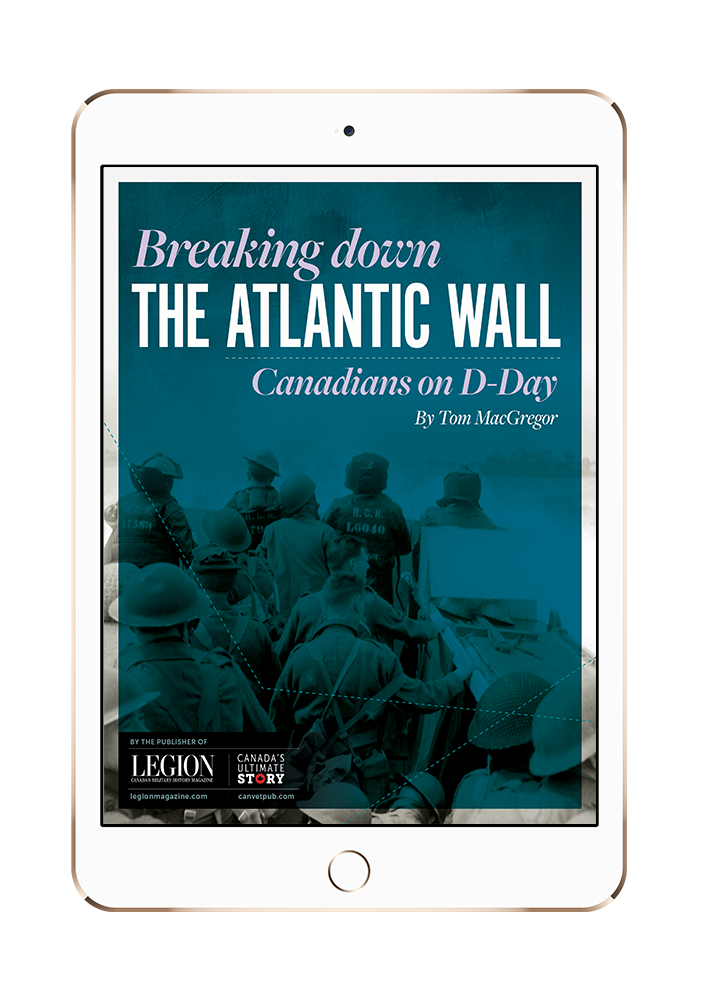

Free e-book
An informative primer on Canada’s crucial role in the Normandy landing, June 6, 1944.